By Steve Goddard

JAXA shows the area immediately west of Barrow, Alaska as ice free. And it appears to be melting away from the shore.
The animation below shows the month of May so far.
This apparent melt surprised me, because the University of Alaska reports sea ice at Barrow 4-1/2 feet thick and topped by another foot of snow. The ice has thickened six inches during the past month and about 18 inches since the start of the year.

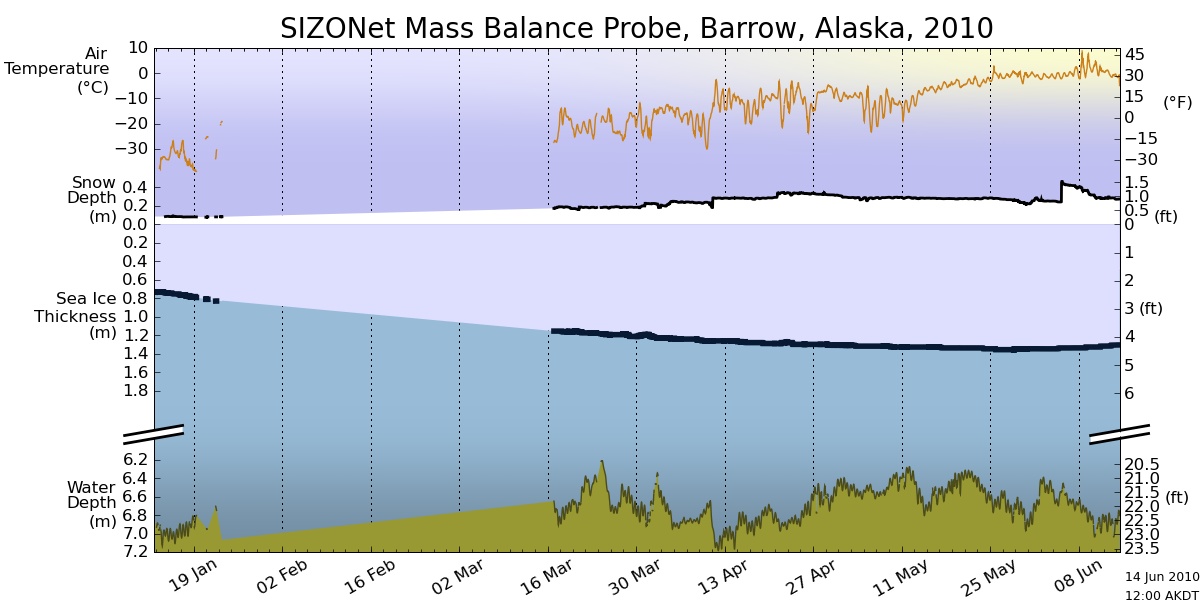

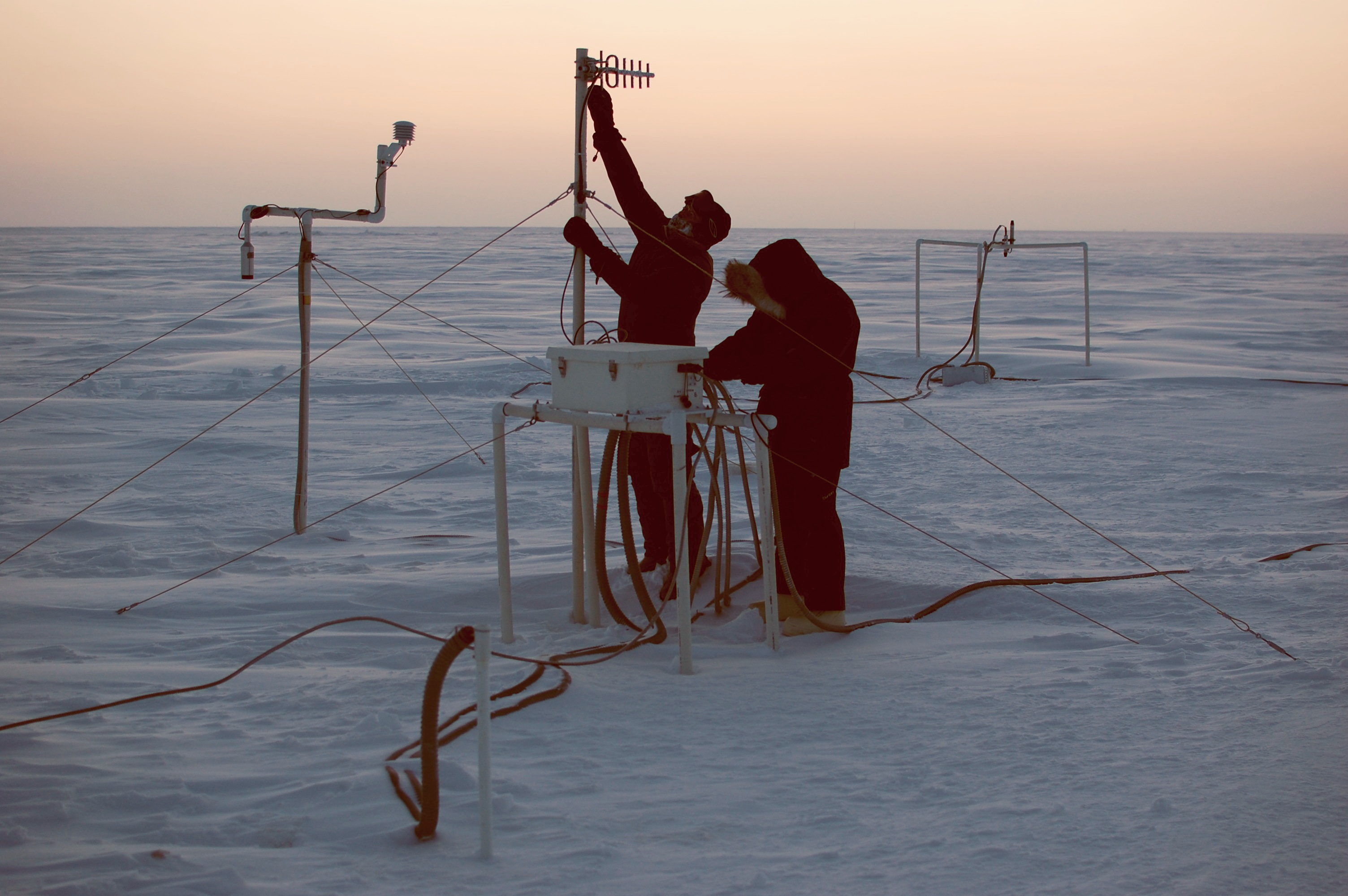
The sensor is located immediately offshore of Barrow, as seen below.

Below is the current view of the ice from Barrow.

We have an apparent paradox. The ice has been steadily thickening all year, yet a big hole has appeared in the ice near Barrow. The hole can be easily seen in the enhanced NASA satellite image below.


What could be causing the hole? The edges of the ice are clean and it has been too cold all month to melt, so something else must be going on.
The video below of the entire Arctic makes it clear. There has been a clockwise circulation which is shearing the ice away from the land in at least four locations (outlined by blue squares.)
We have found the recent decline in the JAXA extent graph, and it isn’t primarily due to melt.

My employer was involved in a lawsuit awhile back. The opposing lawyers had our expert witnesses disqualified and then claimed we offered no expert testimony.
And so it goes with AGW. Put forth any evidence that CO2 is not the primary cause of the Arctic icepack melting and the warmers dismiss it out of hand. Then they claim there is no evidence which contradicts AGW orthodoxy, so it must be caused by CO2.
jeff brown says:
“R. Gates is correct, the Beaufort Gyre is always present, but for thinner ice, the ice moves more easily.”
Let’s think about that for a moment …OK, time’s up. Bogus statement.
A big iceberg moves along as fast as a small iceberg in the current. Otherwise, all the little icebergs would be out in front.
I’m not sure that I would call 4-1/2 foot thick ice “thin.”
R. Gates:
The temperature anomalies in the graphs on the link you posted are of the order of less than 1 degree celcius. What is the current temperature in that place?
How important a factor is a small rise in temperate, at those low temperatures, compared to other factors that can cause ice extent to decrease, such as humidity, wind, and of course the gyre?
Sure, those other factors may (or may not, who knows) have changed due to human activities, but is warming by itself the most important direct factor in creating that hole?
jeff brown
Your criticisms sound like a bunch of meaningless words. Please explain more coherently.
stevengoddard says:
May 27, 2010 at 7:48 am
R. Gates
If it turns out that my forecast for summer ice is incorrect, I’m sure you will let me know. That judgment date is still 3-1/2 months off, so why speculate now?
________________
If models don’t help us speculate, what good are they? Not only are there models for what arctic sea ice will be doing in the longer term, there are models that can accurately predict human attitudes based on a matrix of factors.
R. Gates.
Warming may or may not have something to do with changing currents in the Arctic.
CO2 levels may or may not have much of anything to do with the observed “warming”.
SMokey, once again you don’t seem to understand basic Physics. The internal stressors change as a function of ice thickness. Thin ice ridges and rafts more easily than thick ice. Also, ice bergs are not the same thing as sea ice, I hope you understand where each originates from.
And Steve, while there may be some local thick ice attached to the shores of Barrow, that doesn’t mean the ice isn’t thin elsewhere. There was transport of old ice into the region from the negative AO, so I would expect local variations. But I would expect that the overall warmer winter temperatures all winter in the Arctic impacted on ice growth rates throughout the Arctic Basin.
R. Gates: May 27, 2010 at 7:33 am
I was ridiculed yestereday for example for pointing out that waves change the albedo of ocean water, especially for low sun angles, until I had to dig up all the research to prove my point.
You might want to re-check that — see below.
Steve Keohane: May 27, 2010 at 7:30 am
Interesting, not relevant here though. Your first link only allows for SUB-arctic atmospheric modeling. The second proves there is little to no change wrt wind/waves and albedo. Results below for a 45° angle of incidence:
Wind Speed (MPH) Albedo
1 .037
2 .036
3 .036
4 .036
8 .036
16 .037
32 .037
There doesn’t appear to be much difference, no matter how hard the wind is blowing the waves around.
@ur momisugly R. Gates,
I think what our friends are saying, it isn’t melt. Go here, (http://www.wunderground.com/history/airport/PABR/2010/5/27/MonthlyHistory.html#calendar ) for the temps for Barrow this month. As you can see, the temps show what ever is occurring, one can’t call it melt. At least, not from the top. There are other means for ice to dissipate other than melt, it is easily witnessed in north Alaska. Yes, I know salt water freezes at a lower temp, for those who are curious, Ocean water with a typical salinity of 35 parts per thousand freezes at −1.8°C (28.9°F). Still, it didn’t reach 30 deg. F. until the 22nd of May. Personally, I believe the underwater currents combined with volcanic activity underneath the Arctic is what we’re observing, but I’ve no way to prove it. Another personal opinion, I think both sides of the AGW hypothesis puts way too much emphasis on the ice coverage of the Arctic. Given what I’ve shown, (the temps not being warm enough to melt sea ice) it seems likely, (to me anyway) that we’re observing a completely different phenomenon from any hypothetical CO2 induced heating. Further, while many people fear some ecological shutdown if the ice does melt, I haven’t seen any evidence of that assertion. But then, in my perspective, that’s the whole reason for the discussion. It isn’t whether we’re getting warmer or not, it is whether warmer is detrimental to the human condition or not. Well, some people worry about polar bears, and I do too, but only as they relate to human well being.
On a smaller scale, I have been out on Lake Erie when the wind has picked up out of the south and broken off huge sections of ice and sent them to Canada, much to the dismay of the ice fishermen on the lake at that time. In that case wind, alone, was the cause. Happens quite frequently when the lake is not completely frozen over.
R. Gates
Suppose I am correct and the models are wrong? I will expect mea culpa. ;^)
Dear Mr Defense Minister R. Gates, the Arctic is just – normal. It is even colder than in 40ties.
http://climexp.knmi.nl/data/icrutem3_hadsst2_0-360E_70-90N_na.png
Despite all flaws in HadCRUT, I will take it over GISTEMP with its mad creator any day.
Smokey says:
(…)
A big iceberg moves along as fast as a small iceberg in the current. Otherwise, all the little icebergs would be out in front.
————-Reply:
Well, they are. The smallest ones are found the farthest south, just before they melt completely. 😉
Can’t resist.
Smokey:
“A big iceberg moves along as fast as a small iceberg in the current. Otherwise, all the little icebergs would be out in front.”
R Gates is not making a bogus statement, neither are you. However, lets keep the snips to a minimum. The point should be this: Thin ice is more susceptible to wind forces. However, once the ice succumbs to the wind it doesn’t matter if it is thick or thin it is going to move until something stops it. Hence, if the ice at Barrow is a bit thinner, it will break free easier. Once free it is going to move whatever distance until it hits shore, wind eases or the ice bunches up into existing ice.
R Gates:
2007 left the Arctic with less ice. However, wind pushed ice, thick or thin, is not melting, it is bunching up. So that 4′ ice is now piled on top of other ice, making for thicker and therefor slower melting ice.
To support my point, a little, look at the ocean.dmi.dk site. It indicates that Arctic Temperatures are right at normal values at the moment. There is no special melting, or any special warming/cooling going on. So, big breaks in the ice doesn’t support anyones pet theories, AGW pro, against, agnostic or otherwise.
However, Thanks R Gates. Keep it up.
@James Baldwin,
I wonder if the atmospheric temperature really needs to reach the salt water melting point before there is melting of the ice. As was stated yesterday, currents bring warmer water to the arctic and the ice acts as an insulator. I’m imagining water below too warm for sea ice, a layer of insulating sea ice, and air above too cold for sea water. The warmer the water below, the colder the air needs to be above to maintain ice. I’m no expert and would like someone who knows more to comment further.
A kind reminder that the models were wrong in 2007 🙂
R Gates “If I’m right, and the summer sea ice minimum is this year turns out less than 2008 or 2009, and not more, as Steve has said he believes will happen, then what?”
Then what? I guess we’ll know what we know today.
Sea ice extent fluctuates short term and long term.
What we don’t know now or will now then is if there is any connection to CO2 emissions and AGW.
But we’re stuck in an era of convenient presumptions by alarmists to establish, by suggestion and declaration, as many connections as possible where none exists.
Here in Oregon, academia and the press have reached comedic levels with their broadening suggestions.
“Your Nose Knows: Climate is Changing.”
http://www.oregonlive.com/environment/index.ssf/2010/05/post_14.html
The Beaufort Gyre is not a fixed phenomenon (anymore than any other aspect of the climate). See this site: http://www.whoi.edu/beaufortgyre/results_fwcdecadal.html
It appears the Gyre was stable from the 50’s through the 80’s, then shifted in the 90’s. Could this be yet another 30 year oscillation?
At any rate, I think it is safe to assume that the shearing effect of the BG could vary from year to year, and is at least as likely to be contributing to the current conformation of sea ice as is CO2.
This must be the begining of the Death Spiral.
Excerpt from the newest book by the world’s leading paleoclimatologist:
Climate: the Counter-consensus (Independent Minds)
by Professor Robert Carter
The time scales in which the oceans absorb, recirculate and re-emit heat are often much larger than is dreamt of in the Warmists’ philosophy.
“….Major time lags are built into the climate system such that a warming or cooling event that occurs today (say the Great Pacific Climate Shift in 1976/1977 which corresponded to a worldwide step increase in temperature of about 0.2 degrees C) may be reflecting a change in heat energy that was stored in the ocean hundreds of years ago…
Indeed, he says, some scientists suggest that the rise in atmospheric CO2 in the Twentieth Century may represent ocean outgassing caused as long ago as the Medieval Warm Period.”
I have been trying to say this all along, that the hunt for correlation and causality is befuddled by the long lag times due to the heat capacity of water, and the overwhelming weight of the oceans. Not just water, it is salt water. AGW fundamentalist scientists are pathetically backward where it comes to understanding these principles. Couple that with their lack of comprehension of basic statistical methods, and we have a train wreck.
I am having trouble seeing how CO2 is causing the arctic ice cap to rotate, but we know this must be the case.
My linear projections show that if the rotation is this fast now, that by 2035, the ice cap will be rotating so fast that all the polar bears will spin off into the water and drown, and the baby seals will be crushed as the ice caroms off the coastline.
Sell your SUV’s, kill your dogs, shut down the factories….disaster is imminent!
KW
The University of Alaska sensor shows that ice thickness is increasing. I’m surprised that anyone would try to argue that it is melting. A bit of cognitive dissonance, eh? ;^)
Norseman
“Death Spiral” – LOL
The only real fault with the post as written is the early use of the phrases
“And it appears to be melting away from the shore.”
and then “This apparent melt surprised me, . . .”
Unless someone else first brought up melting these phrases seem out-of-place, insofar as Steve G. then provides us evidence that he knew the ice was not melting.
The exchanges in the comments section suggest this movement or sheer is now a well accepted process. So other than a few ill chosen words, what’s the problem? This is very interesting to see and learn about but otherwise how it relates to CO2 induced climate change seems a long and tenuous path.