By Steve Goddard
The Arctic is still running well below freezing, and as a result there just isn’t much happening, except for an odd discrepancy that has developed between NSIDC and NORSEX related to the 2007 extent. Read on.
The animation video above (generated from UIUC images) shows the entire month of May to date, and as you can see we have yet to see any melt in the Arctic Basin.

http://ocean.dmi.dk/arctic/meant80n.uk.php
The little melt which has occurred since the winter peak has been at lower latitudes, as can be seen in red in the modified NSIDC map below.

The equivalent map below shows changes over the last week. Melt is proceeding very slowly.

The animation below shows Arctic temperatures over the last month. Note that they have alternated between a little above normal and a little below normal. The video was generated from NOAA maps.
More interesting is what is going at the South Pole. GISS says the South Pole has been cold, while NOAA says the South Pole has been hot.

GISS April Antarctica
NOAA almost always shows the South Pole hot for some reason. Temperatures in Vostok averaged -90F in April and a balmy -85F so far in May. It only needs to warm up another 117 degrees to start Hansen’s Antarctic meltdown.
This time of year there is almost no year over year variation in extent, as can be seen in the DMI graph below.

http://ocean.dmi.dk/arctic/icecover.uk.php
What is interesting is that NORSEX shows 2010 extent well above 2007, while NSIDC shows it below 2007.

http://arctic-roos.org/observations/satellite-data/sea-ice/observation_images/ssmi1_ice_ext.png


http://nsidc.org/data/seaice_index/images/daily_images/N_timeseries.png
The four major ice extent indices continue to diverge.

Another interesting observation is that JAXA has changed their graphs. They used to show a weird little bump on June 1 of every year.

JAXA May 2 graph
But that bump has disappeared.

http://www.ijis.iarc.uaf.edu/seaice/extent/AMSRE_Sea_Ice_Extent.png

I hope the Polar bears aren’t disappointed at the loss of their little June 1 mogul. NSIDC anomalies can be seen below in the modified NSIDC map. The Alaska side has above normal sea ice and the Greenland side has below normal sea ice.

This is a reflection of ocean temperatures, which are below normal in the North Pacific, and above normal near Greenland.

http://weather.unisys.com/surface/sst_anom.html
We are still about six weeks away from anything interesting happening in the Arctic. Stay tuned.
Ibrahim says:
May 25, 2010 at 7:17 am
http://www.wmo.int/wcrpevent/jsc31/documents/jsc-31clic_artic_4.2.pdf
Interesting paper.
Because of the very narrow Bering Strait, most of the ocean heat enters the Arctic by way of the North Atlantic. It just so happens that this April, and this January to April, has had the warmest northern hemisphere ocean temperatures on record:
http://www.ncdc.noaa.gov/sotc/?report=global
The warmth was most pronounced in the equatorial portions of the major oceans, especially the Atlantic.
Warmest oceans on record, with an especially warm Atlantic.
And notice the Arctic sea ice extent dropping like a rock:
http://www.ijis.iarc.uaf.edu/en/home/seaice_extent.htm
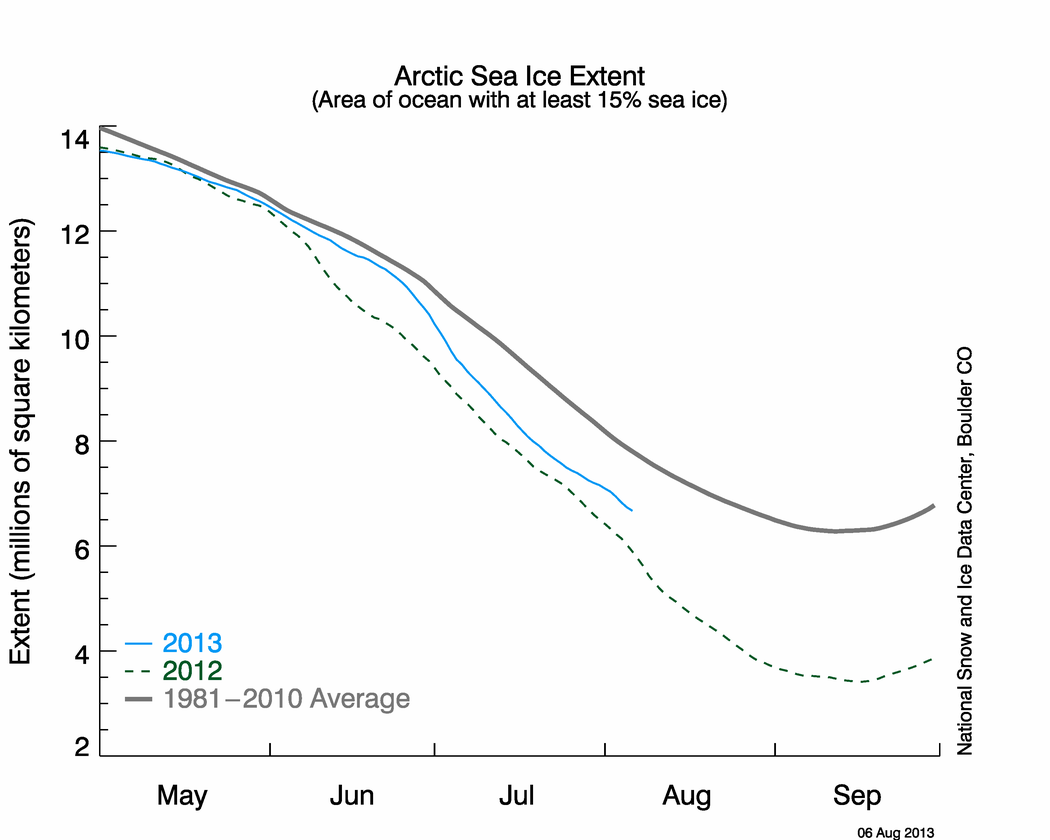
Tonight, 2010 will pass the 2004 curve. Once it drops below the 2006 curve, it will be in “lowest recorded sea ice extent for that date” territory.
AndyW said on May 25, 2010 at 6:47 am:
Now you are talking about known errors with measuring instruments, which ain’t the same thing. These are metrology issues. One type of error is a fixed initial offset, such as an analog voltmeter that should be reading zero but actually shows 0.1V. If it cannot be zeroed, such as with a fixed meter in a process equipment panel, then the adjustment is to subtract 0.1V from all measurements. Another involves a rate of error shown against a reference standard. A voltmeter reads 12.2V with a 12.0V reference, 6.1V with 6.0V, and is zeroed. The adjustment is to subtract 0.1V for every 6.1V displayed. Between the two adjustment methods, good numbers may still be obtained, IF the errors are consistent and repeatable.
That’s the crux of the issue, if the errors are consistent and repeatable. If Barber had established with several years of extensive accurate measurements of Arctic sea ice that the satellites gave a consistent error continually, say that 25% of reported thick MYI was repeatedly shown to be thin “rotten” ice, then adjustments could be made and reliable measurements could be obtained. He didn’t.
If the same instrument was used for all measurements, perhaps good trend information can be obtained without knowing the exact error. If we assume Satellite X has a consistent rate of error and/or a fixed initial offset, then we can analyze its measurements. If it shows less “rotten” ice then there is less “rotten” ice. But until the amounts of errors are known, its data cannot be compared to another satellite, and it can’t be trusted much beyond general trends.
Also with satellites there is a measure of “observational error.” The information needs to be processed. Different algorithms yield different results. So before you can look at the results from the same satellite, you have to have all the data processed by the same algorithm using the same parameters.
Barber said the satellites get it wrong. Calibration is indicated, we need to know what errors are present in what amounts. Until that is done, you cannot significantly compare data between satellites, or even use the same satellite without using the same processing algorithm with the same parameters for all the data and even then the results are of limited value. And this would be with consistent and repeatable errors. Until it is established that is indeed the case, you cannot trust the satellite data. So don’t use it.
Unless, of course, you disagree with Barber and will assert the satellites do get it right, Barber is wrong. In that case you are free to use satellite data for “rotten” ice studies.