By Steve Goddard
The Arctic is still running well below freezing, and as a result there just isn’t much happening, except for an odd discrepancy that has developed between NSIDC and NORSEX related to the 2007 extent. Read on.
The animation video above (generated from UIUC images) shows the entire month of May to date, and as you can see we have yet to see any melt in the Arctic Basin.

http://ocean.dmi.dk/arctic/meant80n.uk.php
The little melt which has occurred since the winter peak has been at lower latitudes, as can be seen in red in the modified NSIDC map below.

The equivalent map below shows changes over the last week. Melt is proceeding very slowly.

The animation below shows Arctic temperatures over the last month. Note that they have alternated between a little above normal and a little below normal. The video was generated from NOAA maps.
More interesting is what is going at the South Pole. GISS says the South Pole has been cold, while NOAA says the South Pole has been hot.

GISS April Antarctica
NOAA almost always shows the South Pole hot for some reason. Temperatures in Vostok averaged -90F in April and a balmy -85F so far in May. It only needs to warm up another 117 degrees to start Hansen’s Antarctic meltdown.
This time of year there is almost no year over year variation in extent, as can be seen in the DMI graph below.

http://ocean.dmi.dk/arctic/icecover.uk.php
What is interesting is that NORSEX shows 2010 extent well above 2007, while NSIDC shows it below 2007.

http://arctic-roos.org/observations/satellite-data/sea-ice/observation_images/ssmi1_ice_ext.png


http://nsidc.org/data/seaice_index/images/daily_images/N_timeseries.png
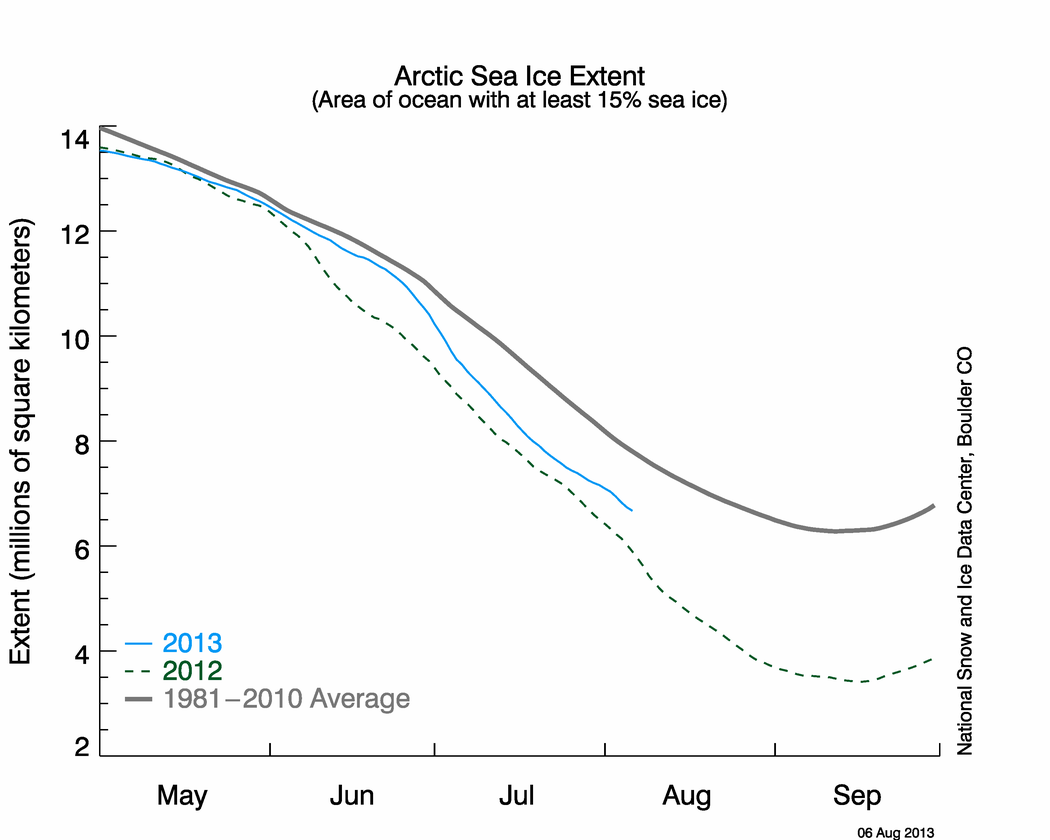
The four major ice extent indices continue to diverge.

Another interesting observation is that JAXA has changed their graphs. They used to show a weird little bump on June 1 of every year.

JAXA May 2 graph
But that bump has disappeared.

http://www.ijis.iarc.uaf.edu/seaice/extent/AMSRE_Sea_Ice_Extent.png

I hope the Polar bears aren’t disappointed at the loss of their little June 1 mogul. NSIDC anomalies can be seen below in the modified NSIDC map. The Alaska side has above normal sea ice and the Greenland side has below normal sea ice.

This is a reflection of ocean temperatures, which are below normal in the North Pacific, and above normal near Greenland.

http://weather.unisys.com/surface/sst_anom.html
We are still about six weeks away from anything interesting happening in the Arctic. Stay tuned.
wildred says: May 24, 2010 at 10:17 am
“You don’t seem to understand that in fact the passive microwave estimates of ice concentration are in error during summer in the interior of the ice pack. This is because the dielectric properties of snow and ice, and therefore their emissivities, change drastically with ice and snow wetness. So when melt water forms at the surface, the emissivity increases to close to 1 causing the surface to appear as a blackbody at microwave wavelengths. This is why places like NSIDC focus on the overall extent rather than the ice concentrations, and why an adjusted is needed if Zhang et al. are going to incorporate daily sea ice concentration fields into their model. Otherwise, they would show much lower ice volume estimates.”
So you are agreeing with what I stated, i.e. “So Zhang used an erroneous data set, weighted heavily when observations didn’t fit the model and then “nudged” its output to the results that he wanted.” You can spin it however you want, garbage data, combined with arbitrary adjustments, results in garbage charts like this:
http://psc.apl.washington.edu/ArcticSeaiceVolume/images/BPIOMASIceVolumeAnomalyCurrent.png
“BTW…the ice loss in 2007 was dramatic, it was a 26% decrease from the previous year. I don’t think Zhang et al. are incorrect for pointing that out.”
Drama is for actors, scientists should use measured tones leveraging sigmas and statistical significance. Given the brief sea ice record we have on our 4.5 Billion year-old planet, the change in 2007 is likely insignificant when viewed over longer timescales, e.g. including the changes that occurred to Arctic sea ice during the Medieval Warming Period and Little Ice Age. Drama is used for effect, to elicit an emotional response and in this instance, to mislead the reader into thinking that something normal is in fact tremendously catastrophically scarily alarming…
Steve Goddard said:-
” Low concentration ice in the Arctic Basin is due to shear stresses on the ice. Temperatures are still too cold for any significant melt to be happening”
Well the low concentrations are getting bigger and considering the temps for winds blowing from the south is bigger than the melting point at the moment, -2C or so, I think it is due to melt and not due to temporary polynyas that come and go.
http://www.iup.physik.uni-bremen.de:8084/amsr/arctic_AMSRE_nic.png
We shall see though, if it is due to movement then they should stay the same size or disappear over time, if it is due to melting they should slowly get bigger. One of them if north of Alaska which is in a region with multiyear ice as you pointed out previously as not likely to melt.
Andy
Andy
Neven says:
May 24, 2010 at 8:09 am
That’s interesting -> what geo wrote about concentration numbers in the core, with 2010 looking much better than previous years.
Why does this picture from the University of Bremen show much lower ice concentration than the picture on CT where you can compare pictures of different dates with each other?
The picture on the front page of CT has similar ice concentrations to the picture of the University of Bremen, and also differs quite a lot from the pictures on the comparison page.
++++
Because the front page of CT uses a different color legend than the comparison page. Look at both closely. What is light purple on the comparison page (80%) would be yellow or green on the front page (still 80%). What is red on the comparison page (60%) would be blue on the front page (still 60%). If you make that translation then the comparison page does not look so different than the front page.
But what really matters is apples-to-apples –how do the comparison pages for same date of the year look across different years?
geo said @ur momisugly May 24, 2010 at 7:18 am
“Not a lot of “rotten ice” in the core right now vs 2008 or 2007 or 2006.”
Sorry but that is wishful thinking as shown by looking at any of the years here
http://www.iup.physik.uni-bremen.de:8084/amsredata/asi_daygrid_swath/l1a/n6250/
Andy
You can also look at any of the images for different days/years here: ftp://sidads.colorado.edu/pub/DATASETS/seaice/polar-stereo/nasateam/final-gsfc/browse/north/daily/ and
here: ftp://sidads.colorado.edu/pub/DATASETS/seaice/polar-stereo/nasateam/near-real-time/browse/north/
Pretty clear that the ice looks more rotten this year than during the past few years of extremely low ice extents….
AndyW–
Thanks for the link. I’ll have to take a longer look at that archive when I have the time. I hadn’t seen it before today. There are some odd inconsistencies from year to year on the legend colors and even the area and orientation of the map it shows that make it harder to make direct comparisons by date.
AndyW said on May 24, 2010 at 12:27 pm:
Sorry, but the esteemed Dr. David Barber, noted educated Arctic Sea Ice expert, has stated the satellites get it wrong, namely they report as thick multi-year ice what is really thin “rotten” ice. Therefore the source for your rebuttal, as they are using satellite data, is unreliable for this discussion about “rotten” ice. You should supply a better source, or several better sources for a robust rebuttal.
kadaka (KD Knoebel) says:
May 24, 2010 at 1:47 pm
“Sorry, but the esteemed Dr. David Barber, noted educated Arctic Sea Ice expert, has stated the satellites get it wrong, namely they report as thick multi-year ice what is really thin “rotten” ice. Therefore the source for your rebuttal, as they are using satellite data, is unreliable for this discussion about “rotten” ice. You should supply a better source, or several better sources for a robust rebuttal.”
Everyone here on this thread is using satellite data Kadaka.
Give me a robust rebuttal showing it really is thick ice for the whole of the Arctic basin without using satellite sources. Feel free to quote Dr David Barbers current estimate using non satellite sources to back your point up and we can take it from there.
Andy
kadaka (KD Knoebel) says:
May 24, 2010 at 1:47 pm
Kadaka I think it’s important to understand why Dr. Barber reported as he did. It is well known that the sea ice algorithms applied to passive microwave brightness temperatures assume “tie points” representing first-year ice, multiyear ice and open water. These tend to be based on typical brightness temperatures for these types of surfaces. Yet it’s entirely possible that as the ice cover becomes more “rotten” that the brightness temperature signal that typically corresponds to multiyear ice no longer matches up to the typical values expected. Changes in the surface impact on changes in volume and surface scattering. That was the reason why the passive microwave observations were found to overestimate the “health” of the ice pack last fall. Passive microwave-derived sea ice concentrations are also subjected to a bias when the surface starts to melt (i.e. they “think” there is open water when in reality it is melting ice). So sometimes they underpredict and sometimes they overpredict the actual sea ice concentrations (extent is less affected by this however). The reality though is that the passive microwave sea ice concentration data record is the best data record out there since it’s often too cloudy to observe the ice with visible or thermal data. When you compare ice concentrations from different years, more reductions in ice concentrations in summer either implies more surface melt or more open water ares. 2010 certainly is seeing more areas of reduced ice concentrations at this time of year than in 2007.
http://arctic.atmos.uiuc.edu/cryosphere/NEWIMAGES/arctic.seaice.color.000.png
The Youtube image doesn’t show the same clarity as the above image does. It appears to be missing much open ocean as indicated in the cryosphere today image attached above. Any ideas why this is so? To me, it looks like the youtube presantation has been subjected to some spacial averaging in areas.
For example, it shows no open water in the Hudson Bay region nor around Q.E Island area
AndyW said on May 24, 2010 at 2:08 pm:
You have done an excellent job of completely missing the point in your reply, possibly by deliberately dodging the issue.
Barber says the satellites get it wrong. If you disagree with Barber then you are free to use satellite data.
Do you wish to state for the record that Dr. David Barber is wrong, the satellites can correctly identify what is thick multi-year ice and what is thin “rotten” ice?
Kadaka you seem to be missing the point that there is no long term in situ observation of the sea ice cover throughout the Arctic. David Barber is correct that the sea ice algorithms don’t tell you how thick the underlying ice cover actually is. Designating something as MYI versus FYI can be deceiving since that MYI may be very thin, rotten ice. So in reality, things are probably worse than we think.
Ok, now would someone please explain that blip in June that was retroactively “dissapeared” from the historical data?
Anyone have any theories about this? For that matter, why should I even have to ask this question? Shouldn’t they tell us? Shouldn’t their latest data come with a note explaining precisely how and why they changed historical data?
I’ll bet what they’re doing is on par with Jim Hanson’s nonsense!
Jeff Brown, if ice concentration is up in the basin (and it is as far as I can tell from side by side pictures) and it is windy, it stands to reason that compared to 2007 and 2008 (2009 is out of the picture because of the satellite problems in 2009), the ice will be thicker (compaction and ridging) and a heck of a lot more difficult to traverse.
Try using a mind experiment. Put into your mind-experiment ice that has a mix of concentrations (such as occurred in 2007 and 2008). Add wind. Compaction will occur but only after lower concentrations are filled first. Now put into your mind a fully concentrated basin. Add wind. Ridging should occur right away. You will likely get more immediate compaction and ridging under those conditions. You might also get slower movement of ice under the same wind conditions.
I wonder what would be the result if we measured amount and speed of ridging (pixel by pixel) as an indirect measure of thickness in any one year. A predominantly flat surface that moves rather quickly would indicate what? A ridgy, compacted surface that moves rather slowly would indicate what?
Or maybe ridging at the land edges might be instructive as to ice thickness. Just because one extent edge is less than it was last year may not mean the entire Arctic is about to melt like an ice cream sandwich on a hot summer day.
My point is that maybe there are other parameters that clue us into ice thickness better than extent edge? Discussion?
Anu said:
If the current generation of American men grew up to be 5′ 2.5″, on average, would that be “normal” in your view ? It’s within natural variability, and 2.5 STD from the average, so no problem.
I hope this isn’t typical of your logic. Are you trying to claim that the SD of a single Arctic season is equivalent to an entire generation of American men? Get real.
As for the Arctic sea ice. All of these conjectures are worth little in my mind. The entire weather pattern could change in July-August and force severe melting or little melting. And when it’s done no one will be convinced that it invalidates their beliefs.
Pamela, first off, what do you mean by the 2009 satellite data problem? When a sensor shows degradation, NSIDC switches to the next one. They always do that, so that’s not a problem. How many sensors do you think are in the 1979-present time-series? I believe they use SMMR, SSM/I F8, SSM/I F11, SSM/I F13, SSM/I F15 and SSM/I F17.
Ice concentration is not up in the basin. If I knew how to attach an image that is not an html link, I would show you a plot of the ice concentration (or total ice area–which is a reflection of ice concentration since it multiplies the extent by the actual ice concentration per pixel) and you would see for yourself that the ice concentrations are not up.
But to get to your question. You are correct that thin ice ridges and compacts more easily than old, thick ice. Thus, in some ways during a thinner ice regime you would expect more ridging and rafting, so locally you could have some very thick ice. And yes you are correct that ice extent is not the full story, the ice volume is the metric you really want to get a handle on. It’s like the old sonar data from submarines that showed ice thinning in the Arctic Basin. They didn’t have Arctic-wide estimates so they couldn’t say with certainty that the ice volume had declined since it could have been exported elsewhere. ICESat and Cryosat are the first opportunities for wide-spread monitoring of ice thickness. Another way to try to get a handle could be through surface roughness estimates from MISR. I don’t think anyone has done that yet though, at least not on a large scale.
I would think a lot of ridging and rafting would occur near the coasts, and that ice has been melting more and more in recent years, so perhaps it doesn’t help the situation all that much.
Even though the real thing we want to know is ice volume, I still think trends in extent do give us some useful information as to what is happening to the ice cover.
Richard M says:
May 24, 2010 at 8:29 pm
Anu said:
If the current generation of American men grew up to be 5′ 2.5″, on average, would that be “normal” in your view ? It’s within natural variability, and 2.5 STD from the average, so no problem.
———-
I hope this isn’t typical of your logic. Are you trying to claim that the SD of a single Arctic season is equivalent to an entire generation of American men? Get real.
I was disagreeing with Gail’s notions on “average” and “normal”:
Since Arctic sea ice extent (>= 15% per gridbox) is a rather distant, non-intuitive value, I switched to men’s heights, something people have personal experience with.
“Normal” is not 2 or 2.5 std dev’s from the population average – showing an average for a population of measurements, and graying in +/- one std dev on the curve, has nothing to do with “mislead”. That’s the data – “alarm” is an emotion, a reaction to data. That’s up to you.
With actual, American men height statistics, 2.5 std devs down from average is 5′ 2.5″. People have a feel for this data. This is not a “normal” height. A single man at 5′ 2.5″ is rather short, but falls within the bell curve. We expect other men to be 6′ 5.5″.
Now, here’s the “generation of American men” part:
http://nsidc.org/images/arcticseaicenews/20090908_Figure2.png
If all the recent summer minimums fall below 2 std devs, for 10 years, then 20, then 30, what we have is a new climatology – a new “population statistics”.
This would be like a generation of American men with a new average height, 2.5 std devs down from the old average.
http://www.ijis.iarc.uaf.edu/en/home/seaice_extent.htm
This has been happening since 2000.
And btw, average height for American men went up for generations born after WWII, due to better nutrition and healthcare. Population statistics and averages can easily change.
As for the Arctic sea ice. All of these conjectures are worth little in my mind. The entire weather pattern could change in July-August and force severe melting or little melting. And when it’s done no one will be convinced that it invalidates their beliefs.
I don’t know about that – if there were a dramatic melt, caused by the warming oceans and thinning ice, and summer minimum went below 2007, down to 3.5 million sq km, I bet a lot of people would re-examine their beliefs rather closely.
Even the Union of Unconcerned Scientists might be compelled to release a statement to the press.
jeff brown said on May 24, 2010 at 3:42 pm:
Sorry, you’re not a good enough magician to pull off such misdirection while performing sleight-of-hand switches.
“Rotten” ice is being discussed. Satellite data has been referenced for “rotten” ice info. Barber said satellites get it wrong and report thin “rotten” ice as thick multi-year ice. Therefore if you accept Barber’s conclusions then you cannot trust satellite data for “rotten” ice info. If you are supplying satellite data as trustworthy for “rotten” ice info then then it is implied you reject Barber’s conclusions.
That’s all there is to it. One side of your mouth cannot agree the satellites are not trustworthy for “rotten” ice amounts while the other says the satellites provide good data for your conclusions about “rotten” ice amounts. Are the satellites yielding good or bad “rotten” ice numbers, YES or NO? Pick one.
BTW, you’ve essentially just said you disagree with the PIOMAS Ice Volume model, to wit: “Volume estimates using age of sea ice as a proxy for ice thickness are another useful method…” As you are stating it, if MYI can actually be very thin “rotten” ice then you have identified a major flaw, age as a proxy for thickness cannot be relied on.
Good job pointing out a serious issue with that terrifying Arctic Ice Volume anomaly chart!
Kadaka, it is not me missing the point.
Geo made a claim based on satellite data, I produced other satellite evidence to counter his position. So why did you then butt in saying I couldn’t make that claim as satellite data is wrong? Why didn’t you pick geo up also? Like I said this whole blog post resolves around satellite data.
Andy
AndyW said on May 24, 2010 at 10:30 pm:
Now it is confirmed that you are deliberately dodging my point, as you have just asserted “What’s fair is fair” with regards to the point.
Fine then, I agree. geo can use satellite data for discussions involving “rotten” ice amounts if he disagrees with Barber, and you can use satellite data for discussions involving “rotten” ice amounts if you disagree with Barber. Yup, that sounds fair to me.
A lovely exchange resulting in mutual agreement. Thank you for your time!
The ice is very thin indeed and this summer we will forget about 2007.
kadaka, I’ll put it another way. We are comparing several years using one technique, now as it is only one technique being compared over several years and not multiple techniques then it does not matter on if it is not 100% accurate. It is the relativeness and not the absoluteness that matters here.
That’s the point you’ve missed and that’s why I don’t care about the validity or not of David Barbers thoughts, it is not relevant here to my counter argument to geo’s position.
Andy
Sea ice records before 1953 are unreliable (NSIDC).
Even satelite records are unreliable.
In 2009 NSIDC reported a September minimum of 5.1 M km2 on 12 September (NSIDC website, 2009), whereas the Arctic Regional Ocean Observing System (Arctic ROOS based at the Nansen Environmental and Remote Sensing
Center in Bergen, Norway) estimate shows a 6.0 M km2 minimum on that day (Arctic ROOS website).
http://www.wmo.int/wcrpevent/jsc31/documents/jsc-31clic_artic_4.2.pdf
The arctic sea ice melts though and has done so before.
http://wattsupwiththat.com/2010/05/02/catastrophic-retreat-of-glaciers-in-spitsbergen/
Dear me! Conspiracy, dishonesty, criminality—bad, BAD Dr. Zhang! Just wait ’til the end of this season, when the world will see how fakey-hoaxy his model is!