By Steve Goddard
The Arctic is still running well below freezing, and as a result there just isn’t much happening, except for an odd discrepancy that has developed between NSIDC and NORSEX related to the 2007 extent. Read on.
The animation video above (generated from UIUC images) shows the entire month of May to date, and as you can see we have yet to see any melt in the Arctic Basin.

http://ocean.dmi.dk/arctic/meant80n.uk.php
The little melt which has occurred since the winter peak has been at lower latitudes, as can be seen in red in the modified NSIDC map below.

The equivalent map below shows changes over the last week. Melt is proceeding very slowly.

The animation below shows Arctic temperatures over the last month. Note that they have alternated between a little above normal and a little below normal. The video was generated from NOAA maps.
More interesting is what is going at the South Pole. GISS says the South Pole has been cold, while NOAA says the South Pole has been hot.

GISS April Antarctica
NOAA almost always shows the South Pole hot for some reason. Temperatures in Vostok averaged -90F in April and a balmy -85F so far in May. It only needs to warm up another 117 degrees to start Hansen’s Antarctic meltdown.
This time of year there is almost no year over year variation in extent, as can be seen in the DMI graph below.

http://ocean.dmi.dk/arctic/icecover.uk.php
What is interesting is that NORSEX shows 2010 extent well above 2007, while NSIDC shows it below 2007.

http://arctic-roos.org/observations/satellite-data/sea-ice/observation_images/ssmi1_ice_ext.png


http://nsidc.org/data/seaice_index/images/daily_images/N_timeseries.png
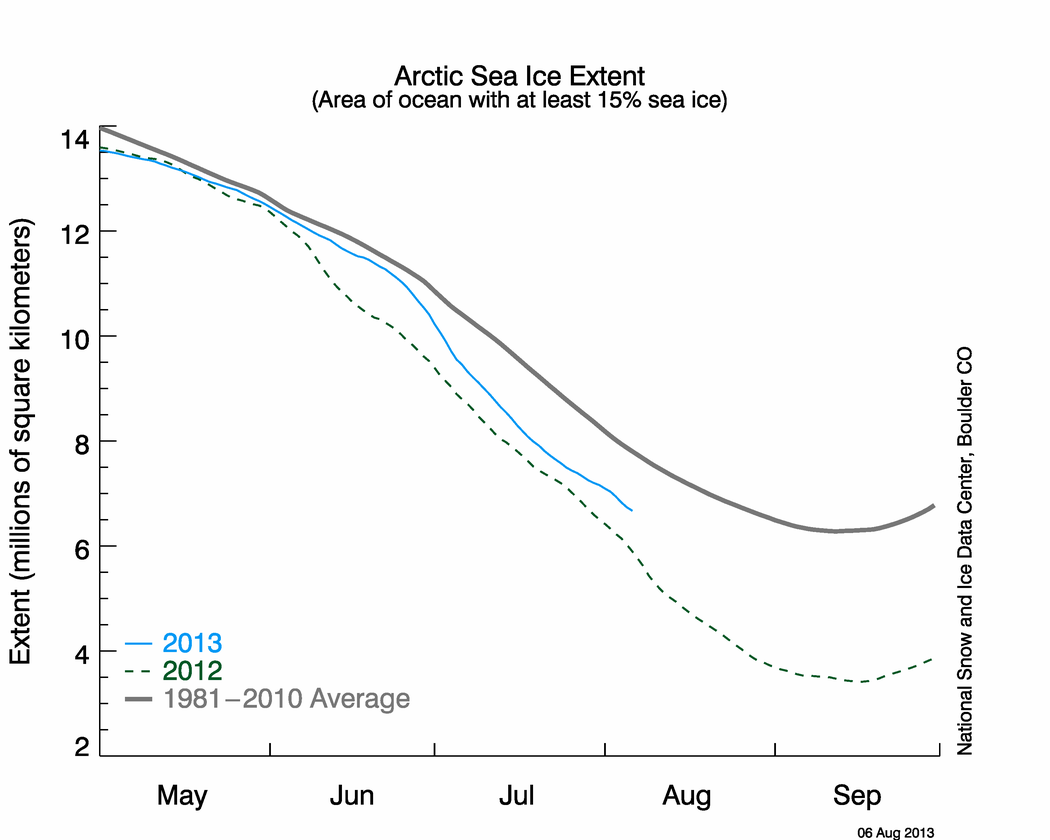
The four major ice extent indices continue to diverge.

Another interesting observation is that JAXA has changed their graphs. They used to show a weird little bump on June 1 of every year.

JAXA May 2 graph
But that bump has disappeared.

http://www.ijis.iarc.uaf.edu/seaice/extent/AMSRE_Sea_Ice_Extent.png

I hope the Polar bears aren’t disappointed at the loss of their little June 1 mogul. NSIDC anomalies can be seen below in the modified NSIDC map. The Alaska side has above normal sea ice and the Greenland side has below normal sea ice.

This is a reflection of ocean temperatures, which are below normal in the North Pacific, and above normal near Greenland.

http://weather.unisys.com/surface/sst_anom.html
We are still about six weeks away from anything interesting happening in the Arctic. Stay tuned.
Amino Acids in Meteorites says:
May 23, 2010 at 11:09 pm
Everything happening with Arctic ice is within normal variation. Nothing unusual is happening with it…
Is this just a “gut feeling”, or are you talking about the satellite record ?
http://iup.physik.uni-bremen.de:8084/amsr/ice_ext_n.png
Are you talking about “normal variation’ between Snowball Earth and Tropical Dinosaur Planet, or something more recent ? Pleistocene ? Holocene ?
Why not make things interesting by actually saying something – “summer sea ice extent will not go below 2007 levels in the next 60 years” – that is falsifiable ?
You seem to like quoting Dr. Serreze – are you trying to say that his predictions are outside the realm of “normal variation” ? “Unusual” ?
“Could we break another record this year? I think it’s quite possible,” said Mark Serreze of the National Snow and Ice Data Center in Boulder, Colo.
I take it that means you think we won’t break another record this year ? Or are you not actually saying anything ?
Hmmmm. I find it both odd and rather unusual for Cryosphere Today to be contradicting themselves so much…The “Compare Daily Sea Ice” map for 5/23/2010 shows considerably more ice in the Sea of Okhotsk and the Bering Sea than their main page image. Of course, it’s really all moot what happens outside the Arctic Basin proper…we know that all of this will melt completely in the coming weeks…as it always has. Nevertheless, I watch it on a daily basis if for no other reason than the fact that I find it more entertaining than watching football!
Stop attacking the guys at NSIDC like that for talking about the chance of spectacular melt seasons. If the weather forecast says a chance of rain and there is not a drop, do you stop paying attention to them? If you read carefully, the NSIDC press releases do mention the fact that what happens will depend on cloud cover and wind patterns (aka: weather) in the summer.
R. Gates,
“The alternative possibility to your assertion would be that the Arctic is responding differently to AGW than the Antarctic because it IS so different.”
Let me see if I understand this. The Antarctic is responding differently to global warming by freezing up. And that of course, proves global warming all the better.
nedhead,
“Remember, global warming does not mean warming everywhere.”
So, global warming is not – global.
Just The Facts says:
May 23, 2010 at 10:43 pm
As you yourself state, Zhang talks about preconditioning from a warming world. The reality is that the Arctic has been warming and so have global temperatures. Regardless of what has caused those temperatures to rise, Zhang is correct that it’s a warming world at the moment. If he doesn’t explicitly state GHG-induced warming, then he isn’t explicitly stating that GHGs are the reason for the observed warmth. Best to stick with what is written and not bias it according to what you want to believe he has written.
Stephen Wilde says:
May 23, 2010 at 11:54 pm
The whole satellite era of polar ice concentration occurred during a period of highly positive Arctic Oscillation (AO) whilst at the same time the sun was more disturbed than previously observed over the past 500 years and the ocean surfaces were warmer than ever previously observed due to a run of powerful El Nino events during a 30 year warm phase of the PDO.
——————
Stephen, no it didn’t. The AO was positive in the late 1980s/early 1990s and has been negative or neutral in all other years of the satellite data record (which is way more than the 5 or 6 strongly positive AO years). And what evidence do you have for a more disturbed sun (not even sure what that means), and can you also show how the El Nino was unusual these past 30 years?
I’d call it 5 weeks to the beginning of “interesting”.
May 1-July 1 just isn’t interesting. People are fretting that 2010 has gone below 2007. Yes, well take a closer look. 2007 was above 2006 at this point with clear daylight between them on the JAXA graph –how’d that work out in the end?
Also note that the great “death spiral is HERE!” year of 2007, shown loving as a comparison on NSIDCs current daily graphs, during this “bottleneck” period of May 1-July 1, is bumping along the bottom of their standard deviation bars. Compare that to April 1 where there is a large gap on 2007 vs the SD bars. More than anything that should tell you that May 1-July 1 just isn’t indicative of much of anything at all as to eventual extent minimum. I’ve been saying that since the middle of April, so no revisionist history there from me.
What matters during this May 1-July 1 period, as Steve pointed out, is what he called the Arctic basin, and what I usually call “the central core”. And the ice concentrations in it looks very good indeed right now compared to previous years. I could wish Steve had done that animation for 2008 as well for comparison purposes.
It’s worth remembering the compare tool at Crysophere uses a different color legend than the full scale pics. What is a light purple on the compare tool would be yellow or green on the large pics if you want to make that kind of translation. But for apples-to-apples comparisons of previous years that doesn’t matter –and those previous years have a lot more 80% or less concentration areas in the central core/arctic basin than 2010 does.
Amino Acids in Meteorites says:May 23, 2010 at 11:15 pm
Mark Serrezes’ prediction for Arctic ice this summer:
Dr. Serreze said winds, cloud cover or other weather conditions could slow the melt, but he points out that the decline is likely to speed up even more in June and July.
I’m going to stick my neck way out here and predict that regardless of any external factors other than the sun, the decline is going to speed up in August and September, then quit.
Gail writes:I suspect that larger intra annual variability would be a likely natural outcome simply because a negative Arctic Oscillation gives larger and longer latitudinal flows of air into and out of the Arctic region as compared to a positive Arctic Oscillation.
Gail, I suspect more interannual variability as the ice cover continues to thin. This is because when the ice is thin an anomalous summer can promote large ice loss, whereas when the ice is thicker you may have a lot of melt, but not much change in extent. Conversely, during atmospheric conditions that favor ice retention, all you need is a thin layer of sea ice to survive to cause the extent to tick back up. Eventually however, the ice becomes too thin to survive regardless of the summer weather patterns. You can see a change in variance of the September sea ice extent over time…
The ice concentration picture in the central core would actually support a higher prediction than my 6.0-6.2M prediction of extent minimum (made in late March). However, I’d have to have better historical daily thickness data to go out any further on the limb. I do think it is pretty clear, however, that the improved multi-year ice picture of 2010 vs 2009 and 2008 is making itself felt in the concentration numbers in the core. Thinner ice breaks up more easily/rapidly than thicker ice. Not a lot of “rotten ice” in the core right now vs 2008 or 2007 or 2006.
It is so obvious that what the world needs today is someone who can tell us all what is, and is not, true. There is just no other solution. Let us dumb together and agree once and for all time, that henseforth and evermore the UN Secretary General shall have the Power of Infallibility. If he says it’s raining, it’s raining. If he says it’s melting, it’s melting. If he says I’m wrong, you’re wrong, we’re all wrong, then by gumbo, we’re wrong. Of course, the reverse is also true; we have a chance of being right sometimes too. Life is just so complicated and people are just too greedy and out for their own gain. I tell you we must do this to save us from ourselves (especially the ourselves that have so much more than the rest of us have).
PS: We probably ought to make the UNSG position a lifetime appointment –you know like the Pope and Iran’s Supreme Iatola and the Queen and the Japanese Emperor. One day we can have Utopia. If we only believe!
Gail Combs says:
May 24, 2010 at 5:38 am
There are natural cycles of about 60 yrs (ocean) and 200 yrs (sun), but we only have data for about 30 yrs so there is no way in heck we have a good handle on the natural variability or what the “true average is”. The whole darn subject and the graphs are very misleading and designed to cause alarm.
The graph uses data from 1979 to 2006 to compute the average. This is less than the thirty years that cover 1/2 an ocean cycle (In my numerous statistics classes I was taught to always use a minimum sample size of 30.) SO what part of the relevant ocean cycles does the average cover?
How about 38 years of data ?
http://iup.physik.uni-bremen.de:8084/amsr/ice_ext_n.png
The Nimbus 5 ESMR data started from 1972.
Here’s a paper that discusses the Arctic sea ice extent in the 70’s:
http://www.tos.org/oceanography/issues/issue_archive/issue_pdfs/6_1/6.1_barry_et_al.pdf
See Figure 3 for 1972, 1973, 1974, 1975 and 1976 summer Arctic sea ice minimums – “about 8 * 10^6 km^2”
Compare with:
http://nsidc.org/images/arcticseaicenews/20091005_Figure3.png
Doesn’t look like a 60 year ocean cycle to me.
Not only is the “average” used for comparison a poor proxy for the “true mean” given it does not include a sampling of all the natural variability, but the gray area signifying “normal” is only one standard deviation from the average. Only 68% of data are within one standard deviation of the mean. So that is meant to cause alarm and mislead too.
The gray area should be 2.5 STD or at least 2 STD since 95% of individuals will have values within 2 standard deviations of the mean. I am sure those constructing the graph know this and that is why they chose to use only one standard deviation.
The average height for men in the U.S. is 5′ 10″. One standard deviation is 3″.
“Normal” is considered 5′ 7″ to 6′ 1″ – yes, about 68%.
Two standard deviations from the average would be 5′ 4″ to 6′ 4″ – 95.2 % of the population.
If the current generation of American men grew up to be 5′ 2.5″, on average, would that be “normal” in your view ? It’s within natural variability, and 2.5 STD from the average, so no problem.
geo says:
May 24, 2010 at 6:51 am
What matters during this May 1-July 1 period, as Steve pointed out, is what he called the Arctic basin, and what I usually call “the central core”. And the ice concentrations in it looks very good indeed right now compared to previous years. I could wish Steve had done that animation for 2008 as well for comparison purposes.
————
Geo, have you looked at the AMSR-E ice concentrations from today? Do you notice the numerous polynyas that have formed? Do you also notice the reduced ice concentrations in the interior of the icepack? Compare that with 2007 at this time, and then think about how thick the ice is this spring compared to what it was in 2007.
Given the thinner ice cover, having these numerous polynyas as the Arctic is about to head into peak solar insolation means more melt since those open water areas absorb the sun’s energy, fostering more lateral and basal melt. To me the situation looks worse than it did in 2007 at this time. But it’s true that there’s a lot that can change as the melt season progresses, but it’s not good to start out where it is right now.
BTW…the MYI picture didn’t improve. Export out of Fram Strait this winter was normal, and the old ice that was transported into the Beaufort and Chukchi Seas was transported further south than the typical Beaufort Gyre circulation, which means that ice is not returning northwards where it could survive the summer melt. Old ice still declined throughout winter in contrast to what Steve would have you believe.
Vincent says:
May 24, 2010 at 6:03 am
Yes, you’re correct that global warming doesn’t imply warming everywhere, because as the planet warms, atmospheric circulation patterns shift which could induce local cooling. The sea ice in the Antarctic is actually behaving as climate models have predicted based on decreases on atmospheric ozone concentrations. But GCMs do predict that over time, the ice in Antarctica will shrink as well. The warming on the Peninsula is some of the most extreme on the planet right now, but its links to GHGs remains unclear. Seems the changes in wind patterns around Antarctica induced in part by ozone losses is playing the dominant role at the moment. Antarctica is also protected from warming atmospheric and oceanic temperatures at other latitudes by the Antarctic circumpolar current.
That’s interesting -> what geo wrote about concentration numbers in the core, with 2010 looking much better than previous years.
Why does this picture from the University of Bremen show much lower ice concentration than the picture on CT where you can compare pictures of different dates with each other?
The picture on the front page of CT has similar ice concentrations to the picture of the University of Bremen, and also differs quite a lot from the pictures on the comparison page.
Given all the polynyas on the Russian side of the Arctic, I wouldn’t be surprised if the northern sea route opens once again this summer. Since 90% of the hydrocarbons believed to be in the Arctic are located on the Russian side, this is good news for them.
Re Serreze. Since NOAA describes their mission as “to understand and predict”, and NSIDC is part of NOAA, then if arctic yearly minimum is greater this year than last year, I think it would be entirely appropriate to say it is time for Serreze to go, as he will have once again faily abysmally at fulfilling their stated mission, and have done so over a multi-year period and in spite of contra-indicating evidence that had absolutely no impact on moderating his extreme views.
Now, understand, I’m giving him the benefit of the doubt by that standard –he’s telling people that this year could be lower than 2007. I’m not saying he should resign if that isn’t true –I’m giving him a much bigger, and kinder, rope than that by saying if 2010 minimum exceeds 2009 minimum then he should go. Because then he will not just have been “wrong again” three years running, but quite significantly wrong again.
geo says:
May 24, 2010 at 8:17 am
Has Dr. Serreze actually said that 2010 is going to be below 2009? I don’t think so. He’s smart enough to realize that no one can predict the summer weather patterns. He simply understands that the ice is thin and vulnerable to melting out again this summer, which could cause another very low summer ice year. BTW…NSIDC is mostly a part of NASA since they are a NASA funded DAAC.
wildred says: May 24, 2010 at 6:29 am
“As you yourself state, Zhang talks about preconditioning from a warming world. The reality is that the Arctic has been warming and so have global temperatures. Regardless of what has caused those temperatures to rise, Zhang is correct that it’s a warming world at the moment. If he doesn’t explicitly state GHG-induced warming, then he isn’t explicitly stating that GHGs are the reason for the observed warmth. Best to stick with what is written and not bias it according to what you want to believe he has written.”
What? Zhang states that, “Arctic sea ice in 2007 was preconditioned to radical changes” and this contributed to “The dramatic decline”, this is not objective science, rather it’s alarmist rhetoric. And let’s claw ourselves out of the weeds on this particular paper and focus on the “nudging” that Zhang used to arrive at this garbage chart:
http://psc.apl.washington.edu/ArcticSeaiceVolume/images/BPIOMASIceVolumeAnomalyCurrent.png
The chart is based on this model;
http://psc.apl.washington.edu/zhang/Global_seaice/model.html
and the page states that:
“Satellite sea ice concentration data are assimilated in GIOMAS using the Lindsay and Zhang (2005) assimilation procedure. The procedure is based on “nudging” the model estimate of ice concentration toward the observed concentration in a manner that emphasizes the ice extent and minimizes the effect of observational errors in the interior of the ice pack.”
According to this paper:
http://journals.ametsoc.org/doi/full/10.1175/JTECH1871.1
“Because of the errors in the summer Gice dataset ice concentration in the interior of the pack (as well as errors in summer ice concentration based on passive microwave observations), assimilation of ice concentration is accomplished in a method that emphasizes the extent over the concentration. The observations are weighted heavily only when there is a large discrepancy between the model and the observed concentration. Each day the model estimate Cmod is nudged to a revised estimate Ĉmod with the relationship.”
So Zhang used an erroneous data set, weighted heavily when observations didn’t fit the model and then “nudged” its output to the results that he wanted. wildred, in your rebuttal you state that it’s “Best to stick with what is written and not bias it according to what you want to believe”. Seems like great advice, perhaps you should pass it onto Zhang…
jeff brown says:
May 24, 2010 at 6:33 am
I should have said that the NAO was highly positive throughout the period with the AO becoming steadily more positive throughout the period.
Gail Combs kindly produced the relevant links in her post:
Gail Combs:
May 24, 2010 at 5:38 am
The gist of my comments is entirely accurate.
Just The Facts says:
May 24, 2010 at 9:14 am
You don’t seem to understand that in fact the passive microwave estimates of ice concentration are in error during summer in the interior of the ice pack. This is because the dielectric properties of snow and ice, and therefore their emissivities, change drastically with ice and snow wetness. So when melt water forms at the surface, the emissivity increases to close to 1 causing the surface to appear as a blackbody at microwave wavelengths. This is why places like NSIDC focus on the overall extent rather than the ice concentrations, and why an adjusted is needed if Zhang et al. are going to incorporate daily sea ice concentration fields into their model. Otherwise, they would show much lower ice volume estimates.
BTW…the ice loss in 2007 was dramatic, it was a 26% decrease from the previous year. I don’t think Zhang et al. are incorrect for pointing that out.
geo says:
May 24, 2010 at 6:51 am
What matters during this May 1-July 1 period, as Steve pointed out, is what he called the Arctic basin, and what I usually call “the central core”. And the ice concentrations in it looks very good indeed right now compared to previous years. I could wish Steve had done that animation for 2008 as well for comparison purposes.
Here’s a comparison from JAXA showing yesterday vs the same date in 2007 (2007 on L, 2010 on R), there’s a slightly different color palate but if anything we are ahead of 2007 over most of the Arctic. More extensive polynyas etc.
http://i302.photobucket.com/albums/nn107/Sprintstar400/20102007comp.gif
We have now identified a new “Arctic Ice Death Spiral” -alarmist favorite map:
http://www.iup.uni-bremen.de:8084/amsr/ice_ext_n.png
Checking out the source, going by the English pages at IUP University of Bremen, the path goes to Data Products then High Resolution AMSR-E 89 GHz Sea Ice Images where we find THIS SHOCKING ADMISSION:
You got that? “This is a work in progress. Use at your own risk. There is no warranty express or implied.”
Highly recommended, click on the “ARTIST” link above for a delightful and scientifically accurate animation. On that page is a “Sea Ice Outlook” link. “Educated Opinions” about the September minimum Arctic Sea Ice extent have been gathered from contributors using May data. Two completed reports are posted, 2008 and 2009. From 2008 we find:
(Note that May figure is found by the “Full Report” tab. It is not in the initial “Overview and Key Highlights” tab that trumpets how well they did, or the flyer available for download…)
From 2009:
What seems like a reasonable conclusion? The May numbers don’t mean much. Twice in a row “Educated Opinions” have yielded underestimations of the final results. Which is surprising considering how the contributors included esteemed experts on Arctic ice like Barber, Meier, Zhang… For interesting reading, at the bottom of both reports can be found statements from the esteemed experts about what happened. I especially like Zhang’s final sentence for 2009:
Oh, general question. In both reports there is a long-term prediction graph of minimum extent going to 2100, here is the 2009 one, which each line being from a “single ensemble member.” Going by eyeball, everyone agrees in about five years there shall be rising amounts for about fifteen years, followed by a resumption of a falling trend. Can someone explain why there is a predicted Death Spiral Interruptus?
BTW, back at the new favorite alarming graph, note how all the recent curves (2003 to 2009) closely converge around the same point in June where the sine waves flip over. This year was a bit odd that ice extent was still going up somewhat late, to about the beginning of April. Doesn’t it make sense that we should see a fast decline so the 2010 curve “catches up” for the June convergence?
Many people, including educated, scientific folk, fail to understand that traditional laws of physics fail abysmally under conditions of modelled, unobserved phenomena, such as AGW, in the proximity of black holes, or under the conditions closely following the big bang. These are not failures of the models, just the inability of physical laws to cope with the complexities found in novel, incompletely described situations. Thus it is totally realistic for sea ice to melt at temperatures way below freezing due to higher than average temperatures in regions one thousand kilometres further south.
Under these conditions, it is equally likely that ice volume estimations must be also subject to sea surface temperature anomaly projections based on the last three years of open ocean in the Arctic region during the fall compared with the previous 21 years ice cover. There were buoys recording data, and ships, and satellites, weren’t there, over that time?