By Steve Goddard
The Arctic is still running well below freezing, and as a result there just isn’t much happening, except for an odd discrepancy that has developed between NSIDC and NORSEX related to the 2007 extent. Read on.
The animation video above (generated from UIUC images) shows the entire month of May to date, and as you can see we have yet to see any melt in the Arctic Basin.

http://ocean.dmi.dk/arctic/meant80n.uk.php
The little melt which has occurred since the winter peak has been at lower latitudes, as can be seen in red in the modified NSIDC map below.

The equivalent map below shows changes over the last week. Melt is proceeding very slowly.

The animation below shows Arctic temperatures over the last month. Note that they have alternated between a little above normal and a little below normal. The video was generated from NOAA maps.
More interesting is what is going at the South Pole. GISS says the South Pole has been cold, while NOAA says the South Pole has been hot.

GISS April Antarctica
NOAA almost always shows the South Pole hot for some reason. Temperatures in Vostok averaged -90F in April and a balmy -85F so far in May. It only needs to warm up another 117 degrees to start Hansen’s Antarctic meltdown.
This time of year there is almost no year over year variation in extent, as can be seen in the DMI graph below.

http://ocean.dmi.dk/arctic/icecover.uk.php
What is interesting is that NORSEX shows 2010 extent well above 2007, while NSIDC shows it below 2007.

http://arctic-roos.org/observations/satellite-data/sea-ice/observation_images/ssmi1_ice_ext.png


http://nsidc.org/data/seaice_index/images/daily_images/N_timeseries.png
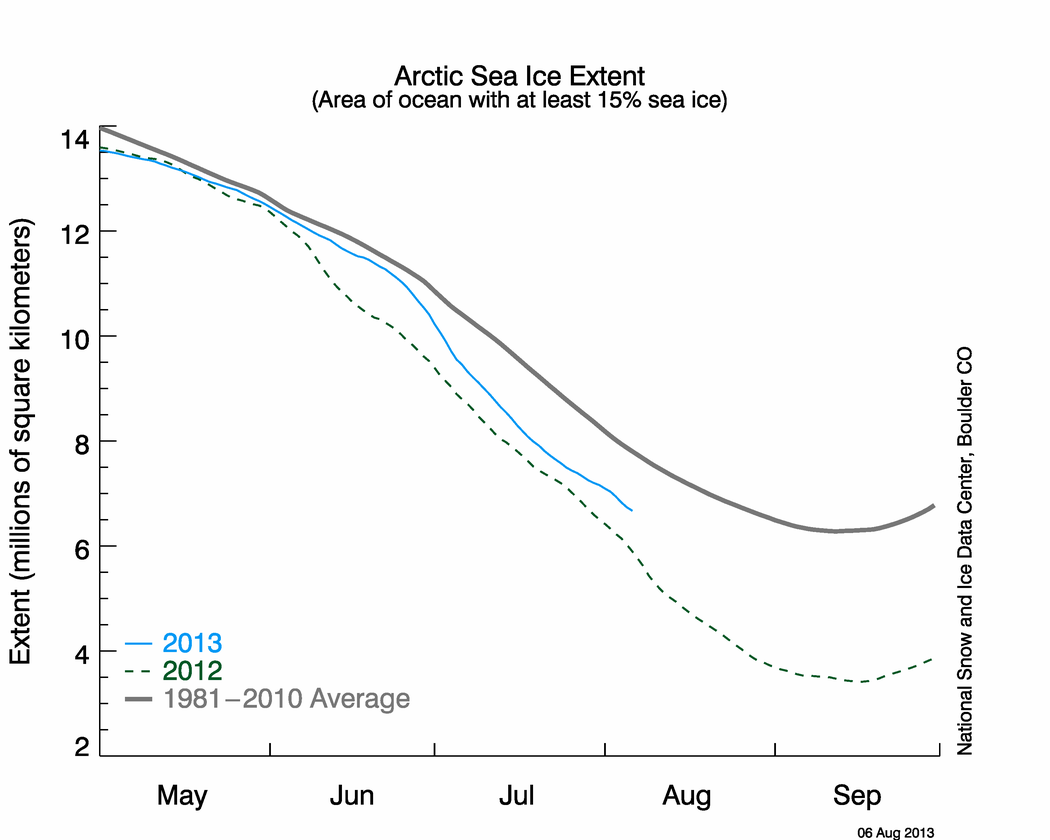
The four major ice extent indices continue to diverge.

Another interesting observation is that JAXA has changed their graphs. They used to show a weird little bump on June 1 of every year.

JAXA May 2 graph
But that bump has disappeared.

http://www.ijis.iarc.uaf.edu/seaice/extent/AMSRE_Sea_Ice_Extent.png

I hope the Polar bears aren’t disappointed at the loss of their little June 1 mogul. NSIDC anomalies can be seen below in the modified NSIDC map. The Alaska side has above normal sea ice and the Greenland side has below normal sea ice.

This is a reflection of ocean temperatures, which are below normal in the North Pacific, and above normal near Greenland.

http://weather.unisys.com/surface/sst_anom.html
We are still about six weeks away from anything interesting happening in the Arctic. Stay tuned.
Back to the picture in Time Magazine, March 17, 1959. USS Skate in open waters at the North Pole.
Following is a cold winter. Up goes the winds to the Arctic, down goes the cold air to Western US.
Some things begin to make more sense.
Great for subs at the North Pole.
JK says:
May 23, 2010 at 3:30 pm
Thanks JK, but, those images have lots of cloud cover, no reference frame, and still not enough resolution. Are these really the images people use to determine ice cover?
Also, my gripe was that these agencies aren’t putting their cards on the table. If you have an image that’s raw data and a pixel is marked as ice or not ice, you can actually go to that site to determine the truth. That’s not possible without *their* data and *their* markup of their data. Am I just finding out about a well-known problem?
Smokey says:
May 23, 2010 at 7:06 pm
You don’t seem to realize what “global” means. If there is diminishing Arctic ice, but Antarctic ice is the same as usual, then the Arctic is simply showing local climate effects.
The question is about global warming [or cooling], not about local variability; that happens all the time, and in this case the Arctic will eventually revert to the mean, as it always does.
————-
Smokey you don’t seem to understand the different processes that control the Arctic and Antarctic climates. For starters, the Arctic is surrounded by land, whereas the Antarctic is surrounded by oceans. Thus, the ocean is a very important factor in Antarctic climate, which has a very large heat capacity. To assume that both poles will respond in the exactly same way is very naiiive of you. Remember, global warming does not mean warming everywhere. It is simply an average of the entire planet, but some regions may show pronounced warming such as the Arctic, whereas other regions may be showing little or reverse warming trends. Climate models have always predicted this to be the case, and observations agree..
JDN says:
May 23, 2010 at 7:52 pm
JK says:
May 23, 2010 at 3:30 pm
Thanks JK, but, those images have lots of cloud cover, no reference frame, and still not enough resolution. Are these really the images people use to determine ice cover?
No, they were actual images taken with MODIS for you to compare with the Microwave images (they have the ability to see through clouds).
Also, my gripe was that these agencies aren’t putting their cards on the table. If you have an image that’s raw data and a pixel is marked as ice or not ice, you can actually go to that site to determine the truth. That’s not possible without *their* data and *their* markup of their data. Am I just finding out about a well-known problem?
No, it’s possible to do what ask, you can get the raw data but it isn’t an image.
How it can be used to make an image is described in several places, I find the papers by Spreen et al very useful:
http://iup.physik.uni-bremen.de:8084/amsr/amsre.html
Comparison with the MODIS images when viewing conditions are good allows anyone to see how accurate the representation is. Having done that on numerous occasions is why I prefer JAXA and CT.
JDN says:
May 23, 2010 at 7:52 pm
“Thanks JK, but, those images have lots of cloud cover, no reference frame, and still not enough resolution. Are these really the images people use to determine ice cover?”
I believe they use microwave, not visible light, sensors. Reference is the land and islands. You can go to the calendar and pick different days with different cloud cover. You can zoom with the gadget in upper left corner. You can actually see the ice cover.
I think you can get the raw data and work it up yourself. I seem to recall someone doing that a few years ago. Since people can get confirmation from airplanes, satellite imagery, ships, etc., I find it doubtful all these various agencies around the world are fudging the data in unison. But that’s why I like to look at the pics.
rbateman says:
May 23, 2010 at 7:27 pm
Back to the picture in Time Magazine, March 17, 1959. USS Skate in open waters at the North Pole.
Wasn’t open water, it was ice about 2 feet thick on a frozen polynya (I read the account of it once).
jeff brown says:
May 23, 2010 at 6:48 pm
Bill, it’s’ curious that the PIOMAS model estimates did pretty well during the ICESat era. Given the in situ observations of the ice cover and the current rapid decline, it’s more likely than not that PIOMAS volume estimates are close to reality.
When the ice cover plummets again this summer perhaps then you’ll realize that the ice is indeed on “thin ice”
________________
Bill, I agree, but the proof will only come over time, but those who have called Dr. Zhang science “garbage” will not pay attention when his PIOMAS model is proven once more as very solid and they’ll have to figure out omething else to focus their “skepticism” on…
Just The Facts says:
May 23, 2010 at 7:22 pm
Exactly, why don’t you read his paper that discusses what drove the dramatic retreat of the ice in 2007. If you do you will understand that he talks about weather patterns, not GHG-warming. Zhang like most all other Arctic scientists spend hours looking at the factors causing the ice loss in the Arctic. Which although Steve doesn’t want to admit it, is declining despite the extremely negative AO this winter. The fact is, the Arctic ice pack continues to shrink each year no matter what sort of natural weather patterns act on it. Natural variability is not explaining the Arctic sea ice decline, and hasn’t for quite some time now.
Smokey says:
May 23, 2010 at 7:06 pm
nedhead,
You don’t seem to realize what “global” means. If there is diminishing Arctic ice, but Antarctic ice is the same as usual, then the Arctic is simply showing local climate effects.
__________________
Nope, two vastly different climate dynamical systems in the Arctic and Antarctic. The alternative possibility to your assertion would be that the Arctic is responding differently to AGW than the Antarctic because it IS so different.
starzmom says:
May 23, 2010 at 6:48 pm
If temperatures in the Arctic are below freezing, is ice melt really happening, or is ice leaving the Arctic through the various straits? Having just flown over the strait between Greenland and Iceland–a diversion courtesy of the unpronounceable volcano–I can tell you from first hand observation that quite a lot of ice is flowing through that strait. There was so much ice that the currents were very visible.
______________
Starmon, your observations are very astute. The increase in ice flowing through the Fram Strait and down the east coast of Greenland picked up quite a bit in the past few months. The last NSIDC update reported:
“A weaker Transpolar Drift Stream also slowed the movement of ice from the Siberian coast of Russia across the Arctic basin, and reduced ice flow out of Fram Strait. The wind pattern changed in March, when the Arctic Oscillation went into a more neutral phase. As a result, the flow of ice sped up through Fram Strait and along the coast of Greenland. This pattern helps to remove older ice from the central Arctic, pushing it toward the warm waters of the North Atlantic, where it will melt.”
Also, as discussed many times here, a great deal of the melting of sea ice is not from above, but from below. There’s been a lot of warm water near Greenland and in the North Atlantic. See for example:
http://iridl.ldeo.columbia.edu/maproom/.Global/.Ocean_Temp/Anomaly.html
And look at all that warm water up there. It is also true that the air temps have been warmer, but this warmer water, has been flowing under the ice and melting it from below in areas around Greenland and up over into the Barants sea. Combine this melting from below, with the warmer air temps, and well, you get a big early melt in these areas. See:
http://arctic.atmos.uiuc.edu/cryosphere/IMAGES/recent365.anom.region.6.html
Despite what others may post here, you can see from these charts, which are quite accurate:
http://iridl.ldeo.columbia.edu/maproom/.Global/.Ocean_Temp/Anomaly.html
http://iridl.ldeo.columbia.edu/maproom/.Global/.Atm_Temp/Anomaly.html
That the area of N. Canada and over into Greenland and futher on into the Barants have been quite warm for many months in both ocean and air temps. There’s nothing the ice can do under these conditions…but melt.
Very impressive, making an animation video showing ” the entire month of May”, especially since more than a week of it lies in the future.
And although smoothing out that little bump in
http://www.ijis.iarc.uaf.edu/en/home/seaice_extent.htm
is indeed interesting, I think more interesting is the fact that 2010 dropped like a rock from being the highest sea ice extent in the IARC-JAXA 2002 to 2010 data to cutting across the curves for 2009, then 2008, then 2003, then 2005, then 2007. (The curve for 2002 started in June, so we’ll soon be below that one, too)
Next up: 2004, then 2006.
The Arctic is still running well below freezing, and as a result there just isn’t much happening,
I guess you haven’t been watching the “dropping like a rock” part.
More interesting is what is going at the South Pole.
What have you been Smokeying ?
This is WUWT Arctic Sea Ice News #6
Arctic. The pole that is melting.
Well, IARC-JAXA only started in 2002. What about satellite data back to 1972 ?
http://iup.physik.uni-bremen.de:8084/amsr/ice_ext_n.png
Huh.
Looks like this summer melt season might be an eye opener.
John Egan says:
May 23, 2010 at 11:45 am
Mark Serreze also says this in the 5/20/10 article:
“We are going to lose the summer sea-ice cover. We can’t go back.”
Still on the ‘death spiral’. He hasn’t changed.
http://www.theglobeandmail.com/news/national/arctic-sea-ice-heading-for-new-record-low/article1575212/
nedhead says: May 23, 2010 at 9:30 pm
“Exactly, why don’t you read his paper that discusses what drove the dramatic retreat of the ice in 2007. If you do you will understand that he talks about weather patterns, not GHG-warming. Zhang like most all other Arctic scientists spend hours looking at the factors causing the ice loss in the Arctic. Which although Steve doesn’t want to admit it, is declining despite the extremely negative AO this winter. The fact is, the Arctic ice pack continues to shrink each year no matter what sort of natural weather patterns act on it. Natural variability is not explaining the Arctic sea ice decline, and hasn’t for quite some time now.”
You mean this paper;
http://psc.apl.washington.edu/zhang/Pubs/Zhang_etal2008GL034005.pdf
that begins with, “A model study has been conducted of the unprecedented retreat of arctic sea ice in the summer of 2007. It is found that preconditioning, anomalous winds, and ice-albedo feedback are mainly responsible for the retreat.” before adding in the standard unfounded Warmist mantra in the third sentence that “Arctic sea ice in 2007 was preconditioned to radical changes after years of shrinking and thinning in a warm climate.”?
Or do you prefer the conclusion that begins with,
“[15] The dramatic decline of the arctic ice cover in summer 2007 occurred after years of shrinking and thinning (Figures 1a, 3a, and 3b) in a warming environment [Hassol, 2004].”
In terms of your argument that, “Natural variability is not explaining the Arctic sea ice decline, and hasn’t for quite some time now.” we have 31 years of sea ice data on a 4.5 billion year old planet. Humans have a rudimentary understanding of Earth’s natural variability, hence no one accurately predicted the decline in Arctic sea ice in 2007, subsequent recovery, and seemingly odd behavior over the last several months. This does not mean that natural variability is not responsible for it, but rather that you, I, Zhang and everyone else do not currently understand the immensely complex natural variability of Earth’s climate system. Instead of deluding yourself into a false sense of understanding Earth’s climate system, try to learn to embrace the uncertainty, as it will likely be around for many generations to come…
Bill Illis says:
May 23, 2010 at 6:05 pm
It seems to argue data with those of his ilk is useless. Data isn’t what they’re concerned about—unless it’s methods methods for manipulating the real data. You have to argue with their vivid imaginations. Because making imaginations somehow believable is the business they are in.
Everything happening with Arctic ice is within normal variation. Nothing unusual is happening with it. But some people here sure are spending a lot of time drumming up ways to make it look like unusual things are happening there. Like the one guy that said the Arctic “enjoyed warm conditions” last winter. So because it was -57 F on some days instead of -60 F it was enjoyable weather. That’s “warm conditions” t-shirt weather! See how that goes?
The sky is always falling with them.
I wonder how they are explaining the unusually cold spring in Northern California, Oregon, and Washington? Oh wait, that’s just ‘weather’ in which case the sky isn’t falling. If it was unusually warm in the same area then the sky would be falling—just like the sky was falling because of the warm weather for the Olympics in Vancouver.
Very interesting. Wonder how long the fake figures can roam the scientific community before the fleas start the scratch.
Mark Serrezes’ prediction for Arctic ice this summer:
Dr. Serreze said winds, cloud cover or other weather conditions could slow the melt, but he points out that the decline is likely to speed up even more in June and July.
http://www.theglobeandmail.com/news/national/arctic-sea-ice-heading-for-new-record-low/article1575212/
I cannot understand all this involved discussion. We have been told, no ifs ands or buts, that the Arctic ice will be gone in the summer of 2013. Not long to wait.
The whole satellite era of polar ice concentration occurred during a period of highly positive Arctic Oscillation (AO) whilst at the same time the sun was more disturbed than previously observed over the past 500 years and the ocean surfaces were warmer than ever previously observed due to a run of powerful El Nino events during a 30 year warm phase of the PDO.
Now all three influences are trending in the opposite direction, namely a quiet sun, a negative PDO and a negative Arctic Oscillation.
Leaving aside for the moment the likelihood that all three phenomena are in some way linked the fact is we have no experience as to how the profile of the Arctic ice extent chart varies during a year with all three influences running opposite to the previous 30 years.
I suspect that larger intra annual variability would be a likely natural outcome simply because a negative Arctic Oscillation gives larger and longer latitudinal flows of air into and out of the Arctic region as compared to a positive Arctic Oscillation.
It has already been noted by many that when the AO is negative the air circulation systems move equatorward giving more ‘loopiness’ in the jets. The larger swings in Arctic ice cover would be a natural consequence.
R. Gates says:
May 23, 2010 at 4:57 pm
Ice melts when it gets in contact with hot water. Nothing to do with CO2.
Anu says:
May 23, 2010 at 10:18 pm
Yes, the summer melt might be an eye-opener, but not anywhere near as eye-opening as the continual stream of heat transferred to the poles while cold air rains down upon the Temperate Zone’s Agriculture.
What happens next year when there’s no El Nino to moderate?
“The equivalent map below shows changes over the last week. Melt is proceeding very slowly.”
That statment is just plain wrong, given that we are likely to see the largest May ice area loss recorded.
Still as you say early days yet, July will be the real indicator.
nedhead, May 23, 2010 at 8:52 pm:
“Smokey you don’t seem to understand the different processes that control the Arctic and Antarctic climates.”
That’s right, I don’t.
But I understand that the currently diminishing Arctic ice cover is not declining due to geography, as you claim: “…the Arctic is surrounded by land, whereas the Antarctic is surrounded by oceans.”
If geography were the cause, the Arctic would always have little ice. Instead, the ice extent is declining from what had been significantly greater ice cover.
How did that greater ice cover build up, prior to 1979? Since you claim to have the answers, tell us why it can not be due to local climate changes.
Why all the concern over the arctic ice, it is proof of nothing, my take on history and geology would have me believe that the north pole was very free of ice in summer in the warmest period of our current interglacial. Greenland and iceland were very conducive to habitation. Travels in my land Australia in my youth, camping in the gibba plains, thousands of flat square miles in the never, never of polished flint like stones full of very fresh looking shells of sea creatures. Tends to make me believe that a vast inland sea prevailed in the not to distant past. That would imply a heightened sea level. Not unexpected if the ice levels of the world were some what depleted.
My problem is that this peak of warmth has passed and the AGW is a fraud, on my part I wish it were true, the ice cores say otherwise. I fear that we are on a very slippery slope, on the wrong side of an interglacial. This is a time in history to invest in the coal and oil industry to ensure a rich future for your children.
Stephen Wilde says:
May 23, 2010 at 11:54 pm
“The whole satellite era of polar ice concentration occurred during a period of highly positive Arctic Oscillation (AO) whilst at the same time the sun was more disturbed than previously observed over the past 500 years and the ocean surfaces were warmer than ever previously observed due to a run of powerful El Nino events during a 30 year warm phase of the PDO.
Now all three influences are trending in the opposite direction, namely a quiet sun, a negative PDO and a negative Arctic Oscillation……
I suspect that larger intra annual variability would be a likely natural outcome simply because a negative Arctic Oscillation gives larger and longer latitudinal flows of air into and out of the Arctic region as compared to a positive Arctic Oscillation.
It has already been noted by many that when the AO is negative the air circulation systems move equatorward giving more ‘loopiness’ in the jets. The larger swings in Arctic ice cover would be a natural consequence.”
_________________________________________________________________________
There are natural cycles of about 60 yrs (ocean) and 200 yrs (sun), but we only have data for about 30 yrs so there is no way in heck we have a good handle on the natural variability or what the “true average is”. The whole darn subject and the graphs are very misleading and designed to cause alarm.
The graph uses data from 1979 to 2006 to compute the average. This is less than the thirty years that cover 1/2 an ocean cycle (In my numerous statistics classes I was taught to always use a minimum sample size of 30.) SO what part of the relevant ocean cycles does the average cover?
This Wiki graph PDO (1650 to 1991) shows the PDO was mainly in a warm phase for 1979 to 2006. A more recent graph from NOAA shows there were only three years with a strongly negative PDO included in the infamous “average”.
This article shows both the arctic oscillation and the atmospheric pressure over the north pole were mainly positive.
And again the North Atlantic Oscillation was also strongly positive through the period.
Wiki NAO graph
The AMO went from negative to positive during the time period. Wiki -AMO graph
The sun has also been in a more active phase during that time period sunspot proxy Here is a more complete look at the subject of the Sun’s activity and TSI over time
Not only is the “average” used for comparison a poor proxy for the “true mean” given it does not include a sampling of all the natural variability, but the gray area signifying “normal” is only one standard deviation from the average. Only 68% of data are within one standard deviation of the mean. So that is meant to cause alarm and mislead too.
The gray area should be 2.5 STD or at least 2 STD since 95% of individuals will have values within 2 standard deviations of the mean. I am sure those constructing the graph know this and that is why they chose to use only one standard deviation.
The “system” has been building “heat” for thirty years we are at the top of the sine curves starting on the downward slope. However just like you can not stop and turn an ocean liner like you can a quarter horse, you can not expect the “system” to change directions in a couple of years. I have no idea what the lag time is but given the changes we saw in the weather patterns last winter, I think the weather will be different (and colder) in the next thirty years than the last thirty.
To be complete the cosmic ray count during the period. Note how 2009 has the highest cosmic ray count during the time period shown (1965 to 2009).