By Steve Goddard
The Arctic is still running well below freezing, and as a result there just isn’t much happening, except for an odd discrepancy that has developed between NSIDC and NORSEX related to the 2007 extent. Read on.
The animation video above (generated from UIUC images) shows the entire month of May to date, and as you can see we have yet to see any melt in the Arctic Basin.

http://ocean.dmi.dk/arctic/meant80n.uk.php
The little melt which has occurred since the winter peak has been at lower latitudes, as can be seen in red in the modified NSIDC map below.

The equivalent map below shows changes over the last week. Melt is proceeding very slowly.

The animation below shows Arctic temperatures over the last month. Note that they have alternated between a little above normal and a little below normal. The video was generated from NOAA maps.
More interesting is what is going at the South Pole. GISS says the South Pole has been cold, while NOAA says the South Pole has been hot.

GISS April Antarctica
NOAA almost always shows the South Pole hot for some reason. Temperatures in Vostok averaged -90F in April and a balmy -85F so far in May. It only needs to warm up another 117 degrees to start Hansen’s Antarctic meltdown.
This time of year there is almost no year over year variation in extent, as can be seen in the DMI graph below.

http://ocean.dmi.dk/arctic/icecover.uk.php
What is interesting is that NORSEX shows 2010 extent well above 2007, while NSIDC shows it below 2007.

http://arctic-roos.org/observations/satellite-data/sea-ice/observation_images/ssmi1_ice_ext.png


http://nsidc.org/data/seaice_index/images/daily_images/N_timeseries.png
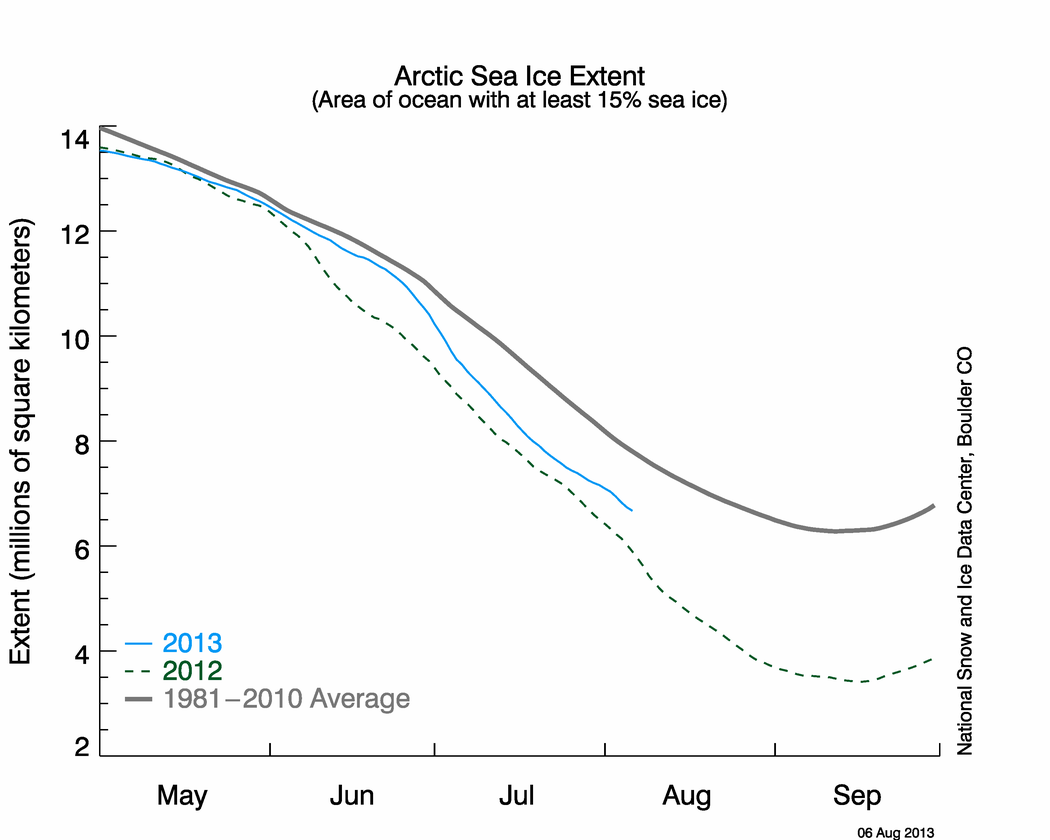
The four major ice extent indices continue to diverge.

Another interesting observation is that JAXA has changed their graphs. They used to show a weird little bump on June 1 of every year.

JAXA May 2 graph
But that bump has disappeared.

http://www.ijis.iarc.uaf.edu/seaice/extent/AMSRE_Sea_Ice_Extent.png

I hope the Polar bears aren’t disappointed at the loss of their little June 1 mogul. NSIDC anomalies can be seen below in the modified NSIDC map. The Alaska side has above normal sea ice and the Greenland side has below normal sea ice.

This is a reflection of ocean temperatures, which are below normal in the North Pacific, and above normal near Greenland.

http://weather.unisys.com/surface/sst_anom.html
We are still about six weeks away from anything interesting happening in the Arctic. Stay tuned.
Here’s the Sea Surface Temps:
http://weather.unisys.com/surface/sst.html
Are we off to sunny Greenland yet? Who wants to be a Viking?
Joe Bastardi says the green (warmth) in the ocean temperature that is heading west of Africa all the way to the Caribbean is going to cause a couple of heavy hurricanes in the USA Gulf this year.
stevengoddard says:
May 23, 2010 at 2:05 pm
Low concentration ice in the Arctic Basin is due to shear stresses on the ice. Temperatures are still too cold for any significant melt to be happening.
Could you do a post just on “shear stresses” that explains it more?
kadaka,
I must admit that scary chart is as good as the debunked Mann chart. I would like to see a chart of the Antarctic using the same axes. But since the percentage rate of increasing Antarctic ice is greater than the percentage loss in the Arctic, they’re not allowed to show the same graph for the Antarctic according to the rules of globaloney.
Of course the scary chart is showing purported ice volume, which at this point is tricky and more or less a WAG. Going simply by area, this shows the difference between the Arctic and Antarctica. It also shows that what is happening in the Arctic is a regional climate effect, not a global effect.
jeff brown asks:
May 23, 2010 at 3:57 pm
“Why did you not discuss how quickly the ice has been declining this month?”
And I ask: Why is Arctic ice currently declining faster than the average over the past 30 years? Is it because of a 0.6° global temperature rise over the past century? In other words, is it due to global warming? Or more precisely, to human CO2 emissions?
Thanks for that update Steve. I was wondering how you were going to characterize the past few weeks of arctic sea ice melt. Interesting to see your perspective, and how different it is from mine.
Here’s an alternate perspective:
Based on the JAXA data, 2010 seems to be experiencing an early start to the real heart of the melt season. Note especially the steep SLOPE of the 2010 melt in the last few weeks, as it crosses the slopes of 2008, 2009, 2007, 2003, & 2005.
http://www.ijis.iarc.uaf.edu/en/home/seaice_extent.htm
Currently, the majority (10 out of 14) the major ice basins in the arctic are showing some level of negative anomaly, with the remainder essentially right at normal. The Barantz Sea has been very negative for quite some time, and now that melt seems to be moving over to the Kara and Laptev Seas:
http://arctic.atmos.uiuc.edu/cryosphere/IMAGES/recent365.anom.region.7.html
http://arctic.atmos.uiuc.edu/cryosphere/IMAGES/recent365.anom.region.8.html
In the past 2 weeks we’ve gone from a 500,000 sq. km negative sea ice anomaly to now well over 900,000 sq. km, and actually very close to 1,000,000 sq. km.
http://arctic.atmos.uiuc.edu/cryosphere/IMAGES/seaice.recent.arctic.png
This week, temperatures above the arctic circle, in Alaska are projected to reach record highs toughing 90 degrees F:
http://www.weather.com/outlook/travel/businesstraveler/tenday/99781?par=Google&site=earth.google.com&promo=0&cm_ven=bd_select&cm_cat=Google&cm_pla=earth.google.com&cm_ite=map
Here’s an alternative, (and quite accurate) rendering of current arctic sea ice conditions that many of you may not have seen before:
http://iup.physik.uni-bremen.de:8084/amsr/arctic_AMSRE_visual.png
Note especially the areas of open water near Siberia and over N. of Alaska. These open areas are not picked up or measure on some products.
In terms of Arctic (and Global Temps), this chart tells the story:
http://iridl.ldeo.columbia.edu/maproom/.Global/.Atm_Temp/Anomaly.html
It’s been warm all along and around the Arctic this past month. Temps well above normal. We’ve got a long melt season ahead, and anything can happen, but if current trends continue, 2010’s summer minimum will easily be lower than 2008 or 2009, and may even give the 2007 record low a run for the money.
Finally, though I know some of you think think the PIOMAS model is not to be taken seriously, (but I’ve not yet heard your reasons why), I think it is very valuable to refer to it anytime you’re giving a full Arctic Sea ice update:
http://psc.apl.washington.edu/ArcticSeaiceVolume/images/BPIOMASIceVolumeAnomalyCurrent.png
Volume is ultimately what determines melting. Thin ice melts fast (as we saw when all the new March “bump up” ice melt away and return the Bering Sea to normal. But the warm winter (in the Arctic) really did have an impact on how thick the ice could get, and as the chart above shows, the volume of sea ice in the Arctic continues to show a very negative anomaly.
WABC Sunday Evening News, May 23, 2010, just ran a story comparing climate skeptics to white supremacists.
Climate Scientists Claim ‘McCarthy-Like Threats,’ Say They Face Intimidation, Ominous E-Mails
http://abcnews.go.com/WN/Media/climate-scientists-threat-global-warming-proponents-face-intimidation/story
The story which broadcast this Sunday evening included screenshots from a racist website. We need to get this evening’s video recording. The above link is not quite the same story but many of the elements are the same. Start making backups of everything before they start rewriting history again. The number of lies in the report are truly unbelievable.
Michael Ronayne
Sorry bad link:
Climate Scientists Claim ‘McCarthy-Like Threats,’ Say They Face Intimidation, Ominous E-Mails
http://abcnews.go.com/WN/Media/climate-scientists-threat-global-warming-proponents-face-intimidation/story?id=10723932
Mike
Oops, almost forgot, here a link to an excellent (and very technical article) as to why warming temps may actually increase sea ice in Antarctica:
http://psc.apl.washington.edu/zhang/Pubs/Zhang_Antarctic_20-11-2515.pdf
The nice thing about this arcticle is that is has nothing to do with the ozone depletion, as some other theories do. Feedback is most welcome!
Philip
It might just be fraud and needs investigating
Here is the full text of the report as of 8:08PM EST May 23, 2010. Read the feedback to ABC News.
Climate Scientists Claim ‘McCarthy-Like Threats,’ Say They Face Intimidation, Ominous E-Mails
http://abcnews.go.com/WN/Media/climate-scientists-threat-global-warming-proponents-face-intimidation/story?id=10723932
Global Warming Denier Says His Side Gets Threats, Too
By DAN HARRIS and CHRISTINE BROUWER
May 23, 2010 —
Climate scientist Michael Mann says he has received hundreds of them — threatening e-mails and phone calls calling him a criminal, a communist or worse.
“6 feet under, with the roots, is were you should be,” one e-mail reads. “How know 1 one has been the livin p*ss out of you yet, i was hopin i would see the news that you commited suicide, Do it.”
“I’ve been called just about everything in the book,” Mann, who runs of the Earth System Science Center at Penn State University, told ABC News. “It’s an attempt to chill the discourse, and I think that’s what’s most disconcerting.”
Mann is not the only one. The FBI says it’s seeing an uptick in threatening communications to climate scientists. Recently, a white supremacist website posted Mann’s picture alongside several of his colleagues with the word “Jew” next to each image.
One climate scientist, who did not wish to be identified, told ABC News he’s had a dead animal left on his doorstep, and now sometimes travels with bodyguards.
“Human-caused climate change is a reality,” Mann said. “There are clearly some who find that message inconvenient, and unfortunately they appear willing to turn to just about any tactics to try to suppress that message.”
Scientists See Political Campaign by Senator
Many climate scientists, however, say the most disturbing recent example of what they call intimidation is not anonymous hate mail.
Rather, they point to a governmental report released in February by Sen. James Inhofe, R-Okla., one of the most vocal climate skeptics in office, which names 17 climate scientists and argues some of them may have engaged in “potentially criminal behavior.”
Inhofe’s report referred to an incident late last year known as “Climate Gate,” in which e-mails hacked from computers at the University of East Anglia in Britain gave the impression some climate scientists may have been trying to hide flaws in their research. Several subsequent investigations have exonerated the scientists’ work.
One section of Inhofe’s report outlined the laws the scientists may have violated, including the Federal False Statements Act, which the report noted could be punishable with imprisonment of “not more than five years.”
Climate Scientist: ‘Modern-Day McCarthyism’
“It’s reminiscent of other periods in American history,” Gavin Schmidt, a NASA climatologist named in Inhofe’s report, told ABC News. “People were smeared not on the basis of anything they did but just by powerful people seeming to … insinuate that they’ve somehow done something wrong.”
Mann agreed.
“Some of the attacks that are being made against climate scientists smack of modern-day McCarthyism,” he said.
Inhofe: ‘The Public Needs to Know’
Inhofe refused to grant ABC News an interview, citing the network’s previous coverage of climate change. But in a statement, he said: “One of the most basic principles of good science is openness and transparency. … As the climate e-mail controversy revealed, it appears some of the taxpayer-funded science used to advance cap-and-trade legislation is being hidden from public view. … The public needs to know whether the research they fund is reliable, objective, and easily accessible.”
Marc Morano, who used to be Inhofe’s spokesman and is now one of the most vocal climate skeptics in the country, told ABC News that the skeptics have been getting threats for years.
“No one is advocating violence,” Morano said, “but it is refreshing to see these scientists hear from the public. When you go to a used-car salesman and you get conned … you don’t go back to the used-car dealer all happy and pleasant. You have a lot of anger, and that’s what these scientists are appropriately feeling.”
Gavin Schmidt of NASA dismissed the idea that climate change is a hoax.
“It’s nonsense,” Schmidt said. “Scientists are hyper competitive. … The idea that you could fool all of these people or get them to just buy into some global conspiracy, is laughable.”
Many scientists say the harassment they endure stifles scientific discovery and progress.
“Good scientists just go where the evidence takes them,” said Peter Gleick, a hydro-climatologist and president of the Pacific Institute. “The idea that they would be limited by politicians in what they can evaluate or study or say, is anathema to them.”
Scientists Issue Public Letter
Gleick, along with 254 other members of the National Academy of Sciences, recently signed a public letter calling for an end to the intimidation of climate scientists.
“Many recent assaults on climate science, and, more disturbingly, on climate scientists by climate change deniers, are typically driven by special interests or dogma, not by an honest effort to provide an alternative theory,” read the letter, which was published in Science magazine earlier this month.
“We … call for an end to McCarthy-like threats of criminal prosecution against our colleagues based on innuendo and guilt by association, the harassment of scientists by politicians seeking distraction to avoid taking action, and the outright lies being spread about them,” the letter continued.
Gavin Schmidt of NASA said attacks are meant to keep scientists from speaking out about climate change in public.
“They’re trying to dissuade people from being involved in the public discussion about what this means and what we can do to prevent it,” he said. “I think people who care about the integrity of science in this country should find that worrying.”
Artic´s behaviour is becoming suspicious, it is showing some “conservative” tendencies when trying to preserve its own ice.
Michael Ronayne,
So, in addition to being compared with Holocaust deniers, those who are merely skeptical of the CAGW conjecture are now being compared with white supremacists?? Can comparisons with child molesters be far behind?
People sure go off the deep end when their gravy train is threatened.
It reminds me of Johnny Cochran’s frank admission after he successfully defended O.J. Simpson: “We played the race card, and we dealt it from the bottom of the deck.”
Maybe there should be a corollary to Godwin’s Law: Cochran’s Law, stating that the first one to refer to skeptics as deniers or racists loses the debate.
stevengoddard says:
May 23, 2010 at 2:05 pm
Low concentration ice in the Arctic Basin is due to shear stresses on the ice. Temperatures are still too cold for any significant melt to be happening.
http://www.esrl.noaa.gov/psd/map/images/fnl/sfctmp_01.fnl.gif
_________________________________________________________________________
Steve, do you know what is happening with the ocean temps and the wind up there. I would expect that has a lot more to do with ice melt than the air temp, especially at this time of year.
TheArctic Oscillation is still negative but certainly not as negative as in mid winter. The North Atlantic Oscillation has also head back to a more neutral state. Anthony discusses what effect this has on the Arctic Sea Ice and N.H. weather in this article.
If Anthony is correct a negative Arctic Oscillation shoves cold air into the lower latitudes which explains why California has record breaking cold this month and we saw 35F here in North Carolina a few days ago. It also means the winds in the Arctic are less strong and the Arctic Stratosphere is warmer as shown in this illustration from NSIDC by J. Wallace, University of Washington
Therefore I am assuming the loss of Arctic sea ice is probably due to the hot spot in the Atlantic ocean between Canada and Greenland. It is running close to three degrees higher than the norm.
One area that is completely neglected is volcanic activity in the ocean. It seems there is a heck of a lot more going on than we think.
“…If you sought to delve into the forces that drive and shape the face of the earth and that distinguish it from all other planets in our solar system, you would shine a spotlight on the mid-ocean ridges.
This—75,000 kilometer (45,000 miles) long—volcanic mountain chain bisects the seafloor and wraps around the entire globe. It is the site where magma continuously erupts to create new crust. As the crust spreads out on both sides of the ridges, it paves the surface of the planet and sets in motion the tectonic forces that cause continents to rip apart and collide, and oceans to open and close.
This planetary extravaganza, full of fury and sound, is accompanied by a constant drumbeat of earthquakes and volcanic eruptions. But the oceans act like a great blue curtain, completely shrouding our view and muting the sound. About 80 percent of all volcanic and earthquake activity on Earth occurs on the seafloor…” Hydrophones reveal a whole lot of previously undetected seafloor shaking: Woods Hole Oceanographic Institution 2004
Smokey says:
May 23, 2010 at 4:52 pm (Something about Antarctic ice volume)
Antarctic ice has a much larger melt/freeze cycle, with much less ice remaining at the end of the melt (and in about the same place), so volume really isn’t such an issue there.
tax-payer-funded ABC already has this story up, in a piece called “Carbon dioxide affecting coral growth”. in other words, both pieces give the impression results are in, but this lengthy article – read it all – suggests otherwise. goes off at length into “ocean acidification”. BBC already there!!
24 May: SydneyMorningHerald, Australia: Underwater lab the first to plot impact of climate change on reefs
by Jo Chandler
ON AN idyllic coral atoll just a two-hour boat ride from Queensland’s Gladstone Harbour, out past the endless line of tankers queued to load coal for export, a half-dozen scientists work frantically against the tide.
Their objective? To explore the consequences of rising atmospheric carbon – which evidence overwhelmingly attributes to the burning of coal and other fossil fuels – on the delicate chemistry of the reef and the creatures living there.
The project team, led by David Kline, a young scientist from the University of Queensland’s Global Change Institute, is completing tests on a new underwater laboratory that will expose living corals on the Great Barrier Reef to the more acidic conditions forecast for oceans by the end of the century…
”This system here is the heart of the experiment,” Dr Kline explains to a film crew from the BBC natural history unit as he stands in the shallows, patting his hand on a floating platform loaded with pumps, cables and 50 instruments, all in constant conversation with ”the brains” – a computer program running in a laboratory a few metres away on shore.
International interest is high because this is the first in situ investigation of its type. Findings from the Free Ocean Carbon Enrichment (FOCE) project will be keenly studied by scientists around the world…
http://www.smh.com.au/environment/climate-change/underwater-lab-the-first-to-plot-impact-of-climate-change-on-reefs-20100523-w3z7.html
R. Gates says:
May 23, 2010 at 5:07 pm
Oops, almost forgot, here a link to an excellent (and very technical article) as to why warming temps may actually increase sea ice in Antarctica:
http://psc.apl.washington.edu/zhang/Pubs/Zhang_Antarctic_20-11-2515.pdf
The nice thing about this arcticle is that is has nothing to do with the ozone depletion, as some other theories do. Feedback is most welcome!
===============
Last I heard, the discussion was about CO2.
R. Gates says: May 23, 2010 at 5:07 pm
“Oops, almost forgot, here a link to an excellent (and very technical article) as to why warming temps may actually increase sea ice in Antarctica:
http://psc.apl.washington.edu/zhang/Pubs/Zhang_Antarctic_20-11-2515.pdf
The nice thing about this arcticle is that is has nothing to do with the ozone depletion, as some other theories do. Feedback is most welcome!”
Interestingly, the article you cite is by the same Dr. Jinlun Zhang who is responsible for the garbage Arctic Sea Ice Volume chart and supporting model that kadaka (KD Knoebel) May 23, 2010 at 4:19 pm posted above:
“Before someone whips out the terrifying Arctic Ice Volume Anomaly chart that tells THE REAL STORY, please note the following:
http://psc.apl.washington.edu/ArcticSeaiceVolume/images/BPIOMASIceVolumeAnomalyCurrent.png”
If you look here:
http://psc.apl.washington.edu/ArcticSeaiceVolume/IceVolume.php
you can see how Dr. Zhang voodooed up that garbage.
Here’s his bio:
http://psc.apl.washington.edu/people/staff_pages/Zhang_Jinlun/home.php
It appears that Dr. Jinlun Zhang is one of the Warmist’s point people for producing misleading research reports on sea ice. I wonder if Dr. Zhang has received any public funds that would justify an investigation into his methods…
R. Gates,
You should just quit using the Polar Science Centre PIOMAS ice volume chart because the math does not work with it. You can figure out on your own why it doesn’t.
And your much touted Zhang Polar Science Centre researcher had one of the worst predictions for last year’s ice extent (along with the other PSC scientists which all tied for third worst – even the highest forecast from the Canadian Ice Service was low by 10% – Zhang by 30% .)
http://www.arcus.org/search/seaiceoutlook/2009_outlook/full_report_june.php
Here’s more detail on Zhang’s model:
http://psc.apl.washington.edu/zhang/Global_seaice/model.html
“Satellite sea ice concentration data are assimilated in GIOMAS using the Lindsay and Zhang (2005) assimilation procedure. The procedure is based on “nudging” the model estimate of ice concentration toward the observed concentration in a manner that emphasizes the ice extent and minimizes the effect of observational errors in the interior of the ice pack.”
WTF is “nudging”?
Here’s where Dr. Jinlun Zhang got the funds to support his adventures in “nudging”:
http://psc.apl.washington.edu/zhang/Global_seaice/ack.html
Bill, it’s’ curious that the PIOMAS model estimates did pretty well during the ICESat era. Given the in situ observations of the ice cover and the current rapid decline, it’s more likely than not that PIOMAS volume estimates are close to reality.
When the ice cover plummets again this summer perhaps then you’ll realize that the ice is indeed on “thin ice”
If temperatures in the Arctic are below freezing, is ice melt really happening, or is ice leaving the Arctic through the various straits? Having just flown over the strait between Greenland and Iceland–a diversion courtesy of the unpronounceable volcano–I can tell you from first hand observation that quite a lot of ice is flowing through that strait. There was so much ice that the currents were very visible.
Just The Facts says:
May 23, 2010 at 5:58 pm Actually Zhang has been known to investigate sea ice links to natural variability. Just do a google search on his articles related to sea ice loss. Before you start spouting off, you may want to check your facts.
JK says:
May 23, 2010 at 5:27 pm
Smokey says:
May 23, 2010 at 4:52 pm (Something about Antarctic ice volume)
Antarctic ice has a much larger melt/freeze cycle, with much less ice remaining at the end of the melt (and in about the same place), so volume really isn’t such an issue there.
Smokey, you don’t seem to realize that Antarctic sea ice is a seasonal ice cover, most of it melts out every summer. This is the direction the Arctic ice cover is heading towards…
nedhead,
You don’t seem to realize what “global” means. If there is diminishing Arctic ice, but Antarctic ice is the same as usual, then the Arctic is simply showing local climate effects.
The question is about global warming [or cooling], not about local variability; that happens all the time, and in this case the Arctic will eventually revert to the mean, as it always does.
nedhead says: May 23, 2010 at 6:49 pm
“Just The Facts says:
May 23, 2010 at 5:58 pm Actually Zhang has been known to investigate sea ice links to natural variability. Just do a google search on his articles related to sea ice loss. Before you start spouting off, you may want to check your facts.”
Google? I posted Zhang’s bio above:
http://psc.apl.washington.edu/people/staff_pages/Zhang_Jinlun/home.php
which lists all his papers through 2008.
Here are few examples of his work:
“Zhang, J., R.W. Lindsay , M. Steele, and A. Schweiger, What drove the dramatic retreat of Arctic sea ice during summer 2007? Geophys. Res. Lett., 35, L11505, doi:10.1029/2008GL034005, 2008.”
Dramatic indeed…
“Serreze, M. C., A. P. Barrett, A. G. Slater, M. Steele, J. Zhang, and K. E. Trenberth, The large-scale energy budget of the Arctic, J. Geophys Res., 112, D11122, doi: 10.1029/2006JD008230, 2007.”
Collaborating with Trenberth and Serreze, nuff said…
“Lindsay, R. W. and J. Zhang, The thinning of arctic sea ice, 1988–2003: have we passed a tipping point? J. Climate, 18, 4879–4894, 2005.”
A tipping point, why yes, it seems that you’ve sold out your scientific objectivity and are now officially a Warmist advocate…
Who care’s if some of Dr. Jinlun Zhang papers explored natural variability? Zhang appears to be a source a Warmist propaganda, and a few potentially legitimate papers in no way negates that…