By Steve Goddard
The Arctic is still running well below freezing, and as a result there just isn’t much happening, except for an odd discrepancy that has developed between NSIDC and NORSEX related to the 2007 extent. Read on.
The animation video above (generated from UIUC images) shows the entire month of May to date, and as you can see we have yet to see any melt in the Arctic Basin.

http://ocean.dmi.dk/arctic/meant80n.uk.php
The little melt which has occurred since the winter peak has been at lower latitudes, as can be seen in red in the modified NSIDC map below.

The equivalent map below shows changes over the last week. Melt is proceeding very slowly.

The animation below shows Arctic temperatures over the last month. Note that they have alternated between a little above normal and a little below normal. The video was generated from NOAA maps.
More interesting is what is going at the South Pole. GISS says the South Pole has been cold, while NOAA says the South Pole has been hot.

GISS April Antarctica
NOAA almost always shows the South Pole hot for some reason. Temperatures in Vostok averaged -90F in April and a balmy -85F so far in May. It only needs to warm up another 117 degrees to start Hansen’s Antarctic meltdown.
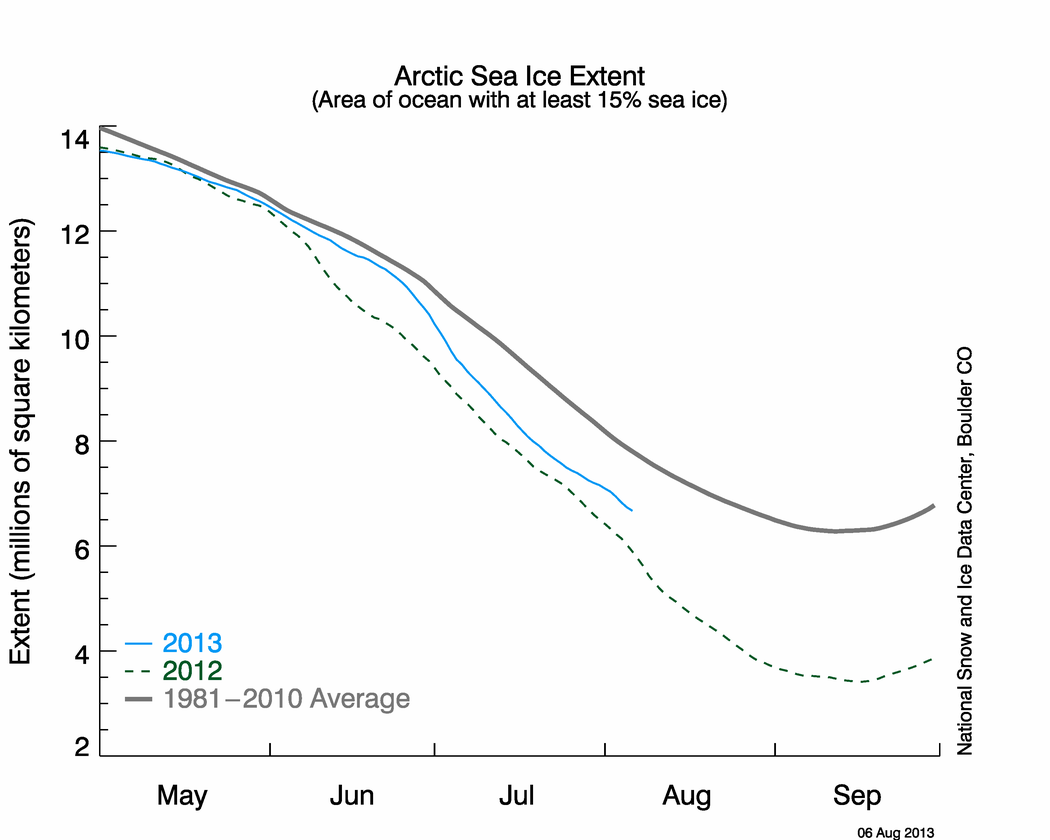
This time of year there is almost no year over year variation in extent, as can be seen in the DMI graph below.

http://ocean.dmi.dk/arctic/icecover.uk.php
What is interesting is that NORSEX shows 2010 extent well above 2007, while NSIDC shows it below 2007.

http://arctic-roos.org/observations/satellite-data/sea-ice/observation_images/ssmi1_ice_ext.png


http://nsidc.org/data/seaice_index/images/daily_images/N_timeseries.png
The four major ice extent indices continue to diverge.

Another interesting observation is that JAXA has changed their graphs. They used to show a weird little bump on June 1 of every year.

JAXA May 2 graph
But that bump has disappeared.

http://www.ijis.iarc.uaf.edu/seaice/extent/AMSRE_Sea_Ice_Extent.png

I hope the Polar bears aren’t disappointed at the loss of their little June 1 mogul. NSIDC anomalies can be seen below in the modified NSIDC map. The Alaska side has above normal sea ice and the Greenland side has below normal sea ice.

This is a reflection of ocean temperatures, which are below normal in the North Pacific, and above normal near Greenland.

http://weather.unisys.com/surface/sst_anom.html
We are still about six weeks away from anything interesting happening in the Arctic. Stay tuned.
It looks to me as if NSIDC ice data for the Baltic sea is lagging some weeks behind. Last week they still showed ice on the Gulf of Finland when there in reality was absolutely none. Now they show ice in the bay of Riga, where there is none. The only ice in the Baltic today is in the northernmost gulf of Bothnia. The Baltic has intense shipping all year and ice reports are available in great detail. Google Baltice or Finnish Meteorological Institute for example.
Have no clue why NSDIC seems to exaggerate our ice cover more often than not, this is just an observation from on site…
There’s a wild card operating this year, and that is Icelandic volcanism.
My assessment is that low-albedo particulate deposition, be it anthropogenic soot or natural ash, is going to come to be seen as an extremely powerful factor in Arctic ice meltback as we learn more about the cycle. Just as such particulates are now realized to be important in Himalayan glacial recession.
So far, Eyjafjallajökull has sent most of its ash southward, but it’s clear if you look at a map that a fair percentage of the remaining ash is falling out over Arctic ice margins.
If the far larger Katla erupts, and eruptions of Eyjafjallajökull are reliably prodromal for Katla, all bets are off.
The SacBee report:
http://www.sacbee.com/2010/05/23/2771182/its-not-your-imagination-coldest.html
Now we’re messing with the brutality of the 1971 cold….and records are dropping.
Another discrepancy:
I check out the NSIDC extent map and chart every day or so, and what I can’t understand is that the gap between the ice extent shown on the maps (vis a vis the 1979-2000 average they show) appears to have narrowed over May while the gap between the two on the chart has widened progressively. I recognize that my visual ‘take” on the map is hardly an exact scientific measurement, but it seems pretty clear that the gap in extent as shown on the map has not widened by anything like the numbers shown on the chart. Perhaps the gap hasn’t in fact narrowed on the map, but it has most certainly NOT widened. Perhaps the numbers used for the chart are generated by some algorithm that doesn’t just count the number of pixels shown on the ice extent map? Perhaps there is some other explanation. But it you just eyeball the “above average” areas that are coded white and apply them against the “below average” areas that blue, the delta with the overall average has not been increasing sharply the way the delta is presented on the graph.
Has anyone else observed the same thing? or do I need a new set of eyeballs?
OT:
“Climate change concern declines in poll
Only 62% of Britons interested in subject, down from 80% in 2006, according to YouGov survey”
http://www.guardian.co.uk/environment/2010/may/23/climate-change-interest-yougov-survey
No link to the actual questions but it was commissioned by EDF, a power company who slather every ad break in the UK with nauseating commercials banging on about how “green” they are. Lots of shots of happy families prancing under windmills et. al.
The other major point of the survey though, how people are becoming more relaxed about nuclear power is more potentially self-serving. It may well be true, but EDF, as front-runners for building any new stations are hardly unbiased.
Maybe they are hedging their bets for if/when the whole green power thing stalls.
Low concentration ice in the Arctic Basin is due to shear stresses on the ice. Temperatures are still too cold for any significant melt to be happening.
http://www.esrl.noaa.gov/psd/map/images/fnl/sfctmp_01.fnl.gif
Flew back from Beijing to New York yesterday, which takes you within about 1,000 miles of the North Pole. Everything looked pretty solidly frozen up in the arctic, at least as much as I could see (there was a lot of cloud cover).
Also, WUWT appears to be blocked in China. I couldn’t raise the website at my hotel, although I was able to access most of those sites I usually visit.
Size matters.
=======
Answered my own question, Antarctic sea ice extent up:
http://arctic.atmos.uiuc.edu/cryosphere/IMAGES/seaice.recent.antarctic.png
He recounts sailing through degraded ice in an icebreaker. The ship’s top speed in open water was 13.7 knots. Its speed through the decayed ice was 13 knots.
“It was almost like it didn’t exist.”
——-
….something tells me that these guys just LOVE crunching through that ice in their icebreakers! If they’d cut that stuff out, maybe the ice could consolidate more? I mean really….Arctic vandalism!
Oh yeah, definitely OT….GO CHICAGO BLACKHAWKS!
“harrywr2 says:
May 23, 2010 at 1:13 pm
OT
Humans caused global cooling 12,000 years ago by killing methane belching woolly mammoths.
http://content.usatoday.com/communities/sciencefair/post/2010/05/mammoth-extinction-triggered-climate-cooling/1
”
I expected onion style spoof news there but it’s written as if it were “real” research. What am i missing? Is it so that they just get away with anything these days? Is it the Zucker-Abrahams-Zucker institution of climate research?
Brad says: May 23, 2010 at 2:32 pm
“Answered my own question, Antarctic sea ice extent up:
http://arctic.atmos.uiuc.edu/cryosphere/IMAGES/seaice.recent.antarctic.png ”
You can also see NSIDC’s Antarctic sea ice chart here;
http://nsidc.org/data/seaice_index/images/daily_images/S_stddev_timeseries.png
and this is Global Sea Ice Area from Cryosphere Today:
http://arctic.atmos.uiuc.edu/cryosphere/IMAGES/global.daily.ice.area.withtrend.jpg
The equivalent map below shows changes over the last week. Melt is proceeding very slowly.
But much faster than usual at this time of year, ~70,000 km^2/day during May.
About 1.6x the average of previous May to this date (JAXA) and 1.3x last year’s May.
Philip Marston says:
May 23, 2010 at 1:48 pm
Another discrepancy:
I check out the NSIDC extent map and chart every day or so, and what I can’t understand is that the gap between the ice extent shown on the maps (vis a vis the 1979-2000 average they show) appears to have narrowed over May while the gap between the two on the chart has widened progressively. I recognize that my visual ‘take” on the map is hardly an exact scientific measurement, but it seems pretty clear that the gap in extent as shown on the map has not widened by anything like the numbers shown on the chart. Perhaps the gap hasn’t in fact narrowed on the map, but it has most certainly NOT widened. Perhaps the numbers used for the chart are generated by some algorithm that doesn’t just count the number of pixels shown on the ice extent map?
That map is very low resolution, take a look at the Nares strait between Ellesmere Island and Greenland, according to that map it’s full of ice, however JAXA and CT show it as open water. It is open water and has been for some time just like it was in 2007, allowing multiyear ice to drift south into Baffin bay.
For an image see here:
http://rapidfire.sci.gsfc.nasa.gov/realtime/single.php?2010143/crefl2_143.A2010143112000-2010143112500.500m.jpg
At the top of this image you’ll see a large open water polynya along the Eurasian coast, can’t be seen in lo-res:
http://rapidfire.sci.gsfc.nasa.gov/realtime/single.php?T101431050
Similarly off Barrow, Hudson Bay and Banks Island.
If you want a better idea of where it’s melting look at CT or JAXA.
http://iup.physik.uni-bremen.de:8084/amsredata/asi_daygrid_swath/l1a/n6250/2010/may/asi180-n6250-20100520_nic.png
Chris Thorne says:
May 23, 2010 at 1:18 pm
There’s a wild card operating this year, and that is Icelandic volcanism.
So far the ash has been the sort that clogs up jet engines, not the sort that darkens ice.
Etudiant, much of the Arctic melt is not melt so much as currents and wind pushing the ice out of the Arctic Basin into warmer waters in the North Atlantic.
Ice extent declines because the ice is no longer there. Usually, there are limited egress points for the ice, as the ice is in large enough pieces to block certain straits. In 2007, the ice was broken up enough from the Beaufort Gyre and other currents to pass through areas that in the past have been bottlenecks.
JDN says: “All you can get is these highly processed low resolution maps that are useless for checking on the differences of methodology & comparing it to reality.”
Try the satellite photos, to really eye-ball it:
http://ice-map.appspot.com/
I would like to know what’s up with all the holes along the coasts around the Arctic Basin.
If you go to the satellite photos, pull down the calendar and click on the 23rd, you can see a beautiful clear image of Iceland, and can zoom into it.
http://ice-map.appspot.com/
I am very surprised by this blog post. I don’t know why Steve does not want to admit that the ice extent has dropped below 2007 and that it is tied with 2006. This is according to both the NSIDC and the AMSR-E data from Bremen. AMSR-E is the highest resolution sea ice data out there and provides the most accurate information out of all the other estimates based on SSM/I data (which is what NORSEX and NSIDC
rely on). Steve, why don’t you grab a MODIS image off of the MODIS rapid fire start and compare the ice edge from that to the NSIDC sea ice concentration fields. Or, use the MODIS sea ice extent product archived by NSIDC and compare that with the sea ice concentration fields from all the institutes. What you will find is that the NORSEX algorithm is underestimating the current ice extent.
I am also surprised that you don’t mention the rate of decline and how that compares to previous years.
And Steve you are incorrect that the surface of the ice has not started to melt. You can see this clearly in the sea ice concentration images (low ice concentration implies either open water or melt), and the MODIS images which clearly show melt on the sea ice (note the flooded areas in the MODIS images).
And for the person who asked by NSIDC images show more ice than there actually is, this is common for regions along the coast because of coastal contamination in those pixels. Whether will also sometimes cause the algorithm to “see” ice when in fact there is none.
JK says:
May 23, 2010 at 3:30 pm
I would like to know what’s up with all the holes along the coasts around the Arctic Basin.
Polynyas, ice blown off shore replaced with water from under the ice. Much more evident than this time last year, more extensive than 2007 even:
http://iup.physik.uni-bremen.de:8084/amsredata/asi_daygrid_swath/l1a/n6250/2007/may/asi-n6250-20070521-v5_nic.png
http://iup.physik.uni-bremen.de:8084/amsredata/asi_daygrid_swath/l1a/n6250/2010/may/asi180-n6250-20100521_nic.png
Steve wrote: The little melt which has occurred since the winter peak has been at lower latitudes, as can be seen in red in the modified NSIDC map below.
What a strange thing to say. Of course it melts first at lower latitudes, it always does. That is how it works, the temperatures rise at the lower latitudes first and spreads further north as summer progresses and temperatures rise.
Why did you not discuss how quickly the ice has been declining this month? Also, linking to the DMI graph and saying there is little variability at this time of year (while that tends to be true) is deceiving since you are only looking at the years when AMSR-E data have been available. Why not show the full passive microwave time series? Why be selective rather than using all observational data available?
John Egan says:
May 23, 2010 at 11:45 am …
Your post confuses me. Being a liberal, are you upset because he goes along with Mr. Bastardi? “I think it’s quite possible,” said Mark Serreze, making a very tentative statement – maybe because Joe is making a much more solid prediction that we will be very low?
Then again, what does he have to do with either “Bush’s Labor Department or Hansen’s NASA-GISS”?
You can get a nice clickable mosaic of the whole Arctic from the Modis satellites here. [Click “prev” to get a complete mosaic for the previous day. You can click on and zoom-in on any area (down to 250M resolution) or get the alternative band which shows ice as orange].
http://rapidfire.sci.gsfc.nasa.gov/subsets/?mosaic=Arctic
NASA’s World Wind 1.4 shows an amazing amount of snow coverage above the 49th parallel in the Northern Hemisphere.
Commensurate with slow ICE loss in the Arctic.
Svensmark WILL be vindicated!
The ice plots have had a couple of weird bumps. Somewhere I read that they are where the processing algorithm is changed each year. Something to do with reflectivity of ponded water on the ice, or something like that. But I thought the June glitch was June 15th, not June 1. The other bump (in October ??) isn’t generally as visible as the June bump.
Perhaps someone with solid knowledge in this area can educate us.
REPLY: These are recalibrations to handle meltwater ponding on the surface of the ice. This confuses the microwave sensor. It is done every year. -A
Before someone whips out the terrifying Arctic Ice Volume Anomaly chart that tells THE REAL STORY, please note the following:
Souce page of the chart:
Home page, “News and Noteworthy” section:
The actual chart was last updated May 13, now ten days ago, when it showed a sudden and steep decline. Since then they have missed about 2 to 4 updates per the posted scheduling (which depends on data availability).
So what happened with PIOMAS? Did the model break?