There’s a lot of interest in the blogosphere in sea ice, and the leading authority, NSIDC, only updates one a month. Yet when we reach things like peak ice, or minimum ice, we often find those occur at times when there’s no input from that organization, or others for that matter. So every week, we’ll offer a summary of sea ice news. Of course if something interesting happens, like the Arctic Sea ice line from NSIDC crosses the normal line, we’ll cover that when it happens.
This new feature gives readers a chance to submit artwork to be used as a header graphic if they wish. For example, the Quote of the Week graphic was provided by WUWT reader “Boudu”. If you have graphical skills and ideas, feel free to post them up to tinypic.com or photobucket etc and provide a link in comments below. – Anthony
WUWT Sea Ice News by Steven Goddard
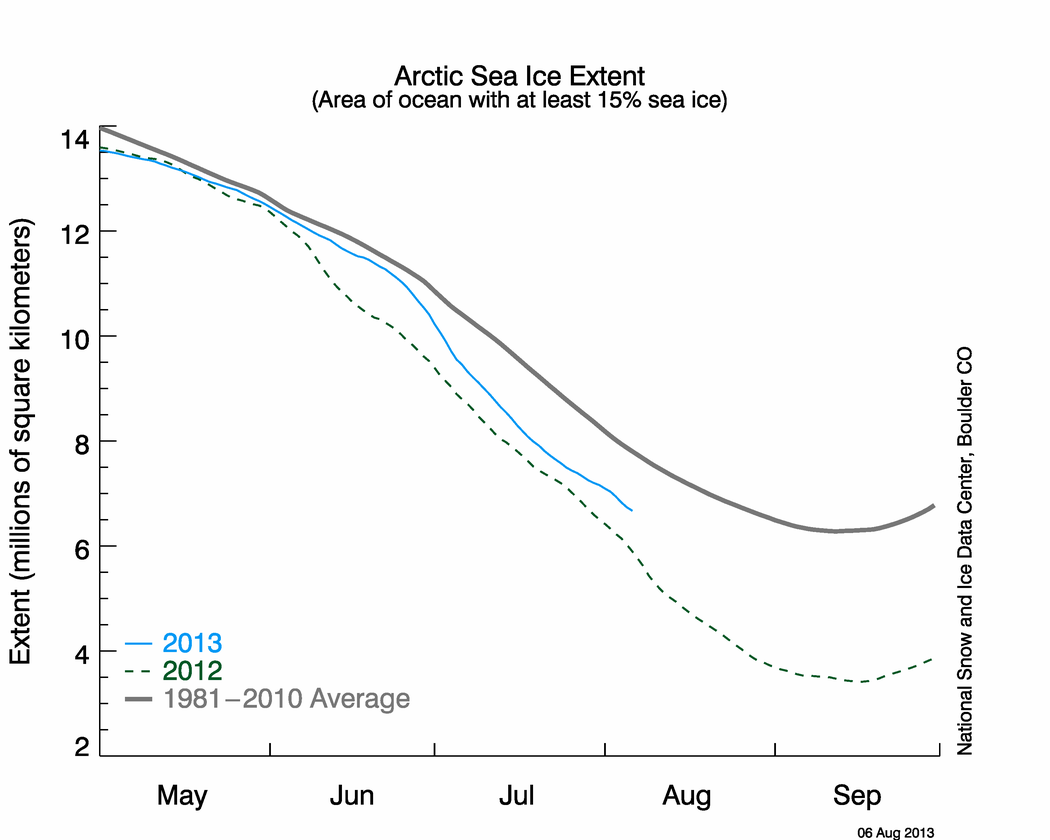
Al Gore calls it global warming. Bill Clinton calls it springtime. Others call it a death spiral, tipping point, or point of no return. Whatever you call it, the Arctic has started to melt and has lost about a million km2 of ice since the peak. The NSIDC graph below does not hide the decline.

http://nsidc.org/data/seaice_index/images/daily_images/N_timeseries.png
I just measured today’s NSIDC sea ice. It has passed the median line, though would require several similar days to appear in their moving average graph.


The image below shows where ice has melted and grown during the past 12 days. Areas in red have declined, and areas in green have increased in extent.

The decline in Bering Sea ice is due to much warmer air that has arrived this week. The sea of Okhotsk remains very cold and has gained some ice near the north end.

http://www.esrl.noaa.gov/psd/map/images/fnl/sfctmpmer_01a.fnl.anim.html
Sea ice remains nearly one million km2 ahead of 2007, and the map below shows where ice has gained and been lost relative to 2007. Green is growth, red is decline.

The map below shows areas of excess and deficient ice relative to the median. Green shows excess ice and red shows deficient. As of today, there is more excess ice than deficient ice. NSIDC uses a moving average, so it would take several days of similar conditions for it to show up in their graphs.

Five years ago, Steve Connor at The Independent feared that the Arctic had “irreversibly” “tipped” “past the point of no return”, but now it looks like the reports of the Arctic’s death were exaggerated.
bubbagyro says:
April 20, 2010 at 1:32 pm
Phil. (20:52:03) :
Wrong again! (6th time).
Of course there will always be some ice from calving bergs. The term to use, so you don’t parse words again, is relatively ice-free, enough to enable passage. Amundsen made the passage in 1907 because the passage was navigable without an ice-breaker – by definition, “relatively ice-free”. It won’t be “ice-free” ever, of course, unless one accepts Phil’s Clintonesque parsing of terms. In fact, it won’t be navigable without an ice-breaker in the near term, IMHO.
It was navigable without an icebreaker in 2007, 2008, 2009 but not in 1903, 1904, 1905 nor 1906 according to Amundsen.
The source was from the Canadian Encyclopedia, which had supplied ample references. What have you against Canadians? Good people, those.
I have nothing against Canadians, however as I pointed out above the author was mistaken and directly contradicts Amundsen’s contemporaneous writings.
And Gail, I was being facetious. I said “by 1908″ which happened a hundred years ago, so I don’t need luck to state history.
Problem is you got it wrong!