There’s a lot of interest in the blogosphere in sea ice, and the leading authority, NSIDC, only updates one a month. Yet when we reach things like peak ice, or minimum ice, we often find those occur at times when there’s no input from that organization, or others for that matter. So every week, we’ll offer a summary of sea ice news. Of course if something interesting happens, like the Arctic Sea ice line from NSIDC crosses the normal line, we’ll cover that when it happens.
This new feature gives readers a chance to submit artwork to be used as a header graphic if they wish. For example, the Quote of the Week graphic was provided by WUWT reader “Boudu”. If you have graphical skills and ideas, feel free to post them up to tinypic.com or photobucket etc and provide a link in comments below. – Anthony
WUWT Sea Ice News by Steven Goddard
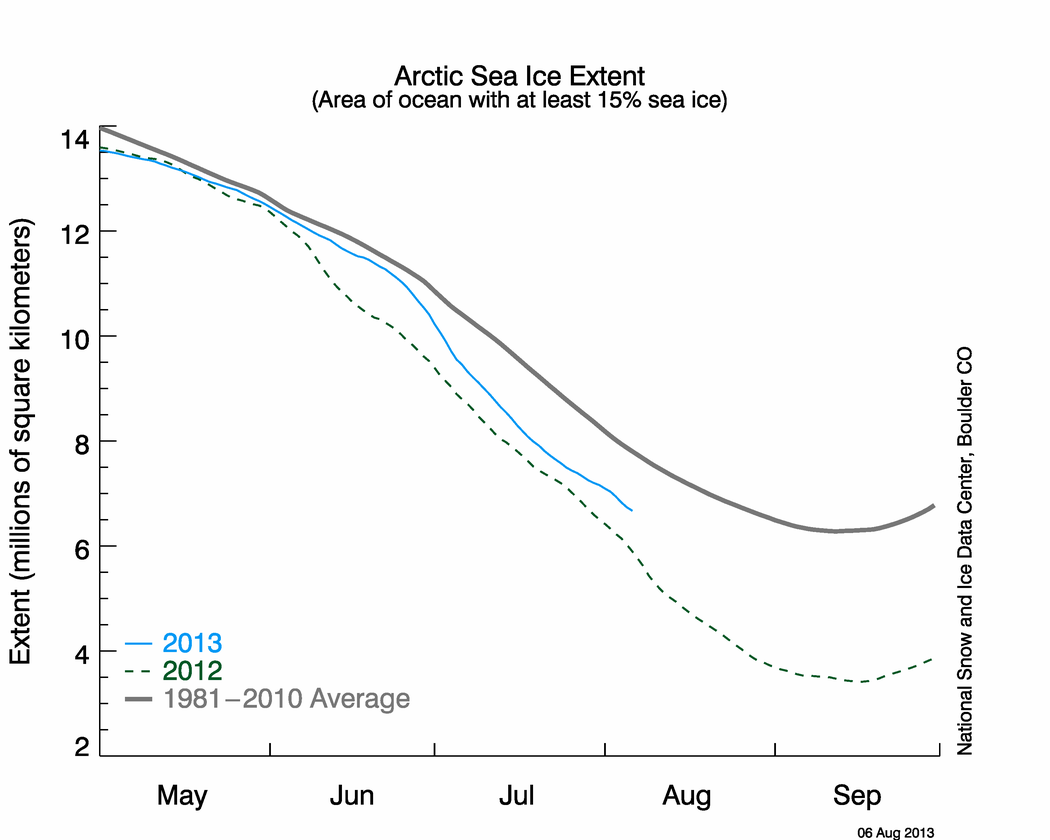
Al Gore calls it global warming. Bill Clinton calls it springtime. Others call it a death spiral, tipping point, or point of no return. Whatever you call it, the Arctic has started to melt and has lost about a million km2 of ice since the peak. The NSIDC graph below does not hide the decline.

http://nsidc.org/data/seaice_index/images/daily_images/N_timeseries.png
I just measured today’s NSIDC sea ice. It has passed the median line, though would require several similar days to appear in their moving average graph.


The image below shows where ice has melted and grown during the past 12 days. Areas in red have declined, and areas in green have increased in extent.

The decline in Bering Sea ice is due to much warmer air that has arrived this week. The sea of Okhotsk remains very cold and has gained some ice near the north end.

http://www.esrl.noaa.gov/psd/map/images/fnl/sfctmpmer_01a.fnl.anim.html
Sea ice remains nearly one million km2 ahead of 2007, and the map below shows where ice has gained and been lost relative to 2007. Green is growth, red is decline.

The map below shows areas of excess and deficient ice relative to the median. Green shows excess ice and red shows deficient. As of today, there is more excess ice than deficient ice. NSIDC uses a moving average, so it would take several days of similar conditions for it to show up in their graphs.

Five years ago, Steve Connor at The Independent feared that the Arctic had “irreversibly” “tipped” “past the point of no return”, but now it looks like the reports of the Arctic’s death were exaggerated.
I wouldn’t get too excited just yet. Here’s another view of Arctic ice extent. The interesting point is the red line showing the anomoly for the past couple of years. As you can see, the anomaly doesn’t really start to show up until the melting season is well under way (May and June). So while I like your initiative we need to wait another month or two before we get an idea of where this years ice is heading. I’d like to think a corner has been turned in recent years but it really is to little data to be confident.
Cryosphere Today
http://arctic.atmos.uiuc.edu/cryosphere/IMAGES/seaice.recent.arctic.png
Paul C (10:07:07) :
“Did Greenland grow in size? Take a look at the comparison in sea ice between 4/18/1980 and 4/18/2010: http://igloo.atmos.uiuc.edu/cgi-bin/test/print.sh?fm=04&fd=18&fy=1980&sm=04&sd=18&sy=2010
….. Is this a trick of the camera angle or is Greenland getting bigger?”
Good catch Paul. If you look closely you can see the bays and inlets have been “filled-in” and the peninsula on the lower left is now gone.
Remember how the Sea Ice had gone above the average line and then was “adjusted” down? I wonder if the ice in the bays was suddenly counted as “land Ice” and removed from the “Sea Ice” count.
Sorry my paranoia is showing but I do not trust anyone when so much money and power is up for grabs.
Gail Combs (19:04:34) :
What $ and power is up for grabs? I don’t get it, but it’s worth asking the folks at uiuc.edu if they use an expanded land mask for the snow extent image.
The sea ice extent data shows just the extent, it says nothing about the ice volume. Since ICESat stopped working there has been a gap in thickness measurements so this spring’s ice thickness is not known. But…folks at
University of Washington have been doing some modeling on the ice thickness and volume changes
http://psc.apl.washington.edu/ArcticSeaiceVolume/IceVolume.php
Thus, it’s hard to know what will happen to the summer ice given it is likely still very thin.
R. Gates (20:41:47) :
“The year to year Antarctic sea ice is of course growing slightly, but this is most likely the effect of the ozone thinning.”
Oh, do tell. Now it’s “ozone thinning.”
Read the toyotawhizguy post @02:58:08. Get educated, at least a little bit.
Smokey (20:11:12) :
Here is a paper you can read about how ozone loss has affect atmospheric circulation around Antarctica and subsequently the sea ice.
http://www.agu.org/pubs/crossref/2009/2009GL037524.shtml
It’s a short 4-page GRL paper so it should be an easy read for you.
This is what you said:
bubbagyro (15:44:29) :
I predict that the Arctic passage will be clear by 1908.
There is no evidence that the NW Passage was clear by 1908, in fact according to Amundsen’s account of his journey (which I have, I don’t get my information from RC) it is evident that at no time from 1903 to 1907 was it clear. It’s also clearly stated in the introduction by Amundsen that he had every intention of sailing the Passage, something he had dreamt of doing since a young boy!
“I proposed to combine the dream of my boyhood as to the North West Passage with an aim, in itself of far greater scientific importance, that of locating the present situation of the Magnetic North Pole.”
I suggest you find a more reliable source.
The extent values bottleneck around late May so what’s currently going on is likely to not matter too much in the grand scheme of things, but the strong -AO this winter will likely be a help this summer as it held in more multi-year ice than the past several winters. So the increase in multi-year ice will likely be an aid in a slower melt if all other things are equal. Of course not all things are equal, so we have to evaluate the pattern as we get closer, but that’s very difficult to do at this stage.
Since we can’t forecast anything majorly anomalous at this juncture for the summer, the natural baseline would be for another increase over 2009’s minimum, which will likely be adjusted either up or down as we get deeper into the melt season and can more accurately forecast the arctic weather pattern throughout the summer.
jeff brown (19:59:52) :
The sea ice extent data shows just the extent, it says nothing about the ice volume. Since ICESat stopped working there has been a gap in thickness measurements so this spring’s ice thickness is not known. But…folks at
University of Washington have been doing some modeling on the ice thickness and volume changes
http://psc.apl.washington.edu/ArcticSeaiceVolume/IceVolume.php
Thus, it’s hard to know what will happen to the summer ice given it is likely still very thin.
In a few weeks, CryoSat-2 should be getting some useful data:
http://www.redorbit.com/news/space/1849097/cryosat2_delivering_first_data/
The Europeans are using synthetic aperture radar – the Americans used a laser altimeter system in ICESat.
http://www.ethiopianreview.com/news/67180
CryoSat’s primary instrument was SIRAL (Synthetic Aperture Radar / Interferometric Radar Altimeter). SIRAL would operate in one of three modes, depending on where (above the Earth’s surface) CryoSat was flying. Over the oceans and ice sheet interiors, CryoSat would have operated like a traditional radar altimeter. Over sea ice, coherently transmitted echoes would have been combined (synthetic aperture processing) to reduce the surface footprint so that CryoSat could map smaller ice floes. CryoSat’s most advanced mode would have been used around the ice sheet margins and over mountain glaciers. Here, the altimeter would have performed synthetic aperture processing and used a second antenna as an interferometer to determine the across-track angle to the earliest radar return. This would have provided the exact surface location being measured when the surface is sloping.
http://en.wikipedia.org/wiki/CryoSat
CryoSat-2 is basically the same as the original crashed CryoSat, but with a fully duplicated payload (fault tolerance) and various improvements to design and operation – same measurements, though.
Whatever happens this summer, most likely CryoSat-2 will be measuring the sea ice thickness rather accurately.
ESA CryoSat-2 Operations:
http://www.esa.int/SPECIALS/Operations/SEM36Z8L6VE_0.html
Anu (22:50:51) :
Will Cryosat produce more accurate ice thickness data than Lewis Pugh or Catlin?
JER0ME (17:19:29) :
As I understand it, these sub-prime loans were generated primarily through govt intervention. There was a drive for ‘every American to own their own home’ or some such. I may be wrong, and that may have been dis-information, but if it was true (and it sounds realistic) then the whole mess was caused by govt intervention, and will not be fixed by same!
As this is not a political blog I will be brief. The catalyst for the whole mess was the creation of The Federal Home Loan Mortgage Corporation (FHLMC), known as Freddie Mac which was a government sponsored enterprise (GSE).
The FHLMC was created in 1970 to expand the secondary market for mortgages in the US. Along with other GSEs, Freddie Mac bought mortgages on the secondary market, pooled them, and sold them as a mortgage-backed securities to investors on the open market.
The Federal National Mortgage Association (FNMA) commonly known as Fannie Mae did much the same thing,
Because these bundles of debt were being sold by government sponsored enterprises, they were given a higher security rating than they actually deserved.
The market discovered too late that the principle asset had no intrinsic value and the market collapsed.
It’s now possible to bet on whether this year’s minimum arctic ice extent will be greater than last years:
http://www.intrade.com/index.jsp?request_operation=trade&request_type=action&selConID=720038
stevengoddard (23:40:29) :
Anu (22:50:51) :
Will Cryosat produce more accurate ice thickness data than Lewis Pugh or Catlin?
Maybe Dr. Laura Edwards can measure a few spot drills more accurately than the satellite, but that leaves a few million square miles unmeasured…
The CryoSat-2 team seems pretty interested in validating their satellite readings with ground truth missions:
http://www.esa.int/esaLP/ASE9BBUG0SC_LPcryosat_0.html
They’ve been getting ready since 2002, since they thought CryoSat would be in orbit 2005 (destroyed on launch). It will certainly be the most accurate ice thickness measuring satellite.
I’m sure they’ll find that the ice is getting thicker, everything is returning to normal, and we can all go watch TV now.
\u263A
From 1979 to today, satellite instruments, data resolution and ice-area-counting methods have changed. How has this contributed to an apparent decrease in “measured” ice area?
Phil. (20:52:03) :
Wrong again! (6th time).
Of course there will always be some ice from calving bergs. The term to use, so you don’t parse words again, is relatively ice-free, enough to enable passage. Amundsen made the passage in 1907 because the passage was navigable without an ice-breaker – by definition, “relatively ice-free”. It won’t be “ice-free” ever, of course, unless one accepts Phil’s Clintonesque parsing of terms. In fact, it won’t be navigable without an ice-breaker in the near term, IMHO.
The source was from the Canadian Encyclopedia, which had supplied ample references. What have you against Canadians? Good people, those.
And Gail, I was being facetious. I said “by 1908” which happened a hundred years ago, so I don’t need luck to state history.
bubbagyro (13:32:13) :
no ice-breaker was needed in summer of 2007. In fact a sail boat went through in 50 days. It took Amundsen MUCH longer than that…and why? Because there was a lot of ice. Amundsen’s route was not only open in 2007, but also in 2008 and 2009. And the Northern Sea route along Eurasia was open in 2008 and 2009. This hasn’t happened in at least 50 years since the Canadians started making their routine observations. And the Canadians also state Amundsen’s route was the most navigable in 2007 than it had been since their records started. Phil is right.
Kurt (11:48:40) :
Kurt, the instruments have been essentially the same since 1979–multichannel passive microwave sensors in similar channels. A lot of time and effort has gone into calibrating the different sensors to make sure the brightness temperatures match up during overlap periods so that the record is consistent over time. Frank Wentz at RSS dose a lot of this work. The sea ice record from passive microwave is considered to be one of the best climate data records from satellite available, especially if you focus on sea ice extent. It is easy to distinguish open water from sea ice in the microwave portion of the electromagnetic spectrum, and you can do this regardless of cloud cover and polar darkness. This is why it is used instead of visible imagery (which would be most accurate) since the Arctic is mostly cloud covered and you can’t view the ice half of the year.
jeff brown (15:41:50) :
no ice-breaker was needed in summer of 2007. In fact a sail boat went through in 50 days. It took Amundsen MUCH longer than that…and why? Because there was a lot of ice.
Yes, it took Roald Amundsen more than three years to get through that Northwest Passage (1903 to 1906), hardly ” relatively ice-free”. Few people had the funds and patience to sit around that long to “make history”:
I wonder if Amundsen saw much rotten ice back then…
Another chart to consider related to sea ice volume. It would seem to me that the volume of ice would be more directly related to amount of energy necessary for melting. See this:
http://psc.apl.washington.edu/ArcticSeaiceVolume/images/BPIOMASIceVolumeAnomalyCurrent.png
Now it is interesting to note on this graph a little “bump” upward in volume during the solar minimum of 2008-2009, but the overall trend is clear, and that bump upward has melted away.
R. Gates (22:16:44) :
I hadn’t seen that graph before, thanks.
I hope CryoSat-2 starts producing real data soon and they can analyze what is happening for this Summer Melt. All that recent ice growth in the Sea of Okhotsk and the Bering Sea, which makes the 2D extent almost “normal” for this time of year (compared to 1979-2000) will be gone soon, and we’ll see how the lowest multiyear ice on record fares this summer.
That’s what they call “preconditioning” the sea ice for a huge summer melt.
We’ll see.
Very interesting checking out the satellite photos here http://ice-map.appspot.com/
Thanks Jakers…I’d not seen that before. Awsome!
From IJIS http://www.ijis.iarc.uaf.edu/en/home/seaice_extent.htm:
“The black dot seen at the North Pole is an area lacking data where AMSR-E cannot observe the Earth’s surface… Please note that this area is also counted as sea-ice cover in our estimation of sea-ice extent. We may change the policy (i.e., filling the gap with full coverage of sea ice) in the near future due to the recent drastic reduction of Arctic sea ice. We will announce this if it is implemented.”
I just noticed this comment and am not sure if it’s a recent change or not. Suspicious if it is.
Jakers (10:44:32) :
Very interesting checking out the satellite photos here http://ice-map.appspot.com/
—–
REPLY: COOL! At the highest magnification, you can see the bones left over from the Catlin expeditionary team!
Poor polar bears….
Jerome:
This aspect was certainly generated by government intervention. It was based upon the (1992?) Boston Fed study on redlining…which was later discredited, but only after affecting the creation of laws which enforced the destruction of lending standards, and multiplied by Fannie Mae and Freddie Mac (for which it was illegal for the administration to intervene/fix). The Boston Fed study was another in which it was years afterwards before anyone was able to get the details of how it was done out of the authors. Ross McKitrick describes one aspect of it here: Case for Due Diligence .
It parallels part of the debate on Climate policy.