There’s a lot of interest in the blogosphere in sea ice, and the leading authority, NSIDC, only updates one a month. Yet when we reach things like peak ice, or minimum ice, we often find those occur at times when there’s no input from that organization, or others for that matter. So every week, we’ll offer a summary of sea ice news. Of course if something interesting happens, like the Arctic Sea ice line from NSIDC crosses the normal line, we’ll cover that when it happens.
This new feature gives readers a chance to submit artwork to be used as a header graphic if they wish. For example, the Quote of the Week graphic was provided by WUWT reader “Boudu”. If you have graphical skills and ideas, feel free to post them up to tinypic.com or photobucket etc and provide a link in comments below. – Anthony
WUWT Sea Ice News by Steven Goddard
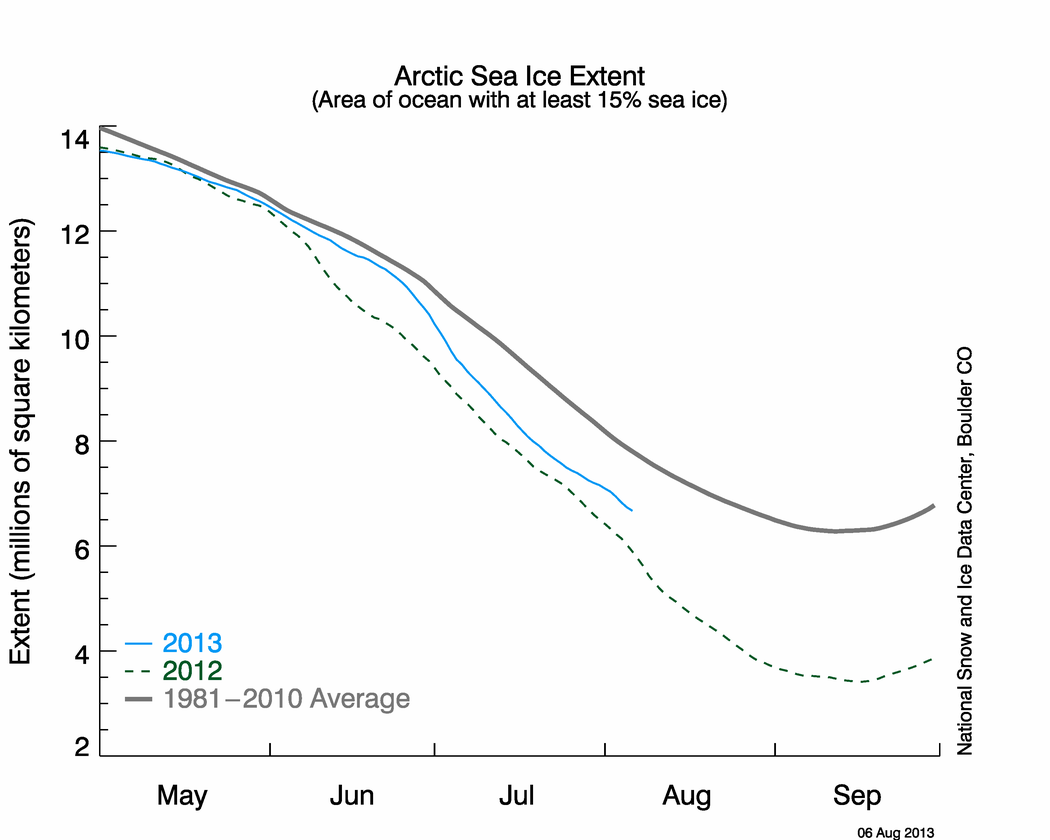
Al Gore calls it global warming. Bill Clinton calls it springtime. Others call it a death spiral, tipping point, or point of no return. Whatever you call it, the Arctic has started to melt and has lost about a million km2 of ice since the peak. The NSIDC graph below does not hide the decline.

http://nsidc.org/data/seaice_index/images/daily_images/N_timeseries.png
I just measured today’s NSIDC sea ice. It has passed the median line, though would require several similar days to appear in their moving average graph.


The image below shows where ice has melted and grown during the past 12 days. Areas in red have declined, and areas in green have increased in extent.

The decline in Bering Sea ice is due to much warmer air that has arrived this week. The sea of Okhotsk remains very cold and has gained some ice near the north end.

http://www.esrl.noaa.gov/psd/map/images/fnl/sfctmpmer_01a.fnl.anim.html
Sea ice remains nearly one million km2 ahead of 2007, and the map below shows where ice has gained and been lost relative to 2007. Green is growth, red is decline.

The map below shows areas of excess and deficient ice relative to the median. Green shows excess ice and red shows deficient. As of today, there is more excess ice than deficient ice. NSIDC uses a moving average, so it would take several days of similar conditions for it to show up in their graphs.

Five years ago, Steve Connor at The Independent feared that the Arctic had “irreversibly” “tipped” “past the point of no return”, but now it looks like the reports of the Arctic’s death were exaggerated.
R Gates: “[snip], I can be a skeptic and believe that AGW is LIKELY correct at the same time.”
====================================
Ummm… anyone know the irony here?
Also the use of the word “believe”?
Nothing more needs to be said.
Chris
Norfolk Virginia USA
R Gates: “Shows 13,752,500 for 4-18-2010. Why the difference? Anybody?”
==================================
Nobody really cares, chicken little, because its all within that great ancient geologic range of natural variability.
Chris
Norfolk, VA, USA
Does anyone know what the actual figure is for the minimum summer extent of the 1979-2000 average trendline? (Eyeballing it, it looks like about 7,500,000.) There is no link given on the graphics page to a table of figures.
davidmhoffer (16:39:53) :
How’s that work then? I would have assumed that it meant that sea ice is nearer the density of sea water than freshwater ice is to freshwater. If not, I would have assumed it would behave in the same way, ie that newly formed ice will float to the top, and form a layer.
I’m not out to contradict, but to learn.
R. Gates (22:30:04) :
No it doesn’t. I looked. The latest value : 13,768,594 km2 (April 18, 2010)
Why does R. Gates continually post such tosh? Is he environMENTAL?
Rhys Jaggar (10:49:57) …this might be of interest.
Unique Arctic Sea Ice Plots, by Jeff Id.
http://noconsensus.wordpress.com/2009/09/23/unique-arctic-sea-ice-plots/
Anu (21:07:25) :
Richard Sharpe (18:53:20) :
“Now, where else have I heard about enormous economic damage being inflicted on the basis of computer models?”
Wall St. ?
LOL. Good answer but not true. Loans were made to borrowers who had no chance of meeting the interest let alone pay the principle. These loans were then bundled up and sold on to others at a discount price. The discounted sub-prime loans (bundles) were then entered into the buyers books and counted as performing debt at high yield. This boosted the notional profit and did wonders for the executive bonuses,
The trick was to sell the sub-prime loans on before the non existant yield was realized in the accounts as non performing debt.
To do this, the seller had to further discount the sub-prime bundles and sell them on the market as very high yielding debt.
This then showed the difference between the bought and sold bundles as a trading loss which was considerably less than having to show the entire debt as a capital write off.
Of course every self serving parasite in the banking system decided they could play the game. It was a game of pass the parcel were the parcel became a worthless pile of paper in the hands of the last sucker who thought they could go on showing a profiting from an asset with an ever diminishing capital base.
In response to my own question to davidmhoffer above, following Weird Al’s advice to “Just Google” (sung to the tune of ‘Beat It’):
R. Gates (22:30:04) :
FergalR (21:52:06) :
JAXA returns to growth:
04,17,2010,13766406
04,18,2010,13768594
———-
That’s what the data says, but the number they give at the top of their graph, here:
http://www.ijis.iarc.uaf.edu/en/home/seaice_extent.htm
Shows 13,752,500 for 4-18-2010. Why the difference? Anybody?
-They check two times a day, round 11 a.m. European time it will be 13,768,594 at the top of their graph.
Seppie.
@R. Gates (20:41:47) :
“The year to year Antarctic sea ice is of course growing slightly, but this is most likely the effect of the ozone thinning.”
– – – – – – –
If Antarctic sea ice extent were to begin to shrink in the future would you attribute this to a reversal in the ozone thinning (some reversal is expected by 2015), or would you change course and attribute it to non-ODF GHGs (specifically CO2) as is currently the explanation offered by the AGW crowd to explain the past shrinkage of arctic sea ice? I raise this question owing to my skepticism becoming elevated whenever a single causal agent is identified as the driving factor for any type of weather or climate phenomenon, when there are a multitude of causal agents that most likely are contributors.
BTW, the climatology hypothesis that ozone thinning produces a net cooling of the troposphere and the earth’s surface once again flies in the face of classical physics, in this case, Planck’s Equation:
The spectral energy density expressed as a function of wavelength:
u(\lambda,T) = {8\pi h c\over \lambda^5}{1\over e^{\frac{h c}{\lambda kT}}-1}
Apparently, classical physics has no place in a post-modern world.
Smokey (18:28:47) :
“…The null hypothesis states that the climate naturally fluctuates within parameters defined by past temperature limits. The planet does not keep getting hotter or colder indefinitely, it always returns to its long term trend line…
But looking at only the past three decades is nearly worthless for deciding if CAGW has any merit. The Medieval Warm Period was warmer than today, but we have no satellite images from 1200 A.D. And the Greek Optimum was warmer than the MWP,,,
Good points Smokey, the null hypothesis hasn’t been falsified yet, despite the IPCC’s erroneous hockey-stick graph.
However, the last 30 years has been long enough to falsify the CAGW conjecture. Over this period CO2 has risen sharply, and while global mean temperature rose slowly over the first 15y, there has been no statistically significant global warming over the last 15y, as cited by Dr P Jones (ex-head of CRU).
Game over for the CAGW myth – time to move on and do some real climate science to find out how climate works.
Does anyone know where to get the JAXA sea ice AREA ( as opposed to extent ) data?
I’ve found it before , by just browsing around. But now I can’t find it.
Help?
could someone explain how norsex monthly deviations algorithm produces such clear signatures for the arctic ice summer minimums of 2007,8,9 but has no trace of the increasing maximums for 2007,8,9,10?
http://arctic-roos.org/observations/satellite-data/sea-ice/total-icearea-from-1978-2007
It looks daft.
Ralph P, as far as counting sun spots, you missed a very old tool called the “camera obscura”. This device, is essentially a pin hole camera, projecting a image on a table, and is ideal for looking for sunspots. Because of the brightness of the sun, one can “magnify” the image by moving the table farther away from the pinhole.
Anthony,
I humbly submit the following graphics for Sea Ice News along with a replacement Quote of the Week – I thought the old one was getting a bit tired!
http://www.kane-tv.com/wuwt/
Let me know if you want them in different sizes, resolutions etc. I’m happy to create more as necessary – see the ‘It’s worse then we thought’ graphic.
Cheers.
Ralph Tittley aka Boudu
ps. I’ll post this in Notes & Tips too.
Did Greenland grow in size? Take a look at the comparison in sea ice between 4/18/1980 and 4/18/2010: http://igloo.atmos.uiuc.edu/cgi-bin/test/print.sh?fm=04&fd=18&fy=1980&sm=04&sd=18&sy=2010
I suppose it could be the angle of the camera, but it looks like Greenland is wider in 2010 than 1980. Look at the Baffin/Newfoundland Seas. When you pull up the Baffin/Newfoundland Sea Ice Area Chart it shows a deficit versus the mean, but if they are measuring the ice cap as part of the sea ice area (hence the wider island) then the total Arctic area will be skewed. Is this a trick of the camera angle or is Greenland getting bigger?
John Finn (16:50:07) :
I’m not sure you understand how anomalies work. Changing the base period might change the raw numbers but it doesn’t alter the trend. It makes absolutely no difference to how much warming or how much ice loss has occurred.
Who said anything about trends? But while you’ve brought it up, ice extent is trending up over the last few years, while global temps have more or less flat lined. My point is that the base period has been presented, by default, as an ideal in both cases. The effect is to exaggerate the departure of current ice loss or temperatures from the norm, even when the trends seem to repudiate AGW. Witness climate scientists that try to rationalize these contradictions by claiming that the warming is hiding somewhere in the system or that the cooling would/should have been greater if not for greenhouse warming.
Nevertheless, if it makes no real difference as you have claimed, then what reason is there to continue to use the same baselines?
R.Gates
After the steep decline of 2007, it was apparent that the arcitc sea ice was much more sensitive to climate change that originally modelled.
Did you forget about the wind? Did you forget about the warm Siberian winter (regional) causing warmer than normal water to flow into the Arctic? Have you forgotten about the fact that Trenberth’s energy balance is crapola and hence the climate models are worthless?
Once you factor all these items into the equation tell me again about how we know enough about the Arctic to claim any kind of sensitivity value.
Phil. (18:33:19) :
Phil wrong again! (For the fifth time, as I count – stop spouting RealClimate, please, it is loaded with disinformation):
\ “The Northwest Passage was finally traversed 1903-06 by Norwegian adventurer Roald AMUNDSEN in his tiny ship, Gjoa. He travelled west and south of Lancaster Sound through Peel Sound and along the western Arctic coast through Queen Maud and Coronation gulfs. His western exit from the Arctic was simply a feasible route out of the area rather than a planned attempt to traverse the Northwest Passage. The first west to east passage by the RCMP vessel ST. ROCH under Henry LARSEN followed a similar route through the relatively shallow channels along the mainland coast 1940-42. Larsen left the central Arctic through Bellot Strait and travelled north and east of Baffin Island.
During the summer of 1944 the St. Roch became the first to traverse the passage from east to west in a single year, using a new route west of Lancaster Sound, south through Prince of Wales Strait between Banks and Victoria Islands, and along the northern Alaska coast. Finally, in 1954, the first ship to achieve the passage from west to east in a single year was the Canadian government icebreaker Labrador.”
Right under the wire! I predicted by 1908!!!
By the way, note in my post above, that the next traversing of the NW passage was in the early 1940s – YES, right after the longest warm spell of the century, the 1930s was the warmest spell to date, but 1998-2002 was too short and not warm enough to make the Arctic ice-free, I predict.
“”” JER0ME (00:11:31) :
davidmhoffer (16:39:53) :
Salt water freezes in a different pattern than fresh water. For fresh water to freeze only the top layer reaches the freezing point, the water below is warmer. For salt water to freeze, all the water must first reach the freezing point and THEN ice starts to form. So even a thin layer of ice is indicative of a LOT of cooling.
How’s that work then? I would have assumed that it meant that sea ice is nearer the density of sea water than freshwater ice is to freshwater. If not, I would have assumed it would behave in the same way, ie that newly formed ice will float to the top, and form a layer.
I’m not out to contradict, but to learn. “””
Don’t know if you got your answer JEROME, but sea ice is pretty much like fresh water ice; it is fresh water ice.
Sea water freezes at a lower temperature than fresh water; typically about -2.5 deg c for ordinary salinity of about 3.5% dissolved salts. BUT, in the freezing process something else happens.
A given trace impurity; such as a salt or a gas like CO2 has a different abundance in the solid phase (ice) from what it is in the liquid phase (water) and that is different again from what it would be in the vapor phase (atmosphere). With the (sea)ice and (sea)water in contact, and in equilibrium; so that ice is neither growing nor melting at that interface; it turns out that an impurity such as salt of CO2 has a much higher preference for remaining in the liquid phase (water), than ofr becoming incorporated into the solid structure of the ice.
This is often expressed as a “segregation” coefficient; that specifies the relative amount of the impurity in the solid to that in the liquid. In the gas/liquid interface situation, Henry’s law controls the amount of a gas like CO2 that dissolves in the water versus the amount in the contacting atmosphere.
In the case of freezing water, the salt has such an abhorrence for the solid state, that it is highly rejected as the ice grows, and remains in the water, as an enhanced salinity “brine” near the boundary layer. In pracitce the ice may tend to grow with lots of bubbles or voids in it, which can be filled with this brine; but the ice itself is almost pure fresh water. So the sea ice tends to float somewhat higher than on a lake, because it is pretty much the samer ice but the sea water is denser than the fresh water.
The same happens to the CO2, and it is also excluded largely from the ice, so it is expelled into the water. It is likely that the cold sea water is almost saturated with CO2 so when the ice forms; some of that excess CO2 can be expelled to the atmosphere.
In the arctic, during the ice freeze, the atmospheric concentration of CO2 increases by about 18 ppm; whereas at Mauna Loa in Hawaii, the increase is only 6 ppm.
I don’t know what the exact mechanisms are for that 18ppm arctic blast of CO2 but expulsion from the growing ice is a likely cause of part of it.
The lower freezing point of the salt water is of some importance in the process, because the temperature at the interface needs to get down to about -2.5 C for the ice to form; but that ice is now fresh water frozen, so it melts at zero deg C.
That means that once formed, the ice is fairly stable, against small temperature fluctuations since it would take 2.5 deg of warming to melt the fresh water ice.
So the process is a bit more complicated than you thought.
MartinGAtkins (01:57:26) :
As I understand it, these sub-prime loans were generated primarily through govt intervention. There was a drive for ‘every American to own their own home’ or some such. I may be wrong, and that may have been dis-information, but if it was true (and it sounds realistic) then the whole mess was caused by govt intervention, and will not be fixed by same!
bubbagyro (15:44:29) :
I predict that the Arctic passage will be clear by 1908.
REPLY:
And I have this nice bridge I want to sell…
u.k.(us) (16:03:31) :
O/T
Are “windmills” designed to resist the effects of volcanic ash entering the gearing/cooling systems?
Seems like a potential problem.
The only reason I ask, is I paid for them.
I wonder what the ash is doing to the solar panels too. I worked in a ceramics manufacturing facility and destroyed a pair of safety glasses a year no matter how carefully I was cleaning my glasses.
To nandheeswaran jothi
The tip of a wind turbine blade is only just subsonic – slow RPM does not mean slow tip velocity when the diameter is large (do the maths on a 90m diameter turbine to calculate the RPM when the tip goes supersonic). Gritty particulates will cause wear when they collide with a resin coating moving at 500mph although the wear will most likely be even on all rotor blades blade replacement will be needed sooner than otherwise would have been the case or efficiency will be degraded.
If the gritty particulates are very fine then they can penetrate moving parts and bearings and cause wear. If the bearings are sealed appropriately then they will be protected.
This is a potentially serious cost to owners of wind turbines in Europe.