There’s a lot of interest in the blogosphere in sea ice, and the leading authority, NSIDC, only updates one a month. Yet when we reach things like peak ice, or minimum ice, we often find those occur at times when there’s no input from that organization, or others for that matter. So every week, we’ll offer a summary of sea ice news. Of course if something interesting happens, like the Arctic Sea ice line from NSIDC crosses the normal line, we’ll cover that when it happens.
This new feature gives readers a chance to submit artwork to be used as a header graphic if they wish. For example, the Quote of the Week graphic was provided by WUWT reader “Boudu”. If you have graphical skills and ideas, feel free to post them up to tinypic.com or photobucket etc and provide a link in comments below. – Anthony
WUWT Sea Ice News by Steven Goddard
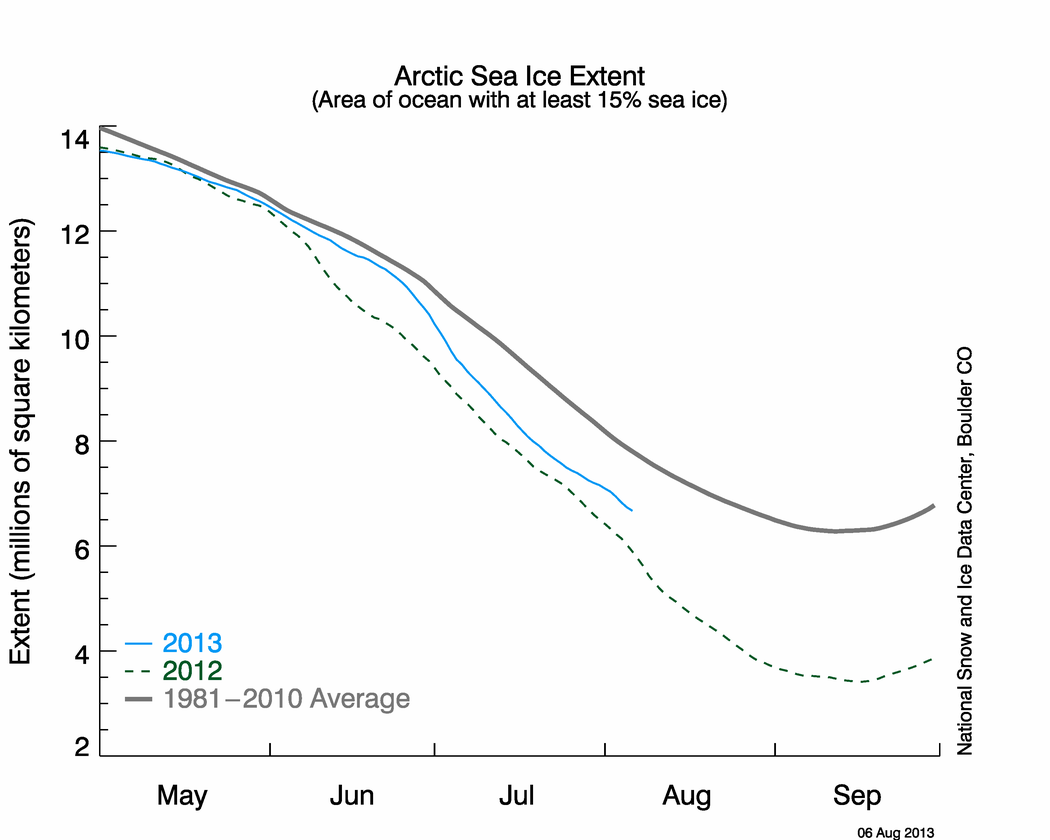
Al Gore calls it global warming. Bill Clinton calls it springtime. Others call it a death spiral, tipping point, or point of no return. Whatever you call it, the Arctic has started to melt and has lost about a million km2 of ice since the peak. The NSIDC graph below does not hide the decline.

http://nsidc.org/data/seaice_index/images/daily_images/N_timeseries.png
I just measured today’s NSIDC sea ice. It has passed the median line, though would require several similar days to appear in their moving average graph.


The image below shows where ice has melted and grown during the past 12 days. Areas in red have declined, and areas in green have increased in extent.

The decline in Bering Sea ice is due to much warmer air that has arrived this week. The sea of Okhotsk remains very cold and has gained some ice near the north end.

http://www.esrl.noaa.gov/psd/map/images/fnl/sfctmpmer_01a.fnl.anim.html
Sea ice remains nearly one million km2 ahead of 2007, and the map below shows where ice has gained and been lost relative to 2007. Green is growth, red is decline.

The map below shows areas of excess and deficient ice relative to the median. Green shows excess ice and red shows deficient. As of today, there is more excess ice than deficient ice. NSIDC uses a moving average, so it would take several days of similar conditions for it to show up in their graphs.

Five years ago, Steve Connor at The Independent feared that the Arctic had “irreversibly” “tipped” “past the point of no return”, but now it looks like the reports of the Arctic’s death were exaggerated.
I was looking at Cryosphere Today and I noticed that it’s four days out of date, how often do they update? It also seems that the ‘compare’ image does not agree with the ‘latest’ for the most recent date. Do these guys share the code that generates the images? It just doesn’t look right. The latest also shows rapidly deteriorating ice concentrations, is this just a transient effect, bug or am indication of things to come?
For those wondering if I think all satellite data is good data, here’s your answer. It’s a video of ISCCP Ice data from July, 1983 to June, 2008.
Bad IceUploaded by magicjava. – Explore more science and tech videos.
And if you’re _really_ masochistic, here’s a video of 1 month’s worth of Aqua AMSU Channel 5 data, as printed out in my debugger.
1 Month Of Data From Aqua ANSU Channel 5Uploaded by magicjava. – Discover more science and tech videos.
As we’re talking about ice in general, arctic or antarctic, we should really talk about ice mass. I hope that charts showing ice mass will show up in these discussions, like this one from the antarctic:
http://www.nasa.gov/images/content/416685main_20100108_Climate_1.jpg
It does a great disservice to the discussion to only talk about ice extent. The mass of the ice is quite important, as it is a better gauge of the overall condition of the ice. With the launch of the CryoSat-2, we’ll get better and better data, and can really see what is happening.
Other graphs that some might find of interest, such as melt trends:
http://earthobservatory.nasa.gov/IOTD/view.php?id=42456
I predict that the Arctic passage will be clear by 1908.
Yes, the AGW Propaganda Machine is desperate. The deperation is an attempt to derail public outcry over the Cap & Trade to pay for unfunded programs that are already passed.
Poll numbers supporting AGW are in decline, and the outrage is already approaching the level of scary. The Congress may lose it’s nerve with elections forthcoming.
Right now, Sea Ice is 231093 km2 ahead of 2003, and 165312 km2 ahead of 2009. according to JAXA That’s not supportive of death-spiral Arctic theory or it’s predictions. It is April 18, 2010, not Sept. 18, 2010, and there is no current Sea Ice data for AGW-backed Cap&Trade to lean on.
O/T
Are “windmills” designed to resist the effects of volcanic ash entering the gearing/cooling systems?
Seems like a potential problem.
The only reason I ask, is I paid for them.
R. Gates (15:34:44) :
The Antarctic graph you linked is the freshwater ice sheet, not sea ice. It is also a WAG because they don’t have any gravity calibration measurements in the interior of the continent. Mass could just as easily be going up.
There aren’t any regular updates of Arctic sea ice thickness that I know of, but if you have a source please let us know.
R. Gates (15:34:44) :
Nice try, R. Gates. The melt season onset graph ends in 2007.
So I ask you: Does time stop in 2007 for sake of argument?
From Bishop Hill, someone else who thinks there are flaws in AGW:
http://claesjohnson.blogspot.com/2010/04/incorrect-postulate-of-climate-science.html
Mr Gates, so balanced for moments, then this…”
We’ve gone through this deep solar minimum, and despite that, the arctic sea ice mass did not fully recover…”
You know perfectly well that even NOAA relates the 07 decline primarily to wind and ocean currents. You also know that the current recovery is the fastest on the 30 year record.
So we went to a 30 year low, and 08 and 09 are the largest fastest most spectacular increase on the record.
Amino Acids in Meteorites (14:40:14) wrote: “What was sea ice like during the Medieval Warm Period? I wish to know that.”
This will indirectly answer your question.
McGhee, R. 2001 [1996]. Ancient people of the Arctic. Canadian Museum of Civilization/UBC Press.
Anthony Watts (13:25:14) :
Always so negative phil
Not negative at all, just observing the actual changes relative to 2007.
nandheeswaran jothi (13:52:39) :
Phil. (13:00:32) :> “The NW Passage shows significantly less old ice and there seems to be a good chance of the northern route opening this year.”
That would be bad…. because???
this has never happened before???
It was just an observation, I didn’t say it was bad nor unique, why so defensive?
Amino Acids in Meteorites (14:42:22) :
Phil. (13:00:32) :
“The NW Passage shows significantly less old ice and there seems to be a good chance of the northern route opening this year.”
You are assuming the opening of the NorthWest Passage is something unusual?
No, but it has been infrequent until the last few years, as far as the northern route is concerned that’s even more infrequent.
Jimbo (14:49:10) :
I suspect that Phil would be greatly saddened if over the next 5 years Arctic sea ice extent and area jumped above the 1979-2000 average during winter and summer. Why???? Warmists seem to be depressed whenever they see recovery. Why???
Straw man, you’re asking the wrong person in any case since I have no emotional attachment to arctic ice, pro or con. So far I see no signs of recovery. All the indications are that the summer ice will be mostly gone in that timeframe though.
Stephan (13:53:40) :
Phil and De Witt Da Pain cannot and will never admit that the ice is extending and thickening.
I will when it happens.
There’s a comparison graph between “this date in 2007 and now”.
I’d be interested in seeing the same graph for 1983 – which is supposed to be the high-ice-year.
R. Gates (15:34:44) :
As we’re talking about ice in general, arctic or antarctic, we should really talk about ice mass.>>
Let’s not. Let’s talk energy. Salt water freezes in a different pattern than fresh water. For fresh water to freeze only the top layer reaches the freezing point, the water below is warmer. For salt water to freeze, all the water must first reach the freezing point and THEN ice starts to form. So even a thin layer of ice is indicative of a LOT of cooling.
The Japanese IJIS website gives daily data and graphical updates on the Arctic Sea Ice Extent here: http://www.ijis.iarc.uaf.edu/en/home/seaice_extent.htm
No base period or comparison to an average. Annual graphical display for the years 2002 to 2010. The 2010 ice extent is the highest in any of these years for the current period
Amino – In case you don’t have easy access to the book noted in my last post (16:16:30), here’s a quote that sums up the answer to your question, from p 230 of that book:
“”during the relatively mild [MWP] the open-water hunting techniques developed in Alaska would have provided the Inuit with an easy lielihood”
The Inuit spread east through the Arctic during this period, using boats and hunting bowhead whales, and displaced the more ice-adapted Dorset culture.
One of their primary movement corridors was the ‘northwest passage.’
What would that suggest? Those who tried to delete the MWP must have tried very hard to ignore Arctic archaeology.
I guess the Inuit failed to publish the appropriately peer reviewed papers on their experiences. But the archaeologists did.
Daniel M (15:21:56) :
Phil. (12:22:12) :
Really, beware what you wish for:
http://iup.physik.uni-bremen.de:8084/amsr/ice_ext_n.png
http://iup.physik.uni-bremen.de:8084/amsr/ice_ext_s.png
Nice try, but you included pre-79 measurements. How about putting up the 1989-2009 as originally stated – then you’ll have my attention.
I’m not sure you understand how anomalies work. Changing the base period might change the raw numbers but it doesn’t alter the trend. It makes absolutely no difference to how much warming or how much ice loss has occurred.
Al Gore’s Weather (AGW): koff…choke…yikes..spittt
…-
“Europe counts saved carbon emissions as flights stay grounded
The grounding of 63,000 flights over the past four days has saved 1.3 million tonnes of carbon dioxide, more than the annual emissions of many developing countries.
Aviation is responsible for about 2 per cent of global emissions of CO2, but accounts for a much higher proportion of emissions in European nations, which have many frequent flyers. Aircraft are responsible for more than 6 per cent of Britain’s CO2 emissions.
On a normal day, the 28,000 flights in European airspace emit about 560,000 tonnes of CO2, or a third of the world’s aviation emissions.
The Aviation Environment Federation calculated that the CO2 saving over four days had been greater than the annual emissions of Malawi, Sierra Leone, Rwanda and about 50 other developing countries.”
http://www.timesonline.co.uk/tol/news/environment/article7101517.ece
Richard Sharpe (09:46:03) :
He, he!
Yup, I’ve signed up too…
maz2 (16:54:25) :
It is the goal of Plane Stupid to make the UK on a par with “Malawi, Sierra Leone, Rwanda and about 50 other developing countries.”
That is why they call themselves and their loyal followers “stupid.”
Phil. (16:19:38) :
my apologies, if you did not mean to imply that it was unusual.
cheers
John Finn (16:50:07) :
Changing the base period changes how much of the graph is above or below normal. Sinusoidal trends that bounce around in a normal range are made to appear frightening when someone cherry-picks the baseline to start at the bottom of a sine. I call that trend stuffing. 2007 was the bottom of a sine, and that is how AGW does it. Fine.
It is now moving up from that bottom, not heading further down, and that is all it is saying. It is also moving up from 2003, as well as 2007, 2008 and 2009. By AGW’s own measure, starting at the bottom, the death-spiral is not happening. By the JAXA 2003 data point on the preceeding downtrend of the sine, it is also not happening.
If you want to play by the trends, then you must take your lumps when it goes against predictions.
maz2:
Too bad – we could have used the CO2 for the crops this summer.
maz2 (16:54:25) :
I’ll gladly give up any savings in C02 rather than be subjected to a volcanic cloud high in flourine and other foul stuff. Not to mention the lung-scarring engine-grinding dust.
Nothing to celebrate about ash & fumes.
RGates
We only have 30 years arctic ice data and you are making big assumtions that there are no cycles involved with minimum extent and the relationship is linear to 2030.
Clearly arctic sea ice extent for the summer minimum has cycled in the past and is not a linear relationship with time. If it were then you could project that slope of your linear relationship backwards as well as forwards to find that in 1850 the arctic sea ice minimum extended to somewhere near California and New york.
Does Arctic sea ice minimum vary on some kind of timescale lagging the OHC and Atmosphere cycle? Or is it a linear relationship with CO2 and time?