There’s a lot of interest in the blogosphere in sea ice, and the leading authority, NSIDC, only updates one a month. Yet when we reach things like peak ice, or minimum ice, we often find those occur at times when there’s no input from that organization, or others for that matter. So every week, we’ll offer a summary of sea ice news. Of course if something interesting happens, like the Arctic Sea ice line from NSIDC crosses the normal line, we’ll cover that when it happens.
This new feature gives readers a chance to submit artwork to be used as a header graphic if they wish. For example, the Quote of the Week graphic was provided by WUWT reader “Boudu”. If you have graphical skills and ideas, feel free to post them up to tinypic.com or photobucket etc and provide a link in comments below. – Anthony
WUWT Sea Ice News by Steven Goddard
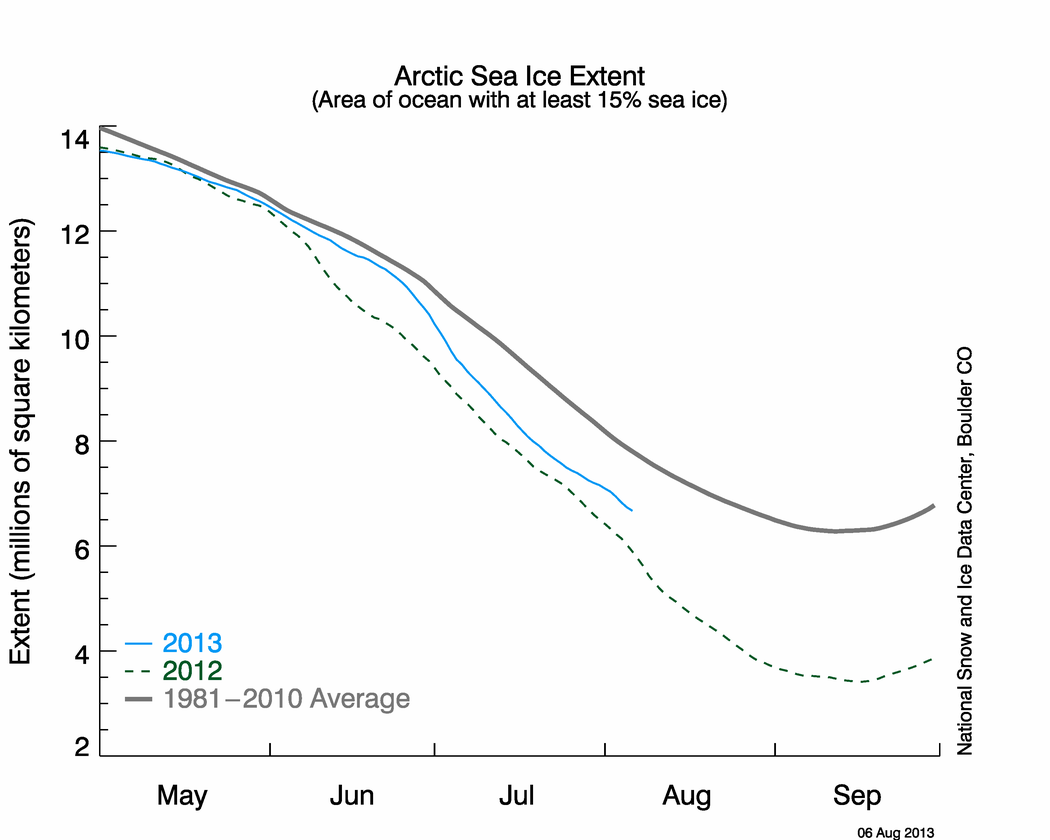
Al Gore calls it global warming. Bill Clinton calls it springtime. Others call it a death spiral, tipping point, or point of no return. Whatever you call it, the Arctic has started to melt and has lost about a million km2 of ice since the peak. The NSIDC graph below does not hide the decline.

http://nsidc.org/data/seaice_index/images/daily_images/N_timeseries.png
I just measured today’s NSIDC sea ice. It has passed the median line, though would require several similar days to appear in their moving average graph.


The image below shows where ice has melted and grown during the past 12 days. Areas in red have declined, and areas in green have increased in extent.

The decline in Bering Sea ice is due to much warmer air that has arrived this week. The sea of Okhotsk remains very cold and has gained some ice near the north end.

http://www.esrl.noaa.gov/psd/map/images/fnl/sfctmpmer_01a.fnl.anim.html
Sea ice remains nearly one million km2 ahead of 2007, and the map below shows where ice has gained and been lost relative to 2007. Green is growth, red is decline.

The map below shows areas of excess and deficient ice relative to the median. Green shows excess ice and red shows deficient. As of today, there is more excess ice than deficient ice. NSIDC uses a moving average, so it would take several days of similar conditions for it to show up in their graphs.

Five years ago, Steve Connor at The Independent feared that the Arctic had “irreversibly” “tipped” “past the point of no return”, but now it looks like the reports of the Arctic’s death were exaggerated.
From that Independent article 5 years ago:
Dr. Mark Serreze
“This will be four Septembers in a row that we’ve seen a downward trend. The feeling is we are reaching a tipping point or threshold beyond which sea ice will not recover.”
And things got even worse in 2007 yet things seem to have turned the corner.
http://www.independent.co.uk/news/science/global-warming-past-the-point-of-no-return-507030.html
Rhys Jaggar (10:49:57) :
It would be interesting and easy to plot UAH or DMI Arctic temps vs. NSIDC extent. Think I might do that later today.
D. King (11:20:45) : “…The fight / flight response is like a drug to some. They like to have the crap scared out of them and others, for the high, and observe the collective response….”
Adrenaline addiction is cunning, baffling, and powerful. Odd that some would associate it with virtue.
Phil. (13:00:32) :> The NW Passage shows significantly less old ice and there seems to be a good chance of the northern route opening this year.
That would be bad…. because???
this has never happened before???
the reason why we have been focusing on this arctic ice because some people have been trying scare people into believing that summer arctic ice extent in a death spiral and so “we are all going to die because of that”. that itself was a questionable claim. Now this northwest passage that has happened before, in the near past!!!!
so, is this whole AGW is going to keep transmogrifying in to more and more useless, irrelevent minutiae???
what am i missing here?
Phil and De Witt Da Pain cannot and will never admit that the ice is extending and thickening. It would be like admitting that AGW is not occurring this is why they will continue to push the agenda whenever possible LOL
R Gates
Are you saying the AGW crowd doesn’t consider 100% of the warming since the 60’s to be greenhouse gas driven? They sure take every opportunity to trumpet that it is.
Oh well its official now the Sun does affect climate after all hahaha.
R. Gates (12:08:03) :> Green House gases work over the medium term (20-1000+ years with a strong climate effect)
This point, you seem to be stating as a fact is what is being questioned, is it not? particularly the characterization “strong climate effect”.
is there any reason to club that with the other three factors that nobody is questioning here in this site??
R. Gates. I am in agreement that we do not know whether the disappearance of Arctic sea ice is a good or a bad thing. You appear to feel AGW is well established. I lean the other way; I don’t see much evidence of AGW. As for predictions of a clear arctic by 2030, there is no evidence of this either, although — who knows — it could happen. But there is no evidence that I have seen that convinces me either way. What I see is multidecadal mild fluctuations, not linear trends. The clear inverse relationship between north and south sea ice is a telling detail. It is a dynamic that remains largely unexplained, yet it appears to be an overriding factor. If the arctic goes ice-clear in a few decades, I would wager that the antarctic hovers at relative high ice levels until the pattern reverses. It seems that the two polar sea ice reservoirs play a zero-sum game of short-term fluctuation, overlayed on long-term trends that are subject almost entirely to natural cycles and external factors such as solar irradiance and geological events beyond our control.
In the end, who cares about SEA ice? I realise there’s the albedo question, but I have seen no evidence that disappearing sea ice leads to climate tipping points that tend to armageddon-scale disaster. Geological/biological records tell us that the world and its biosphere have fared quite well without sea ice, and will do so again.
The melting of the Antarctic ice sheet, however, would bring a MAJOR disaster, if it happened over a short time span, like a century. However, this is practically a physical impossibility, and requires several orders of magnitude more heating than anything the most alarmist models any reputable scientist has proposed (I don’t include Al Gore in this category!). We are quite safe from that.
Steven G: about this new feature — can I request that an effort be expended to provide balance and cover more of the cryosphere? My pet peeve about the ice-sites on the web is this unnatural obsession over a thin skin of ice on arctic waters. Let us get regular updates on what is known about the massive volumes of thick ice on the continent below. That is more like 95% of the cryosphere — shouldn’t it get more than 1% of the attention than this gossamer covering over which the alarmists continually wring their hands??
The other day a friend of mine sendt a mail to all the most important newspapers in Norway, telling them the JOYFULL news about Arctic Sea Area level returning to normal.
Surely this is reason for joyful celebrations ? Champagne?
Surely there would be frontpage news next day?
No. Not a single word.
Mister Gates:
Really? GHG very strong?
I think it is well established now that the effect of GHG is very weak, unless water is included, and water appears to have negative and positive feedback attributes. Besides, “greenhouse” is a poor choice of words, since we have no glass on our “greenhouse” to prohibit convective effects, as has been well established.
Really? Effect of volcanoes very weak? I think the Permian extinct species will have a word with you in the next incarnation.
As Monty Python put it so well, “it is not just the number of words that is important, it is getting them in the right order.”
Bill Tuttle (13:06:23) :
R. Gates (10:36:41) :
…but prior to 2007, the AGW models were suggesting that arctic would be ice free in the summers by 2100, but now the range in more in the 2030 range.
Is that due to a change in the models, a change in the observations, or a panic effort to help push Cap ‘n’ Trade?
—————
Bill, the AGW models are constantly being refined, like any good model. After the steep decline of 2007, it was apparent that the arcitc sea ice was much more sensitive to climate change that originally modelled. Indeed, if the steep decline of 2007 had continued, the arctic would have been ice free in 2013, but a little thing called the deepest and longest solar minimum got in the way (as well as to a lesser extent a La Nina). I look forward to more concrete research related to this solar minimum, and more to the point, the decrease in Galactic Cosmic Rays that may have led to an increase in cloudiness and slight cooling during the 2005-2009 period.
So here we are in 2010, and now we can see if the GHG signal once more takes charge. Of course the El Nino of 2009-2010 has had an effect as well in the warming so far this year, and of course we’ll see a reduction in the warming later on this year as the El Nino fades…but on top of all that, as a stronger signal, AGW models would say that GHG’s will show their forcing.
We’ve gone through this deep solar minimum, and despite that, the arctic sea ice mass did not fully recover, meaning we are heading into some years of higher solar activity, lower GCR’s, and the arctic more vulnerable than it was in 2006 based on sea ice mass. Much of the arctic sea ice is thin, and with a warm summer it will melt fast.
————-
Mike G. said:
R Gates
Are you saying the AGW crowd doesn’t consider 100% of the warming since the 60’s to be greenhouse gas driven? They sure take every opportunity to trumpet that it is.
———–
Mike, again you have to talk about time frames. Some of the warming this year is related to El Nino, and some is from GHG’s. The El Nino will fade but the GHG’s are still here. The same with the sun, it is up and down pattern, with higher highs during the more active solar periods. Go back an look at this graph:
http://www.climate4you.com/Sun.htm#Global temperature and sunspot number
What you see is higher highs during the peak solar years. So the effect of the sun is shorter term than the effect of GHG’s. So your question is, mainly, yes, all the longer term trend heating is from GHG’s, with shorter term up and downs related to shorter term events like solar cycles, El Nino, La Nina, etc.
To correct my previous post– of course it is an “increase” in GCR’s that causes in an increase in cloudiness. It is a decrease in the output from the sun that allows greater amounts of GCR’s to reach earth, affecting the formation of clouds.
stevengoddard (10:03:38) :
Can you imagine anyone signing up to spend their time desperately trying to keep bad news alive? That could probably be described as a form of mental illness.
I have wondered that about Al Gore, not kidding.
A weekly update is an excellent idea, thanks Anthony.
Interesting how so many different Arctic sea ice data sets are in use!
As at 17-Apr-2010, the sea ice extent and area are both at the 1979-2006 average on the Arctic-ROOS site here:-
http://arctic-roos.org/observations/satellite-data/sea-ice/ice-area-and-extent-in-arctic
I find it very worrying how rapidly the ice has recovered from the 2007 low, well before the effects of a quiet sun should be being felt on our climate system. There would be many benefits if we get an ice free Arctic again.
Phil. (12:22:12) :
What was sea ice like during the Medieval Warm Period? I wish to know that.
nandheeswaran jothi (13:52:39) :
so, is this whole AGW is going to keep transmogrifying in to more and more useless, irrelevent minutiae???
what am i missing here?
———–
REPLY: The answer to your first question is “yes.” Case in point = “missing” heat….
Suddenly, ManBearPig has discovered a cloaking device!!! Not to mention the effects of climate change on volcanic eruptions etc.
Second question? Governments are desperate to institute new carbon taxes (either by a transparent consumption tax or, preferably, a cap & trade mechanism) and will use any type of fear/panic-mongering at their disposal to accomplish this aim.
Phil. (13:00:32) :
The NW Passage shows significantly less old ice and there seems to be a good chance of the northern route opening this year.
You are assuming the opening of the NorthWest Passage is something unusual?
What was it like during the Medieval Warm Period?
Having just watched a documentary about the building of Ice Breakers I wonder if this is having any affect ice loss figures. the Russians are now taking tourist to the North Pole on huge ice breakers and they are coming up with better ways of breaking the ice.
Maybe they should be a bit more careful with how much they break up the ice before blaming Climate Change.
Funny how some people have become experts on exactly what North Pole ice is supposed to, and, not supposed to, be like.
One thing that can be said is that it is unlikely North Pole Ice will be gone in 4 years. I say 4 years because 1 year ago Al Gore made his prediction that all North Pole Ice could be gone in 5 years. 4 years left now. And that ice is heading in the opposite direction that the biggest name in global warming said it would go.
I suspect that Phil would be greatly saddened if over the next 5 years Arctic sea ice extent and area jumped above the 1979-2000 average during winter and summer. Why???? Warmists seem to be depressed whenever they see recovery. Why???
Religion? Agenda? Embarassment? I would be thrilled to bits to see contrary signs of AGW particlularly over 5 to 10 years.
Clarification:
If I were a warmist I would be thrilled to bits to see contrary signs of AGW particlularly over 5 to 10 years.
How about the real thing from Barrow?
http://www.gi.alaska.edu/snowice/sea-lake-ice/barrow_webcam.html
Phil. (12:22:12) :
Really, beware what you wish for:
http://iup.physik.uni-bremen.de:8084/amsr/ice_ext_n.png
http://iup.physik.uni-bremen.de:8084/amsr/ice_ext_s.png
Nice try, but you included pre-79 measurements. How about putting up the 1989-2009 as originally stated – then you’ll have my attention.
Can’t predict the weather, can’t predict the climate.
Can’t even predict the weather one, two, or three days out, because feedbacks get in the way.
If you don’t understand weather feedbacks, you can’t possibly understand climate feedbacks.
Yes, they keep adjusting and refining their computer climate programs.
Because they can’t get them right!