There’s a lot of interest in the blogosphere in sea ice, and the leading authority, NSIDC, only updates one a month. Yet when we reach things like peak ice, or minimum ice, we often find those occur at times when there’s no input from that organization, or others for that matter. So every week, we’ll offer a summary of sea ice news. Of course if something interesting happens, like the Arctic Sea ice line from NSIDC crosses the normal line, we’ll cover that when it happens.
This new feature gives readers a chance to submit artwork to be used as a header graphic if they wish. For example, the Quote of the Week graphic was provided by WUWT reader “Boudu”. If you have graphical skills and ideas, feel free to post them up to tinypic.com or photobucket etc and provide a link in comments below. – Anthony
WUWT Sea Ice News by Steven Goddard
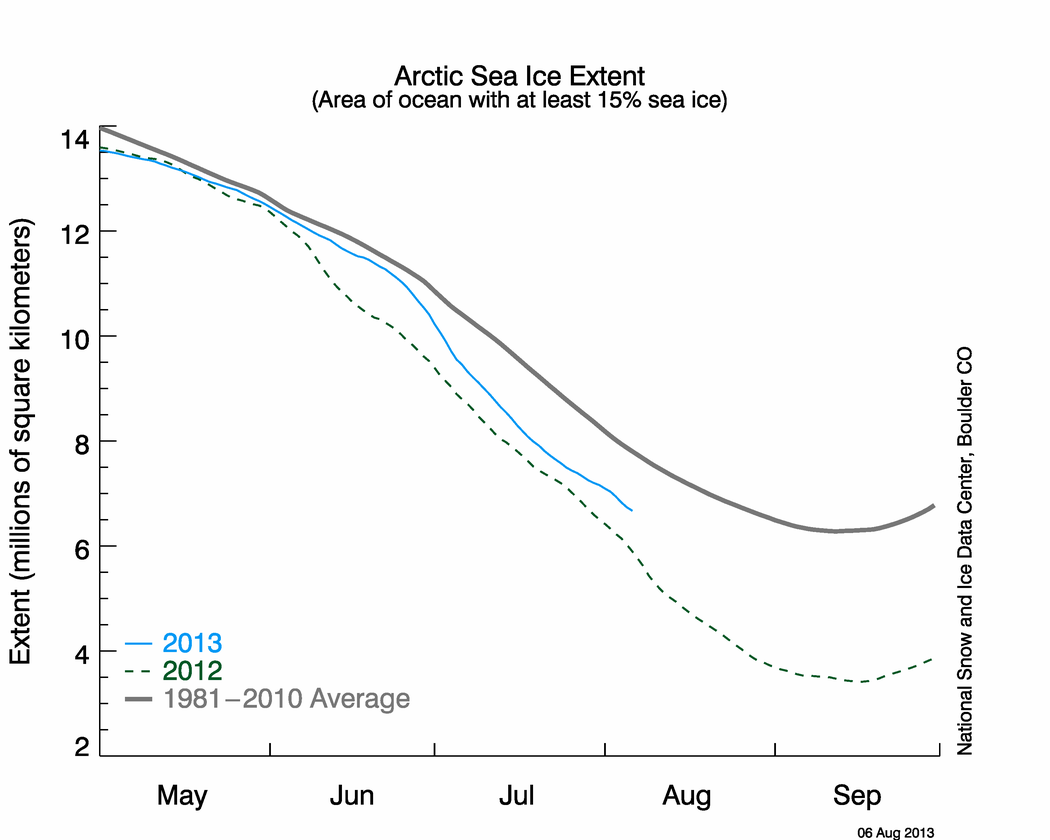
Al Gore calls it global warming. Bill Clinton calls it springtime. Others call it a death spiral, tipping point, or point of no return. Whatever you call it, the Arctic has started to melt and has lost about a million km2 of ice since the peak. The NSIDC graph below does not hide the decline.

http://nsidc.org/data/seaice_index/images/daily_images/N_timeseries.png
I just measured today’s NSIDC sea ice. It has passed the median line, though would require several similar days to appear in their moving average graph.


The image below shows where ice has melted and grown during the past 12 days. Areas in red have declined, and areas in green have increased in extent.

The decline in Bering Sea ice is due to much warmer air that has arrived this week. The sea of Okhotsk remains very cold and has gained some ice near the north end.

http://www.esrl.noaa.gov/psd/map/images/fnl/sfctmpmer_01a.fnl.anim.html
Sea ice remains nearly one million km2 ahead of 2007, and the map below shows where ice has gained and been lost relative to 2007. Green is growth, red is decline.

The map below shows areas of excess and deficient ice relative to the median. Green shows excess ice and red shows deficient. As of today, there is more excess ice than deficient ice. NSIDC uses a moving average, so it would take several days of similar conditions for it to show up in their graphs.

Five years ago, Steve Connor at The Independent feared that the Arctic had “irreversibly” “tipped” “past the point of no return”, but now it looks like the reports of the Arctic’s death were exaggerated.
But, you are not going to see any mention of that in the brain-dead MSM
Let’s have a weekly update on the sunspot situation as well. The sun has been spotless for a few days, but a weekly update of a graph of cycle 24 compared to others in history would be useful.
Luboš Motl points out this page:
http://www.campaigncc.org/node/384
where the anti-skeptics are organizing …
However, two can play at that game.
Now how will a high latitude volcanic eruption play into this? we are going to find out..
Joe Bastardi predicts a big melt this year. That’s my feeling too.
http://www.accuweather.com/world-bastardi-europe-blog.asp?partner=accuweather
(see THURSDAY 6 PM)
nandheeswaran jothi (09:38:15) :
But, you are not going to see any mention of that in the brain-dead MSM
The MSM is waiting for the official word from NSIDC, which we all know will only report on loss.
Expect their announcement to focus on the seasonal melt as though it were something “unprecedented”, like “It’s worse than we thought, we’ve lost over a million km2 of ice since the beginning of April”.
Richard Sharpe (09:46:03) :
Seems like it should be “septic alerts.”
Can you imagine anyone signing up to spend their time desperately trying to keep bad news alive? That could probably be described as a form of mental illness.
Your maps show ice in the Baltic south of the Danish islands. I doubt there is any by now. Detailed sat image of Denmark doesn’t how any….
TFN Johnson (09:45:45) :
Let’s have a weekly update on the sunspot situation as well. The sun has been spotless for a few days, but a weekly update of a graph of cycle 24 compared to others in history would be useful.
Leif does have some of this already.
http://www.leif.org/research/TSI-SORCE-2008-now.png
http://www.leif.org/research/F107%20at%20Minima%201954%20and%202008.png
Anthony, Steve,
Great stuff. Clear, straight-forward and to the point.
If the media types could/would simply copy and paste your Sea Ice News into their rags, their publications might be worth more than fish-wrap.
This is what is so confounding to me. The information is there… it’s available for all to see. You just have to open your eyes!
Thanks again to you, your contributors and mods for making WUWT a great place to learn and stay light-years ahead of those simply will not see or report on climate just as it is.
Douglas DC (09:48:55) :
If the wind reverses and the ash falls on Arctic ice, it could produce a lot of melting by lowering the albedo. I flew over western Greenland after the big melt summer of 2007, and the ice was extremely dirty with soot – or something similar.
Leif Svalgaard (10:04:32) :
All images are generated from NSIDC maps. If there is ice on the maps, it is because NSIDC reports it.
http://nsidc.org/data/seaice_index/images/daily_images/N_daily_extent.png
So every week, we’ll offer a summary of sea ice news.
I like it!
Who’s the real leader for Arctic Ice? WattsUpWithThat! That’s who!
Steve M. (10:06:17) :
Leif does have some of this already.
This plot shows cycle 24 in context of the previous three cycles:
http://www.leif.org/research/Active%20Region%20Count.png
The data plotted is what I call the ‘Active Region Count’, ARC. It is almost the same as the international sunspot number, in fact ARC is close to 3 * SSN. My definition of ARC is this:
“A count of days in each full month the region [if given a NOAA number] was visible, [and no more than 70 degrees from central meridian] and then summed for every region. Yearly smoothed values are also shown as the smoother curves. Different cycles are coded with a different color. The detailed figures show the transitions between cycles.”
The vertical cyan line goes through the ‘real minima’ where the count of the new cycle overtakes the count of the old cycle. It is interesting to look at the slope of the ascent. You can clearly see that it was large for SC22, a bit smaller for SC23, and smallest for SC24, indicating the expected strengths of the cycles [this is called Waldmeier’s law].
Now that SC24 has begun, I’ll update the graph once a week.
Then cycle 24 page is the best
Thanks for this update Steve. Very helpful.
I think it is also helpful when putting things in perspective to talk about what is really happening with the different areas you should point out for example that the big March “bump upward” which was caused by a short-term cold snap affecting primarily the Bering sea and created very thin ice that was only 4 to 12 inches thick, and just as quickly melted with the passage of the first few warm fronts, as shown in this graph:
http://arctic.atmos.uiuc.edu/cryosphere/IMAGES/recent365.anom.region.2.html
To suggest that the arctic sea ice is still not in peril is misleading. Certainly, the prediction made in Dec. 2007, by only one scientist, that the arctic would be ice free by 2013, was extreme, but prior to 2007, the AGW models were suggesting that arctic would be ice free in the summers by 2100, but now the range in more in the 2030 range. The point being, that predictions of sea ice made off of one month’s data, or one year, or even two or three years, is bound to be wrong. The longest reliable data we have is about 30 years, and the downward longer trend is quite clear, despite the recovery of 2008-2009, which I personally feel had many factors involved, not the least of which were La Nina and more importantly, the very long and deep solar minimum.
Finally, in your summaries, you probably ought to get as much sea ice mass information in them as well. Sea ice mass critical, as the thickness of the ice is so important in determining how fast it will be melting when the June, July, and August melting really gets underway. There is a great deal of very thin ice in many regions of the arctic after the warm winter in these regions, and I believe it will melt very fast this summer, and I stick to my prediction that the summer minimum will be less than 2008 or 2009, but not quite as low as 2007. I also believe, again based on long term charts and sea ice mass, that we will see a new summer low before 2015, and I think an ice free summer by 2030 is quite within the range of possibility. My only caveat is, and always has been the eruption of a Pinatubo level volcano, and certainly the Eyjafjallajokull eruption is not nearly that big yet, but if the nearby Katla volcano wakes up (as it has the last three times Eyjafjallajokull erupted)…then things could get interesting for sure…
Thanx, Steve M. But I’d like rather more explanation. Lief can be rather too technical for the average reader…..
And Antarctic Sea Ice Extent is currently slightly below “average”:
http://nsidc.org/data/seaice_index/images/daily_images/S_stddev_timeseries.png
These must be confusing days for the rapid sea ice decline crowd…
Joe Bastardi in 6 minute video from his blog on Arctic Ice and total sea ice:
“…..you can’t say if something is near normal that it’s, you know, in the tank and rapidly disappearing…..”
http://www.accuweather.com/video/76961658001/more-fun-with-sea-ice.asp?channel=vblog_bastardi
video that he mentions of him debating on The Colbert Report:
http://www.colbertnation.com/the-colbert-report-videos/269929/april-06-2010/science-catfight—joe-bastardi-vs–brenda-ekwurzel
I think this is an overkill. I am just waiting for the minimum ice extent in September. That is the only number which really matters. Last year, Environment Canada started it’s weekly reports of ice in the Canadian Arctic, which are quite interesting, on 14th May. http://ice-glaces.ec.gc.ca/app/WsvPageDsp.cfm?Id=11886&Lang=eng. So there is not that much longer to wait.
It’d be really interesting Anthony to see the 31 year satellite record plotted in a number of ways to see if there are any clear patterns of ice extent oscillations, be that in total extent, local changes etc etc.
Does anyone do that or is the data series still too short to show anything up?
The decline in Bering Sea ice is due to much warmer air that has arrived this week.
The Bering sea is showing some resilience to air temps.
http://polar.ncep.noaa.gov/sst/ophi/color_anomaly_NPS_ophi0.png
For solar activity, this is useful:
http://www.solen.info/solar/images/solar.gif
I’d guess that the top curve (measured solar flux) would be the one to watch if you like the “chilling stars” theory.
Thanx Leif: GR8, just what I need.
“To suggest that the arctic sea ice is still not in peril is misleading”
Keeping in mind that the climate is never static, can’t be static, shouldn’t be static……..
….if it was, we would not be here.
Never in the history of man, that I’m aware of, has a good thing been portrayed as such a catastrophe.