Forecasting The NSIDC News
By Steven Goddard and Anthony Watts
Barring an about face by nature or adjustments, it appears that for the first time since 2001, Arctic Sea ice will hit the “normal” line as defined by the National Snow and Ice Data Center (NSIDC) for this time of year.
NSIDC puts out an article about once a month called the Sea Ice News. It generally highlights any bad news they can find about the disappearance of Arctic ice. Last month’s news led with this sentence.
In February, Arctic sea ice extent continued to track below the average, and near the levels observed for February 2007.
But March brought good news for the Polar Bears, and bad news for the Catlin Expedition and any others looking for bad news. Instead of ice extent declining through March like it usually does, it continued to increase through the month and is now at the high (so far) for the year.
If it keeps this trend unabated, in a day or two it will likely cross the “normal” line.

The Danish Meteorological Institute shows Arctic ice extent at the highest level in their six year record.

The Norwegians (NORSEX) show Arctic ice area above the 30 year mean.

And the NORSEX Ice Extent is not far behind, within 1 standard deviation, and similar to NSIDC’s presentation. Note that is hit normal last year, but later.

And JAXA, using the more advanced AMSR-E sensor platform on the AQUA satellite, shows a similar uptick now intersecting the 2003 data line.

Source: IARC-JAXA
WUWT asked NSIDC scientist Dr. Walt Meir about this event to which he responded via email:
It’s a good question about the last time we’ve been above average. It was May 2001. April-May is the period when you’re starting to get into the peak of the melt season for the regions outside of the Arctic Ocean (Bering Sea, Hudson Bay) and the extent tends to have lower variability compared to other parts of the year as that thinner ice tends to go about the same time of year due to the solar heating. Even last year, we came fairly close to the average in early May.
He also mused about a cause:
Basically, it is due primarily to a lot more ice in the Bering Sea, as is evident in the images. The Bering ice is controlled largely by local winds, temperatures are not as important (though of course it still need to be at or at least near freezing to have ice an area for any length of time). We’ve seen a lot of northerly winds this winter in the Bering, particularly the last couple of weeks.
As we’ve been saying on WUWT for quite some time, wind seems to be a more powerful factor in recent sea ice declines than temperature. Recent studies agree.
See: Winds are Dominant Cause of Greenland and West Antarctic Ice Sheet Losses and also NASA Sees Arctic Ocean Circulation Do an About-Face
You can watch wind patterns in this time lapse animation, note how the ice has been pushed by winds and flowing down the east coast of Greenland:

Dr. Meier also wrote:
This has very little implication for what will happen this summer, or for the long-term trends, since the Bering Sea ice is thin and will melt completely well before the peak summer season.
There’s certainly no reason to disagree with the idea that much of the Bering Sea ice will melt this summer, it happens every year and has for millenia. But with a strong negative Arctic Oscillation this year, and a change in the wind, it is yet to be determined if Arctic Sea ice minimum for 2010 is anomalously low, and/or delayed from the usual time.
In 2009, WUWT noted it on September 15th: Arctic sea ice melt appears to have turned the corner for 2009
Dr. Mark Serreze of NSIDC offered some hopeful commentary in a press release back on October 6th 2009, but still pushes that “ice free summer” meme:
“It’s nice to see a little recovery over the past couple of years, but there’s no reason to think that we’re headed back to conditions seen in the 1970s,” said NSIDC Director Mark Serreze, also a professor in CU-Boulder’s geography department. “We still expect to see ice-free summers sometime in the next few decades.”
Remember this 2007 prediction from The Naval Postgraduate School?
Arctic summers ice-free ‘by 2013’
|
By Jonathan Amos
Science reporter, BBC News, San Francisco |

 |
 Arctic summer melting in 2007 set new records
|

 More details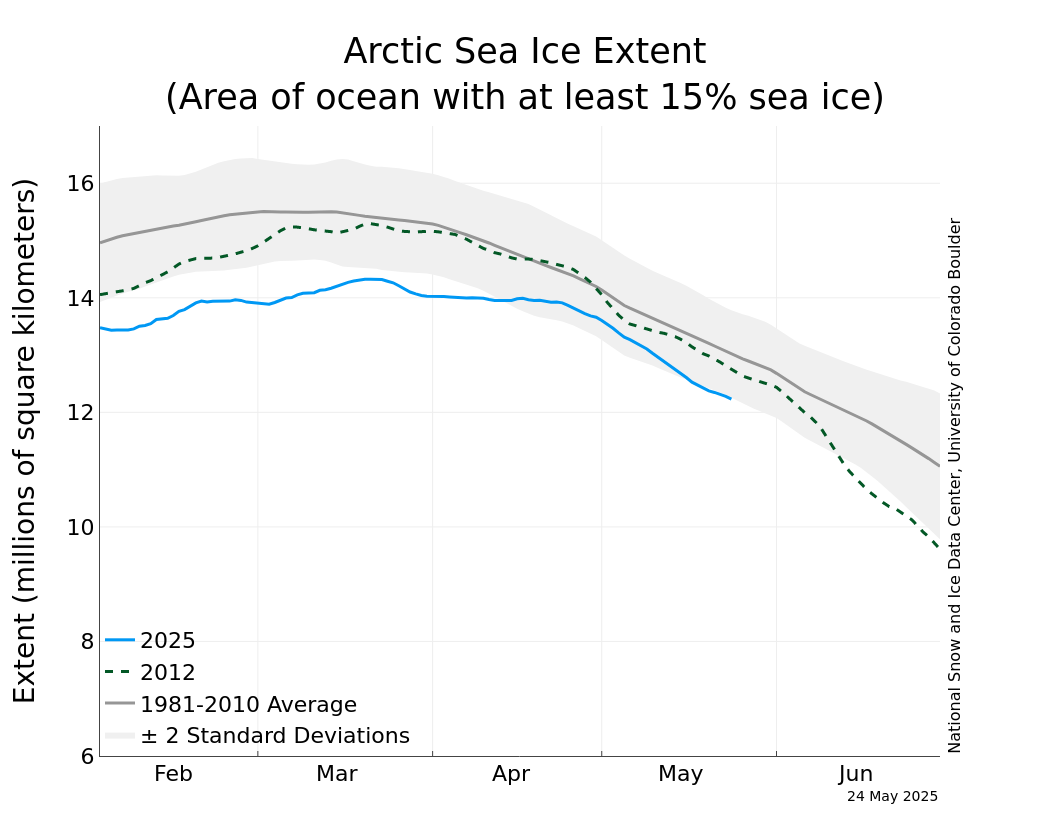

Scientists in the US have presented one of the most dramatic forecasts yet for the disappearance of Arctic sea ice.
Their latest modelling studies indicate northern polar waters could be ice-free in summers within just 5-6 years.
Professor Wieslaw Maslowski told an American Geophysical Union meeting that previous projections had underestimated the processes now driving ice loss.
Summer melting this year reduced the ice cover to 4.13 million sq km, the smallest ever extent in modern times.
Remarkably, this stunning low point was not even incorporated into the model runs of Professor Maslowski and his team, which used data sets from 1979 to 2004 to constrain their future projections.
|
 In the end, it will just melt away quite suddenly In the end, it will just melt away quite suddenly  Professor Peter Wadhams
|
“Our projection of 2013 for the removal of ice in summer is not accounting for the last two minima, in 2005 and 2007,” the researcher from the Naval Postgraduate School, Monterey, California, explained to the BBC.”So given that fact, you can argue that may be our projection of 2013 is already too conservative.”
========================================
Joe Romm wrote up a clever piece last year on this subject:
Exclusive: New NSIDC director Serreze explains the “death spiral” of Arctic ice, brushes off the “breathtaking ignorance” of blogs like WattsUpWithThat
June 5, 2009
I interviewed by email Dr. Mark Serreze, recently named director of The National Snow and Ice Data Center. Partly I wanted him to explain his “death spiral” metaphor for Arctic ice
So now that Arctic ice has returned to normal extent and area, we eagerly await the explanation from the experts about how that fits into the “death spiral” theory. Richard Feynman famously said “Science is the belief in the ignorance of the experts.”
Time will tell. 2010 is looking promising for sea ice recovery again. After all, who wouldn’t want the Arctic Sea ice to recover? WUWT is predicting a recovery again this year, which we started mentioning as a prediction last fall.
So given what we know today, what will NSIDC highlight in their April Sea Ice News?
And even more importantly, will the MSM cover it like they do the ‘terrible’ minimums?
NOTE: The poll code got messed up, duplicating an entry, press REFRESH if you see a double entry. -A
Forecasting The NSIDC News
NSIDC puts out an article about once a month called the Sea Ice News. It generally highlights any bad news they can find about the disappearance of Arctic ice. Last month’s news led with this sentence.
In February, Arctic sea ice extent continued to track below the average, and near the levels observed for February 2007.
But March brought good news for the Polar Bears, and bad news for the Catlin Expedition and any others looking for bad news. Instead of ice extent declining through March like it usually does, it continued to increase through the month and is now at the high (so far) for the year.
http://nsidc.org/data/seaice_index/images/daily_images/N_stddev_timeseries.png
The Danish Meteorological Institute shows Arctic ice extent at the highest level in their six year record.
The Norwegians (NORSEX) show Arctic ice area above the 30 year mean.
Joe Romm wrote up a clever piece last year on this subject:
Exclusive: New NSIDC director Serreze explains the “death spiral” of Arctic ice, brushes off the “breathtaking ignorance” of blogs like WattsUpWithThat
June 5, 2009
I interviewed by email Dr. Mark Serreze, recently named director of The National Snow and Ice Data Center. Partly I wanted him to explain his “death spiral” metaphor for Arctic ice
So now that Arctic ice has returned to normal extent and area, I eagerly await the explanation from the experts about how that fits into the “death spiral” theory. Richard Feynman famously said “Science is the belief in the ignorance of the experts.”
So what will NSIDC highlight in their April Sea Ice News?
-
The increase in both ice extent and quantity of multi-year ice
-
The long-term downwards linear trend line
-
The lack of 4+ year old ice
Sponsored IT training links:
Get free resources including 642-972 tutorial and 1z0-048 dumps questions for guaranteed success in JN0-532 exam.
Steve Goddard: “But geologic history shows us unequivocally that climate is cyclical and dominated by negative feedbacks.”
Hmm. Enlighten me: what sort of negative feedbacks are causing the Arctic sea ice to rebound to near-normal? Maybe its just weather, as you like to point out. What about the more frightening trend in ice thickness? Here’s two recent papers, no paywall:
Lindsay 2009
Kwok 2009
pat (18:51:03) :
The loss of sea ice in 2007 was indeed precipitous. But the recovery in 2008 was equally steep.
————–
Yeah, that was a huge jump in summer ice extent from 2007 to 2008:
http://arctic.atmos.uiuc.edu/cryosphere/IMAGES/seasonal.extent.1900-2008.jpg
(that last little green uptick).
Of course, there is a big difference between “extent” and actual “area”:
http://images.buycostumes.com/mgen/merchandiser/32138.jpg
It’s when the sea ice area is down to 0 sq km that the Arctic summer ice is gone. Even 600,000 sq km of sea ice area could yield an “extent” of 4 million sq km if the floes are spaced out just right. And if the winds are wrong, that 4 million sq km “extent” could collapse into 2 million sq km of more tightly packed ice.
So, how is the Arctic sea ice area doing ?
http://arctic.atmos.uiuc.edu/cryosphere/IMAGES/seaice.recent.arctic.png
Summer minimums have been way below the 1979-2008 mean. Let’s see what summer 2010 brings…
Anecdotal evidence suggests the 1930’s may have been more ice free than today, not to mention the MWP.
It also suggests that submarines surfaced in polynyas that appear in the North Pole. As for the MWP, who knows?
But geologic history shows us unequivocally that climate is cyclical and dominated by negative feedbacks.
Negative feedbacks bring stability. How do we get ice ages/interlgacials if negative feedbacks dominate?
(Unless you think the opposite to a negative feedback is a runaway effect?)
jose (22:06:59) :
Open water at the poles means more heat loss to the atmosphere – i.e. cooling. That is a negative feedback.
AndyW (21:55:18) :
If you remember correctly, the summer 2009 minimum was about 15% higher than summer 2008 and 30% higher than summer 2007. Those are rather impressive gains, and will continue this summer.
http://ocean.dmi.dk/arctic/icecover.uk.php
According to AGW climate scientists climate is 30 years +. In 2007 we had record loss of Arctic ice, caused mostly by wind and currents (since satellite data – 1979) and warmists were “excited” about the loss and it was trumpeted around the globe as a sign of global warming – ‘worse than we thought’.
I understood that an increasing trend was behind that concern not from a single year. Do you have a cite from reputable (or disreputable) climate scientists?
Anu (22:25:14) :
You asked “So, how is the Arctic sea ice area doing ?”
It is nearly one standard deviation above the mean – i.e. close to unusually high.
http://arctic-roos.org/observations/satellite-data/sea-ice/observation_images/ssmi1_ice_area.png
All you non-skeptics should read this post from last April.
http://wattsupwiththat.com/2009/04/15/why-third-year-arctic-ice-will-increase-next-year/
The UK experts say that snowfall is a thing of the past.
http://www.timesonline.co.uk/multimedia/archive/00703/Penicuick_585x350_703520a.jpg
At least after Easter.
Sorry, Anu, I am willing to accept current information from Cryosphere as useful data. However, anyone who uses that 1900-2008 chart loses credibility in my eyes. That chart contains arbitrary and capricious decisions on pre-satellite data — producing levels that are contrary to recorded observations. Its documentation even warns about its reliability.
At JAXA 2010 has just collided with 2003.
http://www.ijis.iarc.uaf.edu/en/home/seaice_extent.htm
Benjamin P. (18:07:19) :
area vs volume?
………………………………………………………………………………………………………
Volume you say? We can Spinal Tap it past 10 it up to 11: i.e., 2010 has just crashed into 2003, its previous maximum at this date!
Steve Goddard (23:16:55) :
The UK experts say that snowfall is a thing of the past.
http://www.timesonline.co.uk/multimedia/archive/00703/Penicuick_585×350_703520a.jpg
At least after Easter.
Is that photo from today?
Amino Acids in Meteorites (23:33:57) :
Yes, the snow photo is from the April 1 Times.
Open water at the poles means more heat loss to the atmosphere – i.e. cooling. That is a negative feedback.
Ice has a very high albedo, reflecting solar radiation. Water is darker than snow (and land albedo, on average). Decreased albedo means more warming. It becomes a numbers game between the negative/positive feedback. Which dominates…?
During deglaciation, the planet warmed – as ice sheets receded. If negative feedbacks dominated in polar regions receiving increased insolation, why didn’t the ice sheet increase?
As insolation changes are very small, and if ice decrease provides negative feedback to temps, that suggests an even greater contribution from other forcings, like greenhouse gases.
I know what a negative feedback is, and that they exist in the biosphere, but you said they ‘dominate’. If they do, as in the example you gave, ice ages shouldn’t happen.
With the sea ice deficit mainly in the Canadian Maritime area and a surplus in the Bering sea, we may see the sea ice extent near, or even above, the average for quite some time. There’s a good chance that the average extent for all of April will be near the 1979-2000 value. This summer could turn into a real body-blow to the AGW preachers.
And it couldn’t happen to a nicer bunch of guys, I say.
But, I also expect the NSIDC to play this pretty straight. They’ve always shown the highest standards of professionalism — even doing guest posts here. If your poll ends up with over 90% way off the mark, some kind of acknowledgment of that might be good.
The UK experts say that snowfall is a thing of the past.
That’s not what they said. That’s a press headline.
(The link is broken)
70’s it the highest point. Why everything went down so quickly? We do need to think about it.
What we can do? Are there any body can tell people and government what we should do and can do?
I blundered here…
“During deglaciation, the planet warmed – as ice sheets receded. If negative feedbacks dominated in polar regions receiving increased insolation, why didn’t the ice sheet increase?”
Should be – “why did the ice sheets decrease so drastically?”
Oops. Seems your peripheral vision isn’t too hot on the right side. You completely missed what was happening to Antarctic ice.
http://nsidc.org/data/seaice_index/daily.html
REPLY: Actually no, we broached the subject (with the southern sea ice graph) a few days back and commented on it, check the previous posts -A
”Phil. (18:04:26) :
As CT shows ice area has continued to fall since the max on March 7th, since then the strong outflow through the Fram and around Svalbard, currently up to ~20km/day, is what’s causing the increase in extent.”
Good try, but it cuts no ice so to speak. The increase in recent weeks has been mostly in the Barents Sea, Bering Sea and the Sea of Okhotsk.
Hide the decline !
Phil. (21:22:02) : “Take a look it’s not new ice it’s fragmented older ice:
http://rapidfire.sci.gsfc.nasa.gov/realtime/single.php?2010090/crefl1_143.A2010090135000-2010090135500.500m.jpg
That pic is very hard to make out. Anyway, any new ice is bound to have fragments of the old. It’s kind of you, Phil, to fend off premature celebrations of ice recovery, but you’ll agree the proof is definitely in the pudding. Onwards to the summer minimum.