Forecasting The NSIDC News
By Steven Goddard and Anthony Watts
Barring an about face by nature or adjustments, it appears that for the first time since 2001, Arctic Sea ice will hit the “normal” line as defined by the National Snow and Ice Data Center (NSIDC) for this time of year.
NSIDC puts out an article about once a month called the Sea Ice News. It generally highlights any bad news they can find about the disappearance of Arctic ice. Last month’s news led with this sentence.
In February, Arctic sea ice extent continued to track below the average, and near the levels observed for February 2007.
But March brought good news for the Polar Bears, and bad news for the Catlin Expedition and any others looking for bad news. Instead of ice extent declining through March like it usually does, it continued to increase through the month and is now at the high (so far) for the year.
If it keeps this trend unabated, in a day or two it will likely cross the “normal” line.

The Danish Meteorological Institute shows Arctic ice extent at the highest level in their six year record.

The Norwegians (NORSEX) show Arctic ice area above the 30 year mean.

And the NORSEX Ice Extent is not far behind, within 1 standard deviation, and similar to NSIDC’s presentation. Note that is hit normal last year, but later.

And JAXA, using the more advanced AMSR-E sensor platform on the AQUA satellite, shows a similar uptick now intersecting the 2003 data line.

Source: IARC-JAXA
WUWT asked NSIDC scientist Dr. Walt Meir about this event to which he responded via email:
It’s a good question about the last time we’ve been above average. It was May 2001. April-May is the period when you’re starting to get into the peak of the melt season for the regions outside of the Arctic Ocean (Bering Sea, Hudson Bay) and the extent tends to have lower variability compared to other parts of the year as that thinner ice tends to go about the same time of year due to the solar heating. Even last year, we came fairly close to the average in early May.
He also mused about a cause:
Basically, it is due primarily to a lot more ice in the Bering Sea, as is evident in the images. The Bering ice is controlled largely by local winds, temperatures are not as important (though of course it still need to be at or at least near freezing to have ice an area for any length of time). We’ve seen a lot of northerly winds this winter in the Bering, particularly the last couple of weeks.
As we’ve been saying on WUWT for quite some time, wind seems to be a more powerful factor in recent sea ice declines than temperature. Recent studies agree.
See: Winds are Dominant Cause of Greenland and West Antarctic Ice Sheet Losses and also NASA Sees Arctic Ocean Circulation Do an About-Face
You can watch wind patterns in this time lapse animation, note how the ice has been pushed by winds and flowing down the east coast of Greenland:

Dr. Meier also wrote:
This has very little implication for what will happen this summer, or for the long-term trends, since the Bering Sea ice is thin and will melt completely well before the peak summer season.
There’s certainly no reason to disagree with the idea that much of the Bering Sea ice will melt this summer, it happens every year and has for millenia. But with a strong negative Arctic Oscillation this year, and a change in the wind, it is yet to be determined if Arctic Sea ice minimum for 2010 is anomalously low, and/or delayed from the usual time.
In 2009, WUWT noted it on September 15th: Arctic sea ice melt appears to have turned the corner for 2009
Dr. Mark Serreze of NSIDC offered some hopeful commentary in a press release back on October 6th 2009, but still pushes that “ice free summer” meme:
“It’s nice to see a little recovery over the past couple of years, but there’s no reason to think that we’re headed back to conditions seen in the 1970s,” said NSIDC Director Mark Serreze, also a professor in CU-Boulder’s geography department. “We still expect to see ice-free summers sometime in the next few decades.”
Remember this 2007 prediction from The Naval Postgraduate School?
Arctic summers ice-free ‘by 2013’
|
By Jonathan Amos
Science reporter, BBC News, San Francisco |

 |
 Arctic summer melting in 2007 set new records
|

 More details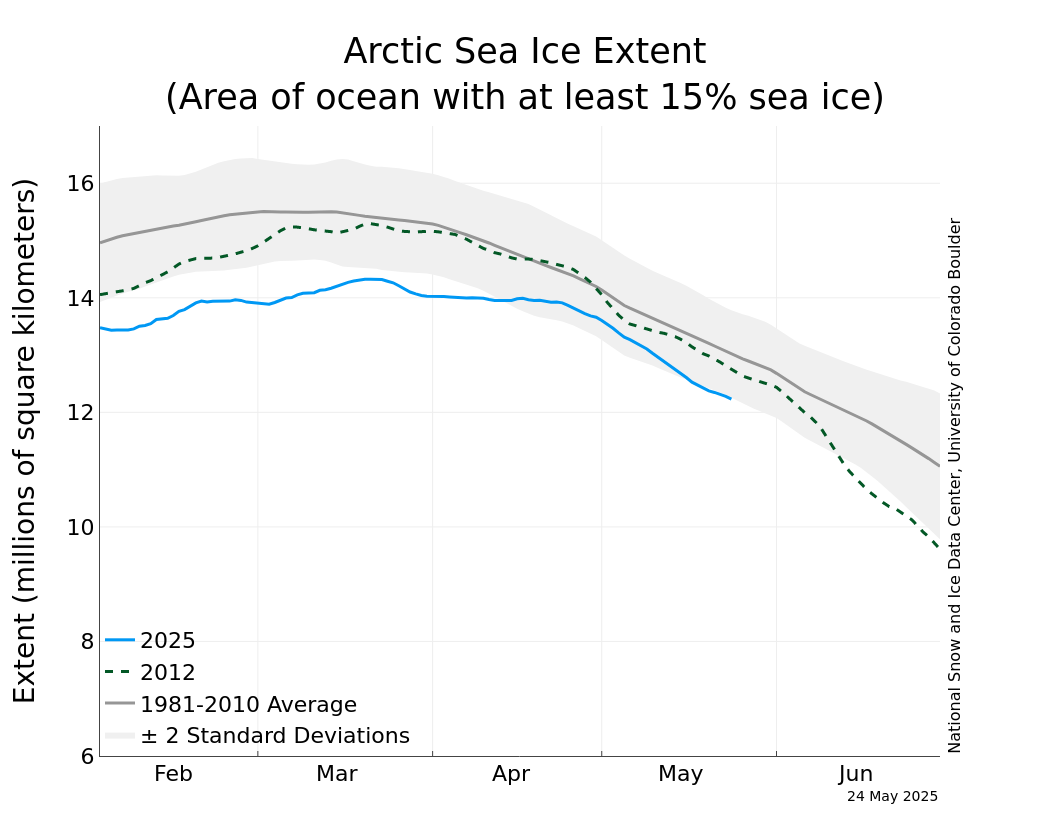

Scientists in the US have presented one of the most dramatic forecasts yet for the disappearance of Arctic sea ice.
Their latest modelling studies indicate northern polar waters could be ice-free in summers within just 5-6 years.
Professor Wieslaw Maslowski told an American Geophysical Union meeting that previous projections had underestimated the processes now driving ice loss.
Summer melting this year reduced the ice cover to 4.13 million sq km, the smallest ever extent in modern times.
Remarkably, this stunning low point was not even incorporated into the model runs of Professor Maslowski and his team, which used data sets from 1979 to 2004 to constrain their future projections.
|
 In the end, it will just melt away quite suddenly In the end, it will just melt away quite suddenly  Professor Peter Wadhams
|
“Our projection of 2013 for the removal of ice in summer is not accounting for the last two minima, in 2005 and 2007,” the researcher from the Naval Postgraduate School, Monterey, California, explained to the BBC.”So given that fact, you can argue that may be our projection of 2013 is already too conservative.”
========================================
Joe Romm wrote up a clever piece last year on this subject:
Exclusive: New NSIDC director Serreze explains the “death spiral” of Arctic ice, brushes off the “breathtaking ignorance” of blogs like WattsUpWithThat
June 5, 2009
I interviewed by email Dr. Mark Serreze, recently named director of The National Snow and Ice Data Center. Partly I wanted him to explain his “death spiral” metaphor for Arctic ice
So now that Arctic ice has returned to normal extent and area, we eagerly await the explanation from the experts about how that fits into the “death spiral” theory. Richard Feynman famously said “Science is the belief in the ignorance of the experts.”
Time will tell. 2010 is looking promising for sea ice recovery again. After all, who wouldn’t want the Arctic Sea ice to recover? WUWT is predicting a recovery again this year, which we started mentioning as a prediction last fall.
So given what we know today, what will NSIDC highlight in their April Sea Ice News?
And even more importantly, will the MSM cover it like they do the ‘terrible’ minimums?
NOTE: The poll code got messed up, duplicating an entry, press REFRESH if you see a double entry. -A
Forecasting The NSIDC News
NSIDC puts out an article about once a month called the Sea Ice News. It generally highlights any bad news they can find about the disappearance of Arctic ice. Last month’s news led with this sentence.
In February, Arctic sea ice extent continued to track below the average, and near the levels observed for February 2007.
But March brought good news for the Polar Bears, and bad news for the Catlin Expedition and any others looking for bad news. Instead of ice extent declining through March like it usually does, it continued to increase through the month and is now at the high (so far) for the year.
http://nsidc.org/data/seaice_index/images/daily_images/N_stddev_timeseries.png
The Danish Meteorological Institute shows Arctic ice extent at the highest level in their six year record.
The Norwegians (NORSEX) show Arctic ice area above the 30 year mean.
Joe Romm wrote up a clever piece last year on this subject:
Exclusive: New NSIDC director Serreze explains the “death spiral” of Arctic ice, brushes off the “breathtaking ignorance” of blogs like WattsUpWithThat
June 5, 2009
I interviewed by email Dr. Mark Serreze, recently named director of The National Snow and Ice Data Center. Partly I wanted him to explain his “death spiral” metaphor for Arctic ice
So now that Arctic ice has returned to normal extent and area, I eagerly await the explanation from the experts about how that fits into the “death spiral” theory. Richard Feynman famously said “Science is the belief in the ignorance of the experts.”
So what will NSIDC highlight in their April Sea Ice News?
-
The increase in both ice extent and quantity of multi-year ice
-
The long-term downwards linear trend line
-
The lack of 4+ year old ice
Sponsored IT training links:
Get free resources including 642-972 tutorial and 1z0-048 dumps questions for guaranteed success in JN0-532 exam.
barry (23:50:39) :
contribution from other forcings, like greenhouse gases.
…………………………………………………………………………………………………………..
What kind of an effect does the greenhouse gas H2O have?
Have you seen this 2 part video series?
Part 1
Part 2
Clouds have a negative feedback.
Steve Goddard (05:57:29) :
http://nsidc.org/data/seaice_index/images/daily_images/N_daily_extent.png
I can see that the area in Eastern Canada that is below the 1979–2000 median line is in an area that El Nino traditionally affects with warmth (Vancouver is also in one of the warm areas)
as seen here:
http://jrscience.wcp.muohio.edu/studentresearch/climatechange03/elnino/weather%20patterns.jpg
El Nino should be over by next winter’s (2010/11) freeze. It seems likely that that same area in Eastern Canada will have more ice next year. The trend of growth in Arctic ice should continue next year.
Steve Goddard (06:07:19) :
From 10 years ago:
According to Dr David Viner, a senior research scientist at the climatic research unit (CRU) of the University of East Anglia,within a few years winter snowfall will become “a very rare and exciting event”. “Children just aren’t going to know what snow is,” he said.
…………………………………………………………………………………………………………………
Now here’s a man that never takes his eyes off the grant money and looks out the window.
The NSIDC April report will focus on the fact that last decade showed the lowest average sea-ice compared to every other decade on record.
Compared to the last Ice Age, there’s hardly any ice left!
R Gates
I can’t argue much here but I would like to point out that given the length of the record a new record by 2015 is very likely. In fact random chance would suggest that the likelihood is on the order of 60% wouldn’t it? This is assuming there is no actual trend at all. There is no such thing as a “long term trend” here. There is no long term data with consistent method to work from.
I wonder what Arctic Extent will look like for April 1? Yesterday it was: 14,407,344 km2.
GORE NOW WITH SEAL BLOOD ON HIS HANDS! I so ashamed that I listened to him and traded in my Hummer for a Prius.
R. Gates (07:14:52) :
The “little bump upwards” you refer to for March was about a million km2 – about the size of Texas and California combined.
http://nsidc.org/data/seaice_index/images/daily_images/N_timeseries.png
Today’s graph is oh so close to the “Normal” line. With any luck we will hit it by Good Friday (That would be a good Friday).
R. Gates (07:14:52) :
What are you talking about? There is no long downward trend. There is in fact a short (3 year) upward trend. Maybe you are confusing things. I think the message from this bump is that El Nino has artificialy depressed this years maximum sea ice extent. As El Nino is fading, the ice is now rebounding some what, even though this is traditionaly the begining of melt season.
Amino Acids in Meteorites (07:36:03)
During the late 1990s, winters were very warm in the UK. This led a lot of people to believe Hansen’s claims that CO2 increases were leading to linear/exponential warming. Myself included. I was a global warming believer until about four years ago, when I started looking at the facts for myself.
Looks like there is zero possibility of sea ice not reaching the cherry picked 79-00 average now. How is THAT for an April Fool’s Day joke on the AGWers? And I will futilely wait for the MSM to report on this tomorrow.
“New Ice Age has started as predicted in the 1970’s”… Could be the headline they all go for.
So cold, will summer ever return to the UK?
Steve Goddard: “Open water at the poles means more heat loss to the atmosphere – i.e. cooling. That is a negative feedback.”
What is cooling? The ocean? Doesn’t this mean that the atmosphere receiving the heat is warming? Doesn’t that mean warmer air temperatures and even less sea ice? That’s a positive feedback.
It is only since February that the ice extent has started to return to normal. This has nothing to do with feedbacks (which in your flawed example would only work during the ice formation period anyways), and everything to do with the weather conditions of this winter. I would submit that the strong AO has everything to do with the current ice extent.
Check out this line from Rigor et al, 2001: “Here it is shown that the memory of the wintertime AO persists through most of the subsequent year: spring and autumn SAT and summertime sea-ice concentration are all strongly correlated with the AO-index for the previous winter.”
Amino Acids in Meteorites (07:36:03) :
Steve Goddard (06:07:19) :
From 10 years ago:
According to Dr David Viner, a senior research scientist at the climatic research unit (CRU) of the University of East Anglia,within a few years winter snowfall will become “a very rare and exciting event”. “Children just aren’t going to know what snow is,” he said.
…………………………………………………………………………………………………………………
Now here’s a man that never takes his eyes off the grant money and looks out the window.
In fairness to Viner Steve did omit the second part of the quote: “Heavy snow will return occasionally, says Dr Viner, but when it does we will be unprepared. “We’re really going to get caught out. Snow will probably cause chaos in 20 years time,” he said.
Seems rather accurate to me (just a little earlier than he thought).
Me too: “Science is the belief in the ignorance of the experts.” The sky is falling, the sky is falling says Duck Little. If everyone had half a brain they would see that there is no such thing as a warming trend that humans are responsible for, itis merely a means of “World Wealth Redistribution”, PLAIN AND SIMPLE. Wake up Simpletons of Earth!
Question: how is the warmest February on record, so-said because of extreme conditions in the Arctic, co-incident with a significant increase in new ice? I think this is known as a “rhetorical question”, as I would answer that the Arctic temperatures are artifacts of corrections and averaging. Still, does this “divergence” of situations have a warmist explanation? Perhaps Al Gore was visiting, and The Effect is responsible. So many mysteries.
It’s not unusual at all, just predictable human behavior. It’s like people watching a marathon, the biggest cheers happen at the finish line.
Agreed that the 30 year mean is just a ‘line in the sand’ but then finish lines in any race are arbitary aren’t they?
How much do you want to stretch your finish line? Another ten years? Careful, don’t forget that that will then push the mean curve downward a little by including the last 3 years that are currently not represented in http://arctic-roos.org/observations/satellite-data/sea-ice/observation_images/ssmi1_ice_ext.png
(And also don’t forget that ‘stretching the finish line’ is becoming a predictable asylum for CAGW believers: “Yeah, well just wait another 100 years and we better enact cap and trade just to be safe in the meantime.” )
OK, the first report of the sea ice turning downward is here:
http://ocean.dmi.dk/arctic/icecover.uk.php
It had to happen some time but it sure has been a great run.
However, tomorrow’s NSIDC plot may make folks suspicious. Their smoothing algorithm often makes retroactive changes to the graph. If, tomorrow, this graph:
http://nsidc.org/data/seaice_index/images/daily_images/N_stddev_timeseries.png
looks like they “revised away” today’s peak, don’t have a cow. This is normal for their smoothing algorithm. They use more smoothing than other sources; that’s why their graph is less jagged. It’s perfectly valid and it would be unfortunate if the newer ice watchers here started howling about some kind of cover-up.
jose (08:40:35) :
The heat capacity of the oceans is vastly greater than the air. Air temperatures in the desert can rise 70 degrees in a matter of hours.
Phil. (08:43:38) :
The 2009-2010 UK winter has not been defined by a “heavy snowfall.” It has been defined by persistent cold and snow over a five month period. 2008 also saw the first October snowfall in decades.
How about the Albedo effect?
All of Eastern Europe was under snow and fully reflective until just a couple of weeks ago, and I daresay much of Russia was much the same (and eastern Canada?)
In terms of Europe, this was a very late season, and all that snow must have considerably reduced the amount of incoming energy that was supposed to warm the land for the spring season. Less warmth in the N Hemisphere equals more ice up north.
Re: Tina (23:55:30) :
We do not know that the 70s were the apex. We do not have data before that. Perhaps the 70s are an anomoly? That would tend to support the old salts of the Nuclear navy that have anecdotal stories (from the 50s and 60s) of Polar ice being gone in the summer (at least around what is acknowledged to be the North Pole).
Steve:
Who’s talking about deserts? The historical trend towards decreasing summer sea ice extents will release huge amounts of energy to the Arctic atmosphere. As the heat leaves the ocean, it warms the air. Warmer air = less sea ice. This is a positive feedback. Please try and tell me again how its negative.