First, we pointed this out quite some time ago. See: Winds are Dominant Cause of Greenland and West Antarctic Ice Sheet Losses and also NASA Sees Arctic Ocean Circulation Do an About-Face
Second I’m pleased to see the Guardian finally catching on.You can watch wind patterns in this time lapse animation:

From the Guardian:
Wind contributing to Arctic sea ice loss, study finds
New research does not question climate change is also melting ice in the Arctic, but finds wind patterns explain steep decline.
Much of the record breaking loss of ice in the Arctic ocean in recent years is down to the region’s swirling winds and is not a direct result of global warming, a new study reveals.
Ice blown out of the region by Arctic winds can explain around one-third of the steep downward trend in sea ice extent in the region since 1979, the scientists say.
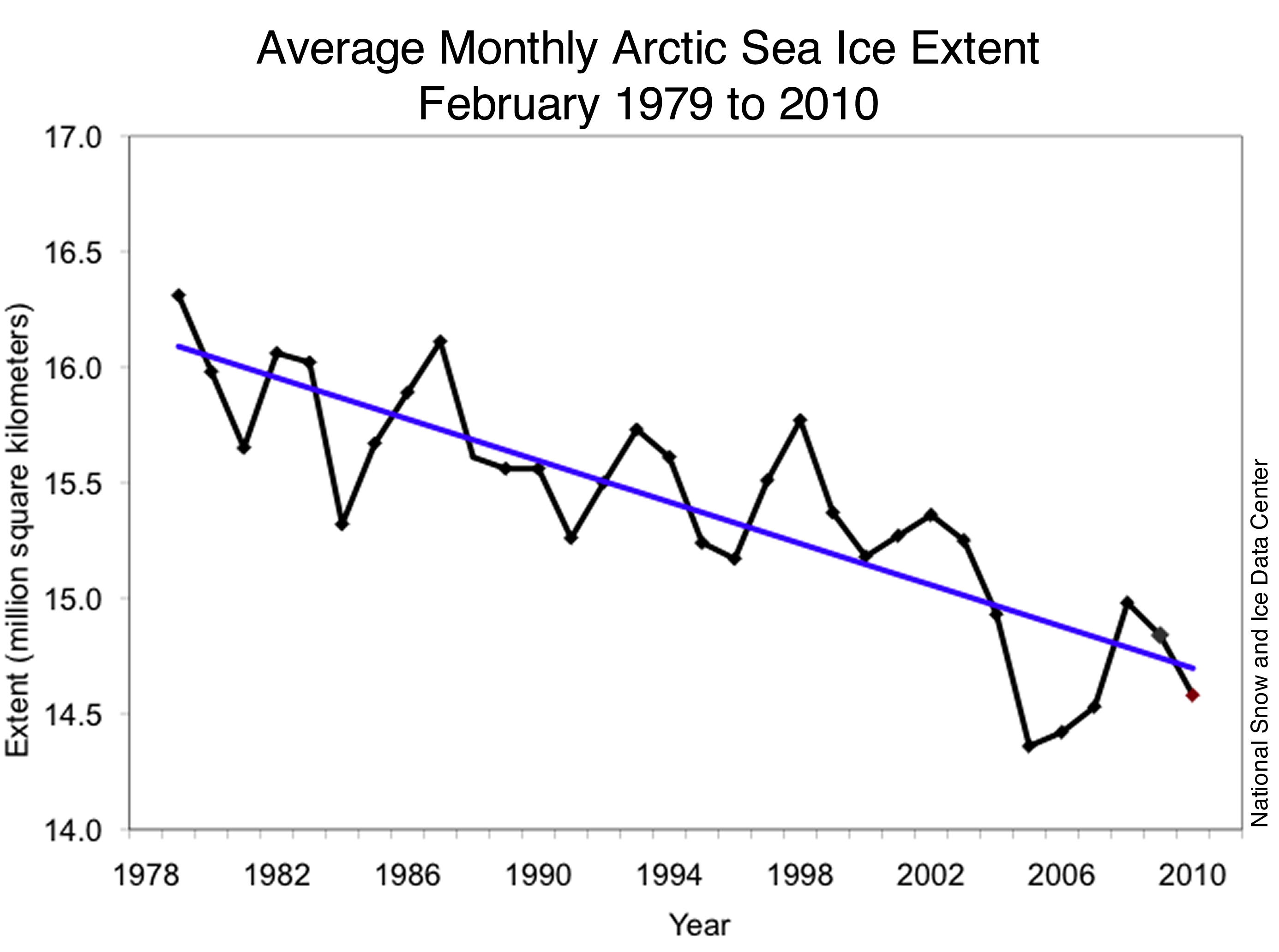
The study does not question that global warming is also melting ice in the Arctic, but it could raise doubts about high-profile claims that the region has passed a climate “tipping point” that could see ice loss sharply accelerate in coming years.
The new findings also help to explain the massive loss of Arctic ice seen in the summers of 2007-08, which prompted suggestions that the summertime Arctic Ocean could be ice-free withing a decade. About half of the variation in maximum ice loss each September is down to changes in wind patterns, the study says.
Masayo Ogi, a scientist with the Japan Agency for Marine-Earth Science and Technology in Yokohama, and her colleagues, looked at records of how winds have behaved across the Arctic since satellite measurements of ice extent there began in 1979.
They found that changes in wind patterns, such as summertime winds that blow clockwise around the Beaufort Sea, seemed to coincide with years where sea ice loss was highest.
Writing in a paper to be published in the journal Geophysical Research Letters, the scientists suggest these winds have blown large amounts of Arctic ice south through the Fram Strait, which passes between Greenland and the Norwegian islands of Svalbard, and leads to the warmer waters of the north Atlantic. These winds have increased recently, which could help explain the apparent acceleration in ice loss.
…
read the complete story at the Guardian
Jeff in Ctown (Canada) (10:28:39) :
Chris G
Please give us some refferences as to the people using the North West Passage. I have not heard these stories. The only ones I hear are either ice breakers (hardly qualifies), or people getting stuck in the pack ice. The NE passage on the other had, has been used off and on for a long time.
—————-
Cruise ships can now make it through the North West Passage.
http://www.mycruiseblog.co.uk/blog/_archives/2007/9/5/3208677.html
The German Hanseatic cruise ship is not an icebreaker, but it is an “ice-strengthened” cruise ship:
http://www.travelserver.net/travelpage/ubb-bin/ultimatebb.cgi?ubb=get_topic&f=1&t=010019&p=3
ICE-1A* – Vessel which may operate in channels prepared by icebreakers and/or in open waters with smaller ice floes. Extreme ice conditions. Ice floes of thickness 1.0 m are anticipated
http://www.cruisemates.com/ships/more-ships/hanseatic.html
George E. Smith (11:08:28) :
“Well Vukcevic, I too am quite partial to books on dead tree. I simply cannot read online texts, or manuals, help notes or anything else, so If I have to look for it on line, I still have to print it to be able to read it.”
Hi Mr.Smith
It is a pithy that some of the stuff , most notably Google books, cannot be printed directly. I normally hit ‘PRINT SCRN’ key, then go directly to blank page of MS-Word, and paste. Using graphic tool crop unwanted bit and print directly, if print is too small it can be stretched to required size.
The CCD chips that replaced professional TV camera tubes were originally low resolution of 625 pixels/line, while the new HDTV have 1920 pixels/line.
I think CCDs diodes are up to an order of magnitude more sensitive than CMOS, have lower fixt pattern noise and certainly are far more expensive once they are stuck on the prism block. Tubes were pain in the neck.
Even if E is not for Elwood, it is pleasure to exchange few words.
G. Elwood Smith did do a great job, took lot of tediousness out of my work in years gone by, kind of a hero.
“Not true. AGW proponents make many claims and advance hypotheses of their own.”
Fixed it for you.
Re: Chris G (Mar 23 07:09), “In perspective, prior to 2000, men had been seeking a Northwest passage for 3 or 4 centuries and only had one success, and that took 3 years.”
3-4 centuries ago was the Little Ice Age. One would tend to expect the world to warm up from an extrema point like that and that there would be difficulty passing through the poles after such an event.
Contrast that with events PRIOR to the LIA like Gavin Menzies’ maps of the Chinese voyages he postulates SIX centuries ago. LinkText Here If Menzies’ postulations bear out, the successful Chinese voyages may have prompted the later searches for the Northwest Passage.
Jeff in Ctown (Canada) (10:28:39) :
Chris G
Please give us some refferences as to the people using the North West Passage. I have not heard these stories. The only ones I hear are either ice breakers (hardly qualifies), or people getting stuck in the pack ice. The NE passage on the other had, has been used off and on for a long time.
Last summer the NW Passage was traversed by the following yachts:
Bagan,
Ocean Watch,
Baloum Gwen,
Silent Sound,
Fleur Australe,
Fiona.
These are just the ones that I knew about and followed, a similar number made the journey in 08.
http://nsidc.org/data/seaice_index/images/n_plot_hires.png
@Phil. — Yeah, but those recent traversals were made to prove a point, and they were, I suspect, tricky or difficult to make. I suspect they could have been done earlier, if there’d been motivation.
50-some years ago, when last the ice was low, there were probably few similarly reinforced cruise ships, so naturally there would have been no galivanting about up there then.
Modern vessels have the very real advantage of knowing beforehand where open passages are thanks to airplanes and satellites. Prior to that, you simply plowed into a passage based on wind direction, ice movement, and reports from the year before. The early explorers didn’t even know where the passages were.