First, we pointed this out quite some time ago. See: Winds are Dominant Cause of Greenland and West Antarctic Ice Sheet Losses and also NASA Sees Arctic Ocean Circulation Do an About-Face
Second I’m pleased to see the Guardian finally catching on.You can watch wind patterns in this time lapse animation:

From the Guardian:
Wind contributing to Arctic sea ice loss, study finds
New research does not question climate change is also melting ice in the Arctic, but finds wind patterns explain steep decline.
Much of the record breaking loss of ice in the Arctic ocean in recent years is down to the region’s swirling winds and is not a direct result of global warming, a new study reveals.
Ice blown out of the region by Arctic winds can explain around one-third of the steep downward trend in sea ice extent in the region since 1979, the scientists say.
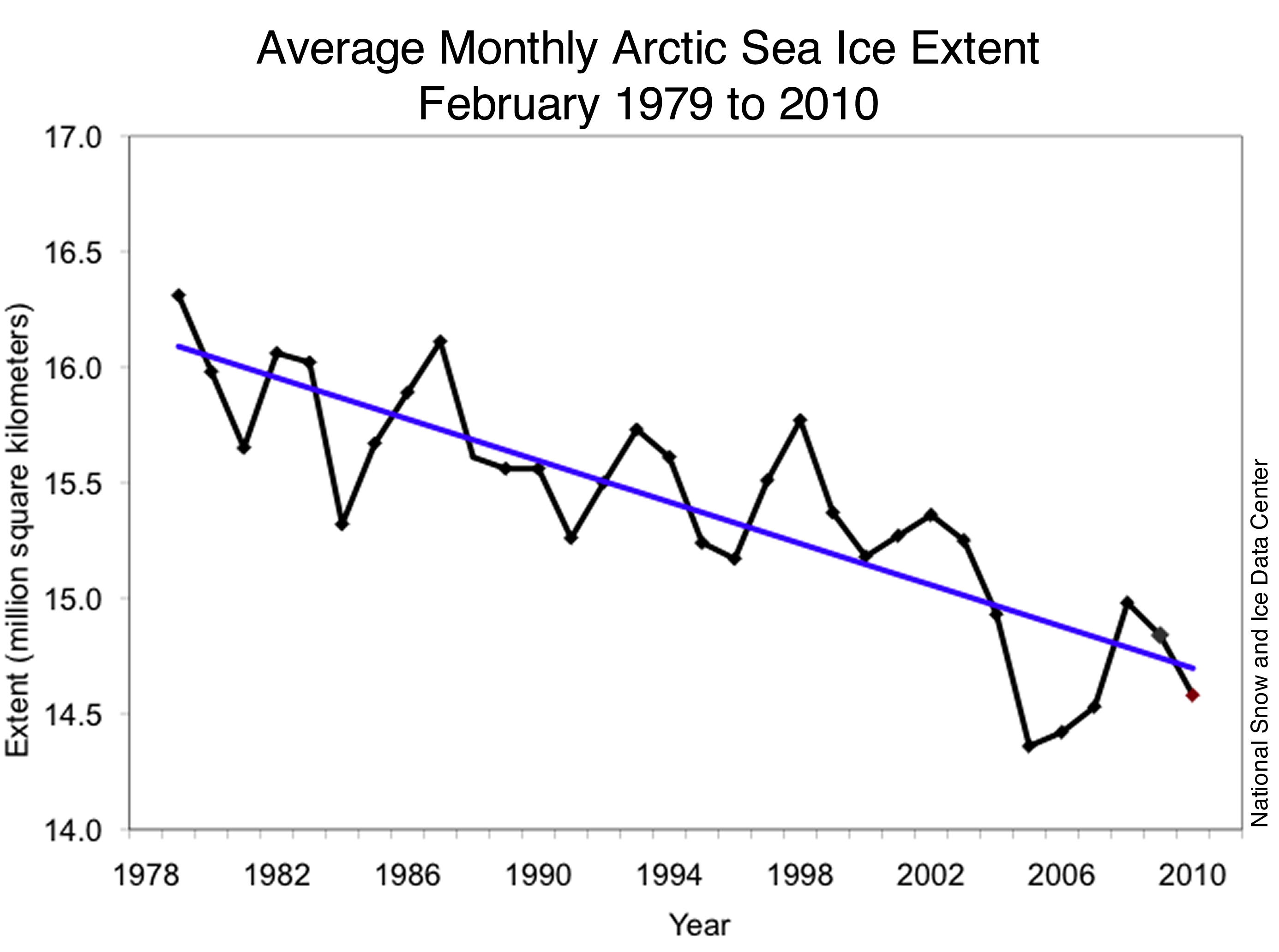
The study does not question that global warming is also melting ice in the Arctic, but it could raise doubts about high-profile claims that the region has passed a climate “tipping point” that could see ice loss sharply accelerate in coming years.
The new findings also help to explain the massive loss of Arctic ice seen in the summers of 2007-08, which prompted suggestions that the summertime Arctic Ocean could be ice-free withing a decade. About half of the variation in maximum ice loss each September is down to changes in wind patterns, the study says.
Masayo Ogi, a scientist with the Japan Agency for Marine-Earth Science and Technology in Yokohama, and her colleagues, looked at records of how winds have behaved across the Arctic since satellite measurements of ice extent there began in 1979.
They found that changes in wind patterns, such as summertime winds that blow clockwise around the Beaufort Sea, seemed to coincide with years where sea ice loss was highest.
Writing in a paper to be published in the journal Geophysical Research Letters, the scientists suggest these winds have blown large amounts of Arctic ice south through the Fram Strait, which passes between Greenland and the Norwegian islands of Svalbard, and leads to the warmer waters of the north Atlantic. These winds have increased recently, which could help explain the apparent acceleration in ice loss.
…
read the complete story at the Guardian
@R. Gates (16:52:33) :
Toyotawhizguy said:
“Warming due to warm ocean currents is regional warming, and is not global.”
______
This is an unproven assertion, not in line with the known global circulation of ocean currents…both in depth and extent.
– – – – – – –
Given that within the context, I was referring to warm ocean currents, specifically the Norwegian warm ocean current which warms the arctic, and not to the entirety of the global conveyor belt (which also includes cold ocean currents), the logic of your statement escapes me. The idea that a specific ocean current, such as the Gulf Stream (warming – NW Europe) or the California Stream (cooling – Hawaii) primarily affects a particular region is well established within the scientific literature.
Map link: http://en.wikipedia.org/wiki/File:Corrientes-oceanicas.gif
Smokey: “Skeptics simply ask for the data, code and methods showing that a conjecture or hypothesis explains reality better than an alternative conjecture or hypothesis.”
Not true. Climate sceptics make many claims and advance hypotheses of their own. For example:
“They reject the scientific method because they are paid to do so.”
“…natural variability in the Holocene shows that the current climate is nothing unusual.”
“The evidence points to the climate’s sensitivity to CO2 being significantly less than one…”
So AGW sceptics do much more than “simply ask[ing] for the data, codes and methods”. Rather, they stake out their own positions on the issue, and some of those positions achieve “true believer” status.
Brendan H (22:27:59) :
You should read Smokey entire statement.
It has always been incumbent on AGW advocates to demonstrate that natural variability is not the current driver of climate, just as it has been in the past. This they have failed to do.
@Phil. (17:34:25) :
“Put some iodine crystals in a flask and leave them to equilibrate at room temperature, and you should see a violet vapor (the vapor concentration is about the same as CO2 in the atmosphere).
http://upload.wikimedia.org/wikipedia/commons/8/84/IodoAtomico.JPG ”
– – – – – – –
Nice try, but that wiki photo you linked to is not illustrating even close to 380 ppmv of Iodine vapor, and that’s not the color intensity you get per your description. The concentration of Iodine vapor in the photo is certainly >> than 380 ppmv.
1) Although Iodine will sublime at room temperature, the flask in the wiki photo has obviously been heated. Note, that Iodine M.P. = +133.7C and B.P = +184.3C. In fact if you read the wiki article on “Iodine” that accompanies the photo you linked, it makes obvious reference to the flask being heated as part of a classroom demo. No crystals are visible at the flask bottom, only liquid or possibly re-solidified, which means the flask has been heated >+133.7C.
2) It appears in the photo that some of the color visible is due to Iodine vapor that has condensed onto the interior walls of the flask, so in this case much of the color is due to liquid or possibly re-solidified Iodine.
3) I have stored and handled pure Iodine crystals and the solid simply does not sublime any where near this amount at room temperature, in fact I’ve never even noticed it.
4) A 10% solution of elemental Iodine as Povidine Iodine, stored in a capped clear glass vial at standard temperature and pressure produces zero discernible color from the vapor above the liquid level, and that is by direct observation. The pungent odor present when the cap is removed confirms the presence of Iodine vapor.
Any time I wonder along the lines of “it’s the sun, stupid,” I get clobbered by SVIPs (Scientifically Very Intelligent People.)
SVIPs invariably pull out a graph showing me the TSI (Total Solar Index,) and whip off some neat calculations showing that the difference between the top and the bottom of the sunspot cycle is a very small amount of heat.
I have no answer to this, but lately I’ve taken to furrowing my brow and stating, “Have you added in the USA?” Few SWIPs ask me how the TSI is influenced by the USA, or even what USA stands for. (Undiscovered Solar Amplifier.)
Usually they just leave me alone, and I get to puzzle in peace.
Last year I got to thinking that even a slight change in solar intensity effects land masses far more swiftly than oceans. If you live by the sea you notice this on a daily basis. Therefore, because the northern hemisphere has much larger land masses than the southern hemisphere, I thought I’d just watch the northern hemisphere’s land masses to see if they got colder than any other place.
Lo and Behold, anomaly maps showed that they indeed get colder, last winter.
Everyone explained this as a side effect of the AO, suggesting the AO is the “driver.” But what if, at least to a small degree, the AO is the “driven.” Maybe it was the colder land masses that drove the AO to record-setting levels.
Of course, when we say “record setting” we should be humble and admit the records only go back to the late 1800’s, but still last winter’s AO was nearly double the level ever seen before.
There is a lot we are studying for the first time. The last time we switched over to a cold PDO the only way to bomb other nations was with airplanes. We had nothing even close to the data we now get with satellites. Also this sunspot cycle is different from most we have studied in the recent past. Therefore we shouldn’t pretend we know everything, and need to study HTBH, (How To Be Humble.)
Gilbert: “You should read Smokey entire statement.”
I have. That’s why I was able to quote some of his claims.
Maybe they should just ask a few old Siberian peasants or Inuit. They’d sniff the air, walk 5 yards, sniff again, and tell them where the ice went.
Roger Knights (21:31:25) :
Phil. (18:51:44) :
gofer (17:26:18) :
From the New York Times, 128 years of looming polar doom:
• 1937: “Continued warm weather at the Pole, melting snow and ice.”
How did they know?
Flyover by a scout plane? They had such things in Alaska at the time.
Alaska isn’t the North Pole!
toyotawhizguy (00:54:16) :
3) I have stored and handled pure Iodine crystals and the solid simply does not sublime any where near this amount at room temperature, in fact I’ve never even noticed it.
4) A 10% solution of elemental Iodine as Povidine Iodine, stored in a capped clear glass vial at standard temperature and pressure produces zero discernible color from the vapor above the liquid level, and that is by direct observation. The pungent odor present when the cap is removed confirms the presence of Iodine vapor.
I’ve used iodine as a laser filter and in an optical cell at room temperature and the color is easily visible (I used a path length of about 1 foot and measured absorption in the green of over 99%).
Using a solution gives a much lower vapor pressure (Henry’s Law).
Povidone (sic) iodine is a compound of iodine not free iodine and would have a much lower vp.
In perspective, prior to 2000, men had been seeking a Northwest passage for 3 or 4 centuries and only had one success, and that took 3 years. (Well OK, an icebreaker went though in 1969.) In most years since 2000, it has been possible to transit it in a matter of weeks by any competent sailor and many have done it. So, what, has there been wind in the past decade unlike any seen for hundreds of years? Or, is the arctic warming up more than has been seen for hundreds of years?
Ed Forbes (16:42:31) :…Or changes on the earth are wrongly dated, perhaps due to changes in not considered GCR changes…hmmm
Jimbo (16:44:23) : You can not cook with a hairdryer range…
gofer (17:26:18) : An interesting list of its psychological projection: Translation “My readers are melting away!!!!”
gofer (17:26:18) :
From the New York Times, 128 years of looming polar doom:
———————
Newspapers aren’t the best source of science information, even a “respected” newspaper like TNYT.
On January 12, 1920, the paper ran a story on a Smithsonian press release about a “multiple charge high efficiency rocket” that rocketry pioneer Robert Goddard was working on. The next day, an unsigned NY Times editorial heaps scorn on the Clark University professor who believes his rockets will one day reach the moon. “After the rocket quits our air and really starts on its longer journey it will neither be accelerated nor maintained by the explosion of the charges it then might have left. To claim that it would be is to deny a fundamental law of dynamics, and only Dr. Einstein and his chosen dozen, so few and fit, are licensed to do that.” It expressed disbelief that Professor Goddard actually “does not know of the relation of action to reaction, and the need to have something better than a vacuum against which to react” and even talked of “such things as intentional mistakes or oversights.” Goddard, the Times insisted, apparently suggesting bad faith, “only seems to lack the knowledge ladled out daily in high schools.”
On July 17, 1969—the day after the launch of Apollo 11— the New York Times published a short item under the headline “A Correction,” summarizing its 1920 editorial mocking Goddard, and concluding: “Further investigation and experimentation have confirmed the findings of Isaac Newton in the 17th century and it is now definitely established that a rocket can function in a vacuum as well as in an atmosphere. The Times regrets the error.”
FYI, GISS of climate science fame:
http://data.giss.nasa.gov/gistemp/graphs/Fig.A2.lrg.gif
is named after this Robert H. Goddard.
Caleb, if you are curious about some unknown solar amplifier, get a good book on the Sun. For your purposes, just about any book will do. That way you will have something intelligent to say or comment on regarding discussions about the Sun. Why depend on solar scientists to answer your questions?
I am curious. Do you think there is some mysterious beam of material or essence emanating from the Sun that has not been detected because it is an unknown substance (like back in the old days of unknown atoms)? Or do you think the fairly steady state Sun is interacting with some Earth variable and that this interaction drives our climatic atmosphere?
I’m more inclined to point to the heavenly body that has been demonstrated to have many more intrinsic variable components (both chaotic and oscillatory) that are known to affect weather pattern variability and long term climate as being the source of our climate variability, both in the long and short term.
So 1/3 of the ice disappearance was not warming? What happened to ‘faster than expected’ ‘worse than we thought’ ‘Doooooooommmm!!!‘?
>>
Smokey answered you well and I cannot exceed his answer except in brevity. True skeptics say “We (the current state of scientific understanding) do not know the extent of AGW or the benefits vs the negative impacts, therefore we do not wish to enact worldwide political change and taxes with numerous known negative consequences.
>>
No true scientists do science , report science then shut up.
The whole current problem is that they have the hubris to think that being “clever” at science qualifies them as clever at everything and to play at politics.
Sadly, they are on the whole grossly inept at politics and their well intended environmental strategy does not get any more sophisticated than exaggerating the science results more and more until till we all panic.
People who work at politics say “here is a strong popular movement driven by naive activists, how can we turn this to our advantage?”
One of the first groups to exploit this was the nuclear energy PR machine. They have tirelessly engineered the “green movement” (for green they are) into believing N.E.is now essential to “save the planet”.
25 years ago nuclear was the nemesis of the green movement. Now many are saying “nuclear power , yes please!”
Scientists trying to play green activist politics have been mugged (and half the planet along with them).
Sadly, the day they shut up and go back to science it will be too late , no one will believe their science anymore because they lie.
Get ready for a “low level” radio-active dump near YOU! You do want to save the planet don’t you??
Chris G
Please give us some refferences as to the people using the North West Passage. I have not heard these stories. The only ones I hear are either ice breakers (hardly qualifies), or people getting stuck in the pack ice. The NE passage on the other had, has been used off and on for a long time.
Pamela Gray (08:10:48) :
>> Caleb, if you are curious about some unknown solar amplifier…
The amplifier is in the atmosphere but may well respond to something like sun’s magnetic field or solar wind that is not taken into account by simplistic climate models.
What may be more to the point is to ask IPCC sources for climate models how they justify “mysterious CO2 amplifier”. My contact with the UK Met. Office revealed that their models ASSUME a climate sensitivity of x4 for CO2.
This is nothing more subtle than making up for the part of the warming they CANNOT explain by simple energy balance by ARBITRARILY multiplying the _known_ CO2 effect by FOUR times.
In science and engineering this is called a fudge factor. It is bullshit.
Some how this bullshit becomes an undeniable truth if you feed it into a very, very big computer.
Rather than posting Caleb, I propose that your ask the Met office what the scientific basic for the CO2 sensitivity is:
enquiries@metoffice.gov.uk
Ask a thorough question and they will answer it (with a bit of prodding).
R. de Haan (14:05:11) :
The unbeatable logic of Joe Bastardi!
http://www.ogimet.com/cgi-bin/gsynop?zona=artico&base=bluem&proy=orto&ano=2010&mes=03&day=23&hora=12&vte=Te&enviar=Ver
Perhaps this has something to do with – Note the 2 Automatic Stations are 20 degrees warmer than all the others.
Phil
On August 12, 1937 Sigismund Levanevsky of Russia took off from Moscow to fly to Fairbanks by way of the North Pole. His last transmission had him 300 miles from the NP on the Alaskan side and having engine problems. His plane was a large four engined wheeled craft. The search for his plane was begun almost immediately by the Mackenzie Air Service. A couple of days later, others joined the search using pontoon planes and a PBY. They searched for 7 months over 170,000 sq. miles of the Arctic Ocean, but the Russians were never located.
The article “Our Search for the Lost Aviators” NatGeo Mag. August 1938 is a good source of information and pictures including some pretty rotten ice.
Here’s a direct quote from the author:
“In my opinion, August is the least favorable month to fly in the Arctic, especially in a plane fitted with wheels, as was Levanevsky’s. At that time of year the Arctic floe ice is much broken. The summer rains have melted the ice surface and deep gutters have been cut in the ice, making it treacherous for any landing on wheels.”
Aviators had been flying around the Arctic since at least the 1920’s.
Caleb:
>>
Last year I got to thinking that even a slight change in solar intensity effects land masses far more swiftly than oceans.
>>
Read up Henrik Svensmark’s papers. http://www.dsri.dk/~hsv/ and the CLOUD project at CERN.
They are trying to quantify cloud seeding effects by cosmic radiation, exposure to which is modulated by the solar activity (other than its irradiance).
“”” vukcevic (14:50:33) :
George E. Smith (12:02:59) :
Re: “General Chemistry by some chap called Linus Pauling”
It is nice to know that in this virtual world there are still people who prefer solid printed book to CRT, LCD or whatever some of us stare for a few good hours on weekly if not daily bases.
Despite everything Google occasionally still deserves some praise:
“General Chemistry” by Linus Pauling is available (or most of it) now in the Google books library:
http://books.google.co.uk/books?id=EpxSzteNvMYC&printsec=frontcover&dq=General+Chemistry++Linus+Pauling.&source=bl&ots=PHSGmpC0Q-&sig=JJB-jWIYj2EIBFPbGNWIJiCvvPA&hl=en&ei=FuGnS46lOMOOjAelp8CjDQ&sa=X&oi=book_result&ct=result&resnum=1&ved=0CAkQ6AEwAA#v=onepage&q=&f=false
Since I mentioned CRTs, LCDs etc may also add :
To Dr. George Elwood Smith of the CCD fame, I am evermore grateful for ending (part of) 15 tedious years of my working life; setting the operating parameters of plumbicon, leddicon and saticon tubes. My thanks, gratitude and greatest respect for Dr. George Elwood Smith. “””
Well Vukcevic, I too am quite partial to books on dead tree. I simply cannot read online texts, or manuals, help notes or anything else, so If I have to look for it on line, I still have to print it to be able to read it.
Sadly, a lot of stuff the web lets you read, it also stops you from printing.
So i keep a camera in my desk drawer, so anything I can bring up on screen, I can photograph, and then print the photo from my computer.
As to George Elwood Smith; nobellist in Physics (2009); we have never met, but we have crossed paths many times; and anyway, I am not him. My E is not for Elwood; but relates to an old line English Shoe making family that emigrated to New Zealand a couple of centuries ago.
But I know folks who know Elwood personally , from industry connections, so I am familar with his career.
I work for an outfit, that has made literally billions of digital video cameras; well between one and two billion; but they are all CMOS sensors, and not CCDs.
Trouble with CCDs is that the silicon process is not compatible with CMOS, so you can’t integrate the sensor and processing functions.
All out CMOS cameras come with an on chip computer integrated with the sensor; and they are all high speed; up to 10,000 frames per second; but gawdawful on resolution. 15 x 15 up to 30 x 30 pixels.
“”” Ric Werme (19:41:54) :
George E. Smith (12:02:59) :
> The Linus Pauling cost me $21; the modern supertext a whopping $157. It’s a bit easier to read; but that’s the most I have ever spent on any Book.
I went to CMU around 1970, I still have a Don Knuth “Art of Computer Programming” volume 3 (“Sorting and Searching”). I moved the price tag inside – $19.50. Assuming the books are equally “supertexts, that’s a 8X increase.
http://www.usinflationcalculator.com/ says $19.50 then is $108.93 now, a 5.6X increase. Somewhere in the ballpark….
The Pauling book is a Dover paperback brand new from a 1988 edition.
I very nearly bought Marie Curie’s thesis on Radioactive Substances for $7.95
So inflation doesn’t explain the increases.
During my first year of high school chemistry; the very first experiment called for adding an Iodine crystal to a sliver scraped off a stick of white Phosphorous, in a crucible; to demonstrate a “Chemical change”.
In an adjoining class having the same lecture by a newly graduated MSc in chemistry; the head of the Chem department happened to enter the room just in time to see the lecturer upending a bottle of Iodine crystals onto a whole stick of white Phosphorous.
They did manage to get all the students out of the room, before the visibility went to 0-0.