With apologies to Dr. Roger Pielke Sr. and Steve McQueen, I offer this advice: run ! A giant temperature anomaly is attacking Canada and Greenland.

An Example Of Why A Global Average Temperature Anomaly Is Not An Effective Metric Of Climate
Roy Spencer and John Christy of the University of Alabama at Huntsville have reported in their Global Temperature Report that February 2010 was the 2nd warmest February in 32 years (e.g. see Roy’s summary).
Their spatial map of the anomalies, however, shows that most of the relative warmth was in a focused geographic area; see
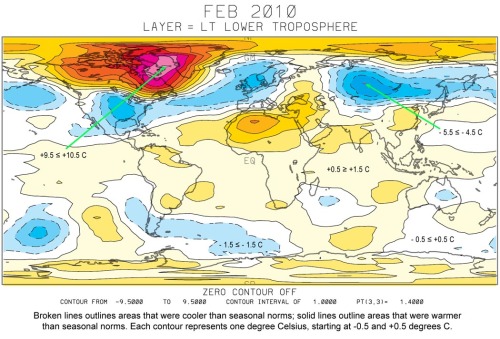
The global average is based on the summation of large areas of positive and negative temperature anomalies.
As I have reported before on my weblog; e.g. see
What is the Importance to Climate of Heterogeneous Spatial Trends in Tropospheric Temperatures?,
it is the regional tropospheric temperature anomalies that determine the locations of development and movement of weather systems [which are the actual determinants of such climate events as drought, floods, ect] not a global average temperature anomaly.
Anomalies, trends blobs. Unless we learn more about the vast ocean circulation systems which span all time scales, we know nothing.
Measuring T’s does not tell us the energy budget of the globe. May be a fun exercise but not useful enough regards AGW.
For all we know, the warmth seen by sattelites and measured by ground stations may be caused by the discharge of heat by the oceans.
The atmosphere barely affects the oceans, but the oceans profoundly affect the atmosphere.
This laymans advice? Study the oceans, everything else will fall into place.
@Wondering Aloud (12:02:26) :
What are you looking at? most of the world is normal with below average areas appearing larger than above average. Even with the large polar exaggeration it doesn’t look anything like “most of the earth’s lower troposphere was warmer than the seasonal norms”
Seriously, what the heck? Is this some of that post normal reality stuff? Are you trying to be ironic or do you need to see a specialist
No need to be upset, but you are misreading the chart. (Maybe it’s time to think and look closely before wondering aloud :D) Try breaking the chart into grids, or even longitudinal sections, and it’s plain that more than half the chart shows above normal temperatures.
BTW, the cream, yellow and red bits are above normal temps, not below! Only the blue bits are below normal (I realise you might live in a ‘blue bit’) and the white bits are unchanged.
The above normal constitutes more than half of the chart. Both satellite records show the lower troposphere temperature was the second hottest ever recorded for February. (If you have a problem with their readings, best write to John Christie or Roy Spencer – maybe they messed up again!)
Click here
to see what was happening around the world last month – like the hottest Feb ever recorded in the Southern Hemisphere; the second hottest global ocean temperatures ever recorded; and the sixth hottest February recorded for both land and ocean temps; and the second hottest lower troposphere. Ah – and much of the USA was cooler than normal – maybe that’s all that some people want to focus on.
R. Gates (16:43:09) :
2) Will arctic sea ice ever go above the long term year-to-year avergage,
We don’t know the long-term year to year average.
We only started measuring using the current methods in 1979. As that was a cold period (relatively speaking), any ice coverage compared to that is always going to be below “average”.
We will see Arctic sea ice go above long term average if the long term average is allowed to be calculated. But not any time soon if arbitrarily taking 1979-1990 as the base.
We all know that the trend is important, not comparison to some arbitrary base. And I’m not convinced we have enough data for that either.
The very negative AO kept the cold air on the Siberian side.
Is the Blob also “consistent” with what climate models predicted?
I figure it must be since eveything else imaginable is.
If the blob dwindles away and the global temperature average trends like the rest of the non-blob area will it be a travesty?
Are the warmers betting their everything on the blob?
Hey that makes them Blobbers.
And I’m a Blobophobe?
Stephen Skinner
Stephan
I hope you guys are joking around, there was an article posted here from some character from NASA talking about “lumpy” CO2 distributions in the atmosphere – this “lumpiness” was somewhere either 6 or 8 ppm (2%) – not very lumpy is it?
…and all the talk of CO2 “domes” around cities, it’s just a temporal manifestation from all the local CO2 output before it has time to disperse. If anyone thinks UHI is caused by CO2 domes and not all the asphalt and energy use then… well, hate to break the news but sorry.
On the issue of the CO2 being well mixed in the atmosphere… show me something to the contrary. I’ve never seen anything to convince me that the orthodox/”consensus”/whatever-you-want-to-call-it view on this one is wrong.
Ok, so higher temperature anomalies = more snow because of excess moisture, right? So where did all this snow go to? Europe, which did have a lot of snow? Why Europe and not Greenland, which is in between the two?
And where was it that I read El Nino was the dominant temperature signal? That doesn’t look like an El Nino signal.
richcar 1225 (12:10:16) :
“It would be interesting to see if the difference in anomalies from the US to the blob can be historically associated with eastern US snowfall and the negative arctic oscillation.”
Yes! “richcar 1225” and several other posters have gotten pieces of the puzzle, but I’ll try to tie these things together a bit below, after my disclaimer.
Disclaimer Statement – First I should declare this is my initial posting (sorry for its length) at WUWT, and also that I’ve been a meteorologist for many years. I’ve taught meteorology at the university level, but have spent most of my career in government and private practice. I’ve been reading this site for a few years, but more often of late. For the record, I’m an AGW skeptic in the sense that I think that most AGW alarmists grossly overstate their case. However, many AGW skeptics do the same. I’m interested in ultimate truth, and therefore, my aim is to go where science takes me, regardless of political ideology. I believe mankind has some effect on global climate change, but that this effect is much smaller than the effects caused by natural forces over the past millennium. So perhaps I might best be categorized, at present, as a mild luke-warmer.
Now to my interpretation of the warm “blob” in the UAH February 2010 analysis, which I believe to be real. As limited confirmation, I checked February surface temperature data for a station in NE Canada near the bulls eye of the blob – Iqaluit – and it did show temperatures well above average for much of the month, especially the latter half.
Before getting to the immediate cause, we must first understand that short-term upward and downward global temperature trends, over periods of a few months to a few years, have nothing to do with long-lived greenhouse gases such as CO2, methane, nitrous oxides, etc. Because their concentration changes rather slowly, these gases should have only long term effects, so we must look for trends in temperature over multi-decade and perhaps even multi-century periods to possibly see a “fingerprint” due to increasing concentrations of these. For anyone to attribute the “warmest February” in 30 years to AGW is laughable. There are obviously much longer climate cycles at work (MWP, LIA). To explain relatively short-term anomalies, we must look for shorter-term forcings, which can be related to volcanic eruptions, ENSO cycles, etc.
The setup for the record snows in the mid-Atlantic and the anomalous February warmth in eastern Canada may have begun with the last La Nina cycle, which apparently helped damp out tropical storm formation in the Atlantic and Gulf of Mexico (GOM). Tropical storms are large heat transfer devices, in multiple ways. One transfer is from ocean to atmosphere vertically, and then horizontally in the atmosphere (ultimately northward). Heat transferred vertically in the storm allows some of the energy to radiate to space from near the top of the atmosphere. As we know, radiation from near ground level is not very effective at cooling the Earth at tropical and mid-latitude locations. Once the tropical system is caught up in the mid-latitude jet steam, its heat is transported to more northerly latitudes where the greenhouse effect is lower, there is less solar insolation, and where energy loss to space is more effective. Another heat transfer is downward in the sea, as storms mix water vertically, thus leaving the surface water cooler after they pass.
Given the very minimal Atlantic/GOM tropical storm activity this past summer, the waters off our south and east coasts remained warmer than normal going into fall and winter. I experienced this personally, late in October 2009, as I swam off the SW Florida coastline in water that was 90F one day and 91F the next. Check out the US October temperature anomalies reported by NOAA, and you can see the warm GOM waters had their effect on FL, while most of the nation had temperatures well below average.
Now lets add in the effects of the developing El Nino this past fall and winter. Besides adding heat and moisture to the atmosphere over the subtropical Pacific, this helped move the primary storm track across the southern US. Once those storms reached the SE US, they tapped into a very warm GOM. The higher water temperature resulted in greater moisture transport into the storms, which then dropped extremely heavy, moisture-laden snow in the mid-Atlantic states, which happened to be just cold enough to drop the bulk of the moisture as snow.
Anyone with an elementary understanding of latent heat knows that when water vapor condenses, it releases massive amounts of sensible heat, and if it goes all the way to solid (snow), there is a substantial additional increment of sensible heat release. All of that combined heat release was then carried by the February storm systems as they moved NE – toward NE Canada and Greenland. Do you think all that latent heat release was radiated to space before the storms reached eastern Canada and Greenland? Not enough time! Also, these early February East Coast storms then fed into, and perhaps helped maintain, a persistent, massive, broad area of low pressure covering most of eastern Canada. This low was circulating air counterclockwise from Canada’s east coast all the way back over Manitoba and then down over the western Great Lakes. That large gyre kept spinning for many days, almost stationary, until it finally lost the “steam” (water vapor and energy) that warmed eastern Canada and Greenland for much of February (check for yourself the February temperature curve for Iqaluit on Weather Underground).
I don’t know how much the AO fed into this, but this anomaly seems to be consistent with the AO pattern. The question is, did the AO help cause this anomaly, or did the features that caused this pattern help to cause or at least fortify the AO? I don’t know.
Anyway, this is my interpretation of the origin of all that energy represented by the UAH February “blob.”
There are too many polar bears around that thermometer.
R.Gates: Watch out for changing goal posts! In light of the onslaught of evidence, the natives here are getting restless, and soon any metric at all of global climate change will be called into question. Surface records? Junk. Satellite records? No good anymore. Dendrochronology? Worthless. Ice cores? So what. Warmest year EVER recorded? Pfft. Not where I live.
Nothing will be good enough for those who have already made up their minds. That’s my prediction. I’d like to be proven wrong though.
Sou (19:57:42) :
Congratulations…you just fell into the Meractor Projection bias.
The USA/Europe/Russia/N. China/N. Atlantic and N. Pacific all ran cold.
The Arctic is small and still quite frozen for the anonaly as is the Antarctic.
Greenland is 2mi thick ice.
Nobody lives on Greenland Ice Cap or the Arctic Sea Ice.
Non-trend = extremes in regions where real people live.
That’s what the topic is all about.
Now we have massive flooding in the Upper Mississippi Valley. Claims are being made about never-before-seen, but nobody is showing data.
Me wonders why.
Steven Mosher quoted Pielke Sr :
“It is the regional tropospheric temperature anomalies that determine the locations of development and movement of weather systems [which are the actual determinants of such climate events as drought, floods, etc] not a global average temperature anomaly.”
Pielke Sr. gets the causality wrong: it’s on the contrary the development of tropospheric weather systems that will lead to temperature anomalies cold or warm; In fact one needed simply to check the satellite evolution in February to understand the chain of cause and effects. From this data, it is clear the warm anomaly was caused by Gulf of Mexico moisture laden warm air advection –which resulted in mega snowstorms on the NE- due to the conjunction of 1) strong polar air anticyclones descending southward over the US –cold anomaly on most continental US, frost in Florida etc…- and 2) descending polar anticyclones on Western Europe. In fact, it is precisely this configuration that slowed the development of arctic sea-ice along Greenland during that time (advected warm temps). Breaking this configuration has since then in March allowed sea ice to grow back in this area (cf. NSIDC maps). Central Europe showed a slight warm anomaly on the western flank of the powerful Siberian anticyclone agglutination (stable over 3 months of -30c in western Siberia) because of warm air advection on the eastern side of Scandinavian anticyclones. Nothing exceptional, if only the strength of polar anticyclones…
Of course, averaging these temperature anomalies is meaningless physically and climatically; anyone having read Leroux could swiftly figure that one out. Moreover droughts and floods are not climatic events but weather phenomena. Honestly, Pielke Sr. should know better.
jose
There are moving goalposts on both sides, and I think all level headed folks should shun the practice. That doesn’t mean we’ll agree on everything, but certain things are generally accepted here – IMO at least:
The surface temp reconstructions are junk, sorry. They say they’ve corrected (overcorrected in the case of GISS according to Hansen) UHI, but that doesn’t seem to be the case… and all their adjustments and homogenizations seem to have, at least in the case of CRU a 20% increase in temp trends vs. the raw analysis by Dr. Spencer.
Satellite records are – despite what some people here may say – reliable unless someone comes up with some seriously concrete evidence to the contrary.
Dendochronology… why not use tea leaves? It’s a proxy for CO2 and rainfall maybe more than temperature, hasn’t worked (or maybe it has?) since the 60s, conflicts with historical records, and the definitive reconstruction was put together by a guy who appears to have made up his statistical rules as he went along.
Ice cores? What is the confusion on ice cores? AFAIK they show a MWP… are you talking about the “causative” relationship between CO2 and temp when CO2 lags temp?
I’m all for calling people out when theymake unsupportable statements. The questioning of the sat record of late is misplaced… and at the same time running around chasing AO or ENSO signals and yelling “look global warming” is, IMO, just adding to the noise and not really accomplishing anything.
Make your point, by all means, but that comment seemed to take the shape of a broadside leveled at just about everyone here. Lets keep it civil, right?
@ur momisugly rbateman (22:24:40) :
How about the massive snow cover? Could that have any effect on flooding?
-facepalm-
February’s high Arctic temperatures do not seem to have impacted the areal extent of the winter ice. Only 2003 shows a greater extent
rbateman (22:24:40) :
Sou (19:57:42) :
Congratulations…you just fell into the Meractor Projection bias.
I don’t agree. Look at the middle of the chart! If you want to only include the bits that are cooler, that’s up to you. It doesn’t change the following facts:
Both satellite records show the lower troposphere temperature was the second hottest ever recorded for February. The Southern Hemisphere had the hottest Feb ever recorded; February had the second hottest global ocean temperatures ever recorded; and the sixth hottest February was recorded for both land and ocean temps.
It does seem odd that some people are looking at such a warm month to argue that it’s cooling (the second warmest lower troposphere temperature for February ever recorded by satellite, and the sixth hottest land and ocean temps recorded for Feb in more than 100 years). I await the rest of the year with bated breath.
jose (21:57:58) :
Changing goal posts? HA! You’ve got to be kidding me!
I am tired of all the “adjusting of data” which Alarmists have resorted to, and now have been caught red-handed at. It disgusts me, and what is more it makes me suspicious of honest scientists, when they change charts and graphs for honest reasons.
What sort of changing-goal-posts was it when Mann erased the MWP? Or how about all of Hansen’s and Jones’ tweaking of temperature data? Or how about Briffa ignoring whole series of tree rings to focus only on a small set in Yamal, with a single tree having huge influence? You don’t think the effect of that was “changing-goalposts?”
Once these boobs make a joke of science and peer-review, it forces everyone to go back and look at other changes which we all accepted.
I can move on to the work of GS Callender on CO2 levels, which altered charts he himself was involved with publishing earlier, alterations which scientists like Jaworowski blow a fuse about. In measuring CO2 levels, a lot of “bad readings” are thrown out. Must I now climb Mauna Loa myself, to make sure these guys aren’t selectively throwing out data, due to an agenda?
Or how about the change in TSI charts? Up until around six years ago the charts showed the high points in sunspot cycles had lower TSI in the late 1800’s than in the late 1900’s. Abruptly those charts were changed to show there was no change. Must I go back and re-examine the reasons for the changing charts, suspicious of an agenda?
Sadly, the answer is yes. For Mann did more than break the rules, when he erased the MWP. He broke the trust. It did enormous damage to relations between scientists, the relationship between scientists and the public, and (worst of all) to the ideal of healthy and clean environmentalism.
To break the trust is no small thing. It actually turns out to be an insidious and invisible form of pollution, blacker than any crud poured out by a smoke-stack, and grosser than any strip mine. The fact these fellows such as Hansen and Mann think they are “cleaning” the environment displays a total lack of awareness, on their part, of the existence of things such as the mental, social, and even spiritual environment.
In any case, Jose, you really should blush. It wasn’t the skeptics who “changed the goalposts.”
The hotspot is actually not that big!
Its about 10 times smaller than it apears to be on the map above!
But because they use a Mercator map projection it looks as if Greenland(2.175.600 km2) is about half size of Africa.(44.900.000 km2.)
But in the real world it is just 5% of Africa.
Equator to 30 N is about 25% of Earths area
30 N to 60 N is about 18,3%
60 N- 90 N 6,7%(60 N-70 N 3,68%, 70 N- 80 N 2,26% and 80 N- 90 N 0,76%)
Geir in Norway (12:12:33) :
“The huge differences in anomalies in the Arctic and Antarctic regions are no surprise to me living in Norway. The thing is, the colder the temperature, the greater it swings within a day or night or week or month. In the summer, the air is more full of water vapor and the less the temperature varies. In the winter, the air is cold, its relative humidity is very low and large swings are common – more than 20 degrees Celsius in a few hours is not unusual at all, but common most days in January and February given relatively cold nights. As the sun comes up the day warms up tremendously…”
We get the same pattern, albeit with smaller differences, when the same conditions happen here in England. The speed of change is sometimes awesome!
I wonder if the algorithms used when processing the AMSU raw data cope with such large and rapid swings at differing geographic scales?
aired (21:47:52) :
“I don’t know how much the AO fed into this, but this anomaly seems to be consistent with the AO pattern. The question is, did the AO help cause this anomaly, or did the features that caused this pattern help to cause or at least fortify the AO? I don’t know.”
Thanks for an authoritative meteorological viewpoint. I wonder if an examination of the change in atmospheric pressure would help to resolve the question you pose.
If one compares the AO with the historical record of atmospheric pressure north of 65°N it can be seen that the AO is simply a proxy for atmospheric pressure in the Arctic. This influences the strength of the outflow of cold air from the Arctic. The distribution of of land and sea and in particular the almost permanent high pressure cells over the sea determines where that air goes.
Atmospheric pressure varies with the distribution of the atmosphere which responds (at higher elevations) as an electromagnetic medium responds to change in its electromagnetic environment. A rise in atmospheric pressure at the poles is conjunctive with a fall at the equator.
I look at some of the broader aspects in an article called ‘Natural climate variation’ at:http://climatechange1.wordpress.com/
In the big picture falling pressure at the equator is very strongly related to cooling in the tropics and across the globe.
Tim Channon (15:55:28) :
Thanks Tim, very nice presentation.
Princeton Alumni Weekly: Temperatures rising!
In an interview last year with The Daily Princetonian, Happer characterized hostility toward climate skeptics in harsh terms. “This is George Orwell,” he said. “This is ‘the Germans are the master race. The Jews are the scum of the earth.’ It’s that kind of propaganda.” In an e-mail following an interview for this article, he warns against “the capture of U.S. society” by a “scientific-technological elite.”
http://tomnelson.blogspot.com/2010/03/princeton-alumni-weekly-temperatures.html
Ref – R. de Haan (05:22:44) :
“Princeton Alumni Weekly: Temperatures rising!”
___________________________
Thanks for posting this link. So true!
It (AGW or the NEW “Climate Change” Cause) is so like a religion that it’s painful. Scientists and their societies/associations (and psyentists and their PACs) have swallowed this crap to such an extent that I fear the consequences will impact them and the future of their profession more than any other group. Instead of staying on the edge of this, they jumped in with both feet and are up to their necks. Too few had the foresight to see, or the courage to say, that the matter was too unsetteled, unproven, unknown. Tis best NOT sign a petition or statement unless you know all the science and all the ramifications– even if you do support 90% of the data, the 10% you don’t can really hurt you.
About the Blob its only weather.
“Ian H (16:15:51) :
This information has restored my faith in satellite measurements.
If you want to measure overall global temperatures then satellites are the way to do it. They are not subject to the kind of issues that afflict land based measurements, and they see the whole globe directly. The only problem for climate purposes is that the satellite measurements don’t go back very far.”
Please check out my earlier post {correction added]: 4.4 deg C per century seems to be the value for warming. This is not insignificant!!!!!!!!!!!
Harry Lu (13:11:58) :
AMSU Channel data from satellite data
Data from:
discover.itsc.uah.edu/amsutemps/execute.csh?amsutemps
Note that all data is used (there seems to be none before 1998 for these channels
http://img201.imageshack.us/img201/1151/amsuamar2010.png
near surface is warming at 1.21[*10^-4]C/day=4.4C/century
3300ft data (now discontinued) was warming at 12deg/century
sea surface is slightly cooling but only 8 years of data.
No problem there then!
The “blob” has nothing to do w/CO2. It has everything to do w/a semipermanent low-pressure system just to the SE of the “blob”, pulling up N Atlantic maritime air toward the NW, then W into Canada. To the SW of the low, NW winds are cooling down much of the US.
IOW, it’s weather.