by Steven Goddard and Anthony Watts
In late 2009, Anthony forecast that Arctic sea ice would continue to recover in 2010. Last month Steve Goddard did an analysis explaining why that was likely to happen and yesterday NSIDC confirmed the analysis.
The pattern of winds associated with a strongly negative AO tends to reduce export of ice out of the Arctic through the Fram Strait. This helps keep more of the older, thicker ice within the Arctic. While little old ice remains, sequestering what is left may help keep the September extent from dropping as low as it did in the last few years.
The wording of NSIDC press releases usually highlight the negative (this one being no exception) but the message is clear. This summer is likely to continue the trend since 2007 of increasing summer minimums.
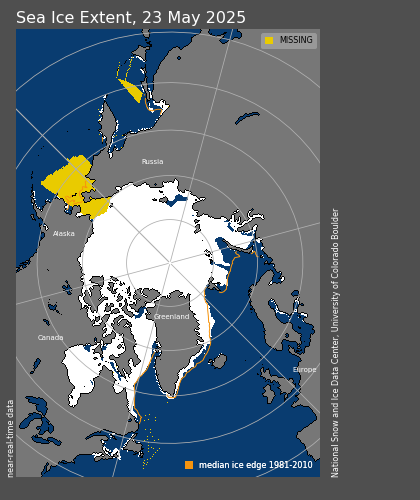
So how is Arctic sea ice looking at this point, near the winter maximum? NSIDC shows ice extent within 1 million km2 of normal and increasing.

http://nsidc.org/data/seaice_index/images/daily_images/N_timeseries.png
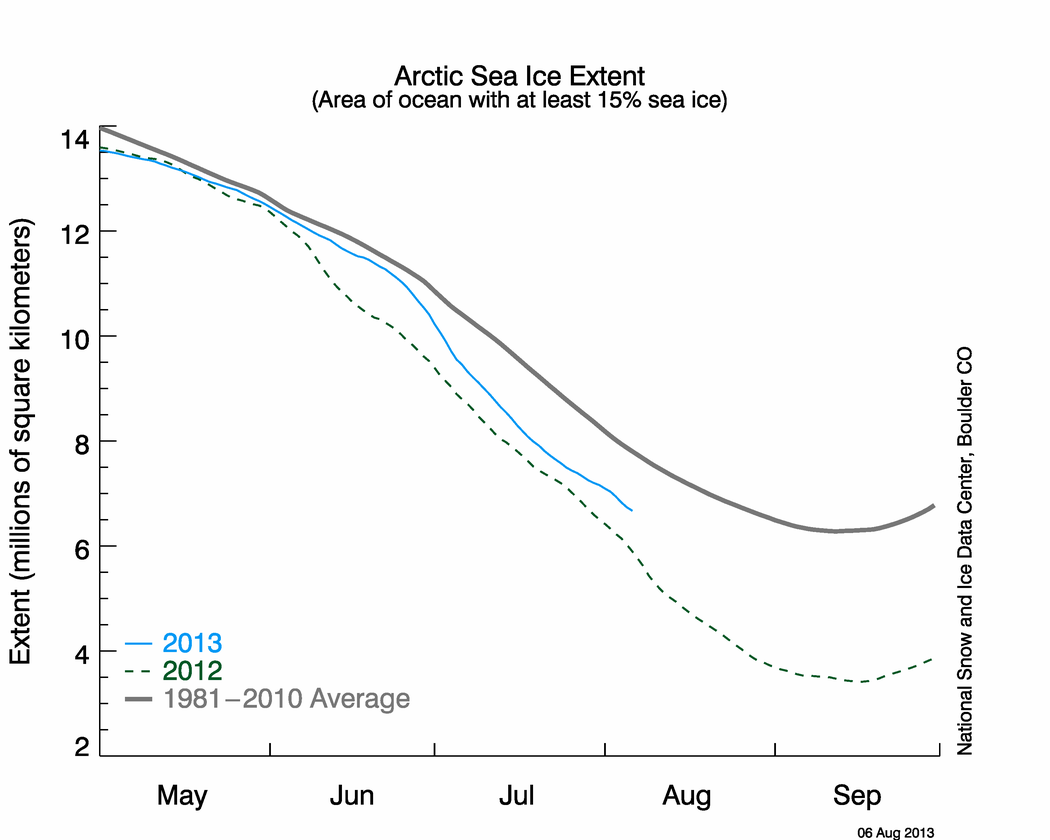
The Baltic and Bering Sea have slightly above normal ice. Eastern Canada and The Sea of Okhotsk have slightly below normal ice.

http://nsidc.org/data/seaice_index/images/daily_images/N_daily_extent.png
DMI shows sea ice extent at nearly the highest in their six year record.

Sea ice extent for the past 5 years (in million km2) for the northern hemisphere, as a function of date.
http://ocean.dmi.dk/arctic/icecover.uk.php
NORSEX shows ice area just outside one standard deviation (i.e. almost normal.)

http://arctic-roos.org/observations/satellite-data/sea-ice/observation_images/ssmi1_ice_area.png

There’s also some interesting comparisons to be made at Cryosphere Today. When you compare the current images in recent days with the same period in years past, you notice how “solid” the ice has become. For example compare March 3rd 2010 to March 3rd 2008, when we saw the first year of recovery:

Note that there’s no “fuzziness” in the signal return that creates this image on the right. A fuzzy return would indicate less than solid ice, such as we see on the left. The CT image from March 3rd is “deep purple” through and through. The edges of the ice are very sharp also, particularly near Greenland and also in the Bering sea. These two visual cues imply a solid, and perhaps thicker ice pack, rather than one that has been described by Dr. Barber as “rotten ice”.
I wish I could compare to March 3 2009, but the CT images were offline last spring then while both they and NSIDC dealt with issues of SSMI sensor dropout that was originally brought to their attention by WUWT, but was deemed “not worth blogging about“.
According to JAXA, 2003 was a good year for Arctic sea ice. Note the blue line.

So how does that year on March 3rd compare to our current year using CT’s imagery?

Compared to the best year for Arctic sea ice in the past decade, March 3rd this year looks quite solid. The setup for 2010 having more ice looks good.
You can do your own side by side comparisons here with CT’s interactive Arctic sea ice comparator.
The Arctic continues to recover, and one of the last CAGW talking points continues to look weaker and weaker. It wasn’t very long ago when experts were forecasting the demise of Arctic ice somewhere between 2008 and 2013. And it is not the first time that experts have done this – they were claiming the same nonsense in 1969, right before the ice age scare.

Note the column at the right. Even back then, skeptics got the short shrift on headlines because as we know: “all is well, don’t panic” doesn’t sell newspapers.
UPDATE: And then there’s this:
AROUND 50 ships, including large ferries reportedly carrying thousands, were stuck in the ice in the Baltic Sea today and many were not likely to be freed for hours, Swedish maritime authorities said.
R Gates,
Are you going on record as predicting record warmth for 2010?
Good luck with that.
Paul Daniel Ash said;
“My assertion is that most people on both sides of the debate come to their understanding of the science from pre-established prejudices.”
I don’t think that’s strictly true Paul-many of those who are now genuinely skeptical did at one time believe what we were being told. However, when things didn’t seem to add up we did more research and found out the facts weren’t as we had been told and the scientific method had been set aside for a much lower burden of proof-post normal science.
I can’t comment if your remark holds true to believers.
Its a shame that the two sides are so entrenched as there must be a middle ground in wanting to look after the environment, help the third world prosper, find new sources of energy etc, but the AGW juggernaut just sucks up time money and resources, and steamrollers any other more productive debate.
tonyb
TonyB (11:57:26) :
I’ll say “many people on both sides,” then. I can’t say it’s “most,” but it sure seems so from internet comments.
I think it is good that this site seems to be providing a place where we can discuss the existing science and indeed be skeptical. Stepping outside of our prejudices as much as possible is also important.
I would also like to point out that it might be productive to discuss what are some rational, logical, and sound proposals for action should it turn out that man-made CO2 emissions are indeed causing a problem. I do not currently believe that they are, but I could be wrong, after all 🙂
So far, the proposed “solutions” that I have seen are far worse than the supposed magnitude of the “problem”.
We have enough brilliant minds here that it shouldn’t be too tough to come up with some ideas on “Ok, we are not necessarily stipulating that human emissions of CO2 are a huge problem, but if it turns out that mitigating our CO2 input into the atmosphere is actually warranted, here is what WE would propose for potential solutions, as opposed to this monstrous mess that is currently being proposed…”
Paul Daniel Ash
What happens Paul if in September 2010 we get a further recovery, will you accept that it is now a recovery from September 2007 as well as a trend?
To me it appears that no matter how you argue it IF nature continues to confound AGW then you are on a loser with this one and we may suddenly hear no more from you.
Paul Daniel Ash
I aplord you for taking the time and trying to understand both sides of the argument, and especially for debating here and sticking at it, you will find a lot of very knowledgeable people here. And in general this has been an interesting and good debate to follow where “both sides” have debated without becoming personal as so often happens in many warming vs sceptic debates.
You wrote:
“My assertion is that most people on both sides of the debate come to their understanding of the science from pre-established prejudices”
I am a skeptic now but was two – two 1/2 years ago a stanch warmist – I had a pre-established prejudice for AGW. But then I started hearing the occasional skeptic articles and decided to learn as much about it as well to see if there was any truth in the skeptical claims. for over two years I spent on average 2 hours a day reading articles both for and against AGW, as well as looking at the raw data behind the articles and claims, to the best of my ability. And from my studies I came to the conclusion that although the earth may have warmed a bit over the last 150 years, it is part of natural climate variability – nothing out of the ordinary – with mans effect to be negligable or minimal at worst (any effects by man most likely not due to CO2 but black carbon and changes in land use).
Keep on learning with an open mind, look at the raw data, debate and think for yourself.
Patrick.
Jimbo (13:28:34) :
What happens Paul if in September 2010 we get a further recovery, will you accept that it is now a recovery from September 2007 as well as a trend?
It’s not me who accepts or doesn’t accept. I’m just a shmoe. This is what the analysts that Anthony said confirmed Goddard’s forecast said:
I have no idea if that’s valid or not, but it’s what they say.
In the light of the inexorably rising global temperature, coupled with polar amplification, it would be interesting to know on what basis anyone would predict a ‘recovery’ of Arctic sea ice. Increasing ice in a warming Arctic is, on the face of it, counter-intuitive.
Did anyone notice what the nsdic said this week…
A recent report (Turner, et. al., 2009) suggests that the ozone hole has resulted in changes in atmospheric circulation leading to cooling and increasing sea ice extents over much of the Antarctic region.
So its changes in the ozone hole that is causing more ice in Antarctica, not colder temperatures from other natural sources.
Paul Daniel Ash,
This would be year three and no one knows what “within natural variability” is. Do you offer any evidence that the Arctic is currently outside natural variability?
icarus,
Looks like Arctic temperatures have been running pretty close to the 1958-2002 mean.
http://ocean.dmi.dk/arctic/plots/meanTarchive/meanT_2010.png
http://www.vancouversun.com/technology/Arctic+vanishing+fast+researcher/2532081/story.html
Here are WUWT threads critiquing Steig’s article, in date order. Asterisked threads are the most important ones:
http://wattsupwiththat.com/2009/01/21/antarctica-warming-an-evolution-of-viewpoint/
http://wattsupwiththat.com/2009/01/22/antarctic-warming-part-2-a-letter-from-a-meteorologist-on-the-ground-in-antarctica/
http://wattsupwiththat.com/2009/02/04/snow-job-in-antarctica-digging-out-the-data-source/
http://wattsupwiththat.com/2009/02/15/redoing-steig-et-al-with-simple-data-regrouping-gives-half-the-warming-result-in-antarctica/
http://wattsupwiththat.com/2009/02/28/steigs-antarctic-heartburn/
http://wattsupwiththat.com/2009/04/12/a-challenge-to-steig-et-al-on-antarctic-warming/
http://wattsupwiththat.com/2009/04/18/what-happens-when-you-divide-antarctica-into-two-distinct-climate-zones/
* http://wattsupwiththat.com/2009/05/20/steig-et-al-antarctica-warming-paper-process-is-finally-replicated-and-dealt-a-blow-to-robustness/
(“A central prerequisite point to this is that Steig flatly refused to provide all of the code needed to fully replicate his work in MatLab and RegEM, and has so far refused requests for it.”
Say, I wonder if the recent statements by scientific societies re the Jones case that such data withholding can’t be justified can be used to shake the code loose from Steig?)
** http://wattsupwiththat.com/2009/05/29/steig-et-al-falsified/
* http://wattsupwiththat.com/2009/06/07/steigs-antarctic-peninsula-pac-mann/
http://wattsupwiththat.com/2009/08/06/the-climate-science-credit-crunch/
http://wattsupwiththat.com/2009/09/04/dmi-arctic-temperature-data-animation-doesnt-support-claims-of-recent-arctic-warming/
http://wattsupwiththat.com/2009/09/20/antarctica-warming-ice-melting-not/
http://wattsupwiththat.com/2009/12/13/frigid-folly-uhi-siting-issues-and-adjustments-in-antarctic-ghcn-data/
Steve Goddard (14:51:46) :
“Looks like Arctic temperatures have been running pretty close to the 1958-2002 mean”
It doesn’t look that way to me –
http://data.giss.nasa.gov/cgi-bin/gistemp/do_nmap.py?year_last=2010&month_last=1&sat=4&sst=3&type=anoms&mean_gen=0112&year1=2009&year2=2009&base1=1958&base2=2002&radius=1200&pol=reg
PDA–
Take at look at the graph on the right side of this: http://www.arctic.noaa.gov/reportcard/figures/seaice2009fig4.jpg
That’s declassified us submarine sonar data going back to 1976, three years before the satellite data. 1976 would be about the time that at least some scientists, and parts of the press, and at least one encylopedia run by the Brittanica people at the time (Compton’s yearbook for 1975 or 1976, I have both so I can rarely remember which it is without going to look) were getting concerned about a possible ice age. Can we agree that encylopedias are a higher standard repository of current scientific thinking than popular reporting like Newsweek and NY Times?
Now ask yourself what that submarine sonar graph would likely look like if it extended back another 10, 20, (or optimally) 30 years. Might it bottom out around where 2007 was? Some of us think it might.
Now, in theory, a regular natural cold/warm variability of 60 years (30/30) would allow you to calculate the variability with only 1/2 the data (a full 30 year 1/2 cycle worth) if you had it, and you believed in the variability. The average for a full 30 year 1/2 cycle should be the same (different sign, of course) as the other 30 yr 1/2 cycle.
But where it makes a difference of course, is if you believe the variability cycle is there or need it proved to you conclusively (which isn’t unreasonable). . . and even if the “mean” doesn’t change then it certainly could impact your thinking about how big the “error bars” need to be around that mean to capture the range of variability.
Said another way, some of us believe there is a pretty good chance that 2007 was the bottom of the hot half of the 60 year cycle.
Unlike the climate modellers, at least our theory is falsifiable. We should know in about 5 years, I’d think, if we’re wrong, with regular checkpoints after that to confirm or not.
I suspect that we’ll find that the bottom of this next 30 yr cold 1/2 cycle will be somewhat higher than the bottom of the previous cold 1/2 cycle. . . and the difference will turn out to be the real C02 AGW signal. . . and quite a bit smaller than the IPCC has currently put their chips on.
Steve Goddard said (11:38:27) :
“R Gates,
Are you going on record as predicting record warmth for 2010?
Good luck with that.”
I am indeed on record as predicting record warmth for 2010…with the only caveat being a volcanic eruption of the magnitude of Mt. Pinatubo (or the more unlikely event of a large asteroid strike, in which case we’d have much bigger problems than warming).
Two other predictions I’m on record on saying are likely:
We will NOT see a record arctic sea ice minimum this summer but will in 2011 (i.e. the September low in 2011 will be lower than the summer low of 2007).
Solar cycle 24 will be more active than the reduced activity expected just a few months ago. Specifically, the sunspot number for the maximum will be revised upward somewhat.
With CO2 at MODERN record levels, and GCR’s falling, and the related solar activity increasing fairly rapidly, none of these predictions is all that difficult to make. Our pause in the rate of troposhereic warming due to the deep and prolonged solar minimum and the La Nina of 2008-2009 is over. The troposphere is already very warm this year, and the real warmth is yet to come.
Steve Goddard (15:05:33) :
My first thought was to rip that scientist a new one for being so stupid as to let a prediction like that pass his lips. . . and then I noticed it was “worse than I thought”. That’s a prediction for ice free *winters* in the Arctic by 2013-2030.
So now I’m feeling slightly more chartible and thinking he couldn’t possibly have said that, and the reporter needs to be flogged.
” TonyB (08:01:21) :
Caleb
Thanks for your kind comment. Yes its certainly not fashionable to research the older cultures that inhabited the Arctic area. I have been in correspondance with a guide there and there is no doubt that there is a great deal to learn about the region and our perceptions of it would I suspect change if a really good research project could bring us up to date. The more I look into it the more I realise that;
A) Periodic melting -to a greater or lesser extent than today is perfectly normal every 60/100 years or so
B) There have been various extended periods in the past which have been substantially warmer than today when arctic ice was at much lower levels than today and civilisations thrived.
Oh for some research money from Big Oil!”
Doesn’t it really irk you that all that money was wasted promoting CAGW while a worthwhile and very interesting project like this gets scraps at best. I think this is a good example of the true cost of the CAGW craze. I wonder how many years research has been set back in many scientific disciplinces because of “Political Correctness” in science “research”. As a scientist I found it a really big turn off thirty years ago and it wasn’t as hardcore then.
Icarus,
GISS doesn’t have any stations over the Arctic Basin, and only a small handful in the Arctic south of that.
http://data.giss.nasa.gov/cgi-bin/gistemp/do_nmap.py?year_last=2010&month_last=1&sat=4&sst=0&type=anoms&mean_gen=01&year1=2010&year2=2010&base1=1951&base2=1980&radius=250&pol=reg
Steve Goddard (14:51:46) :
icarus,
Looks like Arctic temperatures have been running pretty close to the 1958-2002 mean.
http://ocean.dmi.dk/arctic/plots/meanTarchive/meanT_2010.png
————————
Those DMI plots are interesting, but they are not *Arctic temperatures*.
As you can see from http://ocean.dmi.dk/arctic/meant80n.uk.php
these plots are for “the Arctic area north of the 80th northern parallel”.
The Arctic is defined as north of 66 deg 33 min Northern latitude, so it takes in a lot more area than these plots.
Note also that the mean temperatures from 1958 to 2002 are already elevated compared to the longer trend (but it doesn’t break down the small area of 80 N and above):
http://forces.si.edu/arctic/02_01_02.html
And click on the year 2008 (in the dmi.dk website) to see how a year that starts out fluctuating around the 1958-2002 mean winds up being uniformly warmer in the second half of the year.
Icarus (15:25:50),
Note that your link used a zero baseline anomaly of 1958 – 2002. Since global temperatures began declining in 2002, that baseline trick skews the map colors.
So let’s look at some straight graph info from the other end of the world, to get a global perspective: click
Sea ice disappears due to many reasons, and temperature is one of the less important ones. There’s also wind and currents, which interact in different ways, moving the ice around and altering the hemispheric sea ice extent: click
So looking at the big picture, is the planet losing ice? You decide: click
Now you can see why the focus is currently on the Arctic, which has lost ice. But the Antarctic makes up for it, so the net result is neutral.
And it’s all well within the parameters of past natural variability. What you’re seeing is normal and natural. As John Daly pointed out, in 1987 and in 2000 the North Pole was ice free. You might ask yourself: what made it freeze over since then?
Roger Knights (15:15:23) :
Thanks for all the links to previous blog threads dealing with the published science: “Warming of the Antarctic ice-sheet surface since the 1957 International Geophysical Year”, by Eric J. Steig et al, Nature, 22 January 2009
In case you’ve never seen the original research:
http://holocene.meteo.psu.edu/shared/articles/SteigetalNature09.pdf
I’ll look over the blog comments later, but keep in mind that amateurs sometimes miss small details that make their entire analysis *wrong*, such as the famous case of:
http://wattsupwiththat.com/2008/02/28/a-look-at-4-globaltemperature-anomalies/
which turned out to be a misunderstanding of what “temperature anomaly” meant, and the fact that GISS had a different baseline period than Hadley, UAH and RSS datasets.
http://tamino.wordpress.com/2008/03/02/whats-up-with-that/
But there’s always a chance an amateur gets lucky, like the high school teacher who had a crucial insight into hydrogen spectra lines about a century ago…
If you know of any *published* work debunking Steig et al, please share.
@R. Gates (15:52:04) :
Counting on two el ninos in a row, are you? Not unprecedented, but not typical. The more typical pattern is a cooling after the el nino to neutral, or a larger cooling to la nina.
Well, congratulations on making a strong prediction verifiable in at least the shortish (as these things go) term. See you in December.
geo (19:01:31) :
@R. Gates (15:52:04) :
Counting on two el ninos in a row, are you? Not unprecedented, but not typical. The more typical pattern is a cooling after the el nino to neutral, or a larger cooling to la nina.
——————-
Not sure what you mean – we are in the middle of an El Nino right now, and it is forecast to continue at least into the N. hemisphere spring, and quite possibly another year.
See page 22 for a plot of El Nino/La Nina since 1950. Looks like we’ve only seen the beginning of a big one.
Anu,
This article is about Arctic summer sea ice, most of which is located above 80N. Temperatures in the middle of Nunavut don’t really affect sea ice.
If you feel that the DMI graphs are mislabeled, “Daily Mean Temperatures in the Arctic 1958 – 2010” you should help those “amateurs” out with your highly respected and anonymous professional opinion.