by Steven Goddard and Anthony Watts
In late 2009, Anthony forecast that Arctic sea ice would continue to recover in 2010. Last month Steve Goddard did an analysis explaining why that was likely to happen and yesterday NSIDC confirmed the analysis.
The pattern of winds associated with a strongly negative AO tends to reduce export of ice out of the Arctic through the Fram Strait. This helps keep more of the older, thicker ice within the Arctic. While little old ice remains, sequestering what is left may help keep the September extent from dropping as low as it did in the last few years.
The wording of NSIDC press releases usually highlight the negative (this one being no exception) but the message is clear. This summer is likely to continue the trend since 2007 of increasing summer minimums.
So how is Arctic sea ice looking at this point, near the winter maximum? NSIDC shows ice extent within 1 million km2 of normal and increasing.

http://nsidc.org/data/seaice_index/images/daily_images/N_timeseries.png
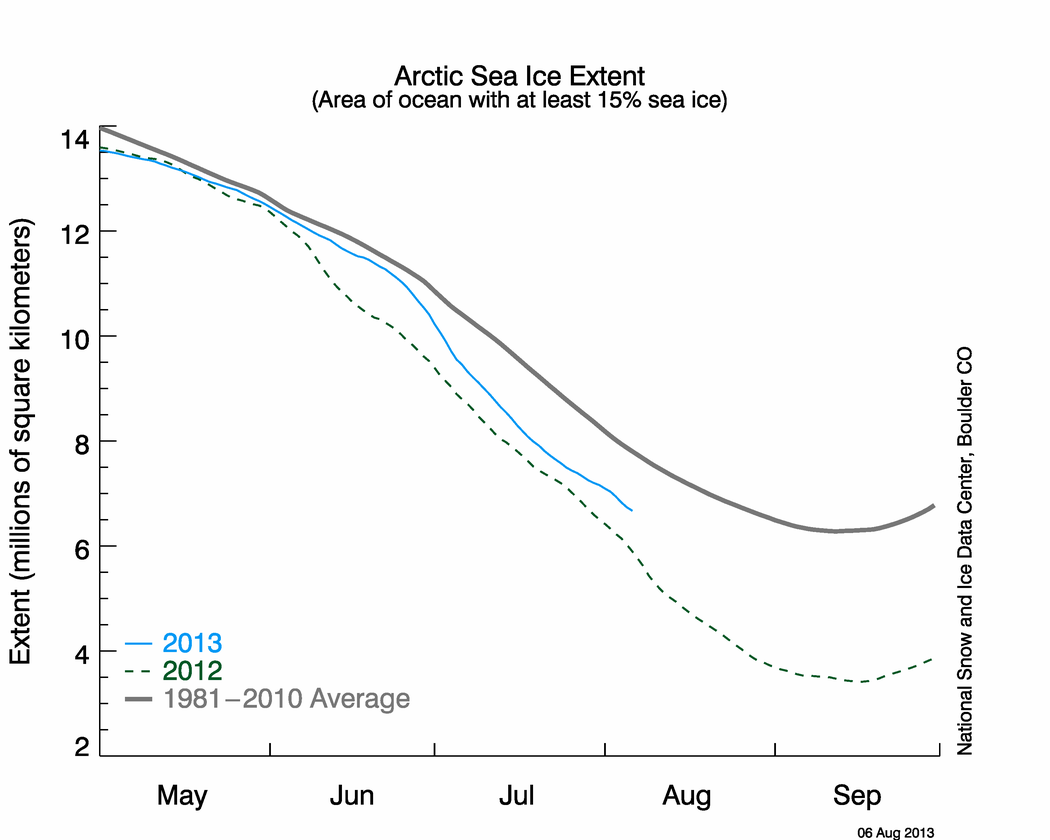
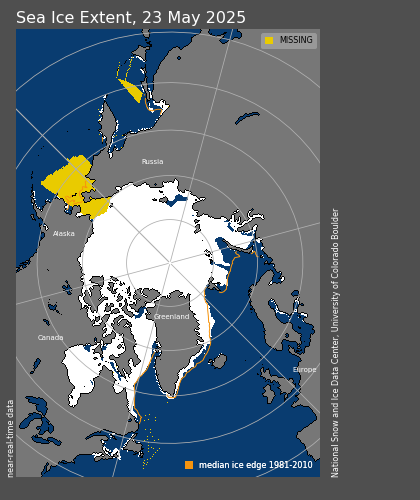
The Baltic and Bering Sea have slightly above normal ice. Eastern Canada and The Sea of Okhotsk have slightly below normal ice.

http://nsidc.org/data/seaice_index/images/daily_images/N_daily_extent.png
DMI shows sea ice extent at nearly the highest in their six year record.

Sea ice extent for the past 5 years (in million km2) for the northern hemisphere, as a function of date.
http://ocean.dmi.dk/arctic/icecover.uk.php
NORSEX shows ice area just outside one standard deviation (i.e. almost normal.)

http://arctic-roos.org/observations/satellite-data/sea-ice/observation_images/ssmi1_ice_area.png

There’s also some interesting comparisons to be made at Cryosphere Today. When you compare the current images in recent days with the same period in years past, you notice how “solid” the ice has become. For example compare March 3rd 2010 to March 3rd 2008, when we saw the first year of recovery:

Note that there’s no “fuzziness” in the signal return that creates this image on the right. A fuzzy return would indicate less than solid ice, such as we see on the left. The CT image from March 3rd is “deep purple” through and through. The edges of the ice are very sharp also, particularly near Greenland and also in the Bering sea. These two visual cues imply a solid, and perhaps thicker ice pack, rather than one that has been described by Dr. Barber as “rotten ice”.
I wish I could compare to March 3 2009, but the CT images were offline last spring then while both they and NSIDC dealt with issues of SSMI sensor dropout that was originally brought to their attention by WUWT, but was deemed “not worth blogging about“.
According to JAXA, 2003 was a good year for Arctic sea ice. Note the blue line.

So how does that year on March 3rd compare to our current year using CT’s imagery?

Compared to the best year for Arctic sea ice in the past decade, March 3rd this year looks quite solid. The setup for 2010 having more ice looks good.
You can do your own side by side comparisons here with CT’s interactive Arctic sea ice comparator.
The Arctic continues to recover, and one of the last CAGW talking points continues to look weaker and weaker. It wasn’t very long ago when experts were forecasting the demise of Arctic ice somewhere between 2008 and 2013. And it is not the first time that experts have done this – they were claiming the same nonsense in 1969, right before the ice age scare.

Note the column at the right. Even back then, skeptics got the short shrift on headlines because as we know: “all is well, don’t panic” doesn’t sell newspapers.
UPDATE: And then there’s this:
AROUND 50 ships, including large ferries reportedly carrying thousands, were stuck in the ice in the Baltic Sea today and many were not likely to be freed for hours, Swedish maritime authorities said.
geo (11:36:49) :
Yes, tantalizing data is frustrating. Too bad the secret subs of the Cold War were not more interested in Arctic sea ice thickness, they probably could have had good data back to 1947 or so…
I saw your graph above, thanks.
http://www.arctic.noaa.gov/reportcard/figures/seaice2009fig4.jpg
I had seen the same graph here: http://www.arctic.noaa.gov/reportcard/seaice.html
but yours is larger.
Sub data is a good confirmation of satellite data, but it doesn’t give large-area coverage. The cyclic looking thickness of the sub data is interesting, but did the sub follow the same path every year ? Was that 38% coverage area the area with thickest ice ? Satellite data doesn’t have those problems.
ICESat died last October:
http://www.spaceflightnow.com/news/n1002/25icesat/
A European replacement satellite is set to be launched soon (delays last month):
http://www.esa.int/SPECIALS/Cryosat/index.html
ICESat data goes back to 2003:
http://www.ens-newswire.com/ens/apr2009/2009-04-06-01.asp
True, the thickness data is just “suggestive”, but it is suggesting Arctic summer ice is disappearing much faster than the 2D satellite maps show.
@Anu: Here are recent posts on Siberian methane from other threads:
Anu,
In your honor, I wrote up an article on the methane story.
Steve Goddard (17:23:15) :
I’m honored.
I noticed that story, and the one on “snowball earth” shortly after I mentioned both. I thought it might be more than coincidence…
And I wouldn’t call it the “panic du jour” – some people were panicked five years ago about what a warming Arctic could do to the methane clathrates:
http://www.energybulletin.net/node/3647
John from CA (11:20:21) :
Is it reasonable to say, current Climate Models are incapable of properly predicting what has already occurred in the past? If they could do that, then there would be a basis for future climate predictions?
———-
Such “hindcasts” are run all the time to test the climate models, for example:
http://ams.allenpress.com/archive/1520-0477/89/3/pdf/i1520-0477-89-3-303.pdf
but as you know, as we go farther and farther back in time, the initial conditions are more vague and unknown (since measurements of climate variables are improving all the time), so it is difficult to test “starting from known climate conditions in 1970, could this model predict the climate in 2010 ?”. Conditions in 1970 aren’t that precisely known. The climate models of 1980 were cruder, and had cruder starting data.
Even today, as the Hadley Centre works on short-term 10 year climate predictions (the Met’s Decadal Climate Prediction System – DePreSys) that take into account more ephemeral phenomena, like the El Nino and other ocean oscillations, the hardest part is entering the initial conditions, since the observations have not been detailed enough for these mid-term predictions until recently:
http://news.bbc.co.uk/2/hi/science/nature/6939347.stm
Anu,
Climate models use tens of thousands of empirically derived parameters based on the recent past. It is therefore not surprising that they model the recent past fairly accurately. In fact it would be astonishing if they didn’t.
BTW – I actually wrote the methane article before you made your post, but you made it more fun. ;^)
Thanks for the link Anu
Steve Goddard (21:12:57) :
The recent past is the only time period for which they have extensive climate measurements. For the far past (with different continent positions, different Sun TSI, different starting conditions in the atmosphere, etc), they have to make some assumptions, but when they do, the climate models still show some interesting results:
Climate Model Links Higher Temperatures to Prehistoric Extinction
August 24, 2005
BOULDER—Scientists at the National Center for Atmospheric Research (NCAR) have created a computer simulation showing Earth’s climate in unprecedented detail at the time of the greatest mass extinction in the planet’s history. The work gives support to a theory that an abrupt and dramatic rise in atmospheric levels of carbon dioxide triggered the massive die-off 251 million years ago. The research appears in the September issue of
Geology.
ps – it did seem like very quick work…
Nice graphics.
Why not include the Arctic Sea Ice Extent graph with +/-2 standard deviations shaded in ?
http://nsidc.org/images/arcticseaicenews/20100303_Figure2.png
You know how excitable some people get when they’re not given the “context” 🙂
John from CA (06:35:17) :
You’re welcome.
Global sea ice context: click
Here’s why: click
U R welcome.
Anu,
I had a chance to briefly skim the link and noticed that the variables didn’t include long wave projections. The variable set for the model seems to be based on observed changes. This is likely a silly Scifi question, if the equations rest on a constant of given long wave input, is the input simply an unknown in the model?
Cryosphere Today reports a -.335 anomaly from the 1979-2008 mean to date; (436,000 sq. km of ice growth in the Northern Hemisphere in the past week).
Solar activity has been very low for the past month. Is low long wave one of the major causes or am I being to simplistic?
I have been looking at the arctic ice and various discussions over the last 3 years and I can add my personal experience. I live in Oulu on western border by the sea and the ice this year is thicker and began earlier than usual, the average temperatures throughout the Winter have been significantly greater than usual and so has the snow depth. I think that the Barent sea temperatures should remain slightly cooler than usual this will also assist in prolonging the artic ice coverage in that area around Svalbard. I believe this argument may also hold true in other areas aorund the northern hemisphere and so hopefully 2010 may turn out to be good year.