by Steven Goddard and Anthony Watts
In late 2009, Anthony forecast that Arctic sea ice would continue to recover in 2010. Last month Steve Goddard did an analysis explaining why that was likely to happen and yesterday NSIDC confirmed the analysis.
The pattern of winds associated with a strongly negative AO tends to reduce export of ice out of the Arctic through the Fram Strait. This helps keep more of the older, thicker ice within the Arctic. While little old ice remains, sequestering what is left may help keep the September extent from dropping as low as it did in the last few years.
The wording of NSIDC press releases usually highlight the negative (this one being no exception) but the message is clear. This summer is likely to continue the trend since 2007 of increasing summer minimums.
So how is Arctic sea ice looking at this point, near the winter maximum? NSIDC shows ice extent within 1 million km2 of normal and increasing.
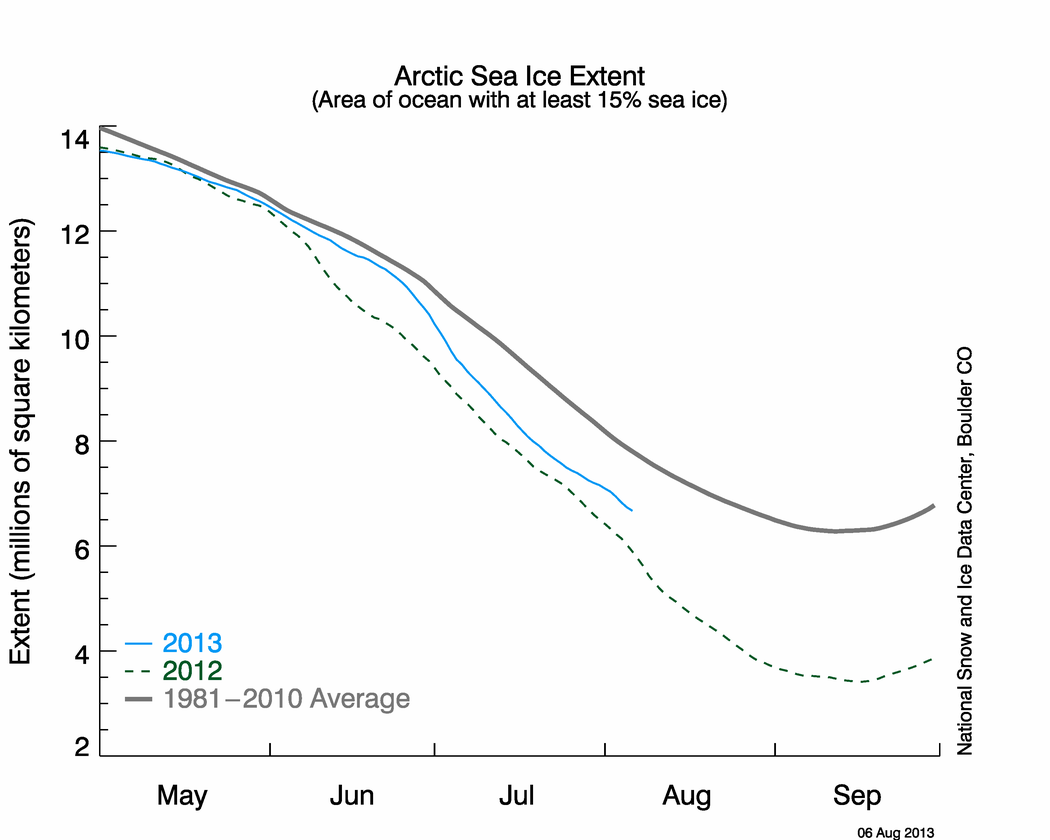
http://nsidc.org/data/seaice_index/images/daily_images/N_timeseries.png
The Baltic and Bering Sea have slightly above normal ice. Eastern Canada and The Sea of Okhotsk have slightly below normal ice.
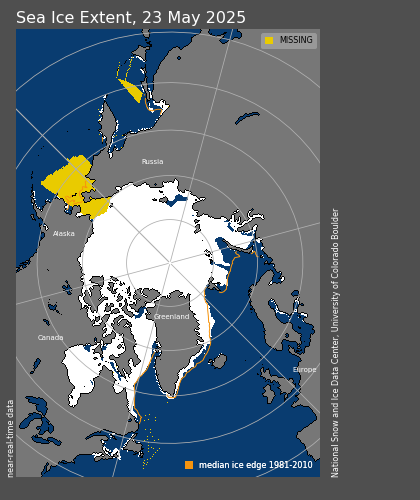
http://nsidc.org/data/seaice_index/images/daily_images/N_daily_extent.png
DMI shows sea ice extent at nearly the highest in their six year record.

Sea ice extent for the past 5 years (in million km2) for the northern hemisphere, as a function of date.
http://ocean.dmi.dk/arctic/icecover.uk.php
NORSEX shows ice area just outside one standard deviation (i.e. almost normal.)

http://arctic-roos.org/observations/satellite-data/sea-ice/observation_images/ssmi1_ice_area.png
There’s also some interesting comparisons to be made at Cryosphere Today. When you compare the current images in recent days with the same period in years past, you notice how “solid” the ice has become. For example compare March 3rd 2010 to March 3rd 2008, when we saw the first year of recovery:

Note that there’s no “fuzziness” in the signal return that creates this image on the right. A fuzzy return would indicate less than solid ice, such as we see on the left. The CT image from March 3rd is “deep purple” through and through. The edges of the ice are very sharp also, particularly near Greenland and also in the Bering sea. These two visual cues imply a solid, and perhaps thicker ice pack, rather than one that has been described by Dr. Barber as “rotten ice”.
I wish I could compare to March 3 2009, but the CT images were offline last spring then while both they and NSIDC dealt with issues of SSMI sensor dropout that was originally brought to their attention by WUWT, but was deemed “not worth blogging about“.
According to JAXA, 2003 was a good year for Arctic sea ice. Note the blue line.

So how does that year on March 3rd compare to our current year using CT’s imagery?

Compared to the best year for Arctic sea ice in the past decade, March 3rd this year looks quite solid. The setup for 2010 having more ice looks good.
You can do your own side by side comparisons here with CT’s interactive Arctic sea ice comparator.
The Arctic continues to recover, and one of the last CAGW talking points continues to look weaker and weaker. It wasn’t very long ago when experts were forecasting the demise of Arctic ice somewhere between 2008 and 2013. And it is not the first time that experts have done this – they were claiming the same nonsense in 1969, right before the ice age scare.

Note the column at the right. Even back then, skeptics got the short shrift on headlines because as we know: “all is well, don’t panic” doesn’t sell newspapers.
UPDATE: And then there’s this:
AROUND 50 ships, including large ferries reportedly carrying thousands, were stuck in the ice in the Baltic Sea today and many were not likely to be freed for hours, Swedish maritime authorities said.
@Anu (19:24:58) :
This El Nino started in July of ’09. They typically last 9-12 months. So this one is in sight of its “sell by” date. In all liklihood we’re looking at somewhere between 6-9 months of no el nino this year.
What I was thinking of was this: http://ggweather.com/enso/years.htm
RE: Paul Daniel Ash (09:53:38) :
——————————–
Gerald Machnee (09:22:06) :
Where is the proof? Where is it MEASURED?
I guess one reason that I might appear like a “know-it-all” is because people keep asking me these kinds of questions, which I go out and try to find answers for.
I’m not trying to present that I just know these things off the top of my head, or that I think the answers are unassailable, just that there are answers to the questions. As I’ve said repeatedly, I’d like to know what the problems/flaws/errors are in the answers I present.
Anyway, as to measurement:
Murphy et. al. presented an analysis of Earth’s “energy budget”: how much is received, how much is absorbed, and how much is reflected back to space.
————————————————
What problems/flaws?
Well, this does not even come close to answering my question.
I want a study that MEASURES the percentage or amount of temperature change due to CO2 or GHG. It must be explicit in the conclusion. All they have now is a graph with rising CO2 and oscillating temperatures. If the GHG were responsible for most of the rise there would only be a variation in the increase, not a rise and fall.
Many of the contributors here have been on both sides of the fence and are now looking for real science.
Paul Daniel Ash: “As I’ve said repeatedly, I’d like to know what the problems/flaws/errors are in the answers I present.”
And as many people have said on here REPEATEDLY, those problems, flaws, errors, and fallacies have been pointed out numerous times…but you [repeatedly] refuse to listen to any advice to the contrary.
I stand by my original unsolicited words: If you want to learn, then keep your mouth shut (and keyboard silent) more…and you will learn.
Trust me…if you would take a few…and actually open your mind [like you claim to be, open-minded] and look at the logic of what Smokey is presenting, you will find little [if any] fault in his arguments. They are bullet proof.
And this is the real test, Paul. The human psyche in all its egoic and cognitive dissonance trappings…sometimes even blinds the smartest of us.
Arguing for arguing’s sake is NOT debate.
You say you want to learn. Prove it.
Chris
Norfolk, VA, USa
Chris
Gail said
“Doesn’t it really irk you that all that money was wasted promoting CAGW while a worthwhile and very interesting project like this gets scraps at best.”
I think that a lot of very intersting research is sidelined because it doesn’t fulfill modern criteria which is to prove AGW. The EU won’t fund such research, the British Govt akways has an agenda behind their funded research projects and all credulity is suspended whilst the AGW steamroller flattens everything in its path.
I tend to look for good pieces of research prior to around 1980 when it tended to be more even handed, and those from pre 1950 are even better. Obviously in examining them the researcher has to be careful that things haven’t moved on.
There has been some great material recently in the Australian press about bats falling from the sky through heat and terrible dust storms-all of course ‘unprecedented’. When you can point to reports from 100 and 200 years ago stating exactly the same thing, people are at first dumbfounded, then dismissive, then continue promoting their own agenda as if nothing had happened.
Tonyb
Steve Goddard (19:29:12) :
Anu,
This article is about Arctic summer sea ice, most of which is located above 80N. Temperatures in the middle of Nunavut don’t really affect sea ice.
If you feel that the DMI graphs are mislabeled, “Daily Mean Temperatures in the Arctic 1958 – 2010″ you should help those “amateurs” out with your highly respected and anonymous professional opinion.
————–
The DMI site is quite precise with its labels and descriptions:
http://ocean.dmi.dk/arctic/meant80n.uk.php
Arctic Temperatures
Daily Mean Temperatures North of 80 degree North.
The plots are labelled:
Daily mean temperature and climate north of the 80th northern parallel, as a function of the day of year.
etc.
I was merely pointing out this is a *fraction* of the entire Arctic, which makes
it harder to compare to other plots showing the longterm trend of warming
temperatures “in the Arctic”, which I also linked to.
Do you feel that “amateurs” should not be commenting on the work of climate
professionals or their websites ?
geo (19:58:21) :
@Anu (19:24:58) :
This El Nino started in July of ‘09. They typically last 9-12 months. So this one is in sight of its “sell by” date. In all liklihood we’re looking at somewhere between 6-9 months of no el nino this year.
—————————
You could very well be right. And as your linked site says, the very *definition* of an El Nino is a bit fuzzy, different organizations have different criteria.
I was looking at page 22 of this NOAA report:
http://www.cpc.noaa.gov/products/analysis_monitoring/lanina/enso_evolution-status-fcsts-web.pdf
Notice 1958, 1970, 1977, 1983, 1987, 1990 to 1995, 2002 to 2006, and the shape of the ENSO event so far:
it could also easily be the case that this El Nino will last into 2011.
It’s a temporary effect, but you know how people get excited about “warmest year ever” stories…
TonyB (23:48:42) :
Gail said
I think that a lot of very intersting research is sidelined because it doesn’t fulfill modern criteria which is to prove AGW. The EU won’t fund such research,
————
Denmark is part of the EU.
Danish scientist Henrik Svensmark at the Danish National Space Center (DNSC) ( he is director of the Center for Sun-Climate Research at the Danish Space Research Institute (DSRI)), who’s “cosmic ray theory” idea formed a centrepiece of the controversial documentary “The Great Global Warming Swindle”, demonstrates that science is open to alternative scientific ideas concerning global warming.
CERN is looking into part of this idea, although the overall theory (detailed in a book, The Chilling Stars, written by Svensmark and British science writer Nigel Calder) is not expected to pan out by many scientists.
Scientists would *love* to prove AGW wrong, especially the younger climate scientists – it would make their career, get them on TV, give them book deals, tenure, and probably a Nobel prize. There are plenty of countries which can launch satellites, and have PhD’s and Universities. Any one of those countries could produce an “AGW theory” killer.
Even Denmark.
Anu,
I have seen many forecasts made by climate professionals go down in flames, and find your appeals to your self-proclaimed and anonymous authority to be completely uninteresting.
http://www.telegraph.co.uk/news/newstopics/politics/scotland/4579829/Scottish-ski-industry-could-disappear-due-to-global-warming-warns-Met-Office.html
http://www.heraldscotland.com/news/home-news/best-season-in-30-years-as-ski-centres-enjoy-record-visitors-1.1011484
Well, the AO continues to moderate (almost to neutral now), and the unusual (but not unprecedented) late growing season spike in the extent continues.
Why don’t we have multi-year graphs of the AO along the lines of the IJIS extent charts? It would be very interesting to be able to eyeball those two side-by-side (if the AO version existed, which so far as I can tell it does not).
The AO may of course triple-dip (it has already double-dipped), but having the historical graphs might provide some insight on the impact of the AO cycles by specific periods of the grow/melt season –for instance, is it more impactful for the AO to be positive or negative in some months rather than others?
Anu,
You can’t “prove” CAGW wrong, because it is the output of computer simulations. Depending on what parameters you use, you get very different results – particularly related to the effect of cloud cover. There is no way to “prove” that one set of parameters is incorrect.
What you can do is observe the failure of climate forecasts, and those failures are piling up almost faster than I can write about them.
Steve Goddard (09:32:16) :
Anu,
I have seen many forecasts made by climate professionals go down in flames, and find your appeals to your self-proclaimed and anonymous authority to be completely uninteresting.
—————
Pointing out that north of 80 deg N. latitude is not “the Arctic” is hardly debatable, now is it ? I need no special “authority” to make that claim. If you cannot read precisely, that has nothing to do with my ‘authority”.
As to the ski industry in Scotland, re-read the link you helpfully provided:
Steve Goddard’s cited article on Scottish ski industry
Alex Hill, chief government advisor with the Met Office, said the amount of snow in the Scottish mountains had been decreasing for the last 40 years and there was no reason for the decline to stop.
He added: “Put it this way, I will not be investing in the ski-ing industry. Will there be a ski industry in Scotland in 50 years’ time? Very unlikely.”
50 years from now, we will see if this prediction has “gone down in flames”. Having nice snowfall this winter has nothing to do with the prediction of “climate change may mean they have less than 50 years of ski-ing left.
I know you’re anxious to prove AGW wrong right now, but you’ll have to wait awhile before you can claim this particular prediction was wrong.
Steve Goddard (12:44:45) :
What you can do is observe the failure of climate forecasts, and those failures are piling up almost faster than I can write about them.
————
I’m not convinced you understand what a “climate forecast” is, after your example with the Scottish skiing industry.
As for Dr. Trenberth:
Kevin Trenberth is head of the Climate Analysis Section at the National Center for Atmospheric Research (NCAR) in Boulder, Colorado. His email was referring to his recent paper.
The global mean temperature in 2008 was the lowest since about 2000. Given that there is continual heating of the planet, referred to as radiative forcing, by accelerating increases of carbon dioxide and other greenhouses due to human activities, why isn’t the temperature continuing to go up? The stock answer is that natural variability plays a key role and there was a major La Niña event early in 2008 that led to the month of January having the lowest anomaly in global temperature since 2000. While this is true, it is an incomplete explanation. In particular, what are the physical processes? From an energy standpoint, there should be an explanation that accounts for where the radiative forcing has gone. Was it compensated for temporarily by changes in clouds or aerosols, or other changes in atmospheric circulation that allowed more radiation to escape to space? Was it because a lot of heat went into melting Arctic sea ice or parts of Greenland and Antarctica, and other glaciers? Was it because the heat was buried in the ocean and sequestered, perhaps well below the surface? Was it because the La Niña led to a change in tropical ocean currents and rearranged the configuration of ocean heat? Perhaps all
of these things are going on? But surely we have an adequate system to track whether this is the case or not, don’t we?
Well, it seems that the answer is no, we do not. But we should!
——————-
It’s a good point – exactly why was 2008 the second coolest year in the hottest decade on record ?
Exactly where is the extra radiative forcing going ? Improved measurements such as the thousands of ARGO floats have helped, but the head of the Climate Analysis Section at the National Center for Atmospheric Research argues that they could use even better measurements.
Big surprise.
Sorry about that “bold” error in my last comment…
I didn’t mean to “scream”.
Anu,
As a scientist, I’ve been watching global warming disaster claims for three decades now. I even believed them for a long time. Probably since you were a baby. I’ve been hearing the “end of skiing” claim since at least the mid 1980s.
They aren’t happening and I really have little patience for people making claims for the next 30-50 years – which will soon be forgotten.
Perhaps it is you who don’t understand how climate models work.
Steve Goddard (16:27:09) :
(thanks for fixing the html error)
Three decades ago, I already had my first degree from MIT – hardly a baby.
If you heard an “end of skiing in 50 years” claim in the mid 1980’s, there is still 25 years to go.
I too have no patience in waiting for the demise of Scottish skiing – but I think the summer Arctic ice cover shrinking dramatically will be the first “aha” moment for many skeptics.
Sure, they still need to refine the climate models and the observation abilities (ARGO is a good start with the oceans, and I’m interested in how ice thickness data such as from ICESat, Envisat and CryoSat-2 unfolds in the next year or two – giving ice thickness in the Arctic, not just 2D extent data).
http://www.jpl.nasa.gov/news/news.cfm?release=2009-107
http://www.esa.int/esaCP/SEMTGPRTKMF_index_0.html
What do you think of the claims that about half of the next 10 years will be the hottest on record (since 1880, not ancient proxy records) ? Soon enough for your “little patience” ?
And what do you think of predictions of a steady warming of about 0.17 deg C/decade ?
http://data.giss.nasa.gov/gistemp/graphs/Fig.A2.lrg.gif
Is there a chance the next 10 years will change your mind again ?
News & Perspective from the Center for Environmental Journalism
Arctic sea ice extent in January fourth lowest on record
http://www.cejournal.net/?p=2955
A little context might help:
http://nsidc.org/images/arcticseaicenews/20100303_Figure3.png
http://nsidc.org/arcticseaicenews/
Anu,
Physics tells us that a doubling of CO2 should increase temperatures by about 1.2C, and that seems quite plausible. What I have a tough time with is the feedback predicted by some climate models of 6+C.
No doubt there was a lot of thinning of Arctic ice during the winter of 2007-2008, but it wasn’t due to in-situ melting (obviously) – rather it was due to drift into the warmer waters of the North Atlantic. Which is exactly what this article and the one it referred to is about.
http://wattsupwiththat.com/2010/02/09/prediction-arctic-ice-will-continue-to-recover-this-summer/
Anu and Steve
Anu
Since you dislike ancient proxy records (no doubt because they ilustrate the huge variabilty of the climate) how about this 1930’s reference to the Scottish winter? I used to ski in Scotland in the late 70’s and early 1980’s and they certainly considered the large amount of snow then to be abnormal.
“Winters here since 1988 are exactly the same now as they were in the first four decades of the past century and for most of the 1970s. Hence they are what has been normal for the past century with the winters of the 1940s, 50s 60s and 77-87 being colder and snowier.
This is what a farmer from Buchan in North East Scotland, one of the snowiest parts of lowland Britain, wrote in the agricultural section of my local newspaper during the exceptionally mild winter of 1933/34.
“1934 has opened true to the modern tradition of open, snowless winters. The long ago winters are no precedent for our modern samples. During the last decade, during several Januarys the lark has heralded spring up in the lift from the middle to the end of the month. Not full fledged songs but preliminary bars in an effort to adapt to our climatic change”
It then goes on to say
“It is unwise to assume that the modern winters have displaced the old indefinitely”
and also
“Our modern winters have induced an altered agricultural regime”
That description sound pretty much apt for the winters today. Hence there has been no change since that era. This current winter has been remarkably snowless in my area but not a patch on 1933/34 when there hadn’t even been a flake falling by this time and daffodils were in full bloom by the fourth week of February.”
Of course if we were not disqualified from using ancient proxies we could cite many similar references.
Tonyb
Anu
I said;
“I think that a lot of very interesting research is sidelined because it doesn’t fulfill modern criteria which is to prove AGW. The EU won’t fund such research/”
In rebuttal you cited Svensmark and indeed that is one of the few exceptions that proves the rule-you will note I said ‘a lot of very interesting research’ not ALL research.
Tonyb
The article and the last 20 or so comments are very interesting. Its great to see a debate and Anu’s comment about “not just 2D extent data” is something that jumps off the page for me. Right up there with the inability to properly display “Sea ice concentrations less than 30%” in the Cryosphere Today images.
Is it reasonable to say, current Climate Models are incapable of properly predicting what has already occurred in the past? If they could do that, then there would be a basis for future climate predictions?
I tossed a link up earlier with “3D” (i.e. thickness) data back to 1975 (I said ’76 upstream, but looking more closely it appears to be 1975– four years before we start having satellite extent data) from declassified US sonar data. The problem is it is only of about 38% of the arctic area that the US subs were regularly patrolling. I find the thickness curve climbing from 1975-1982 to be very interesting in that data. One looks at that and aches to have it from 1945-1975 as well (but, alas, we don’t). It’s certainly suggestive of what it might look like and how that mid/late-40s thickness data might compare to the late oughties.
ICEsat is certainly a great idea. But until you’ve got quite a few more years of it, it is no more than suggestive.
Thanks for the link geo.
I ran across this site as I was looking for information on Sea of Okhotsk currents.
http://sharaku.eorc.jaxa.jp/ADEOS2/sensor/sensor.html
AMSR looks promising – reports on more then a single aspect of climate.
Just me, a retired teacher, not a scientist. I need to find out as much as I can myself, not relying on media. AGW ers are WAY off, at a huge cost to the planet.
Briefly, here is an embarrassing example of the hazards of “subjective” observations by, sadly, one of “our” Canadian astronauts:
http://www.redorbit.com/news/space/1727091/affects_of_global_warming_are_clear_from_space/
“Affects Of Global Warming Are Clear From Space
Posted on: Monday, 27 July 2009, 10:20 CDT
Canadian astronaut Bob Thirsk said about his mission to space, “It will be the supreme thrill of my life.” However, he was less than thrilled to report that the Earth’s ice caps seem to have melted since he was last in orbit 12 years ago.
Thirsk is a flight engineer and member of the Expedition 20/21 crew on the International Space Station. This first Canadian to fly on a Soyuz was launched as a Mission Specialist on the Soyuz mission May 27.”
I heard Mr. Thirst say this on the evening news that day, and immediately I was skeptical. It was so obvious to me to question the statement, and better minds than mine can reach their own conclusions.
Have a look at Cryosphere Today, comparing August 15, 1997, with August 15, 2009 (July, 2009 data not available).
http://igloo.atmos.uiuc.edu/cgi-bin/test/print.sh?fm=08&fd=15&fy=1997&sm=08&sd=15&sy=2009
Subjective observations on everything from the Himalayan and other glaciers, deforestation, hurricanes, floods and fire, among others, were used as “evidence” for dangerous global….oh climate change…in the IPCC, and they are still being spouted by “the movement”. Meanwhile, all of it is based on the false premise that human CO2 emissions are the cause.
Credible scientists in the natural sciences are disputing this with objective DATA every day, while including historical geological evidence. No, 30 years is not enough data to conclude anything, Mr. Paul Daniel Ash, except it would appear YOUR conclusions and those of the AGW elite who are actually putting the survival of all of us at the tipping point for their own POWER and WEALTH.
How do we wake up the innocent, well-meaning citizens of the world?
Steve Goddard (20:58:51) :
Yes, the feedbacks within the climate system are very hard to predict:
http://www.sciencedaily.com/releases/2010/03/100304142240.htm
Methane Releases from Arctic Shelf May Be Much Larger and Faster Than Anticipated
ScienceDaily (Mar. 5, 2010) — A section of the Arctic Ocean seafloor that holds vast stores of frozen methane is showing signs of instability and widespread venting of the powerful greenhouse gas, according to the findings of an international research team led by University of Alaska Fairbanks scientists Natalia Shakhova and Igor Semiletov.
Methane is a greenhouse gas more than 30 times more potent than carbon dioxide. The East Siberian Arctic Shelf is a methane-rich area that encompasses more than 2 million square kilometers of seafloor in the Arctic Ocean. It is more than three times as large as the nearby Siberian wetlands, which have been considered the primary Northern Hemisphere source of atmospheric methane.
“Our concern is that the subsea permafrost has been showing signs of destabilization already,” she said. “If it further destabilizes, the methane emissions may not be teragrams, it would be significantly larger.”
Shakhova notes that Earth’s geological record indicates that atmospheric methane concentrations have varied between about .3 to .4 parts per million during cold periods to .6 to .7 parts per million during warm periods. Current average methane concentrations in the Arctic average about 1.85 parts per million, the highest in 400,000 years, she said. Concentrations above the East Siberian Arctic Shelf are even higher.
TonyB (00:28:00) :
Anu
I said;
“I think that a lot of very interesting research is sidelined because it doesn’t fulfill modern criteria which is to prove AGW. The EU won’t fund such research”
In rebuttal you cited Svensmark and indeed that is one of the few exceptions that proves the rule-you will note I said ‘a lot of very interesting research’ not ALL research.
Tonyb
Yes, I noted that you said ‘a lot of very interesting research’ , and I also noted you did not give any examples. Do none of these “interesting research” ideas have writeups on the Web ?
Do you think that observational research, like the ARGO global array of 3351 free drifting floats was built only because scientists thought it would “fulfill modern criteria which is to prove AGW” ?
http://www.argo.ucsd.edu/
28 countries contribute funds to the ARGO global research, including many EU countries. The initial published results seemed to show the oceans were cooling, which was widely mentioned in the blogosphere.
Did this funding of research, and publishing of results which disagreed with AGW expectations, constitute another of the few exceptions that proves the rule ?
By the way, once the new ARGO floats and older XBT’s were reanalyzed at length to try and explain the discrepancy of these measurements with other measurements, it turns out the oceans are warming pretty much as expected.
http://earthobservatory.nasa.gov/Features/OceanCooling/page1.php