From Spaceweather.com with apologies to Linus and Charles Schulz

The Solar and Heliospheric Observatory (SOHO) is tracking an enormous magnetic filament on the sun. It stretches more than one million kilometers from end to end, which makes it an easy target for backyard solar telescopes. For the seventh day in a row, an enormous magnetic filament is hanging suspended above the surface of the sun’s southern hemisphere. The Solar and Heliospheric Observatory (SOHO) has a great view. How long can it last? Solar filaments are unpredictable. If this one collapses and hits the stellar surface, the impact could produce a powerful Hyder flare.
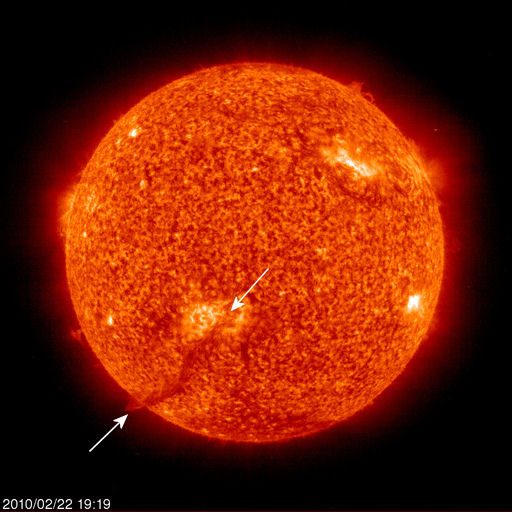


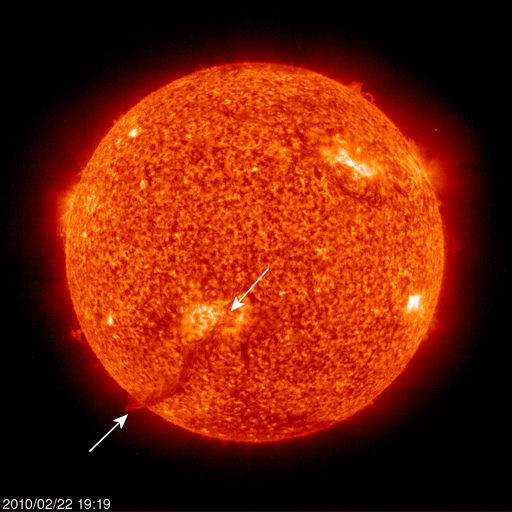
The most recent SOHO image is here
Hyder Flares: from Australian IPS 1. What is a Hyder flare?
Flares are intense brightenings that occur in the solar chromosphere. Flares are generally observed from Earth using narrow band filters, typically with a bandwidth of less than 0.1 nm, and often centred on the Hydrogen-Alpha wavelength of 656.3 nm. (Flares also have counterparts, that is, sudden outbursts, in the radio and X-ray spectrum).
Most flares occur around active regions associated with sunspot groups. However, occasionally a flare (sudden brightening) is observed well away from an active region or sunspot group. These flares are invariably associated with the sudden disappearance of a large (thick, long, ‘bushy’) dark solar filament, and are termed Hyder flares.
2. Why are Hyder flares so named?
Max Waldmeier wrote a paper in 1938 which described the phenomenon of suddenly disappearing filaments (disparition brusque), and mentioned that these can be associated with flare-like brightenings, but it was left to Charles Hyder to postulate the first comprehensive mechanism for the such flares.
Following on work from his doctoral thesis with the University of Colorado in Boulder (1964), Hyder published two papers in the second volume of the journal Solar Physics (1967) in which the mechanism by which Hyder flares might occur was discussed in detail. Hyder was then on the staff of the (US) Air Force Cambridge Research Laboratories at the Sacramento Peak Observatory in New Mexico.
It was these papers in Solar Physics by which Hyder’s name became associated with the flares in question, even though he was by no means the first to observe them.
3. What are the characteristics of Hyder flares?
As previously mentioned, the name Hyder flare is given to a flare that occurs away from an active region or sunspot group and that is associated with the sudden disappearance of a dark filament. The appearance of these flares can range from a string of bright knots on one or both sides of the filament (or rather, the position previously occupied by the filament, sometimes called the filament channel), to a single or double ribbon flare. The ribbons are parallel to the filament channel. If only one ribbon is present, it will lie to one side of the channel, whereas if two parallel ribbons occur, one ribbon will lie on one side of the filament channel, and the other ribbon will lie on the opposite side.
One interesting characteristic of Hyder flares is that they usually develop or rise to maximum brightness much more slowly than do the more common flares associated with active regions. The larger Hyder flares may take 30 to 60 minutes to rise to a peak intensity, and then they may last for several hours. Although they may attain a large area, they usually have a relatively low intensity. Thus, classifications for a large Hyder flare may read 2F, 2N or possibly even 3F. This contrasts to an active region flare in which 3F is very rare. An active region flare that attains sufficient area to put it into the importance class 3, will invariably have either a Normal or more usually a Brilliant brightness classification.
X-ray flares and radio (microwave) bursts associated with the optical Hyder flare, are also generally long lived phenomenon and are classified as the gradual rise and fall type of event (in contrast to the impulsive and complex events associated with large active region flares).
Generally Hyder flares are not associated with energetic particle emission or geomagnetic storms (implying that they may not be associated with a coronal mass ejection). However, this is not always the case, as a large halo CME observed by the LASCO solar coronagraph on board the SOHO spacecraft was most definitely associated with a Hyder flare (2N/M1) observed on 12 September 2000. This same complex also appeared to have produced energetic protons at geosynchronous orbit with energies in excess of 100 MeV, and in substantial numbers at energies of 10 MeV. It is believed that the sudden storm commencement observed at 0450UT 15 September, and the subsequent minor geomagnetic storm was produced by this particular CME.
4. What produces Hyder flares?
Hyder’s explanation of the flare type now named after him depended on the observational evidence that (1) often the flare was a parallel ribbon flare with one ribbon each side of the filament channel, and (2) that geomagnetic storms were not associated with these flares. This led to the speculation that the filamentary material was not ejected far into the corona, but in fact fell back to the chromosphere producing the flare.
Stable or quiescent filaments are believed to lie in and along a magnetic trough. It is thought that the sudden disappearance of such a filament is due to a reconfiguration of the field. In essence, the magnetic trough becomes a magnetic ridge (the bottom of the trough elevating in a period of tens of minutes to become the peak of the ridge). In this process, the filamentary material (cooler gas) is thought to be accelerated into the corona. Hyder’s explanation is that, in the case of the Hyder flare, some or even most of the filament material, instead of suffering acceleration and ejection, falls down the sides of the magnetic ridge and interacts with the lower chromospheric material producing the flare. If the infall process is symmetrical, then the double parallel ribbon flare will result, if asymmetrical, then only one ribbon results. If the infall is sporadic, or the material insufficient, then only bright knots of flare are produced. Hyder did calculations to show that the kinetic energy of the infalling material should be sufficient to provide the required flare energy release observed.
Of late, the Hyder mechanism has come into question. Some people (notably Zirin) have questioned whether infall occurs, stating that the magnetic reconfiguration must always produce ejection. The respective roles of flares and CME’s in solar active processes has also been hotly debated, and this has implications for the exact mechanism of Hyder flares. We certainly have enough observational evidence to show that Hyder flares can be associated with both CME’s and energetic particle production. For the moment, the question of Hyder flare production mechanism appears unresolved, and will probably be sidelined until the more significant (and undoubtedly related) issue of CME – flare production mechanism is sorted out.
The bottom line is that at this stage in solar physics we do not really know what produces a flare nor what produces a CME. There are competing theories, but all tend to have deficiencies with respect to matching the observational evidence. We certainly believe that they all depend on the reconfiguration of magnetic fields as their primary energy source, but in the final analysis, we really only believe this because we can conceive of no other solar energy source of sufficient magnitude.

Thank you for that tutorial, Leif. I have gained a little knowledge, perhaps some insight — even understanding — and feel better for it; but I do not think you need fear your place on the tree of knowledge threatened by my new learning. Perhaps from my grandchildren… I will try and pass it along.
””””’Leif Svalgaard (07:36:05) : But we do look past the current turtle, to the next one or two, but then it is prudent to stop, lest we get sidetracked by ‘alternative views’. ”””””’
Leif,
First, I enjoyed the Physics Today article on plasma that you recommended earlier in this post. I was very pleasantly surprised how readable and understandable it was. Thank you. Now I will try the Solar Cycle article by Hathaway that you recommended.
Second, we can agree on your comment which I quoted above.
Terminal Turtling: So, I close this segment of turtling with what I think are appropriate stanzas from the Rudyard Kipling poem:
“If you can keep your head when all about you
Are losing theirs and blaming it on you,
If you can trust yourself when all men doubt you
But make allowance for their doubting too,
If you can wait and not be tired by waiting,
Or being lied about, don’t deal in lies,
Or being hated, don’t give way to hating,
And yet don’t look too good, nor talk too wise:
If you can dream–and not make dreams your master,
If you can think–and not make thoughts your aim;
If you can meet with Triumph and Disaster
And treat those two impostors just the same;
If you can bear to hear the truth you’ve spoken
Twisted by knaves to make a trap for fools,
Or watch the things you gave your life to, broken,
And stoop and build ‘em up with worn-out tools:”
Thanks to all the great energetic commenters this thread indeed turned into a Great Filament.
Take care.
John
”””’James F. Evans (09:16:33) : John, instead of thinking in terms of particles, it might be more useful to think in terms of discreet energy packets, although, some might consider the two terms as being a distinction without a difference.”””
James,
Ohhh ahhhh, it feels good to be cautiously dipping my toe back into the soothing waters of physics again. Hope I can still swim it.
John
Roger Carr (15:26:56) said to Leif;
”””’Thank you for that tutorial, Leif. I have gained a little knowledge, perhaps some insight — even understanding — and feel better for it; but I do not think you need fear your place on the tree of knowledge threatened by my new learning. Perhaps from my grandchildren… I will try and pass it along.”””’
Roger,
Ditto. That is a nice sentiment.
But I wonder what Leif’s tuition fee is?
Perhaps it will be some of that evil [but good evil] Scandinavian “Aqua Vit” stuff. It is useful in that it can be used as Interstellar Rocket fuel as well as a beverage, so convenient for a solar physicist. N’est pas?
NOTE 1: Aqua Vit -Its name comes from aqua vitae, the Latin for “water of life”. The only way I can drink it is frozen right from the coldest setting in the freezer. A little goes a loooonnnngggg waaayyyyy. I once had a bottle in my freezer for about 15 years.
NOTE 2: Perhaps we can understand now how the Scandinavians keep warm on those subpolar winter periods of darkness. Well, there might be another way . . . . heh, heh : )
John
John Whitman (20:16:51) :
Aquavit […] I once had a bottle in my freezer for about 15 years.
In my freezer, its half-life would be about 3 weeks.
”””’Leif Svalgaard (20:55:33) : In my freezer, its half-life would be about 3 weeks.”””’
Leif,
Ah, so your tuition fee is settled? When payment is due please let me know.
But the big problem remains what kind. The last time I was in Stockholm [early January and dark for ~18 hr/day and daytime wasn’t bright at all] I went with a customer to a bar in an “old town” kind of area. It had a ~25 foot high wall that was probably 30 feet long that was only kinds of Aquavit. They had a library ladder to get access to individual bottles. I only made it ~0.05 % into the varieties.
NOTE: I am in the Bay Area often because my offspring lives there and also I have a number of clients there.
John
John Whitman (21:17:07) :
NOTE: I am in the Bay Area often because my offspring lives there and also I have a number of clients there.
Standing invitation to drop by in lovely Petaluma:
http://maps.google.com/ 1591 Western Avenue Petaluma
Leif Svalgaard (21:29:46) :
Thank you for your gracious invitation.
Likewise you are welcome to visit me if you are ever in Taipei [there Jan thru Apr every year] or the very lovely Adirondack Mtns in upstate New York [there May thru Oct every year] or Sarasota FL [there Nov Dec every year].
I could make turtle soup with Aquavit chasers. In Taiwan they eat a lot of turtle so the turtles do not get to go down very far here before they are dead meat : )
John
Carla (05:41:29) :
Leif, you said the word ‘vooodooo’ again! Doesn’t matter in what context.
Who else accuses people of practising “voodoo science”? Ah yes. Rajendra Pachauri.
Richard Holle has just posted an excellent analysis of terrestrial electromagnetic effects related to planetary and lunar motion on my blog for anyone interested in promising new lines of investigation.
http://tallbloke.wordpress.com/2009/11/30/the-moon-is-linked-to-long-term-atlantic-changes/#comment-613
”””’tallbloke (01:04:15) : Leif, you said the word ‘vooodooo’ again! Doesn’t matter in what context. Who else accuses people of practising “voodoo science”? Ah yes. Rajendra Pachauri.”””’
Tallbloke,
I couldn’t help myself, I must be hanging out way too much at WUWT since the very first thing that occurred to me when I saw your comment was:
Two voodoo data points cannot be statistically significant in the whole world of voodooism?
What would be the possible physical mechanism that would explain the two insances? Magic?
Potential action plan, lets call up Hansen and we can use his data homogenization code to globalize the two data points.
I know I’m bad, bad to the bone. [imagine George Thorogood and the Destroyers playing in the background, loudly]
John
tallbloke (01:04:15) :
Who else accuses people of practising “voodoo science”? Ah yes. Rajendra Pachauri.
No voodoo science here. The reference to voodoo was that some people in the US think that the Haiti earthquake was God’s punishment for the Haitians believing in the perfectly valid religion called voodoo.
Richard Holle has just posted an excellent analysis of terrestrial electromagnetic
Tidal effects are not electromagnetic
The Great Filament Part 2? There appears to be a new filament appearing in upper left on the Sun:
http://sohowww.nascom.nasa.gov/data/realtime/eit_304/512/
Dr Svalgaard, Dr Evans, John Whitman and all you folks who know what you are talking about, can you please confirm?
Interesting, (beating my own drum here) that somewhere in this thread I mentioned that there was a magnetic filament on the far side, which I think is what we are now seeing.
Thank you everybody!
Skylurker Suranda
””’Suranda (10:26:52) : The Great Filament Part 2? There appears to be a new filament appearing in upper left on the Sun . . . Dr Svalgaard, Dr Evans, John Whitman and all you folks who know what you are talking about, can you please confirm? . . . Interesting, (beating my own drum here) that somewhere in this thread I mentioned that there was a magnetic filament on the far side, which I think is what we are now seeing.””””””
I am trying to keep up with the discussions of solar physics, partially succeeding. I am enjoying the effort immensely. Seems you are too. These are rare moments in life.
John
Thank you John ~ I hope I didn’t offend anyone by my comment of those-who-know-who-what-they’re-talking about ~ by that I meant everyone in this thread except me because I am a total novice (and a woo-woo to boot).
Aren’t you folks scared though? Look at this wave rippling action which started on Saturday:
http://solar.nro.nao.ac.jp/norh/html/10min/2010/03/07/movie.html
And it looks as if there are more than one filaments occuring in the northern part of the Sun (but of course spaceweather’s article is for “amateurs”):
http://www.spaceweather.com/
The rippling waves are increasing in intensity:
8 March:
http://solar.nro.nao.ac.jp/norh/html/10min/2010/03/08/movie.html
7 March:
http://solar.nro.nao.ac.jp/norh/html/10min/2010/03/07/movie.html
Activity in the magnetosphere of the Sun or heliosphere? Has this EVER been observed before? Is this man-made? Magnetic field reversal during a solar minimum?
Suranda (05:56:01) :
The rippling waves are increasing in intensity:
They are artifacts [errors] in the data. Not for real.
Thank you Dr Svalgaard, but why all the intense activity (still) on the farside of the Sun? I thought for sure when the farside came around the bend that we would see what’s happening. But it seems still very active over yonder and fairly quiet on this side, with the exception of the new filaments, which are actually quite small compared the great one.
Are there effects from a supernova or a GRB on the farside?
Why so many artifacts?
Suranda (07:31:45) :
Are there effects from a supernova or a GRB on the farside?
No, it happens often that the two sides have different activity, and as the Sun is rotating we soon see what is on the other side. We have spacecraft now that together can see almost all of the sun: http://stereo-ssc.nascom.nasa.gov/beacon/beacon_secchi.shtml
Why so many artifacts?
The Nobeyama radio maps are constructed from an array of 84 separate antennas that need to be worked together. This is a difficult job, but people have developed software that usually do a good job at this. But weather can upset the algorithm and sometimes do. More here: http://solar.nro.nao.ac.jp/norh/html/introduction.html
Suranda,
Terrestrial or extraterrestrial interference good question. Japan experience any seismic “waves,” lately. Did watch the movies from the last 3 months and seems polar signal picks up and then the waves start weak and build. Would that be consistant with interference is building and not sporadic?
Daily movie archive.
http://solar.nro.nao.ac.jp/norh/html/daily/
Beauty Carla! But hey, there are only five filaments whereas there was last week only one, give or take a kilometre or two.
Like ripples in a pond when a stone is tossed in….
these filaments seem to behave as if a ‘huge magnetic stone’
was hurled at the sun.
Are these babes gonna snap like the great filament? It’s like somebody shot the sun in the head.
Sun gets shot in the head during shootout:
http://sohowww.nascom.nasa.gov/data/realtime/eit_171/512/
Actual shootout:
http://www.lmsal.com/solarsoft/stereo/secchi/latest_movies/scc_euvi_beacon_movie_pair_last50_diff_j.html
……just trying to bring a sense of humour to all this while you folks figure out just what is going on……..
Patience and stay safe,
Suranda
Does anyone have a clue what this cube is:
http://iswa.gsfc.nasa.gov:8080/IswaSystemWebApp/iSWACygnetStreamer?timestamp=2038-01-23%2000:44:00&window=-1&cygnetId=40
Suranda (17:14:08) :
Does anyone have a clue what this cube is
Little Green Men playing tricks on us?
No, it is an artifact of he computation. The model operates with different grid sizes close to and far from the Earth, the square [or cube] is where the grid changes. Sometimes the inner and outer solutions don’t match exactly.
Suranda (17:14:08) :
Does anyone have a clue what this cube is:
http://iswa.gsfc.nasa.gov:8080/IswaSystemWebApp/iSWACygnetStreamer?timestamp=2038-01-23%2000:44:00&window=-1&cygnetId=40
Leif Svalgaard (17:31:46) :
Suranda (17:14:08) :
Does anyone have a clue what this cube is
Little Green Men playing tricks on us?
No, it is an artifact of he computation. The model operates with different grid sizes close to and far from the Earth, the square [or cube] is where the grid changes. Sometimes the inner and outer solutions don’t match exactly.
~
This should help get you started Suranda.
“””Current Magnetopause Position Movie
The magnetopause is computed by tracing magnetic field lines in the dayside magnetosphere in 3D data output from the SWMF/BATSRUS magnetosphere real time simulation.
The magnetopause standoff distance as plotted for the last three days is the distance on the GSM Sun-Earth line of the last closed field line of the magnetosphere. The data are available up to 30 to 60 minutes in the future, depending on the solar wind travel time from the ACE spacecraft to the upstream simulation boundary at 33 RE.
Under quiet condition the magnetopause is 10 RE to 12 RE away from Earth. In dense solar wind or in the presence of a strong and negative solar wind magnetic field component Bz, the magnetopause can move closer and even cross geo-synchronous orbit (distance about 6.7 RE).
Uses
The user immediately sees whether the magnetopause boundary comes close to geo-synchronous orbit.
Satellite operations may have to change while the spacecraft exits the magnetosphere and remains in the magnetosheath. “””
References
Space Weather Modeling Framework page at CCMC
NOAA Space Weather Proediction Center
Credits
ACE real time data from NOAA SWPC
SWMF/BATSRUS real time run at CCMC
http://iswa.gsfc.nasa.gov/wiki/index.php/Current_Magnetopause_Position_Movie
I’ll take the high road, you take the low road. Meet you in the middle have a smoke and we’ll go together.
This is some pretty good looking interference config. is this consistent with helmut (skirt) angle of IMF?
ooops hey should put up the link to the image first eh?
http://solar.nro.nao.ac.jp/norh/html/10min/2010/03/09/movie.html
I slowed it down and stopped at 6:20:02. OMG I was imagining imaginary field lines.