Steven Goddard looks at trends in Antarctica and compares to NASA’s recent article.

A January 12, 2010 Earth Observatory article warns that Antarctica
“has been losing more than a hundred cubic kilometers (24 cubic miles) of ice each year since 2002” and that “if all of this ice melted, it would raise global sea level by about 60 meter (197 feet).“
If sea level rose 60 meters, that would wipe out most of the world’s population – which would no doubt make some environmentalists happy. Sadly for them though, Antarctica contains 30 × 10^6 km3 of ice which means that it will take 300,000 years for all the ice to melt at NASA’s claimed current rate of 100 km3 per year. (Chances are that we will run out of fossil fuels long before then.) The surface area of Antarctica is 14.2 million km2 which would indicate an average melt of less than 7 millimeters per year across the continent. (Is NASA claiming that they can measure changes in Antarctic ice thickness within 7 millimeters?) But even more problematic is that UAH satellite data shows no increase in temperatures in Antarctica, rather a small decline.

NASA themselves appear very confused about Antarctic temperature trends. As you can see in the two images below, sometimes they think Antarctica is warming and other times they think it is cooling.


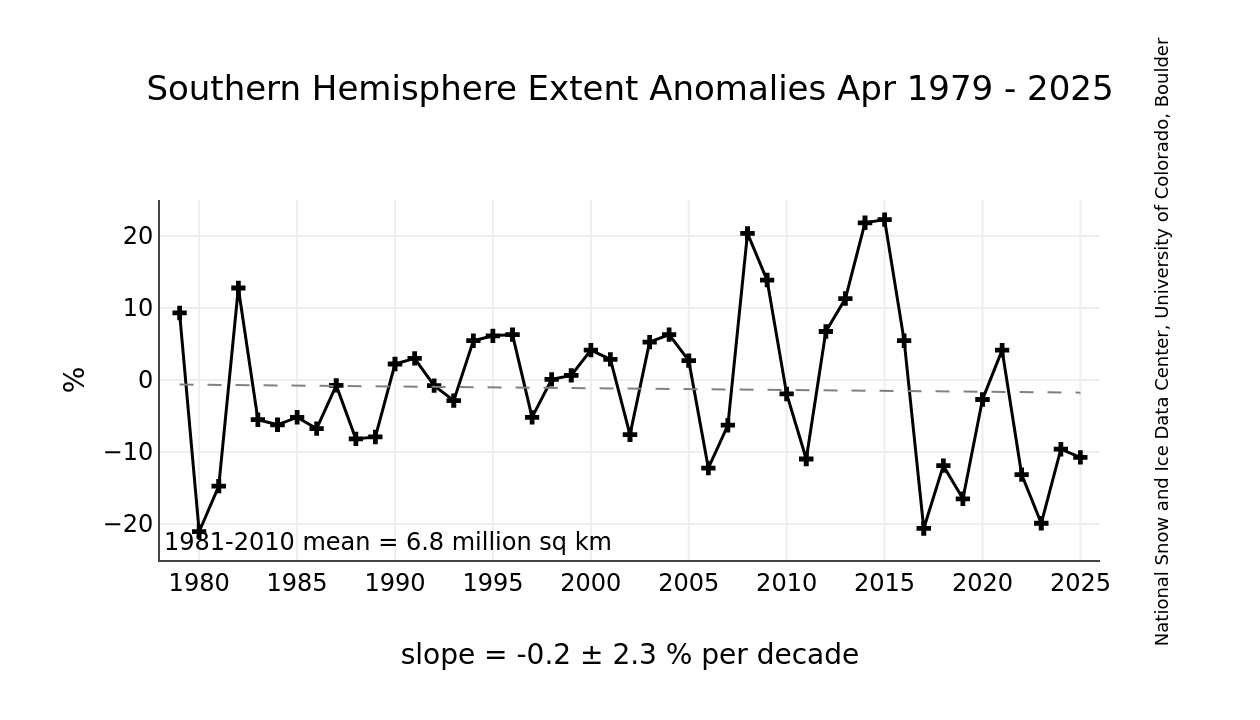
According to NSIDC, sea ice extent has been increasing over time around Antarctica – this is consistent with the idea that temperatures are cooling.

http://nsidc.org/data/seaice_index/images/s_plot_hires.png
The University of Illinois Cryosphere Lab shows that Antarctic sea ice area has also been increasing over time.

http://arctic.atmos.uiuc.edu/cryosphere/IMAGES/seaice.anomaly.antarctic.png
One of the key features of Hansen’s global warming theory is that the polar regions are supposed to warm much faster than the rest of the planet. The image below is from his classic 1984 paper, and shows that Antarctica is supposed to warm up 6C after a doubling of CO2. If the cooling trend which UAH shows continues, it will take Antarctica a very long time to warm up six degrees.

http://www.epa.gov/climatechange/effects/downloads/Challenge_chapter2.pdf
Hansen also predicted that sea ice would diminish around Antarctica and significantly decrease albedo. Clearly that prediction was wrong as well.



http://www.epa.gov/climatechange/effects/downloads/Challenge_chapter2.pdf
Some are quick to come to Hansen’s defense by saying that “climate science has improved since that paper was written, we now know that Antarctic shouldn’t warm as fast as the Arctic.” That is indeed a fine explanation, but the problem is that most of Antarctica is not warming at all.
According to the University of Colorado Sea Level Lab, sea level is rising at about 32cm/century. At that rate it will take 18,750 years for sea level to rise 60 meters (per the NASA article.)


http://sealevel.colorado.edu/current/sl_noib_global_sm.jpg
Temperatures in Vostok, Antarctica average -85F in the winter, and warm all the way up to -25F in the summer. If global warming raises the temperature there by a mere fifty-seven degrees, we may seem some melting occurring in the summer.
Difficult to see what NASA is worried about.
Anne,
The claimed melt rate is 100km2 per year. That is less about 0.0003 percent of the toatl. Do you think the satellites can measure accurately within 0.0003 percent?
Glaciers advance as a result of increasing pressure (from snowfall) in the interior. Retreating glaciers are sign of ice loss, not advancing glaciers.
Phil,
So you choose GISS by default.
Steve,
The claimed melt rate is 100km2 per year. That is less about 0.0003 percent of the toatl. Do you think the satellites can measure accurately within 0.0003 percent?
GRACE is a constellation of two satellites, 220 km apart. They measure their distance in microns. That is an accuracy of 0.000000001%. So yes, that 0.0003% is very plausible.
By the way, the current Antarctic mass loss rate is 246 km3/yr. Why do you use 100 km3/yr?
Glaciers advance as a result of increasing pressure (from snowfall) in the interior. Retreating glaciers are sign of ice loss, not advancing glaciers.
Where glaciers reach the sea, they are buttressed by ice shelves. If these shelves collapse, they no longer hold back the glacier and its speed increases.
Anne,
The 100 km3 per year is from the EO publication which this article is about.
http://earthobservatory.nasa.gov/Newsroom/view.php?id=42399
Steve,
Ok, my comment was originally about the 0.0003% accuracy that looks perfectly plausible to me. Your point now seems to be what GRACE actually measures: ice mass loss or PGR.
Indeed, Velicogna recognizes this and makes a correction for PGR to obtain the ice mass loss. Those figures, after subtraction of the PGR, are: 104 (2002-2006) and 246 (2006-2009) Gt/yr.
Apparently Michael Beavis of Ohio State University did measurements with gps receivers that were anchored on bedrock and got a ~30 Gt/yr lower PGR than Velicogna’s estimate. This would then yield new figures of 74-216 Gt/yr.
There is a notable difference between PGR and ice mass loss. PGR is a very slow and constant process that shows hardly any year-to-year variations. Short term mass fluctuations can therefore only be ice loss.
About the atmospheric mass I would say that there is no long term trend in atmospheric mass over Antarctica, only short term fluctuations.
Btw, any chance to address my comments posted at 06:26:42?
Thanks for your time.
Oops, “~30 Gt/yr lower PGR” should be “~30 Gt/yr higher PGR”.
Anne,
CO2 has not yet reached 2X pre-industrial values, but temperature and sea ice are both trending the wrong direction per Hansen’s predictions. It is not a question of magnitude, but rather the slope is wrong. Looks very bad so far for his predictions, wouldn’t you agree?
Anne,
Antarctica is a very large continent with volcanoes and there can be little doubt that isostasy is very variable. Taking bedrock readings around the coast is interesting but hardly conclusive. Can you judge the isostasy of Lake Michigan by measuring it in California?
Looks very bad so far for his predictions, wouldn’t you agree?
That is a much milder tone than what you said in your article: Clearly that prediction was wrong as well.
Let’s take the A1B scenario which predicts a 2x CO2 in ~2060. The thermal inertia of the Earth demands at least a few decades to reach a new equilibrium, so I feel safe to say that Hansen’s predictions from 1984 were for 2100. We’re now in 2010 and you already declare failure on his predictions. Don’t you think it’s fair to at least wait until the end of the century to pass a judgement on this?
Anne,
A1B assumes little growth in CO2 emissions, when in fact they have grown faster than A1FI. Wouldn’t you expect to have seen temperature rise and albedo loss by now?
People are quick to blame Arctic warming and sea ice loss on CO2 – so why isn’t it also happening in the Antarctic?
Anne van der Bom (12:44:52):
Very fair indeed. Of course, since we don’t know what 2100 will tell us, then we certainly shouldn’t spend any more money on what is very likely to be a non-problem.
I say that because Hansen has made a number of predictions, which cover most eventualities. By picking A1B you demonstrate that.
Even I could make numerous predictions, and point to the one that came closest to predicting the future. It’s called the Texas Sharpshooter fallacy: shoot a hole in a barn door, then draw a circle around it and claim you’re a sharpshooter.
If Hansen had made only one prediction, he would either be credible, or not. So he made enough predictions to be a Texas sharpshooter.
Hansen made predictions for shorter periods than that. The recent flat decade or so has falsified most of them. His model assumes a more or less lockstep (with variations of no more than three years or so) linkup between rising CO2 and rising temperature. Here’s a link to his most embarrassing flub, a WUWT thread titled “A little known 20 year old climate change prediction by Dr. James Hansen – that failed badly”. (He predicted Manhattan would be awash by now.)
http://wattsupwiththat.com/2009/10/22/a-little-known-but-failed-20-year-old-climate-change-prediction-by-dr-james-hansen/
.Hansford (05:20:08) :
Oliver K. Manuel (04:28:26) :
“It has been operating full time since the Apollo landing on the Moon in 1969.”
——————————————————————-
Um, I assume you are not questioning the moon landings themselves, but rather that you are refering to other aspects of research on the material that was brought back…. Yes?
————————————————————–
Oliver K. Manuel (09:23:16) :
NASA really went to the Moon in 1969 and discovered an inconvenient truth:
Under the direction of the US National Academy of Sciences (NAS), NASA became a propaganda machine in 1969, when analysis of the Apollo lunar samples revealed an inconvenient truth – the Sun is not a ball of Hydrogen (H) and H-fusion is not its source of heat.
———————————————————-
Ah, righto. Didn’t think you were actually denying the landings… 🙂
I’ll read the links.
Steve
A1B assumes little growth in CO2 emissions, when in fact they have grown faster than A1FI. Wouldn’t you expect to have seen temperature rise and albedo loss by now?
People are quick to blame Arctic warming and sea ice loss on CO2 – so why isn’t it also happening in the Antarctic?
I pointed this out before, but you seem to have missed it.
There is a good explanation in reduced stratospheric ozone and the southern seas buffering the heat. We still have 90 years to go, so my point still stands: it is not possible yet to declare Hansen’s prediction a failure.
Can you point me to the lower equilibrium figures than decades? I couldn’t find it.
Smokey
I say that because Hansen has made a number of predictions, which cover most eventualities. By picking A1B you demonstrate that.
It is not quite like that. Hansen is in the business of climate prediction, not politics prediction. You are accusing him of being unable to predict our future decisions.
Even I could make numerous predictions, and point to the one that came closest to predicting the future.
That is a distortion of reality. He makes a number of predictions, based on emission scenarios. You can not later pick the prediction that was closest. You have to pick the emissions path according to reality, and then check whether the related climate prediction holds up.
Like I said, you can’t blame Hansen for being unable to predict how much coal we will burn in 2040 or how much forest we chop down in 2025.
Steve,
Forget about my question to your about the time to reach equilibrium. That should not have ended up in my comment.
Roger Knights,
This article is about one particular prediction regarding the state of Antarctica around 2100. Those other predictions for shorter periods have been highlighted before. I’d rather not digress into that area.
Steve Goddard (10:24:42) :
In your response to Herman L you state the following:
The scientists estimate the level of uncertainty in the measurements is between 2-3 degrees Celsius.” So they are trying to claim a warming trend of less than 0.1 degrees with an uncertainty 20-30 times greater than the trend.
You can not compare a trend to an absolute value in this way. A trend of 0.1 degrees per year over 26 years is a total rise of ~2.6 degrees. That is the number that you should compare the 2-3 degrees accuracy to.
Anne van der Bom: “[Hansen] makes a number of predictions, based on emission scenarios. You can not later pick the prediction that was closest.”
But that’s exactly what you’re doing.
J.Hansford (21:48:31) :
“Um, I assume you are not questioning the moon landings themselves, but rather that you are refering to other aspects of research on the material that was brought back…. Yes?”
————————————————————–
Oliver K. Manuel (09:23:16) :
“NASA really went to the Moon in 1969 and discovered an inconvenient truth:
Under the direction of the US National Academy of Sciences (NAS), NASA became a propaganda machine in 1969, when analysis of the Apollo lunar samples revealed an inconvenient truth – the Sun is not a ball of Hydrogen (H) and H-fusion is not its source of heat.”
———————————————————-
“Ah, righto. Didn’t think you were actually denying the landings… 🙂
I’ll read the links.”
———————————————————-
Yes, NASA definitely went to the Moon in 1969 and discovered solar-wind implanted elements in lunar samples that disproved their cherished model of a Hydrogen-filled Sun.
While NASA was busy trying to limit access to lunar samples, the Allende meteorite landed with still unmixed isotopes and elements from different regions of the supernova that gave birth to the solar system:
See this summary of the findings:
“Fingerprints of a local supernova,” in SPACE EXPLORATION RESEARCH (Nova Science Publishers, Inc., Hauppauge, NY, in press, 38 pp, 2010);
http://arxiv.org/pdf/0905.0684
Or read the story as it unfolded:
“Xenon in carbonaceous chondrites”, Nature 240, 99-101 (1972);
http://www.omatumr.com/archive/XenonInCarbonaceousChondrites.pdf
“Strange xenon, extinct super-heavy elements, and the solar neutrino puzzle”, Science 195, 208-209 (1977);
http://www.sciencemag.org/cgi/reprint/195/4274/208-b
“Elemental and isotopic inhomogeneities in noble gases: The case for local synthesis of the chemical elements”, Transactions Missouri Academy Sciences 9, 104-122 (1975).
“Isotopes of tellurium, xenon and krypton in the Allende meteorite retain record of nucleosynthesis”, Nature 277, 615-620 (1979);
http://www.nature.com/nature/journal/v277/n5698/abs/277615a0.html
With kind regards,
Oliver K. Manuel
Former NASA PI for Apollo
Smokey,
Anne van der Bom: “[Hansen] makes a number of predictions, based on emission scenarios. You can not later pick the prediction that was closest.”
But that’s exactly what you’re doing.
No, I am picking the emission scenario not the climate prediction.
Climate change is dependent on the emission of CO2 (and to a lesser extent CH4, NO2, soot, etc). The amount of CO2 that is going to be emitted is a choice, made by humanity. It is inherently unpredictable. The change in climate as a result of that choice is the domain of the climate scientists. The choice wrt emissions is the domain of the politicians. It is not predictable.
Anne,
The areas of East Antarctica which changed from blue to red between maps show between 0 and 0.05 degrees warming, so the total over 30 years is 0-1.5 degrees, which is considerably less than the measurement error. Hardly a basis to change the original map.
Anne,
January, 2010 was the warmest January in the satellite record, due to very warm water in the southern oceans. Yet Antarctica remains below normal temperatures and sea ice above normal. How does that jibe with the cold “southern seas buffering” idea?
http://weather.unisys.com/surface/sst_anom.html
http://www.esrl.noaa.gov/psd/map/ANIM/sfctmpmer_01a.fnl.30.gif
It is always possible that Antarctica will drastically change behaviour before CO2 doubles, and ends up warming 6C – but that doesn’t seem very likely right now.
Anne,
I disagree with your assertion that fossil fuels is a “choice.”
Humanity made a “choice” to lift itself out of squalor via the industrial revolution and fossil fuels. Until there is a viable alternative to fossil fuels, there is no other choice. Our current world without massive use of fossil fuels would be intolerable. There are tens of millions of people in LA and hundreds of other cities who have to get to work and have to eat. What other options do they have? Government mandates about CO2 reduction are meaningless.
Anne van der Bom (04:50:55) :
“Climate change is dependent on the emission of CO2…”
That is a repeatedly falsified statement. It’s not worth my time to refute it again, which I have done numerous times here. Read up on the archives.
As for Hansen’s multiple sharpshooter predictions, one of them is almost in the ball park. Almost. But still a foul ball: click [chart by Lucia]