Steven Goddard looks at trends in Antarctica and compares to NASA’s recent article.

A January 12, 2010 Earth Observatory article warns that Antarctica
“has been losing more than a hundred cubic kilometers (24 cubic miles) of ice each year since 2002” and that “if all of this ice melted, it would raise global sea level by about 60 meter (197 feet).“
If sea level rose 60 meters, that would wipe out most of the world’s population – which would no doubt make some environmentalists happy. Sadly for them though, Antarctica contains 30 × 10^6 km3 of ice which means that it will take 300,000 years for all the ice to melt at NASA’s claimed current rate of 100 km3 per year. (Chances are that we will run out of fossil fuels long before then.) The surface area of Antarctica is 14.2 million km2 which would indicate an average melt of less than 7 millimeters per year across the continent. (Is NASA claiming that they can measure changes in Antarctic ice thickness within 7 millimeters?) But even more problematic is that UAH satellite data shows no increase in temperatures in Antarctica, rather a small decline.

NASA themselves appear very confused about Antarctic temperature trends. As you can see in the two images below, sometimes they think Antarctica is warming and other times they think it is cooling.


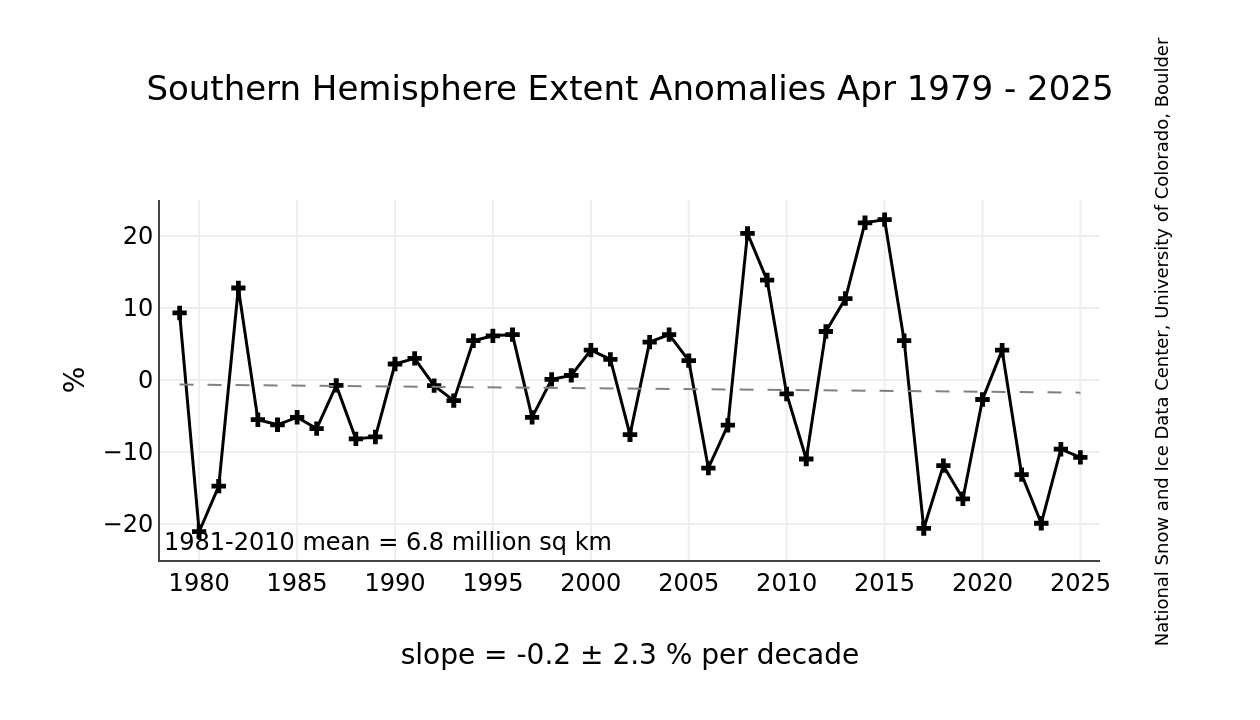
According to NSIDC, sea ice extent has been increasing over time around Antarctica – this is consistent with the idea that temperatures are cooling.

http://nsidc.org/data/seaice_index/images/s_plot_hires.png
The University of Illinois Cryosphere Lab shows that Antarctic sea ice area has also been increasing over time.

http://arctic.atmos.uiuc.edu/cryosphere/IMAGES/seaice.anomaly.antarctic.png
One of the key features of Hansen’s global warming theory is that the polar regions are supposed to warm much faster than the rest of the planet. The image below is from his classic 1984 paper, and shows that Antarctica is supposed to warm up 6C after a doubling of CO2. If the cooling trend which UAH shows continues, it will take Antarctica a very long time to warm up six degrees.

http://www.epa.gov/climatechange/effects/downloads/Challenge_chapter2.pdf
Hansen also predicted that sea ice would diminish around Antarctica and significantly decrease albedo. Clearly that prediction was wrong as well.



http://www.epa.gov/climatechange/effects/downloads/Challenge_chapter2.pdf
Some are quick to come to Hansen’s defense by saying that “climate science has improved since that paper was written, we now know that Antarctic shouldn’t warm as fast as the Arctic.” That is indeed a fine explanation, but the problem is that most of Antarctica is not warming at all.
According to the University of Colorado Sea Level Lab, sea level is rising at about 32cm/century. At that rate it will take 18,750 years for sea level to rise 60 meters (per the NASA article.)


http://sealevel.colorado.edu/current/sl_noib_global_sm.jpg
Temperatures in Vostok, Antarctica average -85F in the winter, and warm all the way up to -25F in the summer. If global warming raises the temperature there by a mere fifty-seven degrees, we may seem some melting occurring in the summer.
Difficult to see what NASA is worried about.
(1) kwik (09:36:11) points out that since the Antarctic temperatures never get above freezing [the highest was -13.6º C on 27Dec78—http://icecube.wisc.edu/info/antarctica/weather.php ] there’s no way the ice is going to melt.
(2) michael hamnmer (13:52:10) argues convincingly that because of the continual cold the actual effect of ‘greenhouse gases’ over Antarctica will be to cool the surface, not warm it.
(3) tty (14:33:51) suggests that because of isostasy and the lack of any visible (= measurable) land under the ice that it would be virtually impossible for to know “whether the ice in Antarctica is actually increasing or decreasing.”
These three points alone would seem to give the lie to the hypothesis that, aside from a few coastal regions where ‘warm’ waters and/or undersea volcanism affect the edges of the ice sheet, the Antarctic ice cap is melting, or even diminishing.
The NASA article claims that
Since clearly there is no melting going on, what’s the explanation for this apparent loss of mass? Says Erik Conway (author of the article):
The ice, in other words, is flowing into the sea, where it dramatically breaks up. And evidently this happens at the margins in West Antarctica. But could ice flow of glaciers into the sea be a serious factor in a continent larger than the United States? It strains credulity. How much mass are we talking about?
One would expect that scientists who work for and represent a prestigious agency like NASA would be very careful to weigh all these factors and questions when making any pronouncements to the public. Yet apparently they are so eager to present ‘evidence’ of any kind for ‘global warming’ that they are willing to gloss over them.
Maybe it’s time for some of them to start reading this blog.
/Mr Lynn
It’s more than just a scam, it’s a crime.
Potentially trillions of dollars and multiple economies at stake worldwide. This is not going away and those who contributed need to be punished – period.
@Steve Goddard:
I’m confused about a few of the assertions made in your post. I’m hoping you can clear things up for me. I’ll try to keep it brief.
#1) “If sea level rose 60 meters, that would wipe out most of the world’s population…”
Do you have a peer-reviewed source for those numbers? A study in PNAS found the number of people within 100m of SL to be only 33% in 1994 (and only ~15% of inhabited land within that distance):
http://www.pnas.org/content/95/24/14009.full
#2) From the NASA page you cited above: “[L]ittle, if any, surface warming is occurring over East Antarctica.”
The images you include seem to show warming over East Antarctica is +- 0.1 C. Based on the images, does this seem to be an unreasonable range of values to you?
#3) Most importantly, I was hoping that you and your WUWT colleagues could provide a list of the datasets you deem to be acceptable, and your rationale for such. It is made painfully clear in some posts that data and subsequent analyses that are products of, NOAA or NASA for example, are unreliable because of issues ranging from incompetence to conspiracy to commit fraud. Then a short time later, datasets compiled by the same agencies are held up as evidence contrary to AGW. I’m sure you can see why this is extremely confusing to the casual reader.
Has there been some analysis by you and WUWT contributors that has identified what are reliable, usable data and what are not?
Thanks in advance.
@Steve Goddard:
Also, in the interest of fairness, perhaps you should have included these other images from the University of Illiois, whose data you also showed above:
http://arctic.atmos.uiuc.edu/cryosphere/IMAGES/seasonal.extent.1900-2007.jpg
http://arctic.atmos.uiuc.edu/cryosphere/IMAGES/seaice.anomaly.arctic.png
http://arctic.atmos.uiuc.edu/cryosphere/IMAGES/seaice.recent.arctic.png
These data would seem to support the NASA conclusions, no?
I can not believe this weather prediction? 300,000 years!
They can not get it right 3 weeks out (farmers almanac excepted).
Has anyone tried a simple (?) experiment to prove CO2 is NOT a pollutant and is really plant food?
Perhaps a controlled environment with CO2 vs. an exactly duplicate controlled environment with no CO2 –
The experiment would be ideal if it could be performed in front of SCOTUS – the people who originally declared CO2 to be a pollutant.
Herman L (16:35:23) :
“If you believe the scientists at NASA are deliberately distorting the data towards a political end, then Steve: come straight out and say that. I do not believe that.”
Herman – there is no question that NASA is manipulating data for political purposes. I worked with NASA in the past and I can’t remember when political aspects did not play a part – are you kidding ? Where have you been lately ??
And this is some of the best anti-AGW evidence I’ve ever seen. But it is a work (at least partially) of the federal government. Should one believe this, or throw it out with the rest of the contaminated data?
http://www.usgcrp.gov/usgcrp/images/Vostok.jpg
Phil M,
One of the first things physical geology students learn is that CO2 solubility in seawater diminishes with increasing temperature. The Vostok cores show this quite clearly. When the temperature drops, CO2 gets absorbed into the ocean and atmospheric CO2 drops. And vice-versa.
So the Vostok cores show this very clearly. CO2 lags and follows temperature.
Phil M,
No doubt that the Arctic ice minimum has diminished significantly relative to 1980.
Notice anything interesting about temperatures in Greenland before and after 1980?
http://data.giss.nasa.gov/cgi-bin/gistemp/gistemp_station.py?id=431042500000&data_set=1&num_neighbors=1
Herman L (16:35:23) :
If you believe the scientists at NASA are deliberately distorting the data towards a political end, then Steve: come straight out and say that. I do not believe that.
The idea! Certainly a person of James Hansen’s character would never manipulate GISS data files and reconstructions for a “political” purpose. Instead, he appears to have done it for secular “religious” purposes.
michael hamnmer (13:52:10) :
HOWEVER over the antarctic the situation is very different for two reasons. Firstly the antarctic is very cold. In fact the surface is not much warmer than the tropopause. Secondly the antarctic is covered with ice and snow. Ice and snow as has been pointed out ad nauseum is very reflective (high albedo).
At visible wavelengths but not at IR.
This means it has a very low emissivity which means it radiates far less energy than would a black body at the same temperature.
Not true at the 15μm band for CO2 where it’s about 95%.
magicjava (12:05:44) :
[quote Phil. (08:25:36) :]
What temperatures are these, MSU/AMSU doesn’t have the capability to measure Antarctic temperature?
[/quote]
Yes it does.
See:
http://wattsupwiththat.com/2010/01/12/how-the-uah-global-temperatures-are-produced/
http://magicjava.blogspot.com/2010/01/how-uah-and-rss-temperatures-are.html
Unfortunately the devil is in the details which aren’t addressed in those sites.
These weighting functions are for the nadir (straight-down) views of the instrument, and all increase in altitude as the instrument scans farther away from nadir. AMSU channel 5 is used for our middle tropospheric temperature (MT) estimate;
Channel 5 is the one that Steve used in this article “The graph in this article uses their readings from the lower troposphere at 14,400 ft.”, note Steve that it’s the middle troposphere according to Spencer.
For their lower tropospheric temperature they “use a weighted difference between the various view angles of channel 5 to probe lower in the atmosphere, which a fairly sharp weighting function which is for our lower-tropospheric (LT) temperature estimate.”
There’s a significant problem (basic spherical geometry) with that approach near the pole (see ref pp5). “Near the poles, cancellation does not occur for the measurements made because the satellite velocity vector is close to being east-west. In this case, the north-south part of the derivative adds instead of canceling. The residual spatial derivative, combined with a large north-south gradient in the temperature, leads to significant errors in the retrieved TLT measurements.”
According to UAH: For those channels whose weighting functions intersect the surface, a portion of the total measured microwave thermal emission signal comes from the surface. AMSU channels 1, 2, and 15 are considered “window” channels because the atmosphere is essentially clear, so virtually all of the measured microwave radiation comes from the surface. While this sounds like a good way to measure surface temperature, it turns out that the microwave ‘emissivity’ of the surface (it’s ability to emit microwave energy) is so variable that it is difficult to accurately measure surface temperatures using such measurements. The variable emissivity problem is the smallest for well-vegetated surfaces, and largest for snow-covered surfaces. emphasis mine.
Channel 5 significantly intersects the surface particularly over the Antarctic (where most of its weighting function is below the surface, the surface temperature product is even worse)!
RSS exclude such areas from their analysis “Land areas with surface height averaged over the 2.5 degree by 2.5 degree cell that exceed a threshold altitude of 1500 meters were excluded from the averages to reduce contamination from surface emission.”
So I repeat, MSU/AMSU doesn’t have a capability to measure Antarctic temperatures, which is why RSS don’t produce data beyond 70ºS.
http://www.remss.com/data/msu/support/Mears_and_Wentz_TLT_submitted.pdf
Interesting point Phil but not sure I agree. The high albedo from snow comes from the surface structure of frequenct significant change in refractive index and that should be the same for the IR as the visible. However the IRIS data from Nimbus 3 is pretty explicit. The black body equivalent temperature each side of the 14.5 micron line is 180K. There is nowhere that I know of either on the surface or in the atmosphere which is as cold as that. The only possible explanation is that one is seeing a warmer surface with low emissivity. Can’t be the atmosphere since each side of the CO2 line is in the atmospheric window and anyway a thick atmosphere will have an emissivity of 1. That only leaves the surface.
The black body equivalent temperature at the CO2 line is significantly higher – there is an emission peak at the CO2 line. That means the impact of CO2 in the atmosphere increases radiation to space at the 14.5 micron line which is the crux of my argument.
Otherwise how do you explain the IRIS data?
Dave Wendt (13:30:28) :
The elevations of mountains and other surface features are quoted from a reference MSL datum that is fixed and has only changed a couple of times in a century, 1929 and 1988 I believe. Given the incredible variability of the oceanic surface elevation across the planet, talking about sea level is essentially as meaningless as talking about average global temperature.
Not quite. According to NOAA you are talking about the “Geodetic Datums” used for North America references.
North American Vertical Datum of 1988 (NAVD 88):
National Geodetic Vertical Datum of 1929 (NGVD 29):
Otherwise, as a Tidal Datum,
MSL: Mean Sea Level:
According to this FAQ from Proudman Oceanographic Laboratory:
Reading further, MSL sounds like a wonderfully complicated thing to calculate and utilize. There doesn’t appear to be any method of directly measuring heights with regards to an absolute reference like the geographical center of the Earth, if that could even be figured. With enough learning one can better appreciate how the “solid ground” beneath us is actually a thin layer of solidified scum floating on top of a molten world, which of itself, seen over a long enough time, has quite a variable surface. Thus the best we can hope for appears to be measuring elevations in regards to a relatively small patch of the scum. See question #2 of that FAQ. There are three different reference points used just between the UK, the Netherlands, and France.
We are now getting better measurements with satellites, because they have a different frame of reference, they are not tied to the surface. Down here, all such height measurements are relative.
Phil; just to add to my previous email. Your comment about high reflectiveity in the visible and yet close to black body behaviour in the thermal IR certainly applies to clouds which are also water (as is snow of course). However in the case of clouds the average particle size is around 2 microns. This is significantly larger than the wavelength of visible light and thus causes scattering (ie: reflection) yet significantly smaller than than the wavelength of thermal IR radiation so that there is little scattering of these wavelengths. However the particle sizes in the case of snow are far larger, larger than the wavelength of thermal IR and thus will also cause scattering of these wavelengths.
Steven Goddard says:
One of the first things physical geology students learn is that CO2 solubility in seawater diminishes with increasing temperature. The Vostok cores show this quite clearly. When the temperature drops, CO2 gets absorbed into the ocean and atmospheric CO2 drops. And vice-versa.
So the Vostok cores show this very clearly. CO2 lags and follows temperature.
This proves nothing wrt AGW.
Solubility of a gas in a liquid and radiative transfer are two completly different, independent physical mechanisms. One doesn’t preclude the other. If you think otherwise does, please provide the proof.
Steve Goddard (16:48:57) : The claimed accuracy (0.01) is much tighter than the claimed precision (2.0-3.0) which is an error that no serious scientist should ever make. Sounds like politics to me.
So, when you wrote “NASA themselves appear very confused about Antarctic temperature trends” you really meant to write that you believe NASA manipulated data for political ends. Why did you not say that at the beginning? Why lead me down the path that I was reading an article about science when, at the core, you believe science was manipulated for political ends?
mkurbo (18:04:57) : Herman – there is no question that NASA is manipulating data for political purposes. I worked with NASA in the past and I can’t remember when political aspects did not play a part – are you kidding ? Where have you been lately ??
Your statement is an assertion and an accusation without evidence. I am married to a NASA scientist and know others through both her work and our community. I’ve never known a shred of “manipulating data for political purposes” in their research or what they produce. Feel free to tell me about the “politcal aspects” in the scientific research you have participated in at NASA.
kwik says
I allways have had the impression the mean tempearature there was around -40 Dec Celcius….and colder…
Meaning; If it was to warm up to over zero degrees celcius….that would be at least 40 degrees celcius warmer…
And if the antarctic is heating up 40 degrees celcius, so must the rest of the planet. Or more.
Mr Lynn already answered part of your question. I’d like to add another point.
Mainly due to the positive ice albedo feedback, it is to be expected that the polar regions will warm more than the lower latitudes (google for polar amplification). So it is contrary to what you suggest: the rest of the planet should warm less, not more.
Steven Goddard,
I have a few questions and comments on your article.
Antarctica contains 30 × 10^6 km3 of ice which means that it will take 300,000 years for all the ice to melt at NASA’s claimed current rate of 100 km3 per year.
That assumes a constant rate of 100 km3 per year. Is that the maximum melt rate or could it be 1000 km3/yr or 10,000 km3/yr? Can you constrain the maximum melt rate. And what value would that be in your opinion?
Is NASA claiming that they can measure changes in Antarctic ice thickness within 7 millimeters?
NASA can measure the distance from the Earth to the Moon with an accuracy of mm’s, so I wouldn’t accept this assertion on face value. Can you provide support for this statement?
Btw. they did not measure this by radio altimetry, but by measuring the gravity field strength. Do you have founded doubts regarding the accuracy of GRACE?
And finally, regarding the lack of warming in the Antarctic interior. Instead of keeping your readers in the dark about possible causes, you could have mentioned that it is attributed to ozone depletion. Stratospheric ozone is a greenhouse gas.
The image below is from his classic 1984 paper, and shows that Antarctica is supposed to warm up 6C after a doubling of CO2.
Hansen also predicted that sea ice would diminish around Antarctica and significantly decrease albedo. Clearly that prediction was wrong as well..
That prediction was made against a doubling of CO2. We clearly haven’t reached that point yet. And he made this prediction for the equilibrium state, which adds another couple of decades. Shouldn’t you at least wait until the CO2 has doubled and a new equilibrium has been established, before taking him to task for this?
Temperatures in Vostok, Antarctica average -85F in the winter, and warm all the way up to -25F in the summer. If global warming raises the temperature there by a mere fifty-seven degrees, we may seem some melting occurring in the summer.
Vostok is in the middle of Antarctica. Around the edges, average temperatures are much higher. And what is also important are the summer highs. That’s when the melting takes place. Once lost, this ice can only be replenished by precipitation. But precipitation over Antarctica is very low, so not much can be expected from that.
And finally, as MrLynn already pointed out, you don’t need melting to lose ice. Ice flows without melting. Through that mechanism, Antarctica can loose a lot of mass.
Phil,
You are very critical of UAH over small details, yet Hansen takes 12 or less irregular readings across a large continent, applies “adjustments” and averages them out over 1200 km.
Which method seems more accurate to you? I think UAH wins.
Anne,
The Vostok cores behave exactly as expected. The temperature moves one direction or the other- and CO2 follows due to absorption or outgassing from the oceans.
Standard modern touchy-feely propaganda techniques want us to weep over the desperate situation of the penguins being deprived of their cozy icy home. Of course, penguins like to lie in the sun on the warm sandy beaches of South Africa just as much as any area of the Antarctic coast- the link photo is from a family member’s trip to Capetown about 3 years ago: http://darktofu.wordpress.com/2010/02/04/if-i-were-a-penguin/
Steve Goddard (06:27:06) :
Phil,
You are very critical of UAH over small details, yet Hansen takes 12 or less irregular readings across a large continent, applies “adjustments” and averages them out over 1200 km.
They are details but not small details, they render the LT measurement unusable over Antarctica which is why Mears et al. don’t use it there.
Check out the UAH ‘readme’ file to see how many adjustments they make!
Which method seems more accurate to you? I think UAH wins.
Over the Antarctic, not UAH, I’d take this one:
http://www.remss.com/msu/msu_data_monthly.html?channel=tlt
Phil,
How can you use RSS for Antarctica? They don’t provide any data. Your choices are GISS or UAH. Which one is better? I vote UAH.
Steve Goddard (08:21:52) :
Phil,
How can you use RSS for Antarctica? They don’t provide any data. Your choices are GISS or UAH. Which one is better? I vote UAH.
That’s the point Steve, they don’t show the data because it can’t be done reliably with MSU/AMSU, which is where I came into this thread! If one accepts your scepticism about the surface measurements then the only choice is that ‘we don’t know’ which is the RSS position, which is why I made that choice.