Steven Goddard looks at trends in Antarctica and compares to NASA’s recent article.

A January 12, 2010 Earth Observatory article warns that Antarctica
“has been losing more than a hundred cubic kilometers (24 cubic miles) of ice each year since 2002” and that “if all of this ice melted, it would raise global sea level by about 60 meter (197 feet).“
If sea level rose 60 meters, that would wipe out most of the world’s population – which would no doubt make some environmentalists happy. Sadly for them though, Antarctica contains 30 × 10^6 km3 of ice which means that it will take 300,000 years for all the ice to melt at NASA’s claimed current rate of 100 km3 per year. (Chances are that we will run out of fossil fuels long before then.) The surface area of Antarctica is 14.2 million km2 which would indicate an average melt of less than 7 millimeters per year across the continent. (Is NASA claiming that they can measure changes in Antarctic ice thickness within 7 millimeters?) But even more problematic is that UAH satellite data shows no increase in temperatures in Antarctica, rather a small decline.

NASA themselves appear very confused about Antarctic temperature trends. As you can see in the two images below, sometimes they think Antarctica is warming and other times they think it is cooling.


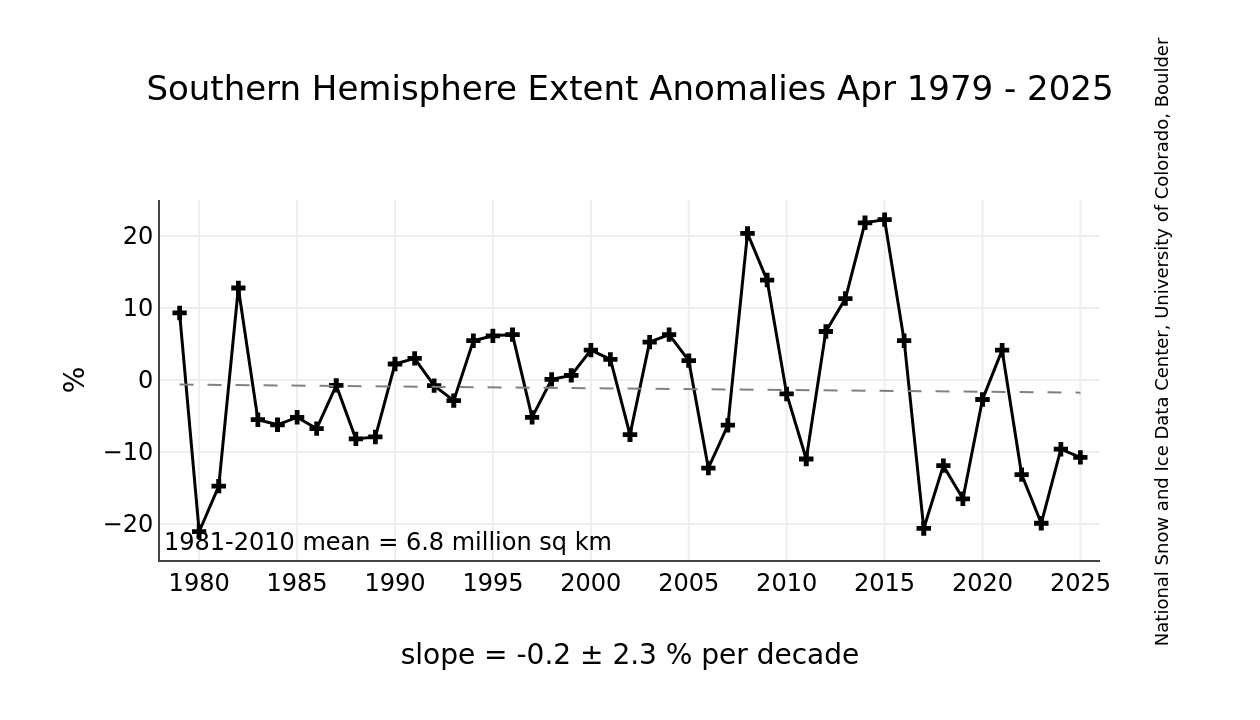
According to NSIDC, sea ice extent has been increasing over time around Antarctica – this is consistent with the idea that temperatures are cooling.

http://nsidc.org/data/seaice_index/images/s_plot_hires.png
The University of Illinois Cryosphere Lab shows that Antarctic sea ice area has also been increasing over time.

http://arctic.atmos.uiuc.edu/cryosphere/IMAGES/seaice.anomaly.antarctic.png
One of the key features of Hansen’s global warming theory is that the polar regions are supposed to warm much faster than the rest of the planet. The image below is from his classic 1984 paper, and shows that Antarctica is supposed to warm up 6C after a doubling of CO2. If the cooling trend which UAH shows continues, it will take Antarctica a very long time to warm up six degrees.

http://www.epa.gov/climatechange/effects/downloads/Challenge_chapter2.pdf
Hansen also predicted that sea ice would diminish around Antarctica and significantly decrease albedo. Clearly that prediction was wrong as well.



http://www.epa.gov/climatechange/effects/downloads/Challenge_chapter2.pdf
Some are quick to come to Hansen’s defense by saying that “climate science has improved since that paper was written, we now know that Antarctic shouldn’t warm as fast as the Arctic.” That is indeed a fine explanation, but the problem is that most of Antarctica is not warming at all.
According to the University of Colorado Sea Level Lab, sea level is rising at about 32cm/century. At that rate it will take 18,750 years for sea level to rise 60 meters (per the NASA article.)


http://sealevel.colorado.edu/current/sl_noib_global_sm.jpg
Temperatures in Vostok, Antarctica average -85F in the winter, and warm all the way up to -25F in the summer. If global warming raises the temperature there by a mere fifty-seven degrees, we may seem some melting occurring in the summer.
Difficult to see what NASA is worried about.
rbateman,
Ever been to the Bristol Channel in the UK? I’ve seen boats in Wales stranded twenty feet above the water due to tidal changes which happened over a few hours. When the tide comes in, people actually surf on the tidal front.
Point is that before/after pictures of sea level are not necessarily a lot of use.
“Difficult to see what NASA is worried about.”
Same thing the AGW academics are worried about. Budget.
Steve Oregon (09:51:11) :
I nteresting -USA superimposed over Antartica
http://lima.nasa.gov/img/us_vs_antarctica.tif
Thanks for that image. I’ve been looking for one like it for a while. Since most images of Antarctica don’t include anything that gives a reference for its true size, most people I encounter don’t have any real mental concept of its scale. Thanks to our wonderful educational system, the ability to deal with large numbers is not wide spread, as evidenced by a number of the comments above. My sister in law, who is one of the brightest people I am personally acquainted with, had no idea that the amount of sea ice that is lost and recreated annually in the Antarctic is almost twice the area of the lower 48. She was completely incredulous when I tried to explain it to her. The alarmist tactic of always refer to the potential”collapse” of Antarctic ice without mentioning that any such “collapse” would take many millenia to eventuate has been very effective. Especially with journalists and politicians, whose relative intelligence is revealed by the overwhelming majority of them who consider Obama to be absolutely brilliant.
Herman,
What could possibly motivate NASA to change from the earlier map (showing cooling) to the later map (showing warming) based on data that which they acknowledge is not precise enough to determine a trend in either direction?
Politics (Hansen’s earlier predictions) perhaps?
Herman L (04:54:48) :
Do you have any names of the environmentalists who you assert would be happy to see this?
Prince Philip…something about reincarnating as a virus
[quote Phil. (08:25:36) :]
What temperatures are these, MSU/AMSU doesn’t have the capability to measure Antarctic temperature?
[/quote]
Yes it does.
See:
http://wattsupwiththat.com/2010/01/12/how-the-uah-global-temperatures-are-produced/
http://magicjava.blogspot.com/2010/01/how-uah-and-rss-temperatures-are.html
Those are some worried looking penguins.
Re: For example, there’s Obama own Science Advisor John Holdren who co-authored a book with the Erlichs a while back. Some rather troubling info on him can be found at:
Compulsory abortion? absolutely horrific
Steve Goddard (11:32:50) :
There are a lot of issues involved in sea levels, I get that.
There is also a lot more to a before/after image of a coastline than the water.
You have a point, though, I don’t see cherry-pick image #1 from the alarmist camp.
What bothers me is I don’t see anybody trying.
Are we wasting our time here?
Boris (10:10:26) :
I’m glad you don’t like my vicious slam. It is an absolutely absurd statement. Now, look at the vicious slam that Steve Goddard made and ask yourself these same questions.
But there are major differences between the two.
Your statement is factually accurate, but its fault lies in not being inclusive enough. Besides Republicans, people like that are found among Democrats, Communists, independents, all over the political spectrum.
However, people that seriously and consistently declare that the world would be better off if the majority of the population was dead and gone, even actively support and engage in measures to that end, are normally considered to have deep-seated psychological problems, often a pathological self-loathing, and to be in immediate need of professional help to ensure they are not a danger to others as well as themselves. Unless of course they cite “concern for the environment” in which case they are perfectly fine and everything is sunshine and rainbows and fresh-smelling free-range puppies.
Thus if you want to find people that would be happy if most of the world’s population was wiped out, and excluded mental wards and those otherwise under psychiatric care for a condition leading to that belief, you would look among environmentalists. And no doubt you would find some as that belief is often cited in the environmentalist dogma, just as no doubt you could find Christians who believe in miraculous spiritual cures and would be happy to see them. Mr. Goddard’s statement is, also, factually correct.
So then, Mr. Goddard made a valid observation, which although you took it as a vicious slam, could easily be interpreted as commentary on a certain sad state of affairs. You, however, carefully crafted a comment that tried to link dark motives to a specific political group for the purpose of making a vicious slam. Oh yeah, there are differences alright.
Besides, I thought it was “common knowledge” among the liberal circles that Republicans, of which I am one, don’t have problems with “foreigners and/or brown skinned” of any number, provided they follow our orders, know their place, and don’t get uppity. Come on Boris, help me out here, we Republicans have a reputation among the liberals to uphold!
😉
Steve Goddard (11:00:59), Phil. (11:01:18), thanks for the confirmations, and the links.
I remember when I heard that, there were questions about how accurately the mountain heights were measured in regards to sea level, so having a long-enough satellite record for confirmation is nice. Then there was the imagined issue where if there is enough pressure exerted from below to cause volcanic eruptions and related phenomena, how could a plate possibly be pushed down against that pressure?
kadaka (13:01:32) :
Steve Goddard (11:00:59), Phil. (11:01:18), thanks for the confirmations, and the links.
I remember when I heard that, there were questions about how accurately the mountain heights were measured in regards to sea level, so having a long-enough satellite record for confirmation is nice.
The elevations of mountains and other surface features are quoted from a reference MSL datum that is fixed and has only changed a couple of times in a century, 1929 and 1988 I believe. Given the incredible variability of the oceanic surface elevation across the planet, talking about sea level is essentially as meaningless as talking about average global temperature.
rbateman (11:23:14) :
rbateman (11:26:38) :
WUWT?? Unless you can prove to me, tide! Those are some great photos you put up. Wish I could locate a before-after I saw years ago, absolutely awesome. Miles and miles of land, add some time, mostly ocean! Oh the shock and awe!
(Careful those are not pre-Photoshop magic, actual photos with cause and time being the illusion.)
An interesting point that I have not seen mentioned elsewhere. It is easy to show that the direct greenhouse impact of rising CO2 COOLS the antarctic rather than warming it.
The action of a green house gas is to absorb the emissions from the surface of the earth at the greenhouse wavelengths. The gas in turn emits energy to space at the same wavelengths from the top of the atmospheric column. Since the top of the atmosphere (in fact the tropopasue for reasons too lengthy to explain here) is normally far colder than the surface of the earth, the emisison from the top of the atmosphere is generally substantially less than the surface emission hence net emission to space at the green house wavelengths is reduced ; thus causing warming.
HOWEVER over the antarctic the situation is very different for two reasons. Firstly the antarctic is very cold. In fact the surface is not much warmer than the tropopause. Secondly the antarctic is covered with ice and snow. Ice and snow as has been pointed out ad nauseum is very reflective (high albedo). This means it has a very low emissivity which means it radiates far less energy than would a black body at the same temperature. A green house gas column if thick enough (and the atmosphere is about 1000 times thicker than thick enough) by contrast will always have an emissivity of 1 at the green house gas wavelengths. When these two factors are both taken into account, it turns out that the surface emission is less than the emission from the top of the atmosphere. The Nimbus satellite data taken over the antarctic proves it beyond doubt. The equivalent surface temperature either side of the CO2 absorption line is 180K (ie: the temperature of a black body emitting as much energy as the surface does) whereas the emission to space at the 14 micron CO2 emission line is equivalent to a black body at 220K. The Nimbus data shows am emission peak at this wavelength not an emission trough as occurs at other latitudes.
This means that the presence of CO2 causes more emission from the tropopause than would otherwise have been emitted by the surface thus cooling the region!
Of course it can be argued that this effect is small compared to warming such as from ocean currents and that may well be true for the arctic but the antarctic is a very large land mass and ocean current warming can only impact the costal fringe not the bulk of the land mass. So AGW should cool the antarctic and if so how can that cause more ice melt?
wayne (13:39:43) :
Those were the ONLY images I have been able to come up with, from a Realtors site (that might be a source for others).
Aside from actual images, what did those before-after scenes tell you about sea-level rise (or increasing height of wave-induced storm erosion)?
Ocean Two:
“60 feet of sea level rise would certainly be a catastrophic environmental disaster”.
You are not wrong. 7.5 million Londoners would move uphill until they ended up at my house. I don’t have a big enough teapot for all of them,
As a matter of fact isostasy is a major problem with all estimates of whether antarctica is gainin or losing ice. Measuring the altitude of the ice surface with high precision from a satellite is (relatively) straightforward. There is no way to measure the level of the rocks below the ice with equal precision is impossible.
So we know that the ice surface is sinking, say a few millimeters per year. But how much does the thickness of the ice really change? To estimate that you have to know how much the rock surface below the ice changes, with millimeter precision.
This is done by measuring how the few ice-free areas in Antarctica move by GPS, and then interpolating beneath the ice-cap based on a mathematical model, which is in turn based on very uncertain assumptions about how much ice there was in Antarctica during the last glaciation, how fast and how much it has decreased, and how the rocks beneath the ice have responded to the change. The actual GPS measurements provide some constraints, but really only in West Antarctica, there being no ice-free ground available in most of East Antarctica. In all this is so uncertain that i personally don’t think anyone can say for sure whether the ice in Antarctica is actually increasing or decreasing.
Alarmists always assume that if snow/ice decreases it must have melted into liquid water. But doesn’t snow/ice also evaporate directly into the atmosphere?
Can’t see the ice for all the snow?
Dave N (15:14:03) :
Antarctica Vacation Plans: Don’t go there.
I’m wondering – why is Antarctica losing mass (and at an accelerated rate) if it is cooling? Do they have specific areas where it is losing mass? What is causing the movement? How much is it “accelerating” by?
oops — I should have de-indented that 2nd paragraph instead of indenting it.
Steve Goddard (11:56:20) : What could possibly motivate NASA to change from the earlier map (showing cooling) to the later map (showing warming) based on data that which they acknowledge is not precise enough to determine a trend in either direction? Politics (Hansen’s earlier predictions) perhaps?
If you believe the scientists at NASA are deliberately distorting the data towards a political end, then Steve: come straight out and say that. I do not believe that.
Herman,
The claimed accuracy (0.01) is much tighter than the claimed precision (2.0-3.0) which is an error that no serious scientist should ever make. Sounds like politics to me.