Steven Goddard looks at trends in Antarctica and compares to NASA’s recent article.

A January 12, 2010 Earth Observatory article warns that Antarctica
“has been losing more than a hundred cubic kilometers (24 cubic miles) of ice each year since 2002” and that “if all of this ice melted, it would raise global sea level by about 60 meter (197 feet).“
If sea level rose 60 meters, that would wipe out most of the world’s population – which would no doubt make some environmentalists happy. Sadly for them though, Antarctica contains 30 × 10^6 km3 of ice which means that it will take 300,000 years for all the ice to melt at NASA’s claimed current rate of 100 km3 per year. (Chances are that we will run out of fossil fuels long before then.) The surface area of Antarctica is 14.2 million km2 which would indicate an average melt of less than 7 millimeters per year across the continent. (Is NASA claiming that they can measure changes in Antarctic ice thickness within 7 millimeters?) But even more problematic is that UAH satellite data shows no increase in temperatures in Antarctica, rather a small decline.

NASA themselves appear very confused about Antarctic temperature trends. As you can see in the two images below, sometimes they think Antarctica is warming and other times they think it is cooling.


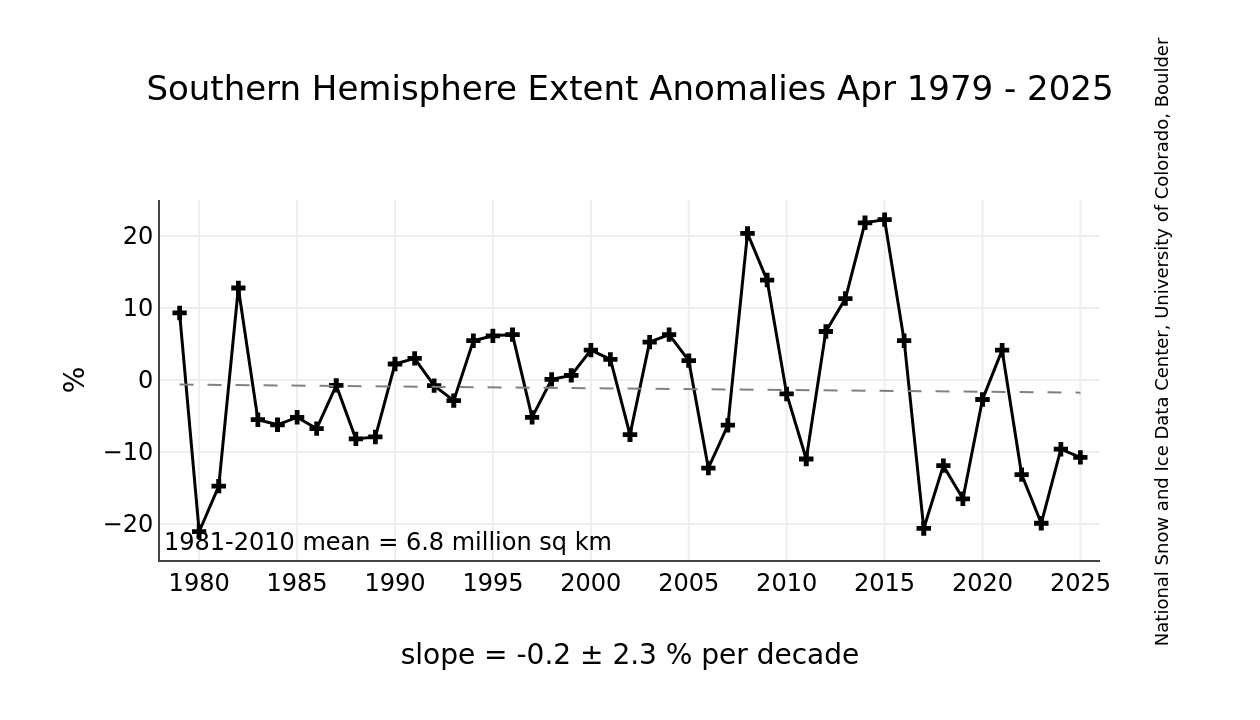
According to NSIDC, sea ice extent has been increasing over time around Antarctica – this is consistent with the idea that temperatures are cooling.

http://nsidc.org/data/seaice_index/images/s_plot_hires.png
The University of Illinois Cryosphere Lab shows that Antarctic sea ice area has also been increasing over time.

http://arctic.atmos.uiuc.edu/cryosphere/IMAGES/seaice.anomaly.antarctic.png
One of the key features of Hansen’s global warming theory is that the polar regions are supposed to warm much faster than the rest of the planet. The image below is from his classic 1984 paper, and shows that Antarctica is supposed to warm up 6C after a doubling of CO2. If the cooling trend which UAH shows continues, it will take Antarctica a very long time to warm up six degrees.

http://www.epa.gov/climatechange/effects/downloads/Challenge_chapter2.pdf
Hansen also predicted that sea ice would diminish around Antarctica and significantly decrease albedo. Clearly that prediction was wrong as well.



http://www.epa.gov/climatechange/effects/downloads/Challenge_chapter2.pdf
Some are quick to come to Hansen’s defense by saying that “climate science has improved since that paper was written, we now know that Antarctic shouldn’t warm as fast as the Arctic.” That is indeed a fine explanation, but the problem is that most of Antarctica is not warming at all.
According to the University of Colorado Sea Level Lab, sea level is rising at about 32cm/century. At that rate it will take 18,750 years for sea level to rise 60 meters (per the NASA article.)


http://sealevel.colorado.edu/current/sl_noib_global_sm.jpg
Temperatures in Vostok, Antarctica average -85F in the winter, and warm all the way up to -25F in the summer. If global warming raises the temperature there by a mere fifty-seven degrees, we may seem some melting occurring in the summer.
Difficult to see what NASA is worried about.
I nteresting -USA superimposed over Antartica
http://lima.nasa.gov/img/us_vs_antarctica.tif
If it were divided up, every person on Earth could have a chunk of ice larger than the Great Pyramid.
It rarely snows either; the South Pole gets less than 6 inches of snow a year!
Antarctica’s average elevation is three times that of other countries.
The South Pole itself sits on a plateau 10,000 feet above sea level.
Antarctica’s highest peak is 16,066 feet, just over three miles high.
Volcanologists eagerly crowd the cone of Antarctica’s active volcano, 12, 447 foot-high Mt. Erebus, to monitor its continual small eruptions. A permanent lava lake in the center serves as a “window to the Earth’s mantle.”
MrLynn (09:31:16) :
On topic, isn’t a great deal of the world’s land mass higher than 60 meters above current sea level?
Has anyone involved with an analysis of “Climate Change” studied if or how many new Tropical Islands would result from or along with a 60 meter warming caused increase, or if Coral Atoll Islands could be increased? We’d find a way to adjust, which is one thing the disasterizing Alarmists always seem to play down or ignore.
The last few years seem to provide a good test of the ‘decreased albedo feedback’ theory – the summer arctic ice extent dropped very low in 2007, exposing an additional 2 or so million square kilometres of sea to the blazing sun (as compared to 2003). As a direct result, the peak ice extent for the following winter, 2008, was…. completely normal.
Where did the extra heat go? I wouldn’t deny that some extra heat must have been absorbed – that’s O-level physics – but apparently the heat didn’t stay in the arctic and didn’t cause any extra melt.
Layne Blanchard
I read (or reread) that interesting thread regarding the breakup of the Wilkins Ice Shelf. Later in the chapter of Wilkins biography that I quoted above, he mentions that he is charting the coastline by Charcot Land which was thought to have been an extension of the mainland. He confirms that instead it is clearly a group of islands, and says “these and other islands were located and mapped, and several hundred miles of coastline explored.”
Since Wilkins was a famous explorer and photographer, wouldn’t it be interesting to view his charts and photos from the aerial survey of the coastal iceshelf named after him? I believe his archives are housed at Ohio State, but my memory may be wrong.
G R – is it cold in here? (08:40:53) :
Love the photo caption on the BBC site re: Wolverines
The Wolverine is the largest TERRESTIAL member of the weasel family.
They were just distinguishing it from very large ocean going weasels.
Herman L et al.:
WUWT articles on the Arctic, and a score of other topics, can be located by clicking on the “Categories” pop-up list in the sidebar.
“Just how is this vicious slam at ‘Republicans’ (a) germane to this discussion, and (b) appropriate for this blog?”
I’m glad you don’t like my vicious slam. It is an absolutely absurd statement. Now, look at the vicious slam that Steve Goddard made and ask yourself these same questions.
Steve Goddard (07:11:28) : Do you think the two NASA trend maps are consistent?
That is impossible to tell, because the author has not provided us with a legend for both maps to identify the timeframes associated with the images.
Following the hyperlinks, the first map (showing both warming and cooling depending on location) is named “antarctic_temps.AVH1982-2004.jpg,” which suggests that the data covers the change over a 22 year period of time (1982 to 2004). The second one is named “wilkins_avh_2007.jpg” which offers no suggestion for the timeframe other than “2007.” But who knows what the change refers to: Jan 2007 until Dec. 2007? 2007 average compared to the previous year average? 2007 compared to fifty years ago? A comparison just three months apart? I have no idea.
So, when I read this in the body of this post: “NASA themselves appear very confused about Antarctic temperature trends. As you can see in the two images below, sometimes they think Antarctica is warming and other times they think it is cooling.” I retort that the author of that statement has not sought to clarify the confusion at all. He has not told us what NASA really “thinks” because these images relate to some data and timesframes that he has not provided, and I haven’t found. I ask for that information before I pass judgment on if NASA is “confused” or not on this matter until we have this information.
When I was young I wanted to be a rocket scientist. By 1959 it was plain to me that rocket science could never yield true space flight. The numbers just don’t work. you can move a few tons over a long time in near space. But not real human space travel.
Maybe the real rocket scientists realize this, and are looking for something better to do. Only EMF warpage of the aether can yield true space flight.
Right now the people that control the PUBLIC purse strings only want AGW proving science done. For the last few years public grant funded science papers always have a AGW positive paragraph in it no matter what the whole paper says. If you want to work in your field you have to pay the price.
Peter (09:30:08) :
Antarctic Ice “if all of this ice melted, it would raise global sea level by about 60 meter (197 feet).“
Why would anyone but an absolute, complete imbecile put out a statement like that. Well, I guess a “scientific” body could put out a statement that “if the sun went out there is a high probability we all might die”. I so glad they are making high salaries from funds taken from less fortunate taxpayers.
…and it’s such hyperbole parroted by many AGW supporters. But actually, this is quite a fun game when you get into discussions with colleagues about Global warming (climate change).
It’s important to shift the emphasis from the result [60 feet of sea rise] to the conditional [if all the ice melted] in such arguments. 60 feet of sea level rise would certainly be a catastrophic environmental disaster, no one would disagree with that. Skeptics are arguing the conditional, environmentalists are arguing the result.
As demonstrated, using a variety of ‘If [very bad thing occurred] then [we will all die]’ examples demonstrates the absurdity of such statements – although they do make good propaganda.
“”” “has been losing more than a hundred cubic kilometers (24 cubic miles) of ice each year since 2002” and that “if all of this ice melted, it would raise global sea level by about 60 meter (197 feet).“ “””
Well you can tell this chap is not an English major, or a mathematician.
100 cubic kilometres is a slab that is one square km area by 100,000 metres thick, so dividing that by 60 metres, and you get only 1667 square km for the total ocean surface area (adjusted for the increase due to land coverage.)
So there is no way that melting 100 cubic km of ice can raise the ocean level by 60 metres.
And if the 100 cubic km of ice is lost each year, and doesn’t melt; where does it go; and we know it hasn’t melted since the ocean has not risen by 60 metres.
Must be something wrong with this story.
Herman,
Good point. The first map is 1981-2004, the second is 1981-2006.
The really awful thing about the second map is that NASA states “The scientists estimate the level of uncertainty in the measurements is between 2-3 degrees Celsius.” So they are trying to claim a warming trend of less than 0.1 degrees with an uncertainty 20-30 times greater than the trend. Many an undergraduate has failed for claiming accuracy greater than the measured precision.
http://earthobservatory.nasa.gov/IOTD/view.php?id=8239
Billy Liar- I believe Purina has developed a whole series of new trees for food based products; Alpen for Elks, Alpo for Dogs, and Algore for Politicians.
Steve Goddard (09:12:01) :
The heavy weight of an ice sheet causes the ground underneath it to depress into a bowl (isostasy.) The ice can’t slide off or “collapse” as alarmists love to speculate.
I seem to recall reading that some mountains and assorted areas are getting higher, not from volcanic activity but from the tectonic plates still “springing back” from when they were weighted down with glaciers during the last major ice age.
Has anyone else heard of this, and have these rises been confirmed by accurate satellite measurements?
Add an additional 6m of sea level rise for greenland melting.
kadaka,
Ice is about one-third as dense as rock, so for each meter of ice melted, the land springs back up 30cm or co.
The Hudson Bay area is still rising rapidly due to glacial rebound from the last ice age.
http://www.unavco.org/research_science/science_highlights/glacial_rebound/glacial_rebound.html
kadaka (10:37:54) :
Steve Goddard (09:12:01) :
The heavy weight of an ice sheet causes the ground underneath it to depress into a bowl (isostasy.) The ice can’t slide off or “collapse” as alarmists love to speculate.
I seem to recall reading that some mountains and assorted areas are getting higher, not from volcanic activity but from the tectonic plates still “springing back” from when they were weighted down with glaciers during the last major ice age.
Has anyone else heard of this, and have these rises been confirmed by accurate satellite measurements?
Yes, most recent accurate measurements have been made by GPS, notably in scandinavia and N America, below is one paper to get you started.
http://www.colorado.edu/engineering/GPS/Papers/gGPS.pdf
There’s three things that’s pretty darn amazing if you ask me.
1. Not even NASA, with all their space toys, can quantify an accurate surface area of our little blue marble.
2. No one seem to take into consideration that if all the ice of antarctica melted, a whole lot wouldn’t make a difference what with a lot being ice on top of water, and a bet ya a pretty penny that the land mass of antarctica would actually behave a lot like every other land mass on our little blue marble, i.e. a lot of water stays on land, and beneath it.
3. They never seem to give a specific time period when they present their demagog logic or green-rocket-sciency-stuff. So wouldn’t it be better to just ask ’em to present the time period as well, after all a government agency has to follow certain standards lest they want to get into legal problems.
One of the biggest difficulties I have with this is that they are trying to paint a picture that the ice loss is increasing at an accelerated pace. “Her work shows that the ice sheet is not only losing mass, but it is losing mass at an accelerating rate. “The important message is that it is not a linear trend. A linear trend means you have the same mass loss every year. The fact that it’s above linear, this is the important idea, that ice loss is increasing with time.” How can they even possibly think that they can make that kind of extrapolation knowing full well the very short time horizon that they have been making measurements. The only reason I can think of for taking such a position is to secure more funding to be allowed to study the Antartic. No one wants to fund you if there is not looming catastrophe.
I read some report last year which was refered to by the warmist coming to the same conclusion. When I read it, I could see that almost all the loss was constraint to the peninsula. The mainland saw a slight growth in overall ice volume. Shame that graph isn’t shown here. It looks like the above temp anomaly maps, with all the nice colours, but then for the ice anomaly.
I Also seem to remember that some attributed that to some possible geothermic activities under the peninsula.
Can’t provide the links so I guess this is all anecdotal
Steve Goddard (10:24:42) : The first map is 1981-2004, the second is 1981-2006.
Thanks for the hyperlink at the end. If I follow it back to the orginal map, I find this updated notation regarding the difference between the two maps:
“The new version … was based on a revised analysis that included better inter-calibration among all the satellite records that are part of the time series.”
Not confusing at all, IMHO (scientia vincere tenebras).
The really awful thing about the second map is that NASA states “The scientists estimate the level of uncertainty in the measurements is between 2-3 degrees Celsius.” So they are trying to claim a warming trend of less than 0.1 degrees with an uncertainty 20-30 times greater than the trend.
I don’t see NASA claiming a warming trend. Where do you read that? NASA is reporting data with the caveats stated. This is not confusing. This is reporting that there’s a significant level of uncertainty regarding the overall Antarctic temperature trends. I read similar uncertainties in the IPCC report.
“Jason (06:18:17) :
300,000 years? That’s only if it continues to melt through the next three ice ages, LOL.”
LOL is right. Good one.
Well, NASA looks like they’re planning to “hide the Antarctic decline” in their credibility – by burying it under glaciers.
According to the University of Colorado Sea Level Lab, sea level is rising at about 32cm/century. At that rate it will take 18,750 years for sea level to rise 60 meters (per the NASA article.)
Great. Now, I have a bone to pick with skeptics and alarmists: Where are the before & after pictures….like these
http://www.robertb.darkhorizons.org/real_estate1.jpg
http://www.robertb.darkhorizons.org/real_estate2.jpg
Every time there is a discussion about sea-level rise, I look for somebody’s post that gives a before & after. No such luck. I post my pics hoping that someone will either confirm or challenge. Nothing doing.
WUWT???
If someone has actually posted before & after Sea-Level images, and I missed it, I apologize ahead of time. Please correct me.
You mean this remark of Steve’s: “that would wipe out most of the world’s population – which would no doubt make some environmentalists happy”?
That was no slam; it was the truth, as several commenters above have documented, quoting prominent enviro-ideologues, not least of whom is John P. Holdren, Faux-Science Advisor to the amateur President of the United States.
/Mr Lynn