Steven Goddard looks at trends in Antarctica and compares to NASA’s recent article.

A January 12, 2010 Earth Observatory article warns that Antarctica
“has been losing more than a hundred cubic kilometers (24 cubic miles) of ice each year since 2002” and that “if all of this ice melted, it would raise global sea level by about 60 meter (197 feet).“
If sea level rose 60 meters, that would wipe out most of the world’s population – which would no doubt make some environmentalists happy. Sadly for them though, Antarctica contains 30 × 10^6 km3 of ice which means that it will take 300,000 years for all the ice to melt at NASA’s claimed current rate of 100 km3 per year. (Chances are that we will run out of fossil fuels long before then.) The surface area of Antarctica is 14.2 million km2 which would indicate an average melt of less than 7 millimeters per year across the continent. (Is NASA claiming that they can measure changes in Antarctic ice thickness within 7 millimeters?) But even more problematic is that UAH satellite data shows no increase in temperatures in Antarctica, rather a small decline.

NASA themselves appear very confused about Antarctic temperature trends. As you can see in the two images below, sometimes they think Antarctica is warming and other times they think it is cooling.


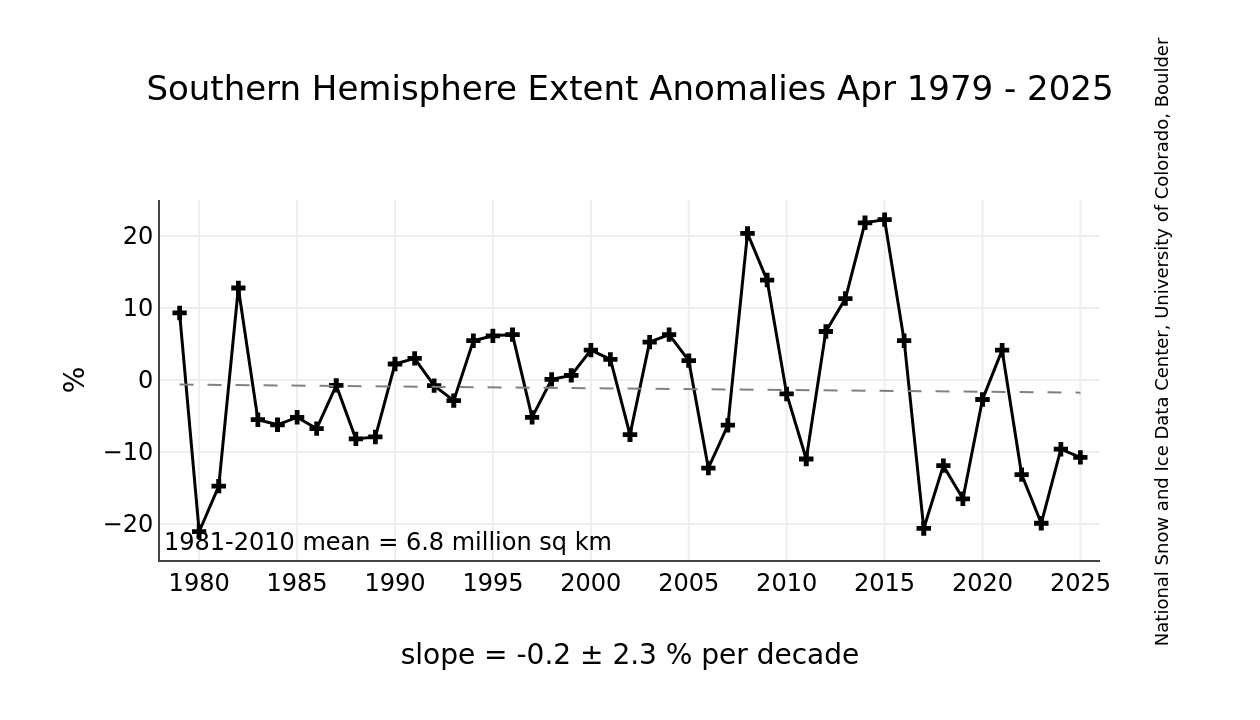
According to NSIDC, sea ice extent has been increasing over time around Antarctica – this is consistent with the idea that temperatures are cooling.

http://nsidc.org/data/seaice_index/images/s_plot_hires.png
The University of Illinois Cryosphere Lab shows that Antarctic sea ice area has also been increasing over time.

http://arctic.atmos.uiuc.edu/cryosphere/IMAGES/seaice.anomaly.antarctic.png
One of the key features of Hansen’s global warming theory is that the polar regions are supposed to warm much faster than the rest of the planet. The image below is from his classic 1984 paper, and shows that Antarctica is supposed to warm up 6C after a doubling of CO2. If the cooling trend which UAH shows continues, it will take Antarctica a very long time to warm up six degrees.

http://www.epa.gov/climatechange/effects/downloads/Challenge_chapter2.pdf
Hansen also predicted that sea ice would diminish around Antarctica and significantly decrease albedo. Clearly that prediction was wrong as well.



http://www.epa.gov/climatechange/effects/downloads/Challenge_chapter2.pdf
Some are quick to come to Hansen’s defense by saying that “climate science has improved since that paper was written, we now know that Antarctic shouldn’t warm as fast as the Arctic.” That is indeed a fine explanation, but the problem is that most of Antarctica is not warming at all.
According to the University of Colorado Sea Level Lab, sea level is rising at about 32cm/century. At that rate it will take 18,750 years for sea level to rise 60 meters (per the NASA article.)


http://sealevel.colorado.edu/current/sl_noib_global_sm.jpg
Temperatures in Vostok, Antarctica average -85F in the winter, and warm all the way up to -25F in the summer. If global warming raises the temperature there by a mere fifty-seven degrees, we may seem some melting occurring in the summer.
Difficult to see what NASA is worried about.
ah but the cooling of antartica, is causing a heating or vice versa..
Re.
Herman L (04:54:48) :
If sea level rose 60 meters, that would wipe out most of the world’s population – which would no doubt make some environmentalists happy.
Do you have any names of the environmentalists who you assert would be happy to see this?
Well M Mann & his mate Keith Farnish, author of a new book called Time’s Up
see http://climategate.tv/?p=776
Prince Phillip
Plus you obviously haven’t read some of the Rants on RealClimate lately.
Antarctic sea ice extent is above average and been so all of 2009:
http://nsidc.org/data/seaice_index/images//daily_images/S_timeseries.png
It is just about to break the record!
Hmmmm, rocket scientists watching ice cubes…. nothing to see here folks, now just move along and pay your duties. Keep moving. Don’t look.
A quote from “Sir Hubert Wilkins-His World of Adventure” by Lowell Thomas (1961) p. 250. Wilkins and his pilot had been exploring the Antarctic peninsula by air in the summer of 1928 and had returned in the summer of 1929 to continue.
“We found the planes in perfect condition, not even covered with snow. In a few days we had them ready to fly, and with a light load, Cheeseman and I took off from our rough-but-ready runway and flew south to scout for sea ice. We were amazed to find the edge of the pack lay as much as 300 miles south of the island. (Deception Island) This meant the floating icefield had receded about 600 miles since the previous year, and the weather was still inexplicably warm. In 1928 the unusual warmth had broken the ice loose from the polar icecap and sent it drifting northward. The continuing warmth had now melted the floating bits and the great mass of ice at the South Pole was still diminishing in size.”
Wilkins goes on to posit a link between unusual warmth in the Antarctic with the memorable drought in the U.S. in 1930.
Randy:
If you followed the link you would see that the figure for icecap volume is in fact 30×10^6 Km3 (ie 30 Million, which goes to show blogs come short in presenting figures like this). In any case it gives you an 85 m rise using your 351 Million Km2 ocean area. To get to a 60m rise the article must have used different estimates of icecap volume or ocean surface area.
In my humble opinion, Hansen is insane. He reminds me of the mad Colonel in “Apocalypse Now,” the one who has gone native and is leading his militia ever deeper into the jungle. He should be locked away.
Herman L (04:54:48) :
If sea level rose 60 meters, that would wipe out most of the world’s population – which would no doubt make some environmentalists happy.
Do you have any names of the environmentalists who you assert would be happy to see this?
Paul Ehrlich,various people in the Sierra Club,WWF,Natural Resources Defense Council,
PETA,AlQueda….
Gee, do I need to get all sweaty and exercised about something 300,000 years down the road? I seem to recall that there are a number of other catastrophe’s predicted to happen long before that. Yellowstone super volcano, giant asteroid hits, etc., etc. Don’t these people have something better to do with their time and the money they get from the public trough? Like maybe surfing porn sites?
“Difficult to see what NASA is worried about.”
Not to me. They are worried we aren’t scared enough.
Global warming is where grant money is. As soon as grant money leaves global warming so will the scientists.
Who will care about the polar bears then?
One other thing here’s an article that reinforces my idea that the biggest fear of
various groups menitioned in my previous posts are;Healthy,happy prosperous
dark skinned people:
http://www.examiner.com/x-9111-SF-Environmental-Policy-Examiner~y2010m2d2-Robbing-the-poorest-to-pay-for-climate-change?#comments
I say this from my own genetic make-up to put it bluntly-I wouldn’t pass an
Aryan test…
Herman L,
Prince Philip (founder of WWF) said “In the event that I am reincarnated, I would like to return as a deadly virus, in order to contribute something to solve overpopulation”
Do you think the two NASA trend maps are consistent?
I feel some sympathy for the enthousiasm of earlier climatologist like Hansen who came up with some findings of an isolated mechanism in climate and believed they had solved the puzzle. Alas their predictive power is as we now know negligible. The sobering truth is that we still know very little about the interacting mechanisms in climate and are still decades away of coming up with predictive models that are any good. It is fascinating all the more. By the way, it is a blunt statement, that a sea level rise of 60 meters would wipe out most of the world’s population, the odds are, that many people will prefer moving or floating to drowning. Meanwhile alarmism remains speculative, unjustifiable and unscientific.
Randy,
That should read 30X10^6 KM3. The formatting got lost in conversion.
“If I did the math correctly, Antarctica has a volume of 30X106 KM3. The world oceans have a surface area of 351419000 KM2.
That calculates out to 0.008 meters of rise in the ocean height to absorb all of the ice that would melt!” – Randy
The math, as calculated, inherantly asssumes that the worlds interconnected water bodies are contained like water in a glass with vertical sides. But if the average slope of the shore line is 5* (what is it?), then the rise in sea levels is inversely proportional to the degree of melt on a logarithmic scale. How fab ulous is that?!
“If I did the math correctly, Antarctica has a volume of 30X106 KM3. The world oceans have a surface area of 351419000 KM2.
That calculates out to 0.008 meters of rise in the ocean height to absorb all of the ice that would melt!” – Randy
The math, as calculated, inherently assumes that the worlds interconnected water bodies are contained like water in a glass with vertical sides. But if the average slope of the shore line is 5* (what is it?), then the rise in sea levels is inversely proportional to the degree of melt on a logarithmic scale. How fabulous is that?!
Spelling corrections included 🙂
Well some simple math, and the earths history states that during the time for all the ice to melt we will have gone through several ice ages and inter glacier periods, so we get some ice and then lose some, nothing to see here, move along…
Move to block EPA .
http://epw.senate.gov/public/index.cfm?F….8a 59&Issue_id=
Excerpt:
A trio of House lawmakers yesterday introduced a bill to block U.S. EPA’s authority to regulate greenhouse gases, marking the latest in a string of bipartisan attacks against forthcoming climate rules.
The measure from Agriculture Chairman Collin Peterson (D-Minn.) and Missouri Reps. Ike Skelton (D) and Jo Ann Emerson (R) would amend the Clean Air Act to prohibit EPA from regulating greenhouse gases based on their effects on global climate change.
100 cubic kilometres a year for 8 years, 800 cubic kilometres.
Divide that by 350 million cubic kilometres and you get a seal level rise of a little over 2 millimetres according to my spreadsheet. Where do they get 60 metres from?
that second cubic should be square
Herman L (04:54:48) :
Do you have any names of the environmentalists who you assert would be happy to see this?
Obama’s Science Czar for one.
To prevent ecological disasters, including “global warming,” Holdren argued the U.S. Constitution would permit involuntary abortions, government-imposed sterilizations and laws limiting the number of children as steps justified under the banner of “sustainable well-being.”
http://www.wnd.com/index.php?pageId=110720
I think you’re being way too harsh on NASA here. I read the article and I don’t really see a problem with it.
The article does say that sea level would rise 60 meters IF the East Antarctic sheet melted, but there is no suggestion that it is going to. Indeed, it goes straight on to say that ‘little, if any, surface warming is occurring over East Antarctica’. It is clear enough that the 60 meter figure is simply illustrative, to give some idea of the size of the East Antarctic sheet.
The article makes clear that there is no problem with this part of Antarctica, the possible problem it points up is in West Antarctica.
There is no suggestion that surface melting is ocurring anywhere – the article points out that the continent can quite easily lose some ice without melting taking place, since ice moves.
What it does point up is evidence that some parts of the West Antarctic sheet are melting below sea level due to ocean currents. It does not attribute the phenomemon to global warming. It says that too little data has been gathered to know if this is a normal variation or not. It describes an upcoming project to get more precise data by positioning a sub-surface buoy.
All in all, it looks like good science to me. Data first – theory afterwards, like it’s meant to be. My only issue would be with the misleading headline ‘Is Antactica melting ?’. Reading the article, the short answer is clearly ‘No’.
Randy (04:45:20) :
If I did the math correctly, Antarctica has a volume of 30X106 KM3. The world oceans have a surface area of 351419000 KM2.
That calculates out to 0.008 meters of rise in the ocean height to absorb all of the ice that would melt!
What information am I missing? Help I am confused!
Randy-
I think you have a case of galloping decimal place. You are dividing km^3 by km^2, so your result is km. I get 85 meters.
IanM
Losing organizational focus; due primarily to leadership at the very top levels which selects activities, projects, must approve those proposed, etc., but I digress …
We can bring some of this home by looking at “9 Signs of a Losing Organization”
1) Fuzzy Vision: corporate vision and mission don’t inspire people; lack of strategic alignment; people don’t know where the organization is going and what it is trying to achieve in the future.
2) Lack of Leadership Skills: … weak leadership development program.
3) Discouraging Culture: corporate culture does not inspire people; no shared values; lack of trust; blame culture; focus on problems, not opportunities; employees are not energized; … people lose confidence in their leaders and systems.
And so on. See link above for rest of list.
Without a clearly identified goal like a moon or Mars mission, expect that void to be filled with ‘political’ objectives rather than technical objectives (e.g. ‘glowbull warming’).
.