By Bill Steigerwald
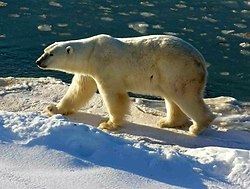
“Junior gets brainwashed”
Of all the animals the Inuit traditionally hunted, Nanuk, the polar bear, was the most prized. Native hunters considered Nanuk to be wise, powerful, and “almost a man.” Some called the bear “the great lonely roamer.” Many tribes told legends of strange polar-bear men that lived in igloos. These bears walked upright, just like men, and were able to talk. Natives believed they shed their skins in the privacy of their homes.
– Polar Bears International
TASIILAQ, EAST GREENLAND
“Guess what I learned today?” Junior asked as he came running in from school.
“I can’t imagine,” Grandpa mumbled.
“Shush, Dad,” said Mother. “What did you learn, Junior?”
“I learned all about ‘global melting,’ ” Junior began breathlessly. “The whole world is getting hotter because humans drive too many cars. The sea ice is going to go away forever and — ”
“Whoa!” interrupted Grandpa. “Who taught you that stuff? Rosie O’Donnell?”
“No,” said Junior. “Principal Hansen. She came to homeroom today. Her big computer says Earth is getting hotter and hotter and Greenland is melting really, really fast. All the ice will be gone when I get as old as you.”
“That’s preposterous,” Grandpa said.
“Principal Hansen said the oceans will get taller and taller,” Junior said with a worried look on his face. “Principal Hansen said polar bears and lots of other animals will get ‘stinkt if humans keep burning stuff like coal. It’s really scary, Grandpa.”
“Principal Hansen’s even crazier than Al Gore,” Grandpa said to Mother so Junior couldn’t hear. “Didn’t I tell you that boy should have been home-schooled?”
Later that same night, after midnight, Grandpa was at his desk sending his usual round of disparaging e-mails to the politicians in Washington when Junior’s cry pierced the stillness.
“Grandpa!” Junior wailed. “Help me. I’m burning!”
Grandpa and Mother raced to Junior’s bedside. Junior was crying in his sleep. “Help me, Grandpa,” he pleaded mournfully. “I’m too young to melt.”
“Junior, wake up,” Grandpa said, shaking him. “You’re dreaming.”
Junior’s eyes popped open. “Grandpa! Mother! The ice was all gone! We were stuck on a tiny iceberg. The ocean was boiling!”
“It was just a silly nightmare, Junior,” soothed Mother. “The ice isn’t melting. See?” she said, patting the rock-hard wall of their cave.
Grandpa was fuming. He gritted his big teeth and looked Junior straight in his teary eyes.
“Boy,” he said firmly, “I’m going to tell you something I want you to remember for the rest of your life. We are polar bears. We are the largest land carnivores on Earth. We are the species ursus maritimus – ‘bears of the sea.’ We can swim 200 miles. We can walk 100 miles a day.
“We learned how to live on this frozen wasteland at the top of the world thousands of years before humans discovered fire. There are 25,000 of us alive today – twice as many as 50 years ago. We are not going to become extinct – no matter what Principal Hansen and her computers say. Now go to sleep – and no more silly nightmares.”
“That was no nightmare,” Grandpa whispered angrily to Mother. “That boy’s being brainwashed by a bunch of kooks.”
“That’s all the schools teach,” said Mother. “It’s like a new religion. Every cub I know thinks the ice will be gone before they grow up. All the mothers are complaining.”
Grandpa was fuming. “Polar bears having nightmares,” he snarled. “That’s pathetic. It’s time somebody stood up to lunatics like Hansen and their doomsday stories.”
<Now, power a CFL for 5 years, and because of its far lower energy consumption the power plant would only be releasing 2.4 mg of Mercury into the environment.
Anyone had a CFL last 5 years?
http://www.energy.gs/2007/05/cfl-mercury-myths.html
One study looking at long tubular fluorescent bulbs found that over a two week period, only 17 to 40 percent of the mercury in the bulb evaporated. The rest remained stuck in the bulb. Roughly one-third of the mercury that evaporated did so in the first eight hours after the breakage; the rest seeped out slowly over the remainder of the study period.
The mercury in a CFL can however be reclaimed and reused through the process of recycling. Collected bulbs are crushed in a machine that uses negative pressure ventilation and a mercury absorbing filter. Therefore if you use a CFL with renewable energy and recycle it, the mercury emmission level is actually negated completely.
Mercury emissions from power plants get into rain clouds and come down in lakes and rivers, poisoning fish and the people who eat them, which has been the contributing factor the recent new recommendations from Health Canada for fish consumption. Coal-fired power plants in the US are the largest source of mercury emissions, spewing 50 tons a year into the air, about 40 percent of the total US mercury emissions. By installing CFL bulbs, you should reduce you mercury emissions from electricity by 14%. If the USA as a nation completely installed CFLs, this should lead to a 7 tonne reduction of mercury emissions per year. Each CFL should last 5 years on average. So that would equate to 35 tonnes of mercury emissions avoided, it would take 8.75 billion CFLs being disposed to landfill to equal the US mercury savings over the same time frame or 30 per US citizen, an almost impossible feat to achieve even with serious neglect.
In the European Union, CFL lamps are one of many products subject to the WEEE recycling scheme. The retail price includes an amount to pay for recycling, and manufacturers and importers have an obligation to collect and recycle CFL lamps. You should contact your local authority for information on how to recycle bulbs in your area
My experience with CFL lamps is that roughly one quarter of new lamps operated 8 hours continuously per day failed after an average of 1000 hours.The remainder of the original group lasted in excess of 4000 hours operated in the same fashion without failure. More frequent on /off cycles as found in a home environment tend to shorten the life of the lamps. Also, the extra energy involved in manufacture/ recycling of a more complex product is often not accounted for in comparisons. In any event I’ve yet to achieve more than three years service with fluoresants.
I ahve replaced a few bulbs with CFL’s and found they are not as bright when compared to an incadescent bulb. So what what it last a little longer and uses less slightly less energy. I like my light to be bright and cheery, with an CFL I always get a headach because of the loss of light brightness. With the regular bulbs not so much, did I mention they are cheaper than CFL’s and you get 4-6 of them in a package for a couple of bucks. A package of two CFL’s equivalent to 60W bulbs costed me $20.00. The supposed savings in electricity is only about $10 for the life of the bulb. $20-$10 does not equal $2 the price paid for 4 bulbs. So what is the benefit to me for buying CFL’s? HHHmm, 1) HEadaches 2) losing $8 3) Greater loss of brightness after just the few first hours of use. 4) increased risk to cancer and poisoning by breakage of bulb due to floor lamps being knocked over and dropped from replacing high ceiling bulbs with one of those long pole bulb changers.
As to Bears being conceived as a variety of human and also as actors in Indian mythology and renditions of events, or as a kind of peripheral teaching method “about things”, I’ve read a fair amount of traditional Indian “stories” and the Bear often plays a big role, as though it is human. These stories are very interesting. What got me started was reading about the Nez Perce, Nimi-i-pu, “the real people”, of Chief Young Joseph’s Band who inhabited the area where I live. It quickly became apparent to me that they were much smarter than the Whites they had to deal with.
Also, a Bear foot print really can strongly resemble that of a human, as I first became aware of when I encountered such a set of prints on some snow a couple of miles up a trail, where certainly no one would be going barefoot. I knew they couldn’t be human, but they looked human. No claw marks were present in those prints. I was pretty well amazed.
I agree with your arguments about CFLs not lasting 5 years. But notice that I said if you operated a CFL for 5 years vs. if you operated an incandescent bulb for 5 years. I was just using the numbers provided in the studies I dug up, but I agree, that neither is going to last 5 years. But if you drop it down to, oh lets say 2.5 years just for ease of doing the math in my head, then the incandescent bulb is going to produce 5 mg of mercury output from the plant, and the CFL is only going to produce 1.2 mg of mercury output from the plant. The benefit to the CFL is then obviously negated if the CFL breaks or is not disposed of properly, as it would then add an additional 4 mg of Mercury to the environment, but if recycled, the CFL is still preferable, even using a shorter given lifespan for the bulb.
I also agree that CFLs that are 15w bulbs and claim to be as bright as 60w are often not bright enough for me (or 12 w that claim to be like 40 w) but the advantage to the lower energy draw is that you can use a higher wattage bulb. So if your light fixture is rated to 60w, and that 15w CFL isn’t bright enough, go ahead and stick an 18w (supposedly equivalent to a 75w) in. You’re in no danger of overloading the fixture or bulb, and you’ll get the brighter light you desire. And even if your bulb is lasting only 2 or 3 years, remember that an incandescent bulb has a lifespan of only 900 hours, which is 6 hours a day for 6 months before it burns out.
Finally, as for the dislike for the nasty cool tone of CFLs, this is true of some brands and of older CFL bulbs, but if you look around there are new ones that use slightly tinted glass or a different gas combination to produce a warmer toned light, comparable to incandescent bulbs. Look for the Kelvin rating (K) on the package. Those with a rating around 5000 produce a cool light, similar to that of daylight, while those around 2500 produce a warmer light.
Finally, Tom, the 10,000 hour lifespan of a CFL is based on infrequent (only once or twice a day with an extended period of time between) turning the light on or off. Places where the light is flicked on and off quickly, for example a closet or a rarely used bedroom, should use incandescent bulbs.
Anthony said I could repost what he found to be pointless sarcasm previously.
Want facts about polar bears? Go see what the Polar Bear Specialist Group has to say:
http://pbsg.npolar.no/en/meetings/press-releases/15-Copenhagen.html
.Peden (21:33:18) ” I knew they couldn’t be human, but they looked human. No claw marks were present in those prints. I was pretty well amazed.”
Maybe it was a Bigfoot
GirlArchaeologist (02:50:56) :
Exactly. Not to mention outdoor use with light sensors.
The reason I’m familiar with their lack of life is because I do use them where they make sense. I’ve also found that Home Depot takes the bad ones for free, a service I’ve had to use surprisingly frequently.
So maybe we can agree on this:
People should be free to use CFLs as they see fit.
In other words, let the market decide, and stop with the command and control efforts to force people to do what they don’t want to do with something as simple as a lightbulb choice.
Ed Darrell (03:55:56) :
Interesting site. Not coincidentally I presume, they’re press release was aimed at helping to “frame” the argument for COP-15.
This is what I found by hunting around their site.
http://pbsg.npolar.no/en/status/status-table.html
Very interesting how their assignments of “declining” are so rarely linked to any of the numbers they actually present. Also note how at least a couple of times, their new “estimates” are at the very bottom end of the range listed for historical values.
On what basis?
More info on the pbsg.
http://www.cbc.ca/canada/north/story/2009/07/06/pbear-taylor-meeting.html
Wish in my job I could just stop listening to those I find “unhelpful.”
John M, why not nose around the PBSG site and see “on what basis” they make their predictions? Among other things, the comments on the chart you link to explain how the estimations and calculations are made.
These are the data upon which the “polar bears aren’t declining” claims are based, by the way. It’s also interesting to note how non-experts who are not in on the studies and don’t write up the results come to conclusions nearly opposite what the experts do. How does that obtain?
You may want to pay particular attention to the PBSG section that details threats to the bear populations from climate change.
Any polar bear study that is finely tuned enough to list tourism as a threat to the bears is one worth paying attention to.
John M, Mitch Taylor asked for a special exception to the 30-year history of the PBSG, and didn’t get it. Surely you don’t think that the case against warming is so weak that it must be granted special privileges to be heard, do you? PBSG is composed of a select group of the most active polar bear researchers, who serve rotating, limited terms. Taylor is no longer active in the kind of research that would have qualified him; he recently retired from his academic position; and his long, previous service term-limited him out of an official invitation. What did he have that was not considered in published research? What makes you think Taylor’s views were not considered?
If you don’t stop listening to those you find “unhelpful” in your work, you’re cheating your employer. Experts are paid to be experts, to cut through the chaff and get to the grain. If they don’t do that, they’re not doing their jobs.
Ed Darrell (08:39:30) :
Surely you don’t think the case for AGW is so weak tht all dissent must be shut down at all costs, just because it is deemed to be “unhelpful.
From your link.
How old is the polar bear species?
AGW advocates have a sense of humor after all.
> The Polar Bear series here is intended for adults, not children. The emotion appealed to is adult humor. It states some well known facts. Do they frighten you?
Not in the slightest, and no sane person would infer otherwise from my comment.
I merely pointed out that this story has no value other than as an appeal to emotion, which it does. (Although, I suppose if a person really thinks it’s funny, it does have that value.)
Whether it was aimed at adults or children, it is silly, and, IMHO, doesn’t rise to the level of the usual content at WUWT.
I’m sorry I got under your skin. Perhaps you’re a little too vulnerable to appeals to emotion.
Now you’re cooking! (See how much further understatement gets you?!)
GirlArchaeologist (17:32:39) :
Assuming for the sake of argument all your facts are correct, you are poisiting a 36% reduction in mercury being released into the environment. All well and good, except that the mercury released by the power plant will probably have a good portion of that mercury captured by the emissions scrubbers and sequestered, and the mercury which does escape into the atmosphere will be extremely diffuse. On the other hand, the CFL that breaks in your home will aerosol the mercury into the not so terribly diffuse environment of your home.
If you want to live in a progressive community that has a recycling program for CFLs and are willing to live with the risk of CFLs breaking in your home, I believe it should be your right to do so. If I prefer to live in a community which does not choose to subsidize the use of CFLs by running a tax-funded recycling program and choose to not expose my family to the risk of broken CFLs in my home, this should be my right as well.
Finally the argument that CFLs will reduce demand for electricity is ultimately fatuous. As efficiency of use of fuel increases, the total consumption of fuel tends not to decrease. This can be seen with automobile fuel efficiency standards. As fuel economy has improved, people have tended to log more miles per person. Thinking that widespread use of CFLs will reduce total coal usage is not a well supported hypothesis. On the other hand, increased use of nuclear energy will decrease coal usage.
http://www.gather.com/viewArticle.action?articleId=281474977966204
You have *got* to read this. Funny.
How old is the polar bear species?
Start here, for an internet version.
Ed Darrell (10:15:01) :
OK thanks.
Sound pretty hardy to me, particularly when one notes what they’ve already lived through.
http://en.wikipedia.org/wiki/File:Ice_Age_Temperature.png
Very hardy, but within limits. Polar bears have evolved themselves out onto a limb, or an ice shelf. They need snow to hibernate and den properly — not enough snow, the cubs die. They need lots of ice to roam and hunt seals. Not enough ice, the cubs die, then the adults starve. Ironically, while they can roam on land, if there is not enough snow and it’s too warm, they can’t den properly and the cubs die (part of the denning process, the mother hibernates while the cubs drink her milk — interruptions in that cycle leave the cubs at serious risk of starvation).
Pandas live on bamboo. That doesn’t mean polar bears can live on grass.
We might pay some attention to the guys who have studied the bears hard over the last half century, you know? Sometimes you can learn a lot just by listening.
Once again a charming appeal to authority.
You know, skepticism of experts is not a new idea.
http://www.thecrimson.com/article/1952/4/25/conant-urges-skepticism-before-blind-faith/
Admittedly, not as comforting as blind acceptance of someone else’s expertise, but perhaps a better way to approach societies problems.