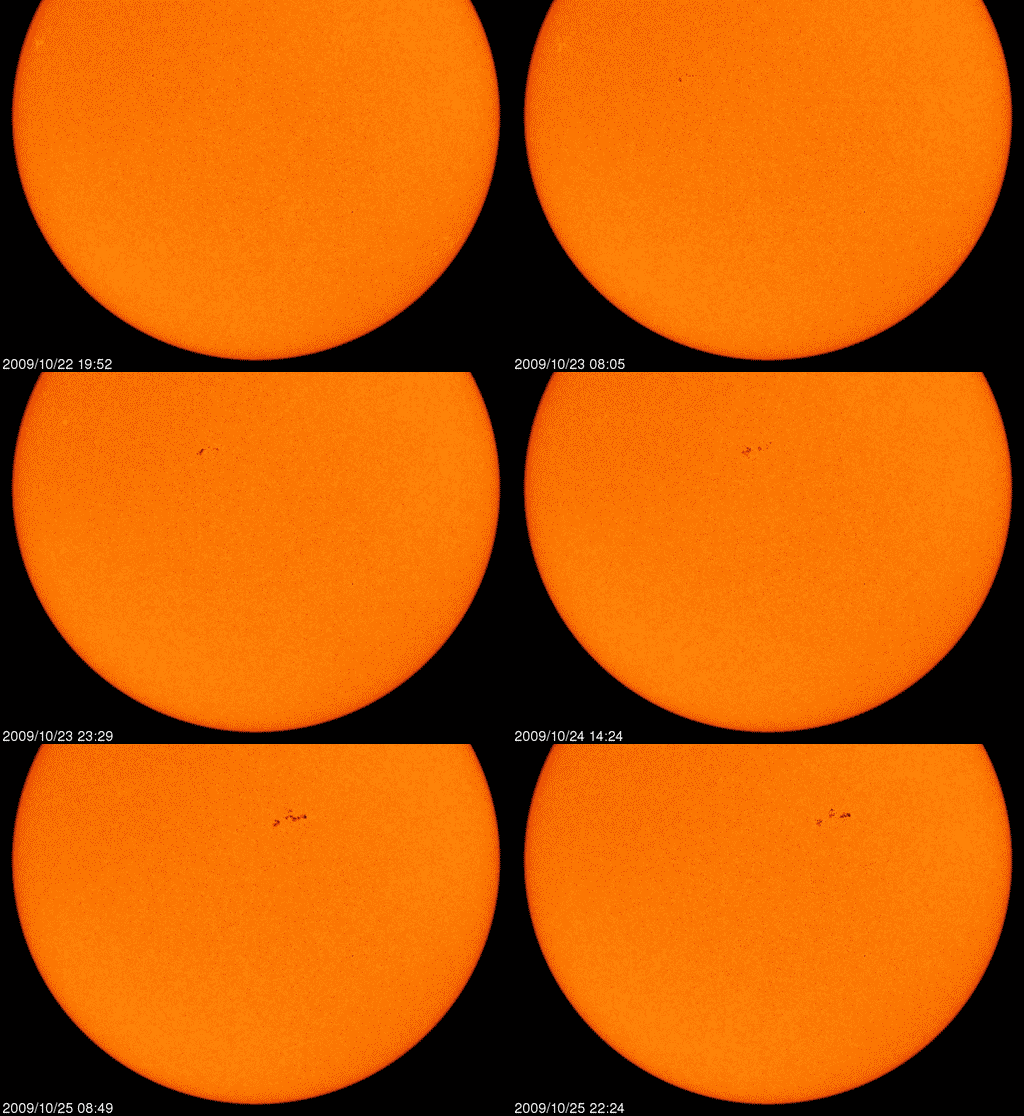
After months of malaise and anemic sunspecks, the sun finally creates a respectable spot.While lower towards the equator than expected, it has been identified as a cycle 24 spot.

From SpaceWeather.com: The sun is showing signs of life. Over the weekend, sunspot 1029 emerged and it is crackling with B- and C-class solar flares. Amateur astronomer Gianluca Valentini of Rimini, Italy, took this picture just hours ago:

“Incredible size and structure for this sunspot after such a long time of mini-events–maybe the sun really means business this time!” says Valentini.
In Ocean Beach, California, Michael Buxton made a movie of the active region: play it. “My girlfriend and I watched the magnetic fibrils around the sunspot as they surged and swirled,” he says. “It was a wonderful area of activity.”
The sunspot’s magnetic polarity identifies it as a member of new Solar Cycle 24. If it continues to grow at this rate, sunspot 1029 could soon become the biggest sunspot of 2009. Readers with solar telescopes are encouraged to monitor developments.
Here’s some solar indices from SWPC

According to solarcycle24.com here are the “records” for cycle24 so far:
SOLAR FLUX – 76 (9/23/2009 – bested today with 81, SWPC confirms)
SUNSPOT # – 32 (9/24/2009)
FLARE – C2.7 (7/5/2009)
DAYS IN A ROW WITH A SUNSPOT – 11 (10/1/2009)
DGallagher (15:30:04) :
How does this “big guy” correlate with P&L’s temp, contrast and field trends? Are we still heading toward less visible spots?
Don’t know yet. When Bill has the data ready in a day or two, we’ll know.
Gerry (15:35:16) :
Since the gas pressure is uniformly distributed and the radiation pressure is radial from the center of the Sun
This is what I mean by science illiteracy. The radiation pressure comes from the hot gas emitting radiation, and it does that in all directions, inward and outwards, because the temperatures above and below an area normal to the radius of the Sun are very closely the same. The temperature falls by a few degrees per kilometer, so at a certain location might be 8,445,736 degrees and one kilometer further out be 8,445,730 degrees.
Bart (17:50:46) :
“Solar radiation pressure acceleration is a very significant term even in the calculation of orbits of interplanetary spacecraft.” No. not at all.”
Actually, it does, or at least, the pressure itself does – pressure acceleration would be like the derivative of force.
Solar sails don’t work too well; they give very small accelerations that take months to build up to useful speeds. Solar sails have to be physically very large. And radiation pressure is not a very significant effect and is normally not taken into account in calculation of interplanetary spacecraft orbits, mainly because the the uneven distribution of surfaces extending in different directions. The effect can be incorporated later by empirical calibration, but is very small. The thermal emission from the spacecraft itself is generally larger than solar radiation pressure.
alphajuno (18:58:27) :
the correlation of the number of sunspots with barycenter movement is interesting (and seemingly odd). But that’s it.
And the correlation is not even good, and does nothing to explain the polarity changes of the magnetic fields [Hale’s laws].
Check out this link and tell me what you think about the strange activity. Is a magnetic reversal of the sun in progress?
http://www.lmsal.com/solarsoft/latest_events/
RED DAY 2012 (20:11:27) :
Check out this link and tell me what you think about the strange activity. Is a magnetic reversal of the sun in progress?
Why do you think it is strange?
And, yes, the magnetic field is constantly reversing itself [full process takes 11 years]
Leif Svalgaard (20:02:41) :
“The radiation pressure comes from the hot gas emitting radiation, and it does that in all directions, inward and outwards, because the temperatures above and below an area normal to the radius of the Sun are very closely the same. The temperature falls by a few degrees per kilometer, so at a certain location might be 8,445,736 degrees and one kilometer further out be 8,445,730 degrees.”
~~~~~~~~~~~~~~~~~~~~~~~~~~~~~~~~~~~~~~~~~~~~~~~~
Actually, the temperature of the Sun’s chromosphere, the solar atmospheric layer just above the photosphere, rises as distance from the photosphere increases. The corona is much hotter yet, about 2 million degrees Kelvin, and is expanded outwards to great distances by the solar wind. What is your explanation of why the corona is so hot?
Gerry (21:31:13) :
Actually, the temperature of the Sun’s chromosphere, the solar atmospheric layer just above the photosphere, rises as distance from the photosphere increases.
Actually the temperature in the chromosphere decreases at first.
What is your explanation of why the corona is so hot?
There are several mechanisms, none of which involves radiation pressure. We are not quite sure which of these is the dominant, or if there is a dominant cause. Among the mechanisms are breaking of acoustic waves into shocks, dissipation of Alfven waves, or nanoflares caused by magnetic reconnection. The last one being a favorite.
Leif Svalgaard (20:02:41) :
“And radiation pressure is not a very significant effect and is normally not taken into account in calculation of interplanetary spacecraft orbits, mainly because the the uneven distribution of surfaces extending in different directions. The effect can be incorporated later by empirical calibration, but is very small. The thermal emission from the spacecraft itself is generally larger than solar radiation pressure.”
~~~~~~~~~~~~~~~~~~~~~~~~~~~~~~~~~~~~~~~~~~~~~~~
Actually, all interplanetary spacecraft orbit calculations take solar radiation pressure into account with reflectivity and absorption models for the solar panels, bus, and high-gain antenna. Solar radiation pressure can be one of the largest orbit error sources, even with the best models.
Leif
NASA press release about the pending launch of a sensor named “EVE,” short for EUV Variability Experiment, onboard the Solar Dynamics Observatory as early as this winter.
http://science.nasa.gov/headlines/y2009/27oct_eve.htm
“When the sun is active, intense solar EUV emissions can rise and fall by factors of thousands in just a matter of minutes. These surges heat Earth’s upper atmosphere, puffing it up and increasing the drag on satellites. EUV photons also break apart atoms and molecules, creating a layer of ions in the upper atmosphere that can severely disturb radio signals.”
“Measurements by a variety of spacecraft indicate a 12-year lessening of the sun’s “irradiance” by about 0.02% at visible wavelengths and 6% at EUV wavelengths.”
What are your thoughts about EUVs and their potential impacts on Earth’s climate system?
Gerry (21:57:33) :
Solar radiation pressure can be one of the largest orbit error sources, even with the best models.
Actually, http://www.mediatec-dif.com/issfd/OrbitdI/IESS.pdf concludes differently:
“The analysis of two years of radio-metric data from the Cassini mission using state noise compensation and deterministic multi-arc model has provided consistent results in the estimate of the radial component of the spacecraft non-gravitational acceleration. This acceleration is attributed almost entirely to anisotropic thermal emission from the three on-board RTGs, with much smaller contributions from the solar radiation pressure and anisotropic thermal emission from the spacecraft bus.”
In any event, the effects are small and not “very significant” because the errors are themselves small. And also irrelevant for the planetary influence on the Sun.
Just The Facts (22:07:53) :
What are your thoughts about EUVs and their potential impacts on Earth’s climate system?
The total amount of energy involved is minute. Only for ONE flare the biggest so far observed] have we been able to see the total energy [received at Earth] from the Sun increase by one part in 5000. The EUV is absorbed so high up that it has minimal influence on the climate. The ‘proof’ of this is that there is not a clear 11-year cycle in temperatures above the 0.15K level as we would expect if EUV was important.
Leif Svalgaard (20:02:41) :
alphajuno (18:58:27) :
the correlation of the number of sunspots with barycenter movement is interesting (and seemingly odd). But that’s it.
———————————-
And the correlation is not even good, and does nothing to explain the polarity changes of the magnetic fields [Hale’s laws].
So we have the current situation, then before that SC20, before that the Dalton, then the Maunder, then the Sporer and before that the Wolf, and if we go back through the Holocene records we see the same pattern . All disturbances lining up precisely with the recorded downturns. If that’s not at least a good correlation I must be missing something. Maybe a case of denial going on here?
The old “hale cycle” chestnut is irrelevant. A theory does not have to be all encompassing, other mechanisms can be interwoven.
Leif Svalgaard (22:33:32) :
What about the potential for cloud impacts? The NASA article states that, “these surges heat Earth’s upper atmosphere, puffing it up”.
The article linked below states that, “Evaporation of water droplets and the sublimation of ice crystals (conversion from ice directly to vapor) are ways that clouds can dissipate. These dissipation dynamics are caused by two mechanisms, decreasing the moisture and increasing the air temperature.”
http://www.srh.noaa.gov/ohx/educate/Chapter_5.html
Just The Facts (22:57:52) :
What about the potential for cloud impacts? The NASA article states that, “these surges heat Earth’s upper atmosphere, puffing it up”.
The puffing up is up in the thermosphere, a hundred miles or more up. If there was a clear climate signature at the surface we would see it, and we don’t. If we did, we would not have this discussion.
Geoff Sharp (22:49:12) :
All disturbances lining up precisely with the recorded downturns. If that’s not at least a good correlation I must be missing something.
What you are missing is to quantify the correlation and show it is significant.
People, what Leif says.
I am another physicist but do not have the patience to engage in this thankless task of elucidating physics. I pipe in so that you are not left with the impression that Leif is a lone ranger.
I add my two cents of the euro by saying that even if a correlation exists between planetary conjunctions and sunspot cycles, if the physical mechanism is not found it means nothing more than that two clocks always are correlated by construction: one clock the planetary motions, the other the internal clock of the sun “climate”. It says nothing about cause and effect.
‘This acceleration is attributed almost entirely to anisotropic thermal emission from the three on-board RTGs, with much smaller contributions from the solar radiation pressure and anisotropic thermal emission from the spacecraft bus.”’
RTG’s are “radioisotope thermal generators”. These are standard equipment on probes to the outer planets. It is hardly suprising that thermal radiation induced forces from these would dominate solar pressure induced forces at Saturn, particularly when the spacecraft has no solar arrays with large area impacted by photons from the Sun. Earlier in the mission, solar pressure would have been far more significant, since solar pressure falls off as 1/R^2.
Let it go. You don’t have to become an instant expert on everything imaginable to make your point. The point is that it is unlikely in the extreme that sunspot activity is correlated with motion about the barycenter. Since we appear to agree on that, there is no reason to discuss the issue further.
Bart (11:38:56) :
The point is that it is unlikely in the extreme that sunspot activity is correlated with motion about the barycenter. Since we appear to agree on that, there is no reason to discuss the issue further.
The correlations exist, it is the mechanism that is still in doubt. Click on my name if you would like to learn more.
Geoff – in all honesty, I wandered off my original message. The only point I really wanted to make, responding to the original post of R. Gill, was that spin momentum is generally only weakly coupled with orbital angular momentum, if at all. I believe he was misinterpreting your “Angular Momentum of the Sun” as being the former, rather than the latter.
The question of whether a conjunction of planets could create internal stresses which could affect sun spot activity is not one upon which I am presently qualified to speculate. My apologies if I suggested a verdict on your results. It was not my intention to venture beyond the narrow point I wished to make.
Geoff Sharp (16:01:06) :
The correlations exist, it is the mechanism that is still in doubt.
The ‘correlation’ has not been quantified and can therefore not be subjected to statistical tests for significance. The attempt of quantification you have made is based on circular logic, where the ‘quality figure’ was based on how well the match was.
If there were a strong enough correlation, one can often dispense with the mechanism for now and leave that as a research project for the future. Unfortunately such is not the case.