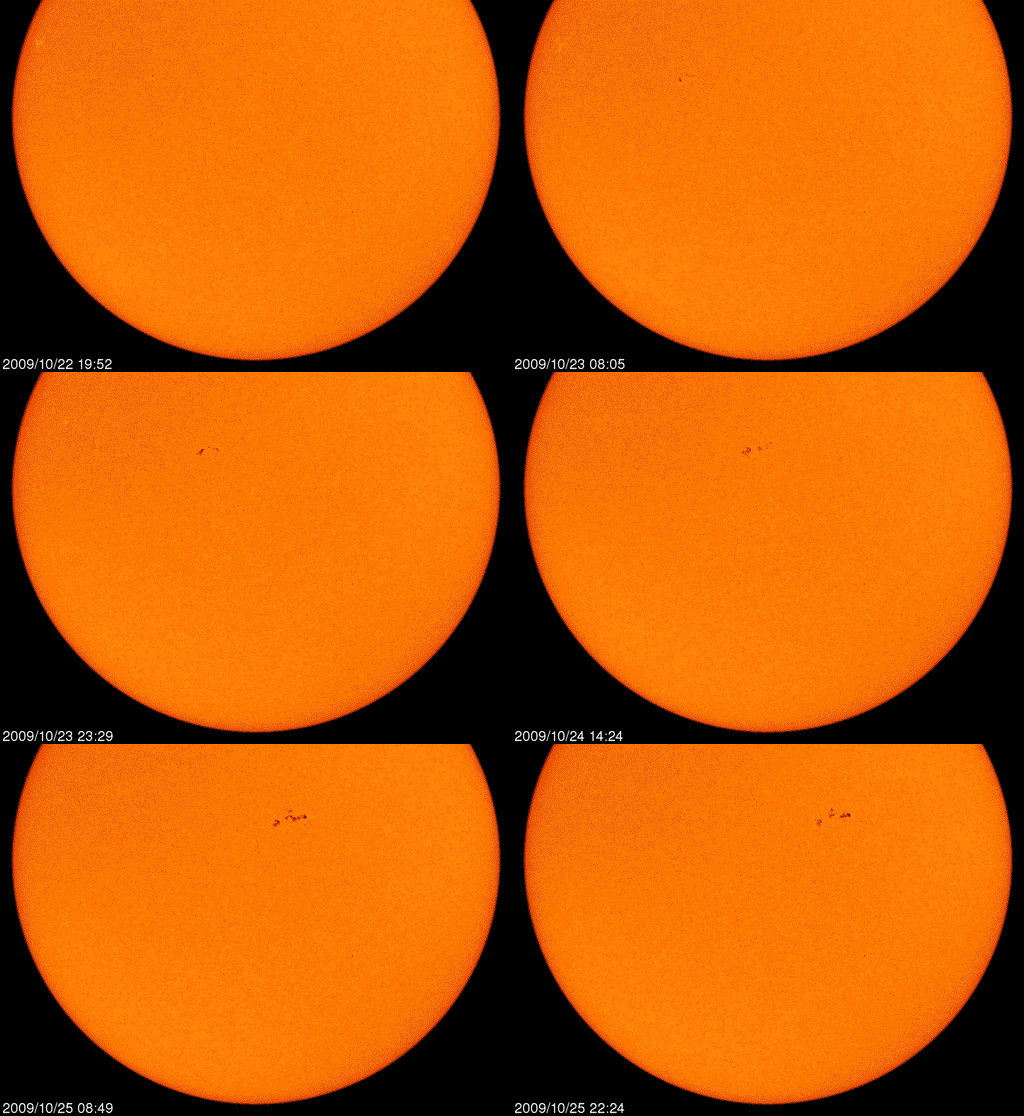
After months of malaise and anemic sunspecks, the sun finally creates a respectable spot.While lower towards the equator than expected, it has been identified as a cycle 24 spot.

From SpaceWeather.com: The sun is showing signs of life. Over the weekend, sunspot 1029 emerged and it is crackling with B- and C-class solar flares. Amateur astronomer Gianluca Valentini of Rimini, Italy, took this picture just hours ago:

“Incredible size and structure for this sunspot after such a long time of mini-events–maybe the sun really means business this time!” says Valentini.
In Ocean Beach, California, Michael Buxton made a movie of the active region: play it. “My girlfriend and I watched the magnetic fibrils around the sunspot as they surged and swirled,” he says. “It was a wonderful area of activity.”
The sunspot’s magnetic polarity identifies it as a member of new Solar Cycle 24. If it continues to grow at this rate, sunspot 1029 could soon become the biggest sunspot of 2009. Readers with solar telescopes are encouraged to monitor developments.
Here’s some solar indices from SWPC

According to solarcycle24.com here are the “records” for cycle24 so far:
SOLAR FLUX – 76 (9/23/2009 – bested today with 81, SWPC confirms)
SUNSPOT # – 32 (9/24/2009)
FLARE – C2.7 (7/5/2009)
DAYS IN A ROW WITH A SUNSPOT – 11 (10/1/2009)
Mr. Alex (10:04:52) :
These are useful (indeed with the current knowledge more useful than spots), however here I refer to solar data obtained via confirmed direct measurement and observation – real time.
Counting sunspots is a very useful thing to so [and that is why it done]
Adding to that it would prove useful to tackle issues of bias with regards to sunspot counting.
This is also an active area of current research. E.g. http://www.leif.org/research/Updating%20the%20Historical%20Sunspot%20Record.pdf
Re tidal effects of Jupiter on Sun and sunspot creation
My understanding from Landscheidt etc. is that it’s not tidal forces that influence sun activity, but angular momentum. As the sun oscillates around the solar system barycentre, there are periods of acceleration and deceleration that appear (good correlation) to match observed solar activity changes.
Angular momentum is conserved (law of physics) so if the sun gets closer to the barycenter it must spin faster to maintain angular momentum (same effect when ice skaters pull arms close to body to create fast spin). This is what is believed by some to cause acceleration forces and maybe disturbances in the sun.
http://www.Landscheidt.com
Zeke the Sneak (10:20:05) :
“One benefit of a cooling period would be the natural control of pests and parasites.”
I would tend to agree (and hope) but don’t think our present world social/economic order will do well in either case. Look what we’ve done to the economy without any help from Mother Nature. Too hot or too cold will tip the scales too far and chaos will likely reign.
Rod Gill (10:50:21) :
My understanding from Landscheidt etc. is that it’s not tidal forces that influence sun activity, but angular momentum.
This is another piece of pseudo-science that relies on the low level of science education. Angular momentum is indeed conserved, but the changes in the Sun’s angular momentum with respect to the barycenter of the solar system is precisely offset by the opposite changes of the sum of the planet’s angular momentum about the same point. An even simpler debunking is that there is no coupling between angular momenta of bodies that are not in contact except by tides and/or magnetic couples, both of which are many orders of magnitudes too weak. In other star systems where there are large planets very close to their star, the tidal effects are, in fact, large and do influence stellar activity, but not in our solar system.
Leif Svalgaard
Do we know enough about Gravity Waves to also rule them out as a factor in Solar/Stellar cycles?
Pascvaks (11:11:22) :
I would tend to agree (and hope) but don’t think our present world social/economic order will do well in either case. Look what we’ve done to the economy without any help from Mother Nature. Too hot or too cold will tip the scales too far and chaos will likely reign.
Point taken. I must be in some kind of wierd silver lining mode.
Zeke the Sneak (10:20:05) :
“The cooler earth will counteract the organic madness.”
I guess previous chemical madness gave rise to the current pest outbreaks…
Pascvaks (11:23:57) :
Do we know enough about Gravity Waves to also rule them out as a factor in Solar/Stellar cycles?
Precision is important here. There are ‘gravitational waves’ that has to do with the propagation of changes in gravity. And there are ‘gravity waves’ that results from gravity acting as a restoring force. If you throw a pebble into a pond, there will be a ripple of small waves propagating outwards from the point of impact. These are gravity waves. Gravitational waves are only really observable in physical systems with extremely high gravity, which are not found in the solar system.
“Angular momentum is indeed conserved…”
Agree with Leif. “Spin” adds to total angular momentum, but is effectively independent of what we typically mean by the term, which is the net angular momentum of revolution.
“Do we know enough about Gravity Waves to also rule them out as a factor in Solar/Stellar cycles?”
I will suggest an answer: we know that, theoretically, they bleed energy from neutron stars orbiting one another, causing the mutual orbit to decay, and increasing the frequency of revolution. But, the effect on slowly moving, relatively small masses should be insignificant over any relevant timeline.
RE: Images of the sun with spots. The butterfly diagram suggests that the years 1957 – 59 were years of exceptional blotchiness, with spots starting further toward the poles than most cycles, and covering more degrees of latitude than even the recent cycle. I looked for pictures of the sun from these years, but couldn’t find any.
Bill P (12:43:05) :
I looked for pictures of the sun from these years, but couldn’t find any.
The Mount Wilson Observatories have drawing of of the Sunspots:
ftp://howard.astro.ucla.edu/pub/obs/drawings/
Here is an example form 1957:
ftp://howard.astro.ucla.edu/pub/obs/drawings/1957/dr570922.jpg
Leif Svalgaard (11:12:35) :
“An even simpler debunking is that there is no coupling between angular momenta of bodies that are not in contact except by tides and/or magnetic couples, both of which are many orders of magnitudes too weak. In other star systems where there are large planets very close to their star, the tidal effects are, in fact, large and do influence stellar activity, but not in our solar system.”
~~~~~~~~~~~~~~~~~~~~~~~~~~~~~~~~~~~~~~~~~~~
Many orders of magnitude too weak? I’m interested in how you made that calculation, Leif. Do you also dispute the numbers in Table 3 of
http://arxiv.org/ftp/arxiv/papers/0903/0903.5009.pdf?
Bill P (12:43:05) :
Try this link:
ftp://ftp.ngdc.noaa.gov/STP/SOLAR_DATA/SOLAR_IMAGES/Beograd_WhiteLight_57to59/
The deciding question then becomes: To which cycle do the spots belong to, and for that you need a corresponding magnetogram. Mt. Wilson and other places should have what you need.
Gerry (12:52:50) :
Many orders of magnitude too weak? I’m interested in how you made that calculation, Leif. Do you also dispute the numbers in Table 3.
Table 3 is OK, but the comparisons are not valid. My own calculation of the tidal force of Jupiter on the Sun [at the surface] is [in MKS or SI units] 3.75065E-10; not too far from Table 3’s. But what you have to compare with is the Sun’s own gravitational force per kg. It is 273.96 in the same units, or 730 billion times stronger. The tidal bulge reaches a height of 0.48 millimeter sweeping by every 13 days [there are two bulges per rotation]. This you can compare to the motions in the solar granules that over churning the surface and the convection zone. The granules are Texas-sized blobs moving at 500 meter/second. Compare that with 0.48 mm/13 days. A similar assessment can be found here: http://www.leif.org/research/jagerversteegh-20063.pdf
Leif Svalgaard (13:42:55) :
Gerry (12:52:50) :
Many orders of magnitude too weak? I’m interested in how you made that calculation, Leif. Do you also dispute the numbers in Table 3.
Table 3 is OK, but the comparisons are not valid. My own calculation of the tidal force of Jupiter on the Sun [at the surface] is [in MKS or SI units] 3.75065E-10; not too far from Table 3’s. But what you have to compare with is the Sun’s own gravitational force per kg. It is 273.96 in the same units, or 730 billion times stronger. The tidal bulge reaches a height of 0.48 millimeter sweeping by every 13 days [there are two bulges per rotation]. This you can compare to the motions in the solar granules that over churning the surface and the convection zone. The granules are Texas-sized blobs moving at 500 meter/second. Compare that with 0.48 mm/13 days. A similar assessment can be found here: http://www.leif.org/research/jagerversteegh-20063.pdf
~~~~~~~~~~~~~~~~~~~~~~~~~~~~~~~~~~~~~~~~~~~~~
As you know, the photosphere, like the chromosphere and the corona, is a hot plasma. As such, the internal gravitational attraction on the mass of its constituent charged particles is largely counteracted by outward radiation pressure. This, in turn, greatly increases the radial size of the tidal bulges from the periodic conjunctions of Jupiter, Earth, Venus, and Mercury. I didn’t see the requisite radiative acceleration term in the equation of your referenced paper, which only cited the proportional gravitational acceleration of the planet compared with that of the Sun. I believe this may explain your calculated 0.48 mm size tidal bulge on a body the size of the Sun.
Solar radiation pressure acceleration is a very significant term even in the calculation of orbits of interplanetary spacecraft.
Deep cooling projected by Russian scientists (again)
http://www.climatedepot.com/a/3515/Prominent-Russian-Scientist-We-should-fear-a-deep-temperature-drop–not-catastrophic-global-warming
The heat stored by the oceans during the active solar period that was the 20th century is currently being released and they say the extra stored heat should be exhausted by 2013.
Gerry (14:46:49) :
As you know, the photosphere, like the chromosphere and the corona, is a hot plasma. As such, the internal gravitational attraction on the mass of its constituent charged particles is largely counteracted by outward radiation pressure.
No, the radiation pressure plays almost no role at all. and BTW, 99.9% of the photosphere is not a plasma, but is neutral hydrogen.
I didn’t see the requisite radiative acceleration term in the equation of your referenced paper
Because it is not relevant.
Solar radiation pressure acceleration is a very significant term even in the calculation of orbits of interplanetary spacecraft.
No. not at all.
I got the italics wrong:
Gerry (14:46:49) :
As you know, the photosphere, like the chromosphere and the corona, is a hot plasma. As such, the internal gravitational attraction on the mass of its constituent charged particles is largely counteracted by outward radiation pressure.
No, the radiation pressure plays almost no role at all. and BTW, 99.9% of the hydrogen in the photosphere is not ionized.
I didn’t see the requisite radiative acceleration term in the equation of your referenced paper
Because it is not relevant.
Solar radiation pressure acceleration is a very significant term even in the calculation of orbits of interplanetary spacecraft.
No. not at all.
Gerry (14:46:49) :
I didn’t see the requisite radiative acceleration term in the equation of your referenced paper
The radiation pressure at the center of the Sun is 1/1000 of the gas pressure. In the photosphere, the gas pressure is 30,000 times larger than the radiation pressure.
You should not blindly accept the pseudo-science that you find on the internet. Come and ask me, if you find something that seems to be odd or stated with too much confidence.
Leif,
How does this “big guy” correlate with P&L’s temp, contrast and field trends? Are we still heading toward less visible spots?
Leif Svalgaard (15:09:48) :
Gerry (14:46:49) :
I didn’t see the requisite radiative acceleration term in the equation of your referenced paper
The radiation pressure at the center of the Sun is 1/1000 of the gas pressure. In the photosphere, the gas pressure is 30,000 times larger than the radiation pressure.
You should not blindly accept the pseudo-science that you find on the internet. Come and ask me, if you find something that seems to be odd or stated with too much confidence.
~~~~~~~~~~~~~~~~~~~~~~~~~~~~~~~~~~~~~~~~~~~~~~~
Since the gas pressure is uniformly distributed and the radiation pressure is radial from the center of the Sun, then it doesn’t much matter how large the gas pressure is – none of it directly opposes the outwardly-directed radiation pressure. There are secondary effects (inertia and turbulent drag), but I don’t believe they are very consequential.
Layman’s Count as follows:
2009/10/27 10:54
1029-506 pixels
1024-313 pixels
1029-73% of pixels within the contrast threshold
1024-68% of pixels within the contrast threshold
Details here: http://www.landscheidt.info/?q=node/50
“Solar radiation pressure acceleration is a very significant term even in the calculation of orbits of interplanetary spacecraft.” No. not at all.
Actually, it does, or at least, the pressure itself does – pressure acceleration would be like the derivative of force. It produces a force against objects proportional to the area exposed to the sunlight. The whole idea of constructing solar sails for boosting interplanetary spacecraft without using propellant depends upon it.
It affects spacecraft in Earth orbit as well, most significantly by exerting a disturbance torque if the center of pressure is displaced from the projected center of mass. This is why geostationary birds often have reflective trim tabs, to balance the solar radiation pressure and prevent momentum saturation of the reaction wheels. Such a torque would affect the spin rate of an uncontrolled spacecraft, but obviously not that of the Sun.
However, before I go too far afield, the statement from Rod Gill (10:50:21) was “if the sun gets closer to the barycenter it must spin faster to maintain angular momentum”. No, it simply will revolve about the barycenter faster, just as an Earth orbiting spacecraft picks up speed at perigee.
There is no dispute that the barycenter moves with respect to the Sun. The dispute centers around if barycenter movement with respect to the Sun has any effect on the number of sunspots the Sun produces. Until a mechanism can be proven, the correlation of the number of sunspots with barycenter movement is interesting (and seemingly odd). But that’s it. There are still too many unknowns.