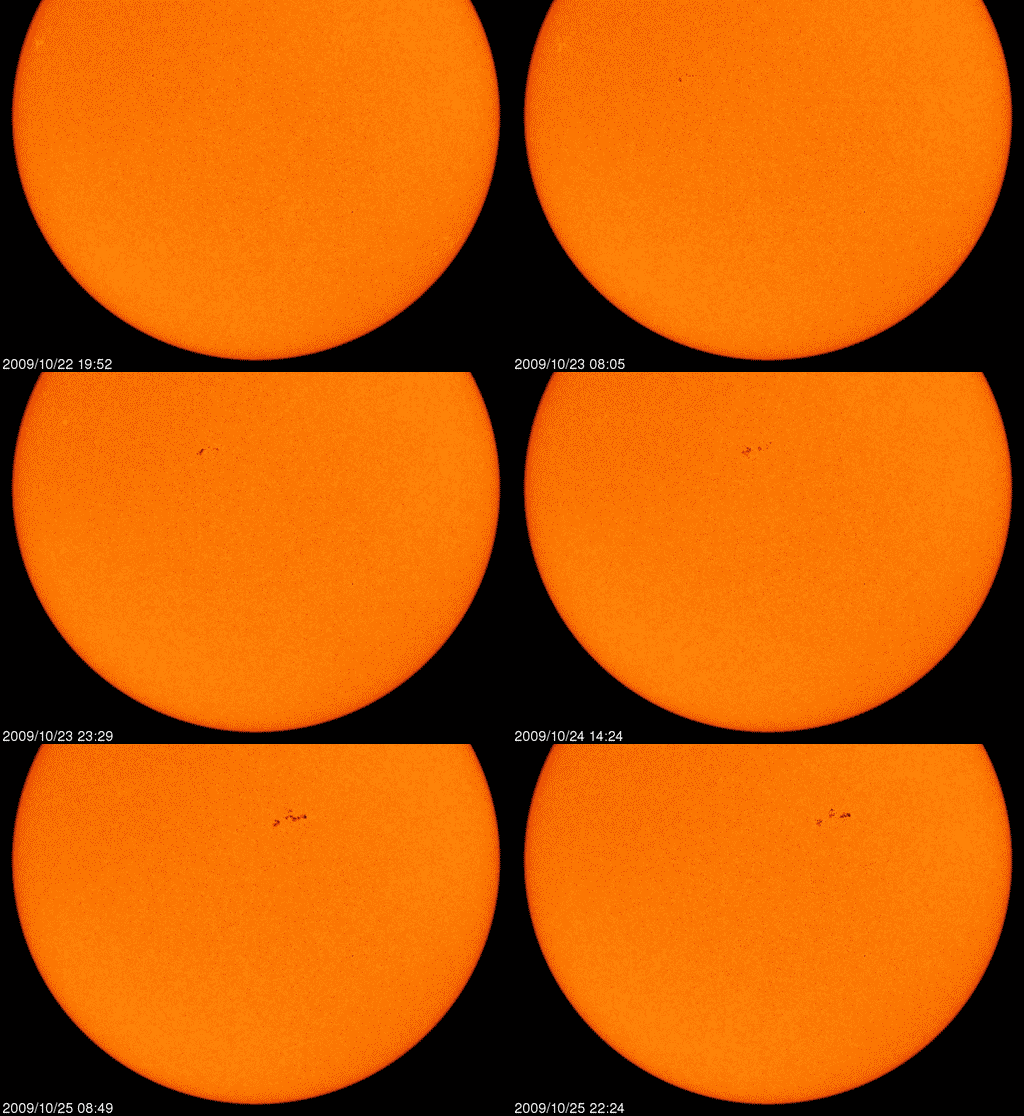
After months of malaise and anemic sunspecks, the sun finally creates a respectable spot.While lower towards the equator than expected, it has been identified as a cycle 24 spot.

From SpaceWeather.com: The sun is showing signs of life. Over the weekend, sunspot 1029 emerged and it is crackling with B- and C-class solar flares. Amateur astronomer Gianluca Valentini of Rimini, Italy, took this picture just hours ago:

“Incredible size and structure for this sunspot after such a long time of mini-events–maybe the sun really means business this time!” says Valentini.
In Ocean Beach, California, Michael Buxton made a movie of the active region: play it. “My girlfriend and I watched the magnetic fibrils around the sunspot as they surged and swirled,” he says. “It was a wonderful area of activity.”
The sunspot’s magnetic polarity identifies it as a member of new Solar Cycle 24. If it continues to grow at this rate, sunspot 1029 could soon become the biggest sunspot of 2009. Readers with solar telescopes are encouraged to monitor developments.
Here’s some solar indices from SWPC

According to solarcycle24.com here are the “records” for cycle24 so far:
SOLAR FLUX – 76 (9/23/2009 – bested today with 81, SWPC confirms)
SUNSPOT # – 32 (9/24/2009)
FLARE – C2.7 (7/5/2009)
DAYS IN A ROW WITH A SUNSPOT – 11 (10/1/2009)
Leif Svalgaard (22:09:23) : Said
p.g.sharrow “PG” (21:55:10) :
the solar system center of gravity will have some tidal effect on our slow boiling pot
No, it will not. As there is no mass at that point. Each planet individually will have a tidal effect. The largest such effect [Jupiter] raises a tidal bulge less than half a millimeter high.
*****
Leif-I assume you are referring to the tidal bulge on the sea?
Sea levels are currently rising at 1mm per year. Is the Jupiter effect always around half a mm or does that vary? What is the total tidal effect of ALL the planets?
Tonyb
Looks like sunspot activity will be back on the upswing and temperatures will be climbing again. Gavin Schmidt predicts that the cooling is over and that 2010 will be warmer.
No. After such neverending cycle like SC23, historical observations say following bunch of cycles will be weak, leading to some kind of solar minima. And even the SC24 will start now, it will peak after several years, not in 2010.
We do not need another Maunder minimum to prove we are right. Drop to climate of 70ties will be more than sufficient, but I foresee at least some kind of Damon minimum (1900-1910).
“Sea levels are currently rising at 1mm per year. Is the Jupiter effect always around half a mm or does that vary? What is the total tidal effect of ALL the planets?”
on the sea? None.
I’d say an aircraft flying over it has more ‘gravity’
“Adam from Kansas (20:04:38) :
There’s also other magnetic areas on the Sun, I guess SC24 had to start up sooner or later.”
But you see that is the problem… plages 1026, 1027, 1028 and 0 designations should all be bursting with sunspots, however spotless plages have dominated, with 1029 the only major spot this October so far. Livingston and Penn Effect in action?
This spot does not exclude the possibility of a grand minimum yet. Take a look at SC 4/5 transition (minimum)
http://www.robertb.darkhorizons.org/DeepSolarMin.htm
At one stage in early 1799 the monthly sunspot number was 20, and in August it dropped to 0. The smoothed curve shows a double minimum occurred. Steady ramp-up only appears from 1800.
“Leif Svalgaard (20:32:16) :
Solar activity is magnetic in nature, and predictions are then really about the magnetic field. The sunspot number is somewhat arbitrary in this regard.”
That may or may not be true, but since the only solar records we have kept that go back 400 years are sunspots it would be useful to keep counting them.
Adding on, it may be that during Maunder/Dalton minima there were many magnetic regions (some even generating flares) which just floated past without spots unnoticed much as 1026, 1027 and 1028 would have been 200 years ago.
Sunspots could be indicative of some aspect of solar activity not yet understood.
Leif Svalgaard (20:48:17) :
Even Anthony’s widget is ‘wrong’ in this respect.
One might be mischievous and ask why it’s on Anthony’s climate widget at all.
Matt (22:59:36) :
What is the most spotted the sun has ever been? Does anyone have a picture of an especially spotted sun?
This one is a SOHO MDI Continuum overlain on a SOHO EIT Color Composite:
http://www.robertb.darkhorizons.org/20031028_CEITspot.jpg
Sunspot image’s prior to SOHO are hard to come by.
Mr. Alex (01:33:56) :
‘Leif Svalgaard (20:32:16) :
Solar activity is magnetic in nature, and predictions are then really about the magnetic field. The sunspot number is somewhat arbitrary in this regard.’
Mr. Alex Reply: “That may or may not be true, but since the only solar records we have kept that go back 400 years are sunspots it would be useful to keep counting them.
Adding on, it may be that during Maunder/Dalton minima there were many magnetic regions (some even generating flares) which just floated past without spots unnoticed much as 1026, 1027 and 1028 would have been 200 years ago.
Sunspots could be indicative of some aspect of solar activity not yet understood.”
I agree, we still have little knowledge on how many solar mechanisms work.
Not surprising I think, as on the time scale of the sun we have not even completed one second of direct observation, so much is yet to be learned. The sun is a messy place with lots of chaotic processes involved, similar to Earth climate but on a larger and more energetic scale.
I’m hoping that with the large array of precision instruments pointing at the sun during this quiet period some more factual evidence of how it works and the connection to climate on the planets.
Hi Leif,
When will the neutron counts start to drop?
Thanks
TonyB (00:59:10) :
Leif Svalgaard (22:09:23) : Said
I’m sure Leif was referring to the tide on the Sun created by Jupiter. One several reasons for setting a high bar for correlation solar activity and planets.
Jupiter’s tidal effects vary due to the eccentricity of Jupiter’s orbit, you can find that readily on the web. Much like how the Sun’s tidal effect on Earth varies with the Earth’s seasons – the solar component of our tides is greater in January during perihelion than in July at aphelion.
I’m lost at your linking Earth sea levels with Jupiter’s tidal attraction on the Sun. While the Earth’s oceans may be growing, the net gravitational field is essentially unchanged. Infalling meteoric and comet debris likely has a bigger impact because increases the Earth’s mass. The effect is computable, it’s not measurable.
The Oulu neutron counter remains at a peak with the current count higher than it was in January.
http://cosmicrays.oulu.fi/
savethesharks (21:30:43) :
> Damn….that is SOME sunspot.
We’ll see. The last decent group didn’t last very long. Back in the good old days a decent group would disappear around one solar limb and reappear a couple weeks later. Hmm, that would be a cute factoid – when did that last happen?
william (18:36:38) :
Apparently the thinking goes like this …
The current El Nino is forecast to get stronger, probably pushing global temperatures even higher next year, scientists say. NASA climate scientist Gavin Schmidt predicts 2010 may break a record, so a cooling trend “will be never talked about again.”
Although one site is saying that means breaking 2005 not 1999. Hard to pin down what’s actually been said.
1029 is the ultimate spot so far during SC24, measuring 462 pixels compared with 313 during 1024. But this is to be expected as we are on the ramp up to some sort of maximum. The Oct mean SSN will come in between 5-10 which is still very low. The L&P reading for 1029 could be very interesting, I believe it will be the end of their theory.
savethesharks (22:14:28) :
You could have answered it simply as it was asked….sans all your invective and commentary
And why is it wrong of me to comment?
Eric (skeptic) (03:09:58) :
When will the neutron counts start to drop?
It takes about a year for the solar wind to reach the termination shock, so cosmic rays lag solar activity by about that amount. Since activity in SC24 has been slow to pick up, the decline in cosmic rays will be slow too. Had SC24 picked up more strongly, the lag would have been less than a year as stuff on its way out would have helped screen away the rays, but with the very slow start, there is not much to keep the rays at bay and the lag might well be larger. The past six months, the cosmic ray intensity has been pretty much constant which might be an indication that we are at the ‘cosmic ray’ maximum.
Mr. Alex (01:33:56) :
That may or may not be true, but since the only solar records we have kept that go back 400 years are sunspots it would be useful to keep counting them.
And we are. We do have other proxies of solar activity [going back 12,000 years] namely the signs of cosmic rays in tree rings and ice cores.
Interesting of course, but if you’ve listened to Leif Svalgaard, more sunspot activity doesn’t significantly affect temps. For now, he’s convinced me of this, which isn’t easy to do. Too bad, ’cause I don’t look forward to a brutal winter.
It seems to me that sunspot 1029 is like a “rerun” of either 1027 or 1028 as the sun rotates. Is there any information correlating magnetically active regions (the same sunspot area) as the sun rotates?
Adding on to Gary P’s comment, to my eye the Oulu neutron count has been at record levels (since 1964) for nearly 3 years.
http://cosmicrays.oulu.fi/webform/query.cgi?startdate=1964/01/26&starttime=00:00&enddate=2009/10/27&endtime=23:00&resolution=Automatic%20choice&picture=on
Here’s what the Russians predicted a year ago:
Habibullo Abdussamatov, Dr. Sc.
Head of Space research laboratory of the Pulkovo Observatory,
Head of the Russian/Ukrainian joint project Astrometria
(translated from Russian by Lucy Hancock)
For their paper and graphics (recommended) See:
http://www.gao.spb.ru/english/astrometr/abduss_nkj_2009.pdf
Prediction of variations in solar cycles 24 to 27
The changing gradient of the bicentennial component of variation in the TSI observed over three consecutive “short” cycles (Fig. 1) delineates further dynamics in the value of the TSI and the level of solar activity, not only of these cycles but also subsequent cycles although with somewhat smaller accuracy. From this consideration, the most probable maximum in the next, the 24th, solar cycle, will be at sunspot number 65 ± 15. But in the subsequent cycles 25-26, falling in the present bicentennial cycle’s phase of active decrease, the trend toward reduction in the absolute value of the TSI will persist, together with decrease in the level of corresponding maxima in solar activity to 45 ± 20 and sunspot number to 30 ± 20 (Fig. 3, 5). Therefore we would expect the onset of the phase of deep minimum in the present 200-year cycle of cyclic activity of the Sun to occur at the beginning of solar cycle 27; i.e., tentatively in the year 2042 plus or minus 11 years, and potentially lasting 45-65 years.
“Well we are on track to have more spotless days in 2009 than we had in 2008”
Yeah, I’ll buy this is ‘the ramp’. Headed for Rmax no earlier that Jan. 2014, perhaps as late as 2016, we’re in for more spotless stretches.
Bateman how’re your faculae doing?
David Schnarae (08:43:15) :
Excerpt from the paper you provided:
Experts of the United Nations in regular reports publish data said to show that the Earth is approaching a catastrophic global warming, caused by increasing emissions of carbon dioxide to the atmosphere. However, observations of the Sun show that as for the increase in temperature, carbon dioxide is “not guilty” and as for what lies ahead in the upcoming decades, it is not catastrophic warming, but a global, and very prolonged, temperature drop.
Khabibulo Abdusamatov
mddwave (07:36:34) :
It seems to me that sunspot 1029 is like a “rerun” of either 1027 or 1028 as the sun rotates. Is there any information correlating magnetically active regions (the same sunspot area) as the sun rotates?
Yes, it has been known for more of a century that new spots often occur in the same area where spots were earlier. Try to google ‘active longitudes’.
Don B (08:07:41) :
Adding on to Gary P’s comment, to my eye the Oulu neutron count has been at record levels (since 1964) for nearly 3 years.
Basing everything on a single station is not sound. The cosmic ray record begins in 1952 and the current values are just at the the ‘normal’ values for odd-even transitions. Here is Thule:
http://www.leif.org/research/thule-cosmic-rays.png and Moscow:
http://www.leif.org/research/Moscow-1958-now.png
and Hermanus (and other South African stations)
http://www.puk.ac.za/fakulteite/natuur/nm_data/data/nmd_e.html
There is no ‘record’ setting this minimum. Just business as usual.
David Schnarae (08:43:15) :
Here’s what the Russians predicted a year ago:
This has been in the wind for many years:
Solar Activity Heading for a Maunder Minimum?
Schatten, K. H.; Tobiska, W. K.
American Astronomical Society, SPD meeting #34, #06.03; Bulletin of the American Astronomical Society, Vol. 35, p.817, 05/2003
Abstract
Long-range (few years to decades) solar activity prediction techniques vary greatly in their methods. They range from examining planetary orbits, to spectral analyses (e.g. Fourier, wavelet and spectral analyses), to artificial intelligence methods, to simply using general statistical techniques. Rather than concentrate on statistical/mathematical/numerical methods, we discuss a class of methods which appears to have a “physical basis.” Not only does it have a physical basis, but this basis is rooted in both “basic” physics (dynamo theory), but also solar physics (Babcock dynamo theory). The class we discuss is referred to as “precursor methods,” originally developed by Ohl, Brown and Williams and others, using geomagnetic observations.
My colleagues [LS: I’m one] and I have developed some understanding for how these methods work and have expanded the prediction methods using “solar dynamo precursor” methods, notably a “SODA” index (SOlar Dynamo Amplitude). These methods are now based upon an understanding of the Sun’s dynamo processes- to explain a connection between how the Sun’s fields are generated and how the Sun broadcasts its future activity levels to Earth. This has led to better monitoring of the Sun’s dynamo fields and is leading to more accurate prediction techniques. Related to the Sun’s polar and toroidal magnetic fields, we explain how these methods work, past predictions, the current cycle, and predictions of future of solar activity levels for the next few solar cycles.
The surprising result of these long-range predictions is a rapid decline in solar activity, starting with cycle #24. If this trend continues, we may see the Sun heading towards a “Maunder” type of solar activity minimum – an extensive period of reduced levels of solar activity. For the solar physicists, who enjoy studying solar activity, we hope this isn’t so, but for NASA, which must place and maintain satellites in low earth orbit (LEO), it may help with reboost problems. Space debris, and other aspects of objects in LEO will also be affected.
This research is supported by the NSF and NASA.
“Leif Svalgaard (06:45:14) :
Mr. Alex (01:33:56) :
That may or may not be true, but since the only solar records we have kept that go back 400 years are sunspots it would be useful to keep counting them.
And we are. We do have other proxies of solar activity [going back 12,000 years] namely the signs of cosmic rays in tree rings and ice cores.”
These are useful (indeed with the current knowledge more useful than spots), however here I refer to solar data obtained via confirmed direct measurement and observation – real time. Adding to that it would prove useful to tackle issues of bias with regards to sunspot counting.
“Geoff Sharp (05:45:00) :
1029 is the ultimate spot so far during SC24, measuring 462 pixels compared with 313 during 1024. But this is to be expected as we are on the ramp up to some sort of maximum. The Oct mean SSN will come in between 5-10 which is still very low. The L&P reading for 1029 could be very interesting, I believe it will be the end of their theory.”
What about L&P measurements for the two minute ‘failspots’ seen in October? (1028 and 0 designation)… not to mention numerous blank plages which currently seem to be following the effect?
An observation which may be irrelevant (or not): referring to the L&P plot notice how data points are not clustered tightly around the curve, for example in 2005/2006 readings lie between 1500 and over 3000 Gauss. There is much spread. Surely the same could be said about the current situation? 1026 is currently “invisible” whilst 1029 could be 3000 Gauss?
It would probably take many more 1029-type spots outnumbering large spotless regions to invalidate the theory.
One benefit of a cooling period would be the natural control of pests and parasites. Eg, aphids, fleas, and slugs survive in fewer numbers when we have a colder winter up here in the NW.
I don’t think people realize how dangerous it is to allow the government to move agriculture toward all organic farming, because many blights on food production can reproduce many times over in one growing season. n becomes n squared that fast.
There is one city that won’t even use powerful chemicals on Japanese beetles which have infested a few street trees. This pest could wipe out many forests in our country.
The cooler earth will counteract the organic madness.
Spot measurements today are:
452 x 10E6 whole spot and 45 x 10E6 umbra.
Umbra is unchanged while the Penumbra has grown.