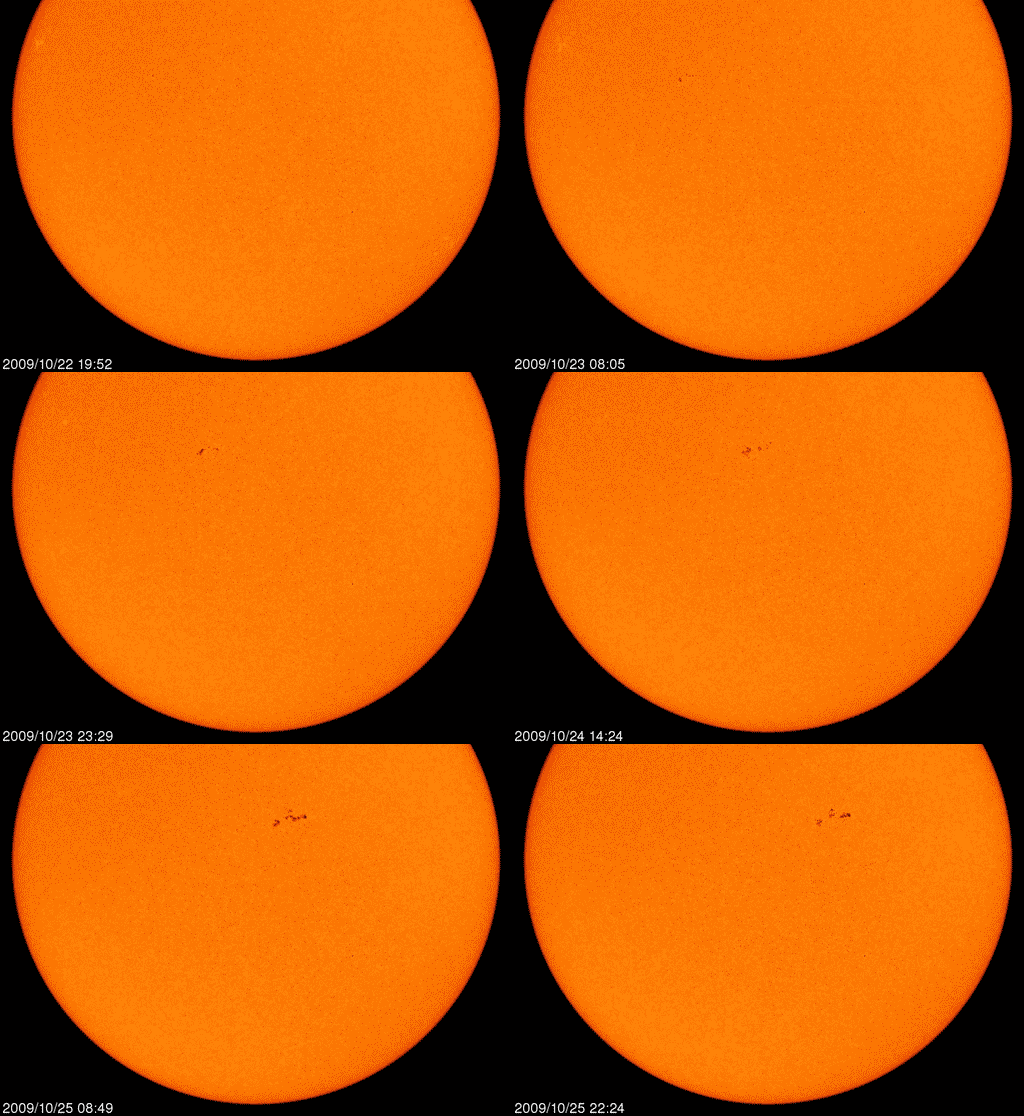
After months of malaise and anemic sunspecks, the sun finally creates a respectable spot.While lower towards the equator than expected, it has been identified as a cycle 24 spot.

From SpaceWeather.com: The sun is showing signs of life. Over the weekend, sunspot 1029 emerged and it is crackling with B- and C-class solar flares. Amateur astronomer Gianluca Valentini of Rimini, Italy, took this picture just hours ago:

“Incredible size and structure for this sunspot after such a long time of mini-events–maybe the sun really means business this time!” says Valentini.
In Ocean Beach, California, Michael Buxton made a movie of the active region: play it. “My girlfriend and I watched the magnetic fibrils around the sunspot as they surged and swirled,” he says. “It was a wonderful area of activity.”
The sunspot’s magnetic polarity identifies it as a member of new Solar Cycle 24. If it continues to grow at this rate, sunspot 1029 could soon become the biggest sunspot of 2009. Readers with solar telescopes are encouraged to monitor developments.
Here’s some solar indices from SWPC

According to solarcycle24.com here are the “records” for cycle24 so far:
SOLAR FLUX – 76 (9/23/2009 – bested today with 81, SWPC confirms)
SUNSPOT # – 32 (9/24/2009)
FLARE – C2.7 (7/5/2009)
DAYS IN A ROW WITH A SUNSPOT – 11 (10/1/2009)
And now for the heretical stuff … all based on nothing!
Venus and Mercury conjunction around the 19th, both now straddling Saturn’s line knocking the sun off balance for a short while. You can see Mercury going right to left on LASCO3. Might be a puff or two up to the 2rd or 3rd when Venus crosses Saturn on one side with Uranus opposite. Mercury is roughly opposing Earth at the same time. Will be interesting to see what (if anything) happens. Expect it’ll pretty much go back to sleep again then till 3rd week in March. 1st week of Jan might see a decent spot or two perhaps.
MC (19:34:47) :
Next, this group is located much closer to the equator of the sun which indicates a mature period of cycle 24
As you can see from the butterfly diagram, the ‘wings’ have a large spread. There is nothing sensational about a 15 degree latitude even early in the cycle:
http://solarscience.msfc.nasa.gov/images/bfly.gif
This brings into question the validity of predictions by Leif of a max cycle sunspot peak of 75 give or take and warrants a closer look at predictions made of a max cycle sunspot number of 45 by Archibald and others.
Solar activity is magnetic in nature, and predictions are then really about the magnetic field. The sunspot number is somewhat arbitrary in this regard. For the years 1947-1990, there was a reasonable correlation between the magnetic field and the sunspot number. There is no a priory that the correlation must hold at all times. There are, in fact, some indications that it does not. E.g. the Maunder minimum, the recent discrepancy between the F10.7 flux and the sunspot number, and the Livingston & Penn measurements. A better measure might be the F10.7 flux, where SSN=75 corresponds to a flux of 120 sfu. If L&P are correct, we could have SSN=0, but F10.7 = 120 sfu, Another measure would be the number of magnetic active regions [that typically each consist of many spots]. The usual conversion factor is about 12, so that a SSN of, say, 72 corresponds to a number of regions of 72/12=6.
You will see in the coming years how some people will try to turn these considerations into support for just about any prediction.
Well we are on track to have more spotless days in 2009 than we had in 2008
Aligner (20:28:34) :
And now for the heretical stuff
that is not heretical, but just nonsense.
Leif Svalgaard (20:08:44) :
Hey….you said “beware the solar flux value”….so that’s why I asked the question.
Chris
Norfolk, VA, USA
Leif Svalgaard (19:32:33) : Eddie Murphy (18:50:17) :the peak of SS24 should be 2010, and the nearest J/S opposition will be 2011.
This seems already to be off the mark.
I pray so… but a dink cycle could do it.
savethesharks (20:39:08) :
Hey….you said “beware the solar flux value”….so that’s why I asked the question
I had already seen the confusion. Even Anthony’s widget is ‘wrong’ in this respect. And I have lost count of how many times I have clarified this point and, yes, railed against the misuse or conflation.
How long was the period between this real spot and the last real spot? Some months as I remember, with just the occasional Tiny Tim. It’s always possible that we will have another some months until the next real spot. What will Gavin Schmidt have to say then, now that he has spilled the beans with his back door acknowledgement of global cooling?
Mr Aligner said (20:28:34) :
“And now for the heretical stuff … all based on nothing!
Venus and Mercury conjunction around the 19th, both now straddling Saturn’s line knocking the sun off balance for a short while. You can see Mercury going right to left on LASCO3. Might be a puff or two up to the 2rd or 3rd when Venus crosses Saturn on one side with Uranus opposite. Mercury is roughly opposing Earth at the same time. Will be interesting to see what (if anything) happens. Expect it’ll pretty much go back to sleep again then till 3rd week in March. 1st week of Jan might see a decent spot or two perhaps.”
Is this the dawning of the age of Aquarius?
That’s a hairy thought.
Leif Svalgaard (20:48:17) :
And I have lost count of how many times I have clarified this point and, yes, railed against the misuse or conflation….
HUH?? Railed against the wha??
You take yourself WAY too seriously Leif. I ask a simple \question.
Leave it to you to turn one question into a silly drama of “who-said” “what-said”.
Sorry I ever blankety-blanked asked.
Do me a favor: If you don’t like the question….then don’t respond.
Geez.
Anyways…..back to the topic at hand.
Damn….that is SOME sunspot.
Chris
Norfolk, VA, USA
william (18:36:38) :
Gavin Schmidt isn’t very good at forecasting the future although he has a good record of hindcasting the past.
savethesharks (21:30:43) :
I ask a simple question.
And I give a simple answer.
I would not totally dismiss “Aligner”. the solar system center of gravity will have some tidal effect on our slow boiling pot, the sun. The more stirring, the greater the turbulence in the metal hydrogen layers, the stronger the magnetic fields, and on and on.
p.g.sharrow “PG” (21:55:10) :
the solar system center of gravity will have some tidal effect on our slow boiling pot
No, it will not. As there is no mass at that point. Each planet individually will have a tidal effect. The largest such effect [Jupiter] raises a tidal bulge less than half a millimeter high.
Leif Svalgaard (21:51:45) :
No. You give a loaded answer.
You could have answered it simply as it was asked….sans all your invective and commentariy
MC (19:34:47) You wrote: “those who were correct in their prediction can then claim the high ground for their prediction of climate effects in the future.”
This seems to be a stretch. Do solar experts claim to be “climate effects” futurists?
When lost in the wilderness, a small cabin in a clearing must look like the Emerald City to the weary. The spot of today is in the same category as that of early July (5th to 9th). It could grow ever larger, but what comes next must wait for tomorrow.
As someone said to me recently, a big spot can come along, and expectations may go hog wild. Put it in context.
Leif Svalgaard (20:48:17) : “…I have lost count of how many times I have clarified this point and, yes, railed against the misuse or conflation.”
Based on my recollection, you’re up to 6 times at the very minimum in the past 12 months, Leif. Probably averaging over once a month, including SC24 threads.
What is the most spotted the sun has ever been? Does anyone have a picture of an especially spotted sun?
I would not want the world to be cold, I would want the world to be warm with verdant fields, bountiful crops and plentiful harvests.
This is how I would want the world to be.
But I do fear that Man caused disaster and Human suffering could be far worse than any mild cooling could bring.
Such is the prospect of Man’s desire to control other men.
This desire is strong and seemingly inborn in the make-up of Man.
Just so, a little cooling now, and the dissipation of the fever that drives men toward fantasies shimmering like mirages on a hot summer day.
A little cooling now will serve to relieve us from the prospects of misguided ventures in misbegotten actions that once done are hard to undo.
A little cooling now…like cool summer breeze…
“Matt (22:59:36) : What is the most spotted the sun has ever been? ”
My favorite is that on 28 September 2001, namely 1.5 year after Cycle 23 peak (March 2000 IIRC). I remember getting it from SOHO page, but unfortunately the details of how. You may visit there and get one.
Adolfo Giurfa (18:22:25) :
“Question to those who know about these matters: If this spot is so near to the equator does it mean that solar cycle 24 is near its end?”
Don’t forget that, on a SOHO image, the solar equator doesn’t coincide exactly with the horizontal line passing through the center of the solar disk.
Around October 26, the center of that disk correspond to a heliographic latitude of +5 degrees. (‘Heliographic’ is to the Sun what ‘geographic’ is to the Earth). Consequently, on the recent SOHO images the solar equator is passing slightly BELOW the center of the image, and the heliographic latitude of the sunspot is slightly greater (northward) than what might be estimated at first sight.
Well, those jolly clever chaps & chapesses @ur momisugly NASA did predict, with the aid of their fancy computer model that was believed to be perfection itself, that Cycle 24 would be fast & furious, so here it is!
Adolfo Giurfa (18:22:25) : You could be right, perhaps we’re are seeing a peaking cycle, we seem to only have a couple of years to go for that!
I have a very basic question, but I really couldn’t find the answer:
There’s this graph with the suncycles, on the x-axis is the year and on the y-axis there is a number, from zero to appr. 150 in the maximum of the cycle.
Is this number: The number of sunspots? The Wolf number? And most important: The number per week? Per month? per??
Matt (22:59:36)
Try this NASA page.