As we’ve seen in this report from John Goetz, GISS: worlds airports continue to run warmer than ROW a significant portion of the GHCN (Global Historical Climate Network) surface temperature record is measured in airports, not rural open fields. Airports, airport expansion, and air travel frequency tend to be linked with the population, growth, and wealth trends of a city. It stands to reason that since the majority of thermometers in the GHCN record are at airports, they’d have a broad application of UHI. Joe tries out a simple method of approximating what the signal might look like with a UHI removal. – Anthony
Chasing a More Accurate Global Century Scale Temperature Trend
By Joseph D’Aleo, CCM, AMS Fellow

Hadley Center Annual Mean Temperature since 1895 shows a warming of about 1C since 1895. – Click for larger image
The long term global temperature trends have been shown by numerous peer review papers to be exaggerated by 30%, 50% and in some cases much more by issues such as urbanization, land use changes, bad siting, bad instrumentation, and ocean measurement techniques that changed over time. NOAA made matters worse by removing the satellite ocean temperature measurement which provide more complete coverage and was not subject to the local issues except near the coastlines and islands. The result has been the absurd and bogus claims by NOAA and the alarmists that we are in the warmest decade in 100 or even a 1000 years or more and our oceans are warmest ever. See this earlier story that summarizes the issues.
No one disputes the cyclical warming from 1979 to 1998 that is shown in all the data sets including the satellite, only the cause. These 60-70 year cycles tie in lock step with the ocean temperature cycles and solar Total Solar Irradiance. The annual mean USHCN temperatures are shown below along with the annual TSI and PDO+AMO.
 Click for larger image
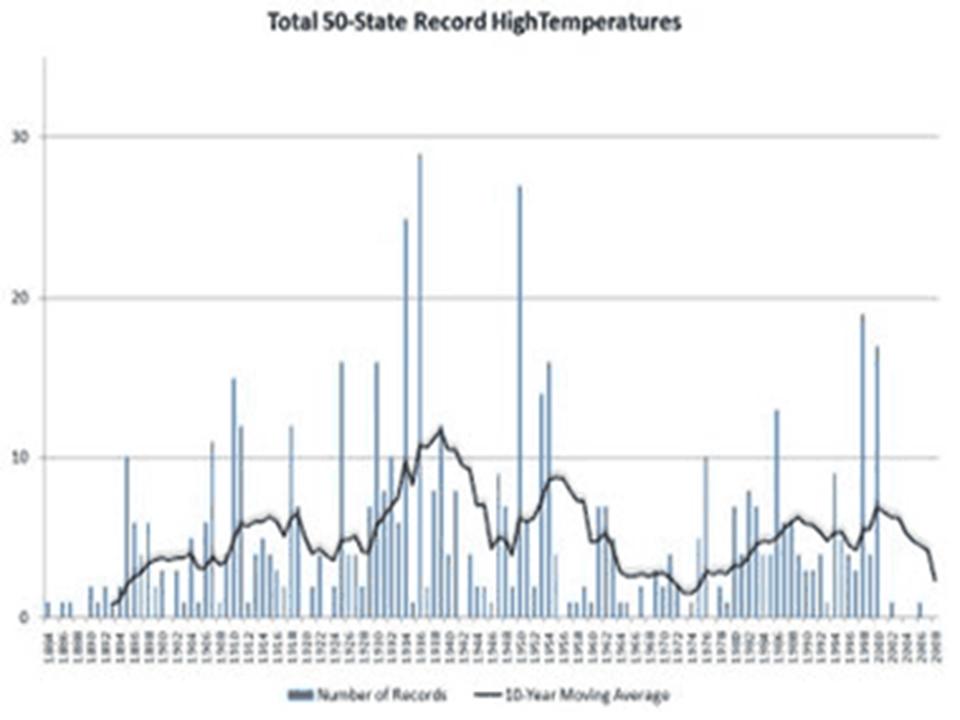
One needs simply to look at the record highs for the United States and globe to see that the warmest years are not all in the last two decades (although some were to be expected given it is one of two peaks in the cycles). The first image below shows the decadal state record all-time highs. The 1930s still clearly dominates (24 state all time records) with only one state (South Dakota) in the 2000s tying a 1930s all-time heat record.
 Click for a larger image
The following image (enlarged here) shows the record monthly highs by individual year. Note the 1930s and 1950s dominate and this decade showing the least record highs than any decade since the 1800s.

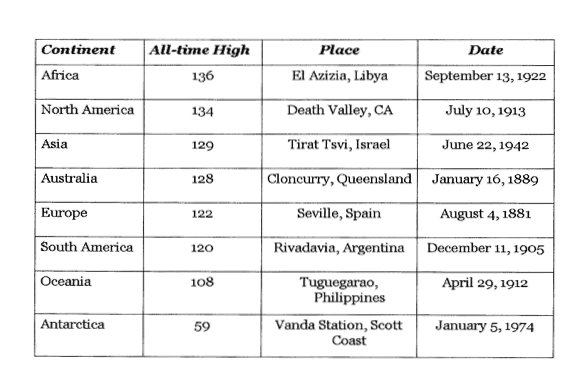
Here is the NCDC compilation of the continental all-time records (enlarged here), note for all the populated continents, the records were in the 1800s and early 1900s.

TRYING TO GET AT A BETTER LONG TERM TREND
NCDC removed the UHI effect for the US in 2007 in version 2 of the USHCN. GISS maintains their version of a UHI adjustment of this NCDC USHCN data. By differencing the two, I found the following (enlarged here):
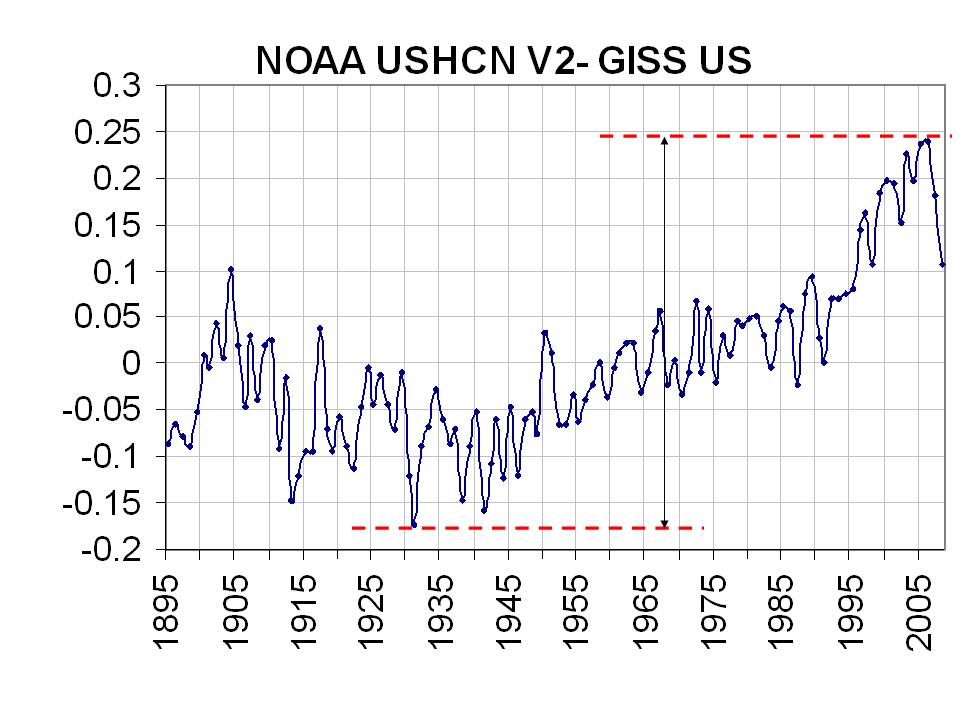
 NOAA USHCNV2 -vs- GISS – click for larger image
It shows an artificial warming of about 0.45 C or 0.75F for the NOAA data for removal of the urbanization adjustment. Phil Jones of the Hadley Center, co-authored a paper that showed the UHI contamination of China was 1 degree Celsius (1.8F) for the century, so this contamination appears not to be unreasonable, in fact it may be conservative.
I then took that UHI adjustment for the United States and applied to the global data. The Hadley center data is dominated by land areas with their ocean temperatures mainly coming from ships and in the northern hemisphere. Here’s what Hadley says about marine data “For marine regions sea surface temperature (SST) measurements taken on board merchant and some naval vessels are used. As the majority come from the voluntary observing fleet, coverage is reduced away from the main shipping lanes and is minimal over the Southern Oceans.”
I subtracted the UHI annual contamination from the annual Hadley CRUT3v global temperatures. I got the following (enlarged here):
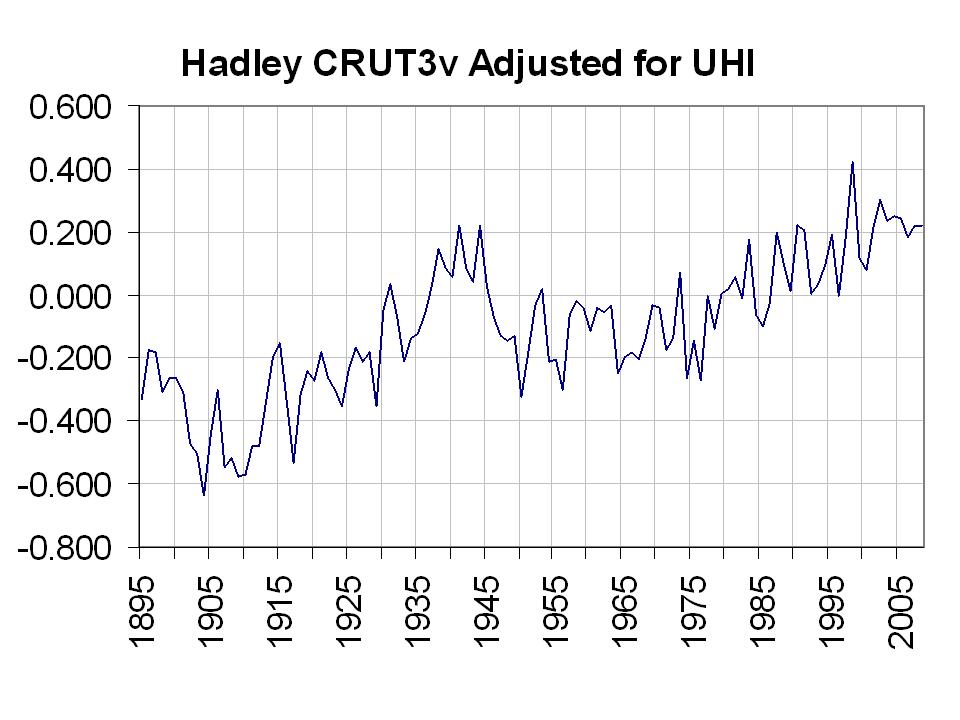

This gives a much more believable view of global temperatures, consistent with the natural forcings and more in line with records shown. The greatest warming was in the early 20th Century. The warming since 1930s and 1940s was negligible (0.2C). It suggests much to do about nothing in DC and Copenhagen. See PDF here.
UPDATE: This post has been changed to include a raw Hadley CRUT3v global plot, a NOAA-GISS difference plot and a corrected adjusted Hadley plot now all in Celsius. This is a work in progress and an attempt to see what Hadley plot might look like with an adjustment for UHI that numerous peer review papers suggest is necessary. Your suggestions are welcome (jsdaleo at yahoo.com).
Finally somebody dared to do this.
My observation is, if you combine HadCRUT till 1978 with MSUAH since 1978, it fits excellently with HadSST dataset. Usual explanation of difference between trends in SST and land stations was the ocean eats the warming while land has not, but UHI is much better explanation – satellite data show no significant differences in tropospheric temperatures above oceans or land. So, SST are also a good global temperature proxy. One thing still remains – removing the sharp step down in SST in 1945 caused by improper taking on sampling techniques.
Joseph D’Aleo (17:19:16) :
said, “… This is from the latest UAH Monthly summary
Sept. 8, 2009
Vol. 19, No. 4
Global Temperature Report: September 2009
Global climate trend since Nov. 16, 1978: +0.13 C per decade
——————————————
That is 0.26 in the 20 year 1978-1998 period.”
Earlier you stated, “Hadley, NASA GISS and NOAA GHCN v2 graphic plots all show 0.4 to 0.5C warming for the two decades which is double the satellite”
So, you are comparing that 0.26C obtained from the linear trend for UAH with the beginning and end points of the 1979-1998 graphs of HADCRUT3 and GISSTEMP.
You also say, “I don’t know what planet you are referring to”, so I’ll tell you. It’s a planet called Earth, which grows things called apples and oranges, which anyone with the remotest competence and honesty knows should not be compared.
You have used the linear trend for the UAH (that +0.13 C per decade). Good. So let us use the linear trend for the other series also. I previously gave the linear trends from 1979 to 1988 inclusive, since that was the period to which you referred.
Here they are again:
Jan 1979 to Dec 1998 global mean linear trend:
HADCRUT3 +0.0153C/year
GISTEMP +0.0143C/year
UAH +0.0113C/year
RSS +0.0154C/year
But if you want to use the linear trend from Dec 1978 to the present for the same four series, then here they are:
HADCRUT3 +0.0158C/year
GISTEMP +0.0159C/year
UAH +0.0124C/year
RSS +0.0153C/year
(see: http://www.woodfortrees.org/plot/hadcrut3gl/from:1978.92/trend/plot/gistemp/from:1978.92/trend/plot/uah/from:1978.92/trend/plot/rss/from:1978.92/trend ).
Neither time spans support your claim. It is false.
Incidentally, Joseph D’Aleo’s original article stated, “No one disputes the cyclical warming from 1979 to 1998” which implies the frequent false meme that “global warming stopped in 1998”.
If that were the case why is it that the linear trends are generally higher from c. 1979 to the present than to 1998? (including UAH, but not RSS which is almost the same). (see my previous post for the data).
If the linear trend from 1979 to the present is greater than the linear trend to 1998, even for UAH, who will stand up and say, “global warming stopped in 1998”?
Scott A. Mandia (20:12:49) : It’s called landuse change. I tell you what, why don’t you ask Roger himself your questions and point him to those papers. I could be wrong but I would bet you that he has seen them and is not terribly impressed.
But for you, some reading:
http://wattsupwiththat.files.wordpress.com/2009/07/2009_christynm_eafrica.pdf
http://ams.allenpress.com/perlserv/?request=get-abstract&doi=10.1175%2FJCLI3627.1
Christy, J.R., 2002: When was the hottest summer? A State Climatologist struggles for an answer. Bull. Amer. Met. Soc. 83, 723-734.
The conclusion of all of these studies is that in all three locations the Minimum trends are unrepresentative of the true temperature trends due to land use changes, the selection of stations to include in the records introduces a warm bias, and that the official data sets are significantly erroneous.
Slioch (01:47:07) : You seem to be adept at calculating trends (although you apparently aren’t capable of understanding the statistical oddity you’ve just described which is just that, an oddity) so I’ll tell you what, why don’t you calculate the trend in the last 144 months (twelve years!) and tell us what the values are? And tell us, then, how a negative trend can equal continued warming.
Adam is just being dense when he says “I don’t care what you think they are supposed to be” it’s not what I think it’s the climate models, and the data itself. Trends aloft should be greater than at the surface.
I grow weary of having to repeat this again and again, but what you and now Shore are doing is totally inappropriate. This is the correct comparison:
http://www.woodfortrees.org/plot/hadcrut3gl/from:1979/offset:-.15/mean:12/scale:1.2/plot/uah/mean:12/plot/hadcrut3gl/from:1979/offset:-.15/mean:12/scale:1.2/trend/plot/uah/mean:12/trend
You are all growing increasingly tedious.
@ur momisugly Andrew (06:44:03) :
Thanks for the links. I agree that land use does affect local temperatures and the links you provide show how land use does in fact affect T and Tmin at those single sites.
However, if land use change were significant at a large percentage of sites, then the data presented in the links I provided would likely not have yielded the results they did. If so, that would imply an urbanization trend that is the same as the land use trend. Seems like quite a coincidence.
Are you aware of any studies that measure temperature trends in areas that are rural and have exhibited no land use change? That would be instructive.
Scott A. Mandia (07:55:15) : The problem is that most weather stations are located where people live, so that they are around for continual observation. So I’m not sure if what you are suggesting is even possible.
Andrew (06:44:03) :
Adam is just being dense when he says “I don’t care what you think they are supposed to be” it’s not what I think it’s the climate models, and the data itself. Trends aloft should be greater than at the surface.
I grow weary of having to repeat this again and again, but what you and now Shore are doing is totally inappropriate. This is the correct comparison:
http://www.woodfortrees.org/plot/hadcrut3gl/from:1979/offset:-.15/mean:12/scale:1.2/plot/uah/mean:12/plot/hadcrut3gl/from:1979/offset:-.15/mean:12/scale:1.2/trend/plot/uah/mean:12/trend
Why is it? Adam is right. The trends are what they are. If you want to argue that the the data doesn’t agree with the models – then fine – but that’s a totally separate issue.
Andrew says:
It is not clear to me how resilient that expected 1.2 amplification factor is. And, of course, there are some reasonably substantial errorbars on the trends, especially for the satellite data. Furthermore, I am not sure why you have chosen to plot just the UAH satellite analysis and not RSS also. In fact, I think there are now 4 different analyses for temperatures on the global scale (the third and fourth being from U of Md and U of Washington if I remember correctly) and I believe it is UAH which has the lowest trend.
John Finn (12:15:56) : Except that if you go over to RC, they will tell you-beat it into your head in fact-that warming simply could not occur without being amplified aloft, whatever the cause:
http://www.realclimate.org/index.php/archives/2007/12/tropical-troposphere-trends/
And not only is the 1.2 ratio what is generally found in models, it is also found in the residuals of the detrended observations ~the same:
http://www.climateaudit.org/phpBB3/viewtopic.php?f=3&t=740
Because it isn’t (ACCORDING TO RC) something the models have wrong which causes this, it’s the nature of the way the system is supposed to behave.
Joel Shore (13:34:16) : Ditto, and RSS is not shown, UMD is not shown, UW is not shown, because those analyses are erroneous (the latter two almost certainly so, but the case against RSS is pretty good to.).
Christy, J. R., and W. B. Norris (2006), Satellite and VIZ-radiosonde intercomparisons for diagnosis of non-climatic influences, J. Atmos. Oceanic Tech., 23, 1181-1194.
Christy, J. R. and W. B. Norris (2009), Discontinuity issues with radiosonde and satellite temperatures in the Australian region: 1979-2006, J. Atmos. Oc. Tech., 25, doi: 10.1175/2008JTECHA1126.1.
Christy, J. R., W. B. Norris, R. W. Spencer, and J. J. Hnilo (2007), Tropospheric temperature change since 1979 from tropical radiosonde and satellite measurements, J. Geophys. Res., 112, D06102. doi: 10.1029/2005JD006881.
Randall, R. M., and B. M. Herman (2008), Using limited time period trends as a means to determine attribution of discrepancies in microwave sounding unit-derived tropospheric temperature time series, J. Geophys. Res., 113, D05105, doi:10.1029/2007JD008864.
But even if you compare surface temperatures to RSS it is still clear that the surface measures have a warm bias:
http://www.woodfortrees.org/plot/hadcrut3gl/from:1979/offset:-.15/mean:12/scale:1.2/plot/uah/mean:12/plot/hadcrut3gl/from:1979/offset:-.15/mean:12/scale:1.2/trend/plot/uah/mean:12/trend/plot/rss/mean:12/plot/rss/mean:12/trend
Again, the evidence that the surface data has a warm bias is extensive. And yet the resistance…the ghost of Kuhn is slowly nodding his head saying “Yup”.
Andrew,
UAH lists their errorbars as +/- 0.05 C/decade (see http://vortex.nsstc.uah.edu/data/msu/t2lt/readme.18Jul2009 , under “Update 7 Aug 2005 *”), at least as of 2003. I don’t know what RSS and HADCRUT list their errorbars as. But, I just wonder if you are taking the data beyond where it can be trusted.
And, by the way, despite John Christy’s papers (and one paper that appears to be written by some independent folks), I don’t think the final word has yet been written on which satellite analysis trends are the most accurate.
Andrew (16:04:13) :
John Finn (12:15:56) : Except that if you go over to RC, they will tell you-beat it into your head in fact-that warming simply could not occur without being amplified aloft, whatever the cause .
I’m not here to defend RC, but my interpretation of their article is that they do expect amlification to occur. They do not say that is happening. In any case you appear to be saying there are 2 wrongs here, i.e. temperature discrepancy and tropospheric hot spot. If the ‘hot spot’ theory is wrong – then there is no discrepancy and vice versa.
Incidentally most of the disagreement between UAH and the others appears to originate in the pre-1992 period. Roy Spencer has commented on the RSS/UAH disagreement on his blog. The trends for all 4 records since ~1992 are remarkably similar. Here’s Joel’s plot using 1992 as a start point (and a slightly different offset)
http://www.woodfortrees.org/plot/gistemp/from:1992/to:2009/trend/offset:-0.28/plot/gistemp/from:1992/to:2009/offset:-0.28/plot/rss/from:1992/to:2009/trend/offset:-0.05/plot/rss/from:1992/to:2009/offset:-0.05/plot/uah/from:1992/to:2009/trend/plot/uah/from:1992
The very slightly higher warming trend in the GISS record is probably due to their arctic extrapolation. The arctic has been warmer over the past few years.
Joel Shore (18:14:39) : eh, whatever.
John Finn (02:48:58) : That trend line is 1. starting right in the middle of Pinatubo, and the amplification factor for volcanoes appears to be even greater than 1.2 (see the plot I showed above) and 2. Right around the time of RSS’s step change from the transition between NOAA 12 and 11 and 10.
timetochooseagain (16:16:07) : The main issue as far as I can see is that Joe has applied an “UHI correction” to the entire globe, including the oceans.
This is not significantly different from what GIStemp does. It UHI adjusts the data (badly, IMHO) and then uses these UHI data to fabricate “boxes and grids” of temperatures over the ocean up to 1200 km from the source thermometer.
That means, for example, that the Military Base at Diego Garcia warms an area the size of 1/2 the United States, and it is almost 100% ocean.
So goose, meet gander.
timetochooseagain (16:16:07) : The main issue as far as I can see is that Joe has applied an “UHI correction” to the entire globe, including the oceans.
This is not significantly different from what GIStemp does. It UHI adjusts the data (badly, IMHO) and then uses these UHI data to fabricate “boxes and grids” of temperatures over the ocean up to 1200 km from the source thermometer.
That means, for example, that the Military Base at Diego Garcia warms an area the size of 1/2 the United States, and it is almost 100% ocean.
So goose, meet gander.
Joel Shore (17:59:07) :
Layne Blanchard says:
“Your point begs the question- Since continental land masses are a small portion of the surface, for periods preceding the satellite record, and periods following it where the satellite record is not exclusively used, are not those land mass records then the basis from which vast ocean surface temps must have been calculated?”
No…I believe that most of the ocean temperature data are from sea surface temperatures measured by ships.
Nope. You have a simplistic and wrong understanding of the process.
GIStemp uses only LAND data up through STEP3 (all the anomaly, boxing, gridding, etc. steps). Only in the optional STEP4_5 does it allow you to bring in a Hadley SST anomaly map (not actual temperatures) and that is based on a variety of things including some completely made up re-imagined data. But since Hadley raw data have become “The Dogs Lunch”, it is rather unclear what value it might add.
http://chiefio.wordpress.com/2009/09/08/gistemp-islands-in-the-sun/
FWIW, STEP4 is pretty ugly:
http://chiefio.wordpress.com/2009/03/07/gistemp-step4-the-process/
Luckily, the STEP3 script makes it clear that it is optional. From:
http://chiefio.wordpress.com/2009/03/07/gistemp-step3-the-process/
echo ; echo “If you don’t want to use ocean data, you may stop at this point”
echo “You may use the utilities provided on our web site to create maps etc”
echo “using to_next_step/SBBX1880.Ts.${label}.$rad as input file” ; echo
echo “In order to combine this with ocean data, proceed as follows:”
echo “move SBBX1880.Ts.${label}.$rad from STEP3/to_next_step to STEP4_5/input_files/.”
echo “create/update the SST-file SBBX.HadR2 and move it to STEP4_5/input_files/.”
echo “You may use do_comb_step4.sh to update an existing SBBX.HadR2 file”
echo “You may use do_comb_step5.sh to create the temperature anomaly tables”
echo “that are based on land and ocean data”
And what sea data is used is hideously mangled by the time it gets to GIStemp as an “anomaly data food product”:
http://chiefio.wordpress.com/2009/02/28/hansen-global-surface-air-temps-1995/
Inclusion of Marine Temperatures
This says that they have had uncertainty in global temperatures due to poor spatial sampling. That is, they don’t cover oceans well.. Add in ships and bouys data and it gets better “but in situ data introduce other errors”. Then they go on to say satellites provide better total surface coverage, but limited time coverage and “The satellite data provide high resolution while the in situ data provide bias correction.” OK, which is it: “introduce other errors” or “provide bias correction”? Please explain how such an error prone data set can be used to correct a new high tech satellite series? This just smells like a cover up of a “Data Food Product Homoginizing Process” coming.
Yup, next paragraph. They talk about “Empirical Orthogonal Functions” used to fill in some South Pacific data… but it uses “Optimal Interpolations” which sure sounds like they are just cooking each datapoint independently… From here on out when they use EOF data they are talking about this synthetic data. It also looks like they use 1982-1993 base years to create the offsets that are used to cook the data for 1950-81. Wonder if any major ocean patterns were different in those two time periods, and just what surface (ship / bouy) readings were used to make the Sea Surface Temp reconstructions? They do say “The SST field reconstructed from these spatial and temporal modes is confined to 59 deg. N – 45 deg S because of limited in situ data at higher latitudes.” OK, got it. You are making up data based on what you hope are decent guesses. But in GIStemp “nearby” can be 1000km away with no consideration for climate differences, so I’m concerned that the same quality of care is being given here.
In short, no real sea data need apply to the GIStemp temperature series. Only a fabricated interpolated filled in sparse modified composite splice anomaly map is used.
Yeah, it’s that good…
Oh, and there is a bit more at:
http://chiefio.wordpress.com/2009/03/05/illudium/
Here is a short quote:
http://www.emc.ncep.noaa.gov/research/cmb/sst_analysis/
Analysis Description and Recent Reanalysis
“The optimum interpolation (OI) sea surface temperature (SST) analysis is produced weekly on a one-degree grid. The analysis uses in situ and satellite SSTs plus SSTs simulated by sea ice cover.”
So here are your first clues. It’s an “analysis” not a reporting of satellite data. It uses “in situ”, that is surface reports from ships, buoys, etc.; along with satellite Sea Surface Temperatures and, my favorite, SSTs simulated by sea ice cover. Given the recent “issues” with sea ice reporting it kinda make you wonder…
So, ok, a stew of ships, buoys, whatever, a dash of satellite data, and some simulations (based on a broken ice cover satellite?) are used to create this analysis product (that some folks want to call “satellite data”…)
“Before the analysis is computed, the satellite data is adjusted for biases using the method of Reynolds (1988) and Reynolds and Marsico (1993). A description of the OI analysis can be found in Reynolds and Smith (1994). The bias correction improves the large scale accuracy of the OI.”
Oh, and the satellite data are adjusted based on an optimal interpolation method. We’re getting even further away from “data” and into the land of processed data food product…
So your “Ocean Temperatures” are not quite temperatures and didn’t quite come from thermometers. These are then BLENDED in with all those boxes and grids made up in STEP3 of GIStemp that are largely based on AIRPORTS on islands. There are dozens of Islands in the Sun, each with an airport warming an area of ocean about 1/2 the size of the continental USA. To the extent a ship wanders into that box, it might contribute a bit to the “average of averages”, but good luck figuring out how much. At this point both anomaly maps are way past the average-the-temperature steps and all you have is to anomaly maps to merge. One data point each per box.
GIStemp is all about smearing airport tarmac into the countryside and oceans.
http://chiefio.wordpress.com/2009/08/26/agw-gistemp-measure-jet-age-airport-growth/
And it’s UHI method is broken too:
http://chiefio.wordpress.com/2009/08/30/gistemp-a-slice-of-pisa/
Adam (05:56:25) : This updated version sure isn’t much better… Just because land areas have better coverage doesn’t mean they are given more “weight” in the global temperature calculation. In other words, nothing changes the fact that you are applying a UHI correction to ~ 70% of the globe that is covered in oceans.
As pointed out in the above links, the “Sea” temperatures in GIStemp are UHI adjusted LAND temperatures that are smeared out over 1200 km radius boxes of OCEAN surface. Then, and only then, may the Hadley SST anomaly map be merged in to fill in any missing bits.
IMHO, the application of that UHI error bias correlation in this analysis is sound in direct proportion to the degree to which GIStemp (and one presumes Hadley, if only they would tell us what their method might be…) does in fact spread UHI land data over the sea.
Basically, you have no sea temperatures to work with only “anomaly boxes” based on land temps from STEP3 with a fudge applied from some simulated interpolated spliced corrected anomaly maps (in optional STEP4_5) for any boxes not already fabricated from the UHI land data in STEP3.
And that, boys and girls, is why “reasoning from what ought to be reasonable” is useless with this AGW game of “hide the data”. You MUST look at the code and see just what shenanigans were really being pulled.
And that is not pretty.
E.M.Smith (10:32:11) : AFAIK the SST is calculated entirely separately-that it has nothing to do with the GISS land analysis-it comes from:
1880-11/1981: Hadley HadISST1 (Rayner 2000),
12/1981-present: Reynolds-Rayner-Smith (2001)
Are you sure about that claim?
Look at these maps:
http://data.giss.nasa.gov/cgi-bin/gistemp/do_nmap.py?year_last=2009&month_last=08&sat=-1&sst=1&type=trends&mean_gen=0112&year1=1979&year2=2008&base1=1951&base2=1980&radius=1200&pol=reg
http://data.giss.nasa.gov/cgi-bin/gistemp/do_nmap.py?year_last=2009&month_last=08&sat=4&sst=0&type=trends&mean_gen=0112&year1=1979&year2=2008&base1=1951&base2=1980&radius=1200&pol=reg
http://data.giss.nasa.gov/cgi-bin/gistemp/do_nmap.py?year_last=2009&month_last=08&sat=4&sst=1&type=trends&mean_gen=0112&year1=1979&year2=2008&base1=1951&base2=1980&radius=1200&pol=reg
Does it look like the combined land and sea surface looks more in the over lap areas in the land only map or the sea surface only? Note the strong “land” warming in the South Atlantic, which isn’t present in the sea surface only…and isn’t present in the combined either. I suspect that the land surface may be an issue closer to shore, but I don’t see the issue you imply showing up.
Andrew (05:56:52) :
Joel Shore (18:14:39) : eh, whatever.
John Finn (02:48:58) : That trend line is 1. starting right in the middle of Pinatubo, and the amplification factor for volcanoes appears to be even greater than 1.2 (see the plot I showed above) and 2. Right around the time of RSS’s step change from the transition between NOAA 12 and 11 and 10.
I’m not sure I understand your points. I used 1992 because off the discrepancy between RSS and UAH before then. What ever the reason for the discrepancy it no longer seems to exist.
Can we agree that since 1992 RSS and UAH now agree:
http://www.woodfortrees.org/plot/rss/from:1992/to:2009/trend/offset:-0.05/plot/rss/from:1992/to:2009/offset:-0.05/plot/uah/from:1992/to:2009/trend/plot/uah/from:1992
It is also the case that, since 1992, Hadley and GISS are very much in agreement with the 2 satellite records.
Perhaps I’m doing you a disservice but your argument seems to hinge on the tropospheric amplification factor (1.2) being exactly the same as the UHI trend in the surface records.
John Finn (15:15:37) : “Can we agree that since 1992 RSS and UAH now agree” No because the step change in RSS relative to UAH is a serious issue that you are trying to gloss over. RSS Shifted up relative to UAH. Yes, there trends are similar afterward, so what?
The rest of your argument appears to amount to “Such a coincidence seems to unlikely to be true”. You might enjoy an anecdote from Richard Feynman:
“Feynman walks into a class late, and announces to the class that he has encountered something astounding. While walking through a parking lot, he saw a car with the plate number 186CSC. What, he asks the class, do they think the odds are of seeing that precise number?”
More seriously, again unless you account for the fact that the response to volcanic eruptions is DEFINITELY amplified in the LT relative to the surface, OF COURSE you will get a higher satellite trend starting from right after one which diverges less from the surface record.
Now, mind telling me why the response to volcanoes, El Ninos, etc. is clearly amplified and the long term trend isn’t? I’ll tell you it seems clear to me that the best explanation of this difference is that the long term trends in one or more datasets is WRONG.
And for the love of god, why are all issues with the surface data conflated with UHI? Siting (hey, look where we are!) is not UHI, Paint is not UHI (Hey, remember that Anthony? Shame that got derailed by the sorry state of the stations as far as siting goes.), Land Use is not always UHI, lack of coverage in certain areas is not UHI, odd limited selection of stations is not UHI (and this issue has been shown to exaggerate warming in Alabama, California, East Africa, by Christy, who inevitably found many temperature records that weren’t included in the official data sets, usually because they weren’t digitized), the HO-83 hygrothermometer is not UHI….
Andrew (14:37:16) :
E.M.Smith (10:32:11) : AFAIK the SST is calculated entirely separately-that it has nothing to do with the GISS land analysis-it comes from:
1880-11/1981: Hadley HadISST1 (Rayner 2000),
12/1981-present: Reynolds-Rayner-Smith (2001)
Are you sure about that claim?
Absolutely.
Read The Code.
Published papers are fine to get an idea what someone claims or maybe even what they intended but the only thing that actually does anything is the code.
And the code says “ALL LAND ALL THE TIME THROUGH STEP3”. (Which step quite definitely creates fictional sea temperatures in boxes of ocean near islands. See the links I gave and you can see the log file output showing the particular ocean boxes created from particular LAND stations on islands.)
It then says “Optionally, you MAY add SST data via the HadSBBX data from Hadley”.
I have no idea what goes into the links you gave, I do know exactly what GIStemp does. It is also possible that the sea temps you are looking at are via the Hadley file merger in STEP4_5, but that just puts us back at asking what Hadley’s dog did with their homework…