Count the number of ifs, mays, and coulds in this story, then look the rebuttal and other supporting information. The Telegraph is repeating alarmism.
From the Telegraph By Kate Devlin, Medical Correspondent
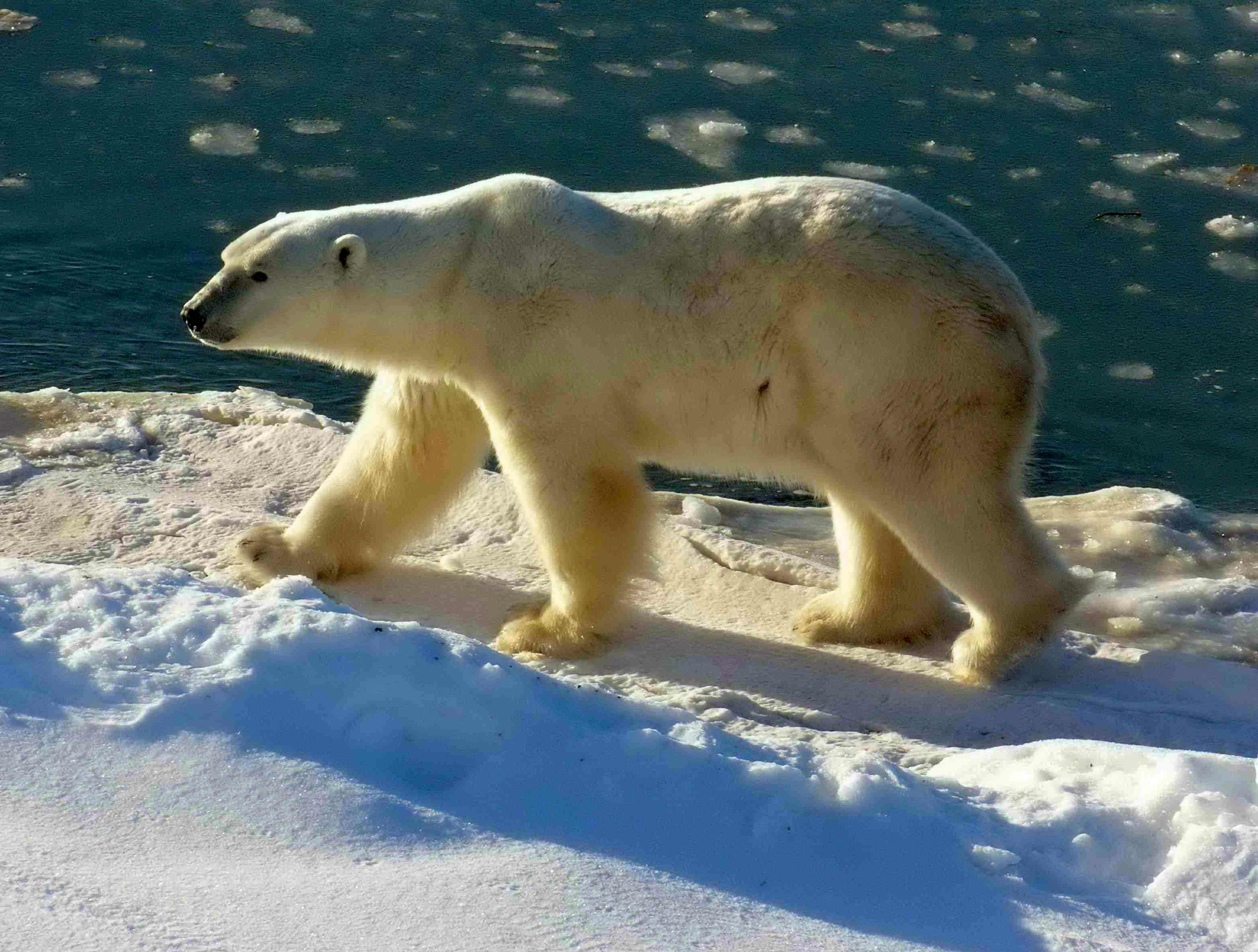
Polar bears face extinction in less than 70 years because of global warming, scientists have warned.
Melting ice is causing their numbers to drop dramatically, they warn. Others also at risk include ivory gulls, Pacific walruses, ringed and hooded seals and narwhals, small whales with long, spiral tusks.
One of the problems is that other animals are moving north, encroaching on their territory, spurred by increasing temperatures, pushing out native species.
The animals are also struggling with the loss of sea ice.
“The Arctic as we know it may soon be a thing of the past,” said Eric Post, associate professor of biology at Penn State University, who led the latest study, published in the journal Science.
“Recent projections suggest polar bears could be extinct within 70 years.
“But we think this could be a very conservative estimate. The outlook is very bleak for them and other creatures such as ringed seals.”
He added: “The rate at which sea ice is disappearing is accelerating and these creatures rely on it for shelter, hunting and breeding. If this goes, so do they.”
Read the complete story in the Telegraph here
OK now for the other side of the story:
A few countering reports:
Christian Science Monitor, May 3rd, 2007 – Despite global warming, an ongoing study says polar bear populations are rising in the country’s eastern Arctic region.
Science Daily May 10th, 2008 – Federal Polar Bear Research Critically Flawed, Forecasting Expert Asserts
National Post March 6th, 2007 – Polar bear numbers up, but rescue continues
WUWT May 9th 2009 – The “precarious state of the U.S. polar bear population”
Dr. Mitchell Taylor, a biologist with Nunavut Territorial government in Canada wrote this letter (PDF) on April 6th, 2006 to the U.S. Fish and Wildlife Service:
Some excerpts:
At present, the polar bear is one of the best managed of the large arctic mammals. If all the arctic nations continue to abide by the terms and intent of the Polar Bear Agreement, the future of polar bears is secure.
…
Polar bears are believed to have evolved from grizzly bears during the Pleistocene era some 200-250,000 years ago (Amstrup 2003). Polar bears were well developed as a separate species by the Eemian interglacial approximately 125,000 years ago. This period was characterized by temperature fluctuations caused by entirely natural events on the same order as those predicted by contemporary climate change models. Polar bears obviously adapted to the changing environment, as evidenced by their presence today. That simple fact is well known and part of the information contained in the reference material cited throughout the petition, yet it is never mentioned. This fact alone is sufficient grounds to reject the petition. Clearly polar bears can adapt to climate change. They have evolved and persisted for thousands of years in a period characterized by fluctuating climate. No rational person could review this information and conclude that climate change pre-destined polar bears to extinction.
…
The petition admits that there is only evidence for deleterious effects from climate change for one polar bear population (Western Hudson Bay [WH]) at the southernmost extreme of polar bear range (Fig. 1). The petition argues that the likelihood of change in other areas is reason enough to find that polar bears should be regarded as a species at risk of imminent extinction. I hope the review considers the precedent set by accepting this argument. Climate change will affect all species to some extent, including humans. If the likelihood of change is regarded as sufficient cause to designate a species or population as “threatened,” then all species around the world are “threatened.”
Some data. With hunting no longer allowed, bear populations have increased 4-5 times:


Thomas J Arnold 12:54:16:
Denis Hopkins 13:41:25
NickB 15:20:05
Hi, all. I agree that the Telegraph is not as it was; nevertheless it still prints articles that don’t follow the AGW line. I can’t give you chapter and verse of everything I’ve read, but recent articles by Janet Daley and Gerald Warner were very critical of the London School of Economics’ idea of reducing population to reduce CO2 emissions for instance; Jeff Howell is openly sceptical in his column about house maintenance and James Delingpole is as anti-AGW as you can get and there have been others. I was just trying to be fair, that’s all.
Denis, about light bulbs: Millions of people have replaced their incandescent bulbs with halogen lights fitted into the ceiling or on tracks, and typically use four to six of these where they previously only had a 100-watt bulb. At 50 watts a go they’re now burning 200-300 watts per room, but nobody wants to ban halogens. Funny, that.
janama (17:03:43)
Thank you for that reference, but the point that I was raising was that observations in a variety of glacial terrains indicate that a surprisingly high proportion of snow and ice loss has been attributed to dry state evaporative loss to cold dry air below freezing point, and it may or may not be wise to just equate loss of Arctic ice solely to temperature variation. Atmospheric humidity and wind speed may be significant controls, but until data has been obtained at high latitudes there remains uncertainty. The possible significance to AGW claims is that variation in ice thickness is not neccessarily a straightforward indicator of warming.
All of this is of course in addition to the effects of prevailing wind vectors/ sea currents on physical break up and drift and cyclicity of variable sub-ice sea temperature discussed on previous WUWT threads.
What’s going on with the background of that photograph? It looks like its been altered. The background seems to have had chunks of ice drawn in to either hide something in the background or possibly to put the idea of breaking ice in the viewer’s mind. Further to that, the ice in the foreground and middle are different colors, although the shadows match.
What do you reckon?
Francis (18:29:38) :
Presumably the brown bears have already expanded to the maximum carrying capacity of their region. So interloping polar bears will ultimately just displace an equal number of brown bears. Resumed hunting may be the sad, ugly, selfish, ruthless… …solution, that is still preferable to all the others.
No a thousand times no. Biologist used to have the golden rule that you do not intervene in the outcome of the natural the processes that you are observing.
If you intervene in an event that you find distasteful then you haven’t understood and nor can you convey the essence of our natural world.
This in no way conflicts with the concept of conservation where man has a direct interaction with the environment and therefore has a natural part to play in the outcome.
Excuse me, but did anyone notice the Telegraph’s related stories to this? Included on their Web page is a link to this piece: “Polar bears face damage to hearing from Arctic industrialisation.”
Apparently polar bears are not only at risk for drowning and starvation, but also at risk for hearing loss. Nowhere in the story do they mention the sorts of noisy industries that are moving into the Arctic. Has GM opened a new assembly plant at the North Pole?? Are road crews jackhammering a new highway between Siberia and Greenland?? Where do these people get this stuff??
Just when you think things can’t get anymore ridiculous….
I was going to post a link to a web site (Polar Bears International) which *had* an ‘ask the experts’ section regarding polar bear population.
Unfortunately:
that article has changed to reflect the views of the web site owners.
the name of the scientist/expert who answered the question has been removed.
the response concentrates on discussing ice loss as the cause of declines than the actual populations.
the majority of factual information was removed.
Note to self – if there’s something that you find is important on the internet, get a screenshot and capture the text of the page.
The current page is here: http://www.polarbearsinternational.org/ask-the-experts/population/
Although I wouldn’t advocate the site as necessarily an authority on Polar Bears, there is some decent *basic* information if you can avoid the [AGW] propaganda and ‘touchy feely’ stuff (disclaimer: do not touch or feel polar bears as they are liable to rip your arm off and use it as seal bait. Any pictures you may see of people hugging polar bears is done by trained professionals who have accepted the loss of an arm, leg or even their head as a minor inconvenience compared to getting The Message across).
Apparently WWF doesn’t read its own publications. On page 9, they present a table of the arctic polar bear population status. They divide the arctic into twenty different regions (the arctic is not one monolithic climatic entity). The polar bear populations of 6 regions are unknown, 10 regions are stable, 2 regions are decreasing, and 2 regions are increasing. There are asterisks on two of the stable regions and one of the decreasing regions–it means those trends are uncertain. It is interesting to note, that those arctic regions where the temperatures are stable, the corresponding polar bear populations are also stable; those regions where the temperatures are increasing the corresponding polar bear populations are also increasing; and those regions where the temperatures are decreasing the polar bear population are also decreasing.
Wikipedia claims a more sinister outcome due to a recent survey (Proceedings of the 14th Working Meeting of the IUCN/SSC Polar Bear Specialist Group. 32.) 5 of the 19 polar bear subpopulations are in decline. All 5 surveys showing decline were done by a computer model (the PVA model RISKMAN–PVA means population viability analysis).
Jim
The results show that spring begins considerably sooner than before. The blossoming and pollination period of plants starts as much as twenty days sooner in comparison to the situation ten years ago.
I said.
http://i599.photobucket.com/albums/tt74/MartinGAtkins/Eureka3.jpg
Canoing our way to Burrow Alaska we hope to find robust evidence of earlier springs in the Arctic harming the native critters.
http://i599.photobucket.com/albums/tt74/MartinGAtkins/Burrow1.jpg
As you can see, early spring in the later years came in with a cold snap but that shouldn’t have disturbed the lemmings little ice holes.
After that they track close until later in spring when the later years are warmer.
So far no “spring begins considerably sooner”.
You know what polar bears call other animals encroaching on their territory?
Dinner.
(I tried it with prey, breakfast, and lunch – and dinner seemed the best idea…)
First, man-made global warming is a farce, and everybody knows it, including the communists and control freaks who are pushing it.
Second, twenty or more species go bye-bye every single day on this planet, and it’s been going on since long before man appeared on the stage.
Anybody who thinks that we can, or should, preserve every single species on this planet is too stupid to get a job as a spell-checker in an M&M factory.
I especially like the part about part of the problem of arctic animals being pushed out of their range by encroaching species from farther south. Now I know they tried to deflect this thought with talking about foxes, but I just really enjoy the mental picture of anything from down here “pushing” the largest land predator on the planet.
POlar Bears are the perfect animal for running a fund raising scam:
They are unapproachable- both by distance and hazard.
They are nice looking in their furry white coats.
Very few people actually see them, or ever will. ‘Experts’ can say just about anything they want without much fear of being shown to be fibbing.
How did the polar bears survive the MWP?
Oh, what a tangled web we weave when first we practice to believe.
Laurence J. Peter
I was recently at Longyearbyen in the Svalbard Archipelago. The locals estimate the polar bear population in the archipelago at 2500 to 5000, and growing! The farthest south population I know of, at James Bay, is also growing. One would ask how the “projections” are made. Murray
An amusing animated filmclip
http://www.metacafe.com/watch/792309/funny_polar_bears_1/
Enjoy
So what if polar bears become extinct? Millions, possibly billions, of species in the history of the plant earth that have failed to adapt to changing conditions have gone extinct. That’s what we call “evolution” and “survival of the fittest”. “Adapt or die” is the most basic law of nature and polar bears are just as subject to those laws as the dodo birds were.
Vincent (03:13:46)
Sudden cooling is fairly common…i.e., from volcanoes or asteroids. Or the freezing of all those Russian mammoths, with flowers in their stomachs.
And I think the polar bears could handle the cold spell, if the seals can.
Other causes of sudden (the non-Mann hockey stick blade) warming are harder to envision. Any suggestions?
The MWP doesn’t come into play. It makes an appearance on the recent Arctic hockey stick graph, but only a small one.
ADAPTATION:
Obviously, the first step would be to read the paper, for more specifics. Then the next step would be to ask a zoologist. How long would it take for polar bears to give up hibernating on the ice, and learn to do it in a den?
1. Need enough polar bears to learn it…to maintain genetic diversity.
2. Will they be too warm for comfort underground?
3. Do hibernating bears dig their own dens?
But I don’t know enough to be an interesting conjecture-er. So remember from the paper, “These species may be headed for extinction.”
Robert E. Phelan (12:10:20) :
“Just my two cents worth: commas placed before conjunctions drive me nuts. Mr. Spock would probably suggest that “… placing a separator immediately before a joiner is not logical…” .”
In addition to the necessity for a comma before a conjunction is a serial list to avoid ambiguity (as has been pointed out above), it’s generally recommended to place a comma before a “but,” which is generally where a pause for breath occurs and where a logical turn occurs.
“Also, somewhat logically, if the comma or period following the quote terminates the phrase or sentence the quote is embedded in, it should be outside the quotation marks. A complete sentence used as a quote should either use ellipses, as I have done above, or it should be placed in a separate block quote.”
That’s the style followed in Britain, and it makes more sense. For several years I used it myself, for that reason. But unfortunately the alternative style is now cast in concrete in the US and it is impossible to change it. (I’ve read that it was adapted because typographers thought it looked prettier.)
“Keep in mind that commas are generally placed in locations in the sentence where you would normally pause for emphasis or draw a half breath while speaking. Unfortunately, the illiterati that write current style manuals haven’t had the good grace or sense to consult with me.”
That’s because everybody has different ideas about where to pause for breath, which makes for chaos–and sometimes these idiosyncratic choices make it harder to follow the logic of a sentence. It’s been years since I’ve read material on the matter, but the justifications I read in favor of “logical” rather than phonetic comma-placement were very persuasive.
(However, in fiction and poetry, idiosyncratic comma placement is not only OK but sometimes essential. James Thurber once showed Harold Ross how mangled certain famous passage of poetry would become if they were edited in accordance with the New Yorker’s style.)
MartinGAtkins (05:29:58)
“…the golden rule that you do not intervene in the outcome of the processes that you are observing.”
I’m sympathetic to such principles from academic biologists. But I note that they’re on the losing side of the argument. (I’ll pass over the condor and the whooping crane, as special cases.)
A FEW EXAMPLES:
…Poisoning of small lakes, to kill off the intruder species.
…Alaskan killing of wolves from helicopter to increase big game populations.
…Similar hunting season decisions elsewhere.
…In the west, rounding up wild horses, to favor burros and the desert bighorn sheep.
…Bounties on predators.
I think that the polar bear situation fits your concept, “where man has a direct interaction with the environment and therefore has a natural part to play in the outcome.”
In part…I’m only suggesting the reintroduction of the polar bear hunting seasons, that have existed in the past.
(Obviously, we’re assuming a warming world…whatever the cause.)
These are triage considerations contemplated only to protect the brown bear gene pool from cold weather genetic adaptations that would be disadvantageous in such a warming world:
…large size
…adaptations for head-butting ice
…greater insulation
…etc.
The first thing that comes to mind is running ability. Brown bears are fast. I’ve never seen (on TV) polar bears running fast. But then, they were running on ice…
“”” pat (23:44:10) :
Hmmm. So those other animals are like……..food to Polar Bears. Right? The largest and meanest carnivore on Earth is scared of lemmings and rodents? Birds and walruses? What am I missing here? “””
Pat you just won yourself a cigar; maybe a hat too. What really made me laugh my A*** off, is the efficient way you put it.
According to a recent PBS program, Polar Bears, and Grizzlies (Kodiaks) are darn near the same thing; sort of like Stoats, and Ermine.
And both those bears are quite happy to hunt and ambush humans, and any other calories on the hoof critter that comes into their territory.
If I’m not mistaken, Alaska is the only place on earth, where it is not legal to hunt polar bears. Not that I am advocating that; as it turns out I think PBs (Kodiaks too) are kind of neat critters. Growing up in a land that has NO native land mammals, I get a kick out of anything that walks on all fours.
But thanks for the daily humor Pat; it’s been a week that could use some of that.
George
“”” jorgekafkazar (14:31:27) :
Bill Illis (05:13:57) : “‘With global warming, will there still be sea ice in the Arctic?’ There will still be 6 months of darkness in the winter. The average annual temperature at the north pole is -25C. The ice really only melts back for about 2 months out of the year. If the ice melts back a little further and a little earlier, the Arctic will still be frozen solid for at least 9 months out of the year.”
True. Note that seawater has an emissivity of 0.993, much higher than ice. Sea water is also a far better heat conductor than the ice. The albedo of seawater at high zenith angles overlaps the albedo range of ice. Those three factors favor the presence of ice at the poles. “””
Over what spectral range does water have an emissivity of 0.993 ? In the solar spectral range water has a refractive index of 1.33 which gives it a normal Fresnel reflection coefficient of 2%, and a Brewster angle of about 53 degrees. So the total Fresnel reflectance is pretty near constant over that 53 deg range, which includes about 64% of the reflected diffuse irradiance. Including the remainder of diffuse irradiance, water reflects about 3% of the solar spectrum. This would seem to limit the emissivity for that spectral range to 0.97.
I have never seen long wave refractive index data for water, so I can’t comment on the long wave IR emissivity; but somehow 0.993 sounds high but by an irrelevent amount IMHO.
In any case there is a reason for ice in the arctic; so I wouldn’t look there for any great contribution to earth’s radiation balance. Try the mid-day tropical equatorial deserts to find out where the real radiative cooling of this planet takes place; and it happens in broad daylight for all to see. UHIs also do their part for cooling the planet.
George
I think the post above made some interesting points, on a related side note I found a used version ofResilience Thinking: Sustaining Ecosystems and People in a Changing World which is directly related to this topic for lessthan the bookstores at http://www.belabooks.com/books/9781597260930.htm
Reply: Spam? Hard to tell ~ ctm