Count the number of ifs, mays, and coulds in this story, then look the rebuttal and other supporting information. The Telegraph is repeating alarmism.
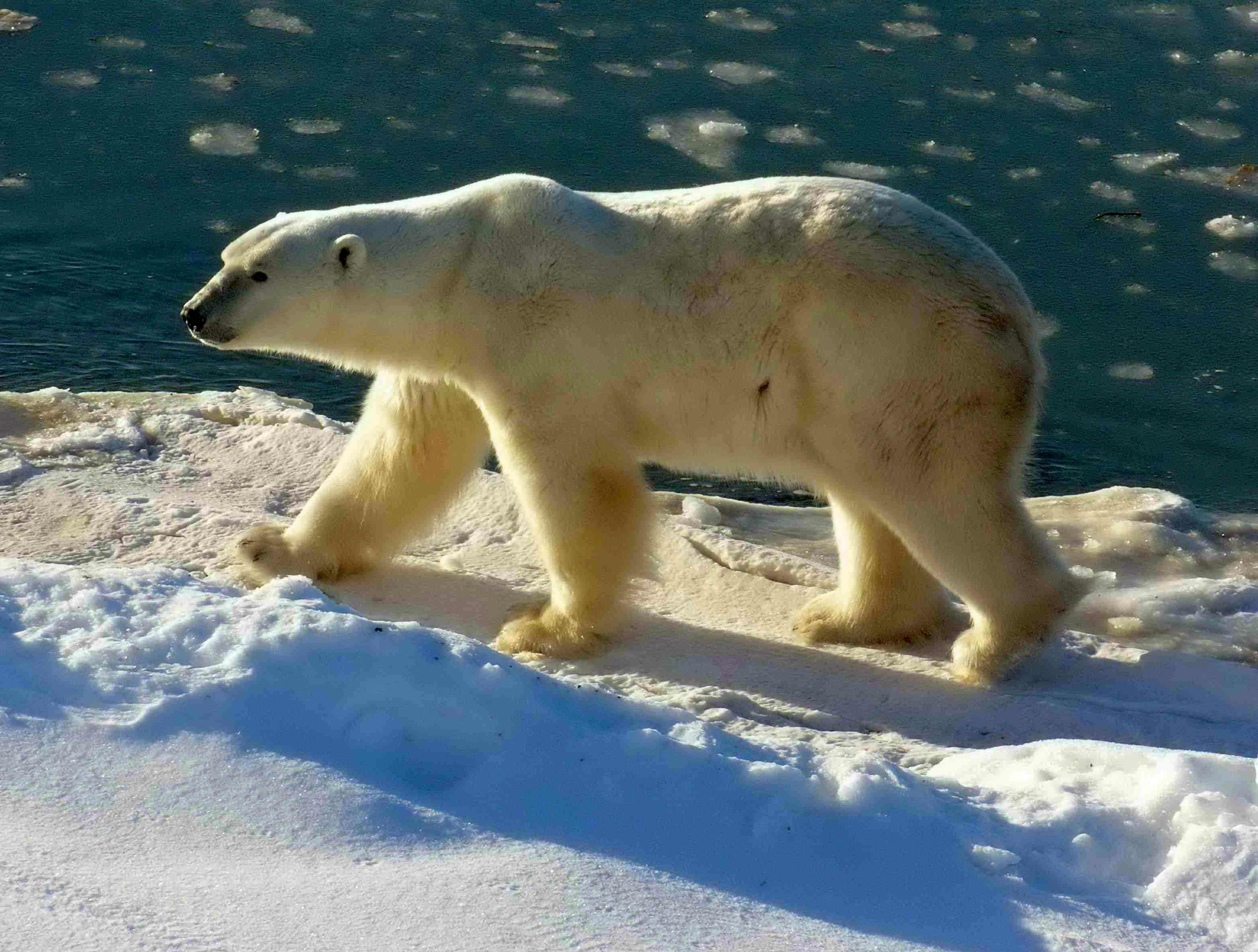
From the Telegraph By Kate Devlin, Medical Correspondent
Polar bears face extinction in less than 70 years because of global warming, scientists have warned.
Melting ice is causing their numbers to drop dramatically, they warn. Others also at risk include ivory gulls, Pacific walruses, ringed and hooded seals and narwhals, small whales with long, spiral tusks.
One of the problems is that other animals are moving north, encroaching on their territory, spurred by increasing temperatures, pushing out native species.
The animals are also struggling with the loss of sea ice.
“The Arctic as we know it may soon be a thing of the past,” said Eric Post, associate professor of biology at Penn State University, who led the latest study, published in the journal Science.
“Recent projections suggest polar bears could be extinct within 70 years.
“But we think this could be a very conservative estimate. The outlook is very bleak for them and other creatures such as ringed seals.”
He added: “The rate at which sea ice is disappearing is accelerating and these creatures rely on it for shelter, hunting and breeding. If this goes, so do they.”
Read the complete story in the Telegraph here
OK now for the other side of the story:
A few countering reports:
Christian Science Monitor, May 3rd, 2007 – Despite global warming, an ongoing study says polar bear populations are rising in the country’s eastern Arctic region.
Science Daily May 10th, 2008 – Federal Polar Bear Research Critically Flawed, Forecasting Expert Asserts
National Post March 6th, 2007 – Polar bear numbers up, but rescue continues
WUWT May 9th 2009 – The “precarious state of the U.S. polar bear population”
Dr. Mitchell Taylor, a biologist with Nunavut Territorial government in Canada wrote this letter (PDF) on April 6th, 2006 to the U.S. Fish and Wildlife Service:
Some excerpts:
At present, the polar bear is one of the best managed of the large arctic mammals. If all the arctic nations continue to abide by the terms and intent of the Polar Bear Agreement, the future of polar bears is secure.
…
Polar bears are believed to have evolved from grizzly bears during the Pleistocene era some 200-250,000 years ago (Amstrup 2003). Polar bears were well developed as a separate species by the Eemian interglacial approximately 125,000 years ago. This period was characterized by temperature fluctuations caused by entirely natural events on the same order as those predicted by contemporary climate change models. Polar bears obviously adapted to the changing environment, as evidenced by their presence today. That simple fact is well known and part of the information contained in the reference material cited throughout the petition, yet it is never mentioned. This fact alone is sufficient grounds to reject the petition. Clearly polar bears can adapt to climate change. They have evolved and persisted for thousands of years in a period characterized by fluctuating climate. No rational person could review this information and conclude that climate change pre-destined polar bears to extinction.
…
The petition admits that there is only evidence for deleterious effects from climate change for one polar bear population (Western Hudson Bay [WH]) at the southernmost extreme of polar bear range (Fig. 1). The petition argues that the likelihood of change in other areas is reason enough to find that polar bears should be regarded as a species at risk of imminent extinction. I hope the review considers the precedent set by accepting this argument. Climate change will affect all species to some extent, including humans. If the likelihood of change is regarded as sufficient cause to designate a species or population as “threatened,” then all species around the world are “threatened.”
Some data. With hunting no longer allowed, bear populations have increased 4-5 times:


Stephen Skinner (10:27:06) :
OT. How does a nuclear powered submarine or ice-breaker keep it’s reactor cool?
Not sure whether ice-breakers care, but the last thing a nuclear sub wants is a thermal trail a smart torpedo can follow…
Here’s a little calculation born out of a lazy Sunday afternoon.
The ice extent minimum is likely to end near 1,000,000 km^2 above the 2007 low. That converts to about 385,000 square miles. To bring that into perspective, that’s the the area of all New England states plus NY, PA, NJ, DE, MD and DC plus California combined with 25,000 sq. mi. left over. Oh hell, throw in Northern VA. to make it match.
Now if we could only arrange to freeze those states over, voila, that’s the end of our global warming issue.
Just my two cents worth: commas placed before conjunctions drive me nuts. Mr. Spock would probably suggest that “… placing a separator immediately before a joiner is not logical…” . Also, somewhat logically, if the comma or period following the quote terminates the phrase or sentence the quote is embedded in, it should be outside the quotation marks. A complete sentence used as a quote should either use ellipses, as I have done above, or it should be placed in a separate block quote. Keep in mind that commas are generally placed in locations in the sentence where you wouold normally pause for emphasis or draw a half breath while speaking. Unfortunately, the illiterati that write current style manuals haven’t had the good grace or sense to consult with me.
David in Davis (11:13:13) : …the news today of the death of Norman Borlaug…
Sorry to hear. But he did live to 95. And he did do a lot of good in the world. “…spawned the “Green Revolution,” …His work saved millions of lives.” He won’t go before God empty handed!
“We all eat at least three times a day in privileged nations, and yet we take food for granted,” Borlaug said recently.
http://www.agriculture.com/ag/story.jhtml?storyid=/templatedata/ag/story/data/1252862299233.xml#continue
Allan M (11:46:27) : Must be the home-grown fresh organic vegetables.
True. And the oils in salmon.
I have to say that as a (very) long-term Telegraph reader, this is the sort of reportage that makes me cringe. I still take it, mainly for the crosswords, but there was a time when regardless of its political stance (it was always known as the Conservatives’ house magazine or in latter days as the Torygraph) its news reporting was objective and straight down the line.
This report would have been lucky to see the light of day under Bill Deedes or Charles Moore both of whom would have demanded some decent follow-up by the reporter involved.
First question: was this a press release? Second question: did you bother to check sources and facts? And that would have applied whether it came from James Hansen or Anthony Watts or anyone else. Editorial comment is different but news, in the Telegraph, used to be sacrosanct.
…nothing dumber than ranting about punctuation and then failing to adequately check your spelling…
Omitting the comma before the last item in a series is definitely not mainstream usage. As the New Yorker review correctly states:
“The book also omits the serial comma, as in “eats, shoots and leaves,” which is acceptable in the United States only in newspapers and commercial magazines.”
No style guide that I’m familiar with, except those aimed at newspapers (where the extra comma might cause a column-wrap) recommends omitting the serial comma. They usually implicitly recommend it by pointing out that it avoids ambiguity in certain cases, such as when the last item in the series contains an internal “and” or “or,” and adding that its proponents argue that therefore, for the sake of uniformity, it should be used everywhere. I.e., it’s not just a snooty affectation.
The “serial comma” is also known as the “Oxford comma,” and is recommended in Britain as well.
eric (10:20:25) :
It’s a mammal that has evolved so far in only a couple hundred thousand years, it’s gotta be more adapatable than something like the Cheetah with its tiny gene pool. Even in the last 10,000 years PB dentition has changed:
http://www.geol.umd.edu/~candela/pbevol.html
Hecht (in Chaline, 1983) describes polar bear evolution: the first “polar bear”, Ursus maritimus tyrannus, was essentially a brown bear subspecies, with brown bear dimensions and brown bear teeth. Over the next 20,000 years, body size reduced and the skull elongated. As late as 10,000 years ago, polar bears still had a high frequency of brown-bear-type molars. Only recently have they developed polar-bear-type teeth.
It survived the Medieval Warm Period and others, it survived the last ice age where ice covered Mt Washington NH, which is now 6,288ft (some 2,000m) above sea level. It survived the low ice autumn of 2007, I suspect it will survive the next several warm spells and ice ages.
Eric, I’m a bit naive about stuff, so could you please identify for me (and others) just which northward-migrating species will be geographically displacing polar bears, as opposed to helping diversify their diets?
eric,
“The temperature increase in the Arctic will be double the average expected global temperature increase. Species have died off as a result of climate change.”
The problem with research that uses as its evidence the output of theoretical models is that it has no scientific value. You have to take these models as fact in order to come to conclusions about the fate of polar bears. And even if we can have a high confidence in the model’s predictive skill, show me any scientist who can accurately predict the behavioural response of a polar bear to a climate change. Or any animal at all for that matter. How many times have we seen studies that have shown (surprise, surprise) animals adapting to warming by moving North?
“Arctic environment that is 6C cooler than the one they will face if Global Warming continues.”
Notice that conditional clause slipping in again?
“I expect that this post will could be ridiculed for looking at this question sensibly and scientifically, since many posters here ridicule sceince.”
People here may ridicule sceince, but they embrace science. There is a difference.
eric.
What Post et al are saying, in a nutshell, is “give us some money, suckers. We need sustaining in our overpaid useless employment.”
DaveF (11:02:47) :
“Those people criticizing the Telegraph for running this story should know that the Telegraph frequently runs articles that are critical of the AGW theories. Also, it has for many years, in its Sunday edition, published the Christopher Booker column which is strongly anti-warmist (and which regularly directs readers to this site).”
Dave, I read the Telegraph and have done so for more years than I care to remember.
I enjoyed the incisive and rigorous editorial. The paper was objective and slightly AGW sceptical. Now under the Brothers Blue, the paper has changed and not for the better either. Geoffrey Lean has joined the staff and I’m sure he’s a nice fellow, but the tone and drift of his loose arguments, are redolent of another ‘broadsheet’ organ. It seems that now in England we have a newspaper consensus on AGW and that is not healthy, the government is spinning mercilessly and I want objectivity!! Once not long ago, the Telegraph would have provided it, now I sometimes despair. When however well intentioned/or boneheaded reporters who should properly research their subject, do not do so and consequently regurgitate the same old same old, tis a trifle trying.
There are still some of the best reporters working for the ‘Torygraph’ and I shall continue to remind them of their duties to their readership. Mr. Booker on a Sunday is a must read, for me personally.
The reality is that the current polar bar population (approx. 25,000) is probably too large, and the number needs to be reduced by a few thousands.
According to a 2006 U.S. Fish and Wildlife Service study (Range-wide Status Review of the Polar Bear), polar bears annually kill up to 44% of new born seal pups in some of their habitats. This is a tremendous number. I don’t know the approximate birth and death rates for a given seal species to avoid its extinction, but I suspect the kill rate of that magnitude is very close to the danger point.
Indeed, the reported declines in walruses and various seal species populations in the Arctic might have much to do with overhunting by polar bears. The recovery of the arctic summer ice extent that is being observed for the past two years might even exacerbate the decline of those species populations that polar bears prey on, since the increased ice cover would help their hunting tactics.
It seems that polar bear lovers are up in arms crying foul about how tiny the cute polar bear population is, but very few, if any, are speaking for the cute seal pups that are slaughtered in thousands every day by polar bears. If there are starving polar bears, it probably has more to do with the overall reproductive success of their own species than any drastic climate change in their habitat.
Aron (03:26:26) : “specie”
The singular and plural of the biological unit are both “species”.
“Specie” applies to money.
More importantly, how did The Onion get my photo?
BTW, here’s a cool story on a recently discovered isolated habitat in New Guinea containing many previously unrecognized species. Great pics:
http://www.guardian.co.uk/environment/2009/sep/07/discovery-species-papua-new-guinea
Mike_s (02:09:26) : “One interesting factoid;
Don’t eat the liver of a polar bear it has deadly levels of vitamin A.–SAS survival guide.”
And make sure you cook the bear well. Polar bears carry trichinosis. Recent autopsies of polar explorers, previously believed to have died from vitamin A poisoning, revealed trichinosis.
I learned that the latter was the correct method, and the former was used by professional writers. So either is correct as far as I know. Guess things have changed since the 70’s 😉
Back on-topic. I blogged about this with respect to the WWF claims, here: http://whatcatastrophe.com/drupal/node/40
And even though the WWF says, on their own site, that Polar Bears are not currently endangered, their future is far from certain. Yet the only reason they say that is due to “forecasts” decades down the road.
Assuming it gets so warm in the Arctic that all North Pole ice melts (it looks like that won’t happen but that North Pole ice is in a growing trend) polar bears will be just fine. It was warmer on earth during the Medieval Warming Period than it is now and polar bears are lived through it.
No one can say that polar bears will all die if the earth gets a little warmer. If they do say it I would like to see the evidence for them to make that claim–I think they don’t have any and they are just making it.
I take the DT every day as well and it has become much more in line twith the “science is decided” type of reporting. It assumes AGW as a given and accepts ridiculous reports with a shoddy disregard for checking even simple facts! It si not alone in this. I despair! Christopher Booker in the ST and Richard Littlejohn in the Daily Mail are the only ones who argue an opposition to this.
Those in USA beware and try to argue now against the loss of incandescent light bulbs!!!! Very little logic in the reasons given for the change and absolutely no reason in terms of a green agenda ( they are not as efficient as claimed. They do not light as bright as claimed and they are only more efficient if left on for continuous stretches of time – negating the point of them.) Not to mention the hazard of the Mercury vapour on disposol.
George PS (13:05:14) I somewhat agree but don’t know the numbers. Imagine the hysteria from the AGW crowd if the bear population increases to some point and it hits the wall of overpopulation, not enough food. Birthrate may drop, disease and starvation may set in, I don’t know how it would play out. The AGW crowd, well we can imagine how they would play it.
Recycling stories. Green and eco-friendly surely?
“Now, more seriously…Anyone else curious how the Bears have survived for at least 110,000 years? Shouldn’t the last interglacial have wiped them out? Hell, what about when Coastal Northern Russia was between 2.5 to 7 degrees warmer in July than the present from about eight thousand to thirty five hundred years ago?” – timetochooseagain (00:50:56)
It’s no wonder that the arctic is all out of kittens or other cats or other large critters as the polar bears ate them all to survive for the last 110,000 years! That’s a lot of other animals they’ve eaten to stay alive up in the highly variable temperature Great White North over all those ages.
Melting ice is causing their numbers to drop dramatically, they warn.
If their refers to polar bears, then I assume that they must also be polar bears. So my question .. exactly how many polar bears were interviewed as part of this study.
Animals in danger? Sounds like a job for PETA! Send them in to rescue the poor polar bears and relocate them. Failing that, instead of switching off lights to keep polar bears cool, why don’t environmentalists try shaving them instead?
Anyway, in other signs of a cooling in the UK global warming market-
http://www.readingchronicle.co.uk/news/roundup/articles/2009/09/12/41320-students-lose-cash-as-energy-college-folds/
—
THE shock closure of a Reading college for climate change inspectors has left hundreds of students with their future in tatters and thousands of pounds out of pocket.
—
600x£3900 per 9 month course sounds like a nice little earner, and why some folks are so keen to keep promoting inconvenient truths I guess.
Bill Illis (05:13:57) : “‘With global warming, will there still be sea ice in the Arctic?’ There will still be 6 months of darkness in the winter. The average annual temperature at the north pole is -25C. The ice really only melts back for about 2 months out of the year. If the ice melts back a little further and a little earlier, the Arctic will still be frozen solid for at least 9 months out of the year.”
True. Note that seawater has an emissivity of 0.993, much higher than ice. Sea water is also a far better heat conductor than the ice. The albedo of seawater at high zenith angles overlaps the albedo range of ice. Those three factors favor the presence of ice at the poles.