Foreword: I give thanks to Steve McIntyre for this analysis. Steve came to a conclusion similar to what I alluded to in my initial rebuttal where I said:
“For all I know, they could be comparing homogenized data from CRN1 and 2 (best stations) to homogenized data from CRN 345 (the worst stations), which of course would show nearly no difference.“
Steve does a superb job of deconstructing the memo’s undocumented results. Perhaps someday Dr. Thomas Peterson of NCDC will tell us how he did his analysis and show supporting data and methods. – Anthony
The NOAA Talking Points memo falls well short of a “full, true and plain disclosure” standard – aside from the failure to appropriately credit Watts (2009).
They presented the following graphic that purported to show that NOAA’s negligent administration of the USHCN station network did not “matter”, describing the stations as follows:
Two national time series were made using the same gridding and area averaging technique. One analysis was for the full data set. The other used only the 70 stations that surfacestations.org classified as good or best… the two time series, shown below as both annual data and smooth data, are remarkably similar. Clearly there is no indication for this analysis that poor current siting is imparting a bias in the U.S. temperature trends.
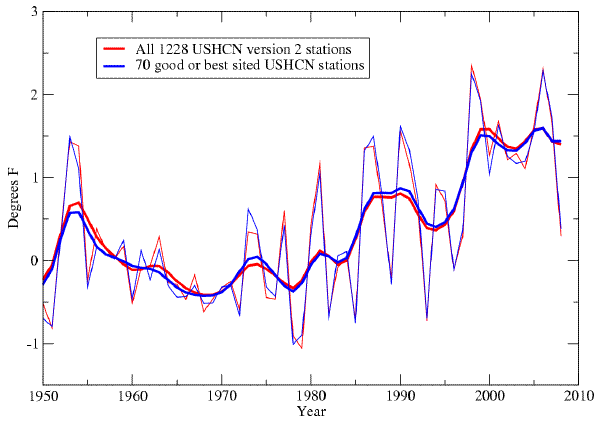
Figure 1. From Talking Points Memo.
Beyond the above sentence, there was no further information on the provenance of the two data sets. NOAA did not archive either data set nor provide source code for reconciliation.
The red graphic for the “full data set” had, using the preferred terminology of climate science, a “remarkable similarity” to the NOAA 48 data set that I’d previously compared to the corresponding GISS data set here (which showed a strong trend of NOAA relative to GISS). Here’s a replot of that data – there are some key telltales evidencing that this has a common provenance to the red series in the Talking Points graphic.

Figure 2. Plot of US data from www1.ncdc.noaa.gov/pub/data/cirs/drd964x.tmpst.txt
An obvious question is whether the Talking Points starting point of 1950 is relevant. Here’s the corresponding graphic with the 1895 starting point used in USHCN v2. Has the truncation of the graphic start at 1950 “enhanced” the visual impression of an increasing trend? I think so.
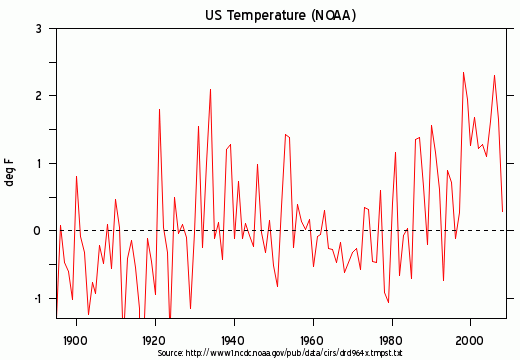
Figure 3. As Figure 2, but to USHCN v2 start
The Talking Points’ main point is its purported demonstration that UHI-type impacts don’t “matter”. To show one flaw in their arm-waving, here is a comparison of the NOAA U.S. temperature data set and the NASA GISS US temperature data set over the same period – a comparison that I’ve made on several occasions, including most recently here. NASA GISS adjusts US temperatures for UHI using nightlights information, coercing the low-frequency data to the higher-quality stations. The trend difference between NOAA and NASA GISS is approximately 0.7 deg F/century in the 1950-2008 period in question: obviously not a small proportion of the total reported increase.

Figure 4. Difference between NOAA and NASA in the 1950-2008 period. In def F following NOAA (rather than deg C)
As has been discussed at considerable length, the NASA GISS adjusted version runs fairly close to “good” CRN1-2 stations – a point which Team superfans have used in a bait-and-switch to supposedly vindicate entirely different NASA GISS adjustments in the ROW, (adjustments which appear to me to be no more than random permutations of the data, a point discussed at considerable length on other occasions.)
For present purposes, we need only focus on the observation that there is a substantial trend difference between NOAA and GISS trends.
Given that, when NOAA’s Talking Points claim that there is a supposedly negligible difference between the average of their “good” stations and the NOAA average (which we know to run hot relative to GISS), then arguably this raises issues about the new USHCN procedures.
Y’see, while NOAA doesn’t actually bother saying how it did the calculations, here’s my guess as to what they did. The new USHCN data sets (as I’ll discuss in a future post) ONLY show adjusted data. No more inconvenient data trails with unadjusted and TOBS versions.
When I looked at SHAP and FILNET adjustments a couple of years ago, one of my principal objections to these methods was that they adjusted “good” stations. After FILNET adjustment, stations looked a lot more similar than they did before. I’ll bet that the new USHCN adjustments have a similar effect and that the Talking Points memo compares adjusted versions of “good” stations to the overall average.
So what they are probably saying is this: after the new USHCN “adjustments” (about which little is known as the ink is barely dry on the journal article describing the new method and code for which is unavailable), there isn’t much difference between the average of good stations and the average of all stations.
If the NASA GISS adjustment procedure in the US is justified (and most Team advocates have supported the NASA GISS adjustment in the US), then the Talking Points memo merely demonstrates that there is something wrong with the new USHCN adjustments.
Good work on fathoming out what the AGW guys are doing. I guess their peer-reviewers never saw through all the shenanigans otherwise, surely, they would have said something?
O/T: WUWT has been a busy place over the last few weeks since the last sunspot related post. I’ve been keeping an eye on them and there have been none of any consequence since then.
I am really looking forward to the objective,, rigorous statistical analysis by Anthony of his surface station data. This should make a good peer-reviewed paper whether the results are positive or negative. It’s still a very much open question as to whether the good stations will show a different slope than the bad ones. I assume that Anthony either has a good understanding of statistics or can find co-auhors and collaborators that do. I hope that he plans is to write a formal manuscript that can be submitted to an appropriate peer-reviewed science journal. Getting a manuscript written for publication requires a careful description of the methods and criteria as well a citations on the importance of the surface temp data and previous relevant papers. Writing such a paper is much more difficult than putting together a blog post but getting a peer-reviewed paper would be worth the time and effort.
I am not an expert on analyzing long term time series physical data. Perhaps analysis of covariance (ANCOVA) can be used on the annual means for the past 30 years. If the good stations show a lower slope, this would be an important result. If there is not statistical difference with such a large data set, this would show that station siting is unimportant.
I am really looking forward to the objective,, rigorous statistical analysis by Anthony of his surface station data.
Wait for it . . .
O/T: WUWT has been a busy place over the last few weeks since the last sunspot related post. I’ve been keeping an eye on them and there have been none of any consequence since then.
Spots or posts? #B^1
evanmjones (22:52:49) :
Spots or posts? #B^1
Sorry – you are right. I was totally ambiguous there!
There have been lots of posts of great consequence.
There have been no sunspots of any consequence.
John F. Hultquist (14:09:20) :
How interesting. NOAA claims poorly sited stations don’t influence the analysis of temperature trends. Why then did someone find it prudent to dismiss one of the offending places?
http://wattsupwiththat.com/2009/06/10/an-old-friend-put-out-to-pasture-marysville-is-no-longer-a-climate-station-of-record/#more-8349
Furthermore, they can’t keep their own facts straight, can’t tell what they did or who did it, can’t ask for up-to-date information because they won’t acknowledge the source, and can’t produce a useful comparison.
Someone tell Obama that no harm will be done and the government can save a lot of money by closing this agency down.
John,
Someone tell Obama that no harm will be done….
You mean like telling the fox he is not aloud to steal the chicken!
The election of Obama was the final move to get the climate legislation in place.
With this they were late on schedule because the basic plan was Al Gore to do the job.
Lucky for us did not win the election, neither did Kerry four years later.
It would save us a lot of energy if we simply accept the facts.
Obama is a warmista pur sang and a big fan of the UN.
If we want to save the US economy (and the rest of the world), we have to stop him and the political process by a majority vote against the Climate Bill in the Senate and prevent EPA to declare CO2 a poisonous gas.
“I am not an expert on analyzing long term time series physical data. Perhaps analysis of covariance (ANCOVA) can be used on the annual means for the past 30 years.”
30years is long term?
Someone needs to seek an injunction against the EPA to prevent them from issuing any regulation regarding CO2. Any competent lawyer should be able to make a case that it would cause unwarranted financial harm to businesses and individuals with no demonstrable benefit.
You know what this reminds me of? ? How our government adjust for “inflation”. Back in the 70’s before cost of living allowance was attached to social security, the rate of “inflation” was understated by only a few percentage points. How the real rate of “inflation” is reflected in the cost of health care. In health care, the government can’t substitute the cost of dog food for the cost of steak.
Tom in Texas (20:41:04) :
“Don’t the models say the SW U.S. will be the canary in the coal mine?
Well they were right on. We’re cooking down here – 103°F again today.”
Well, weather patterns have shifted and the winds bringing moist air in to your area are going elsewhere these last couple of years. You’re hot because you’re dry…not because of CO2. Lower humidity allows for higher temps. Which makes me wonder about that positive water vapor feedback. I mean the more water vapor in the air, the less likely temps are going to skyrocket. Warmer at night, yeah, but during the day?
That AGW thang is full of inconsistencies.
Queen1 writes:
“an odd juncture of history where the agenda of the power-brokers is aligned with the world-view of the press. The media won’t tattle on itself.”
Another odd feature is that the pols who are supposed to be running the show see themselves instead as part of a protest movement against the status quo.
A kind of worldwide vandal-ocracy.
I’m thinking especially about Penny Wong in Aus and Ed Miliband in the UK. Both are cartoonish caricatures of deadbeat student protestors against everything.
Tom in Texas (20:41:04) :
Don’t the models say the SW U.S. will be the canary in the coal mine?
Well they were right on. We’re cooking down here – 103°F again today.
Forecast is for 50% chance of thunder storms tomorrow.
I’ll believe that when I see it.
My lawn is brown and it hasn’t rained since ‘07.
Expect a Texan to whine. :~P
Plenty hot in Dallas — but no chance of a record
The National Weather Service is talking about high temperatures of 103 today in Dallas and at Dallas-Fort Worth International, not to mention a searing 105 in Waco.
True, those would be the highest temperatures this year — but 103 still misses the record for the date by 10 degrees.
Back in 1980, the summer that encapsulates all that is hot about the Texas summer, the mercury climbed to 113 on June 26 and repeated the feat the next day. Those two days were the peak of a mind-numbing 11-day run of record-high temperatures that still stand 29 years later. Here are the specifics:
June 23 104
June 24 106
June 25 109
June 26 113
June 27 113
June 28 112
June 29 108
June 30 108
July 1 109
July 2 110
July 3 109
Tom in Texas (20:41:04) :
Don’t the models say the SW U.S. will be the canary in the coal mine?
Well they were right on. We’re cooking down here – 103°F again today.
Forecast is for 50% chance of thunder storms tomorrow.
I’ll believe that when I see it.
My lawn is brown and it hasn’t rained since ‘07.
Where in Texas do you live? We had tons of rain (records even set) and cool temperatures in North Cental Texas up through the beginning of June. I didn’t turn my sprinklers on until a few weeks ago, and my lawn is currently growing out of control with only one watering per week. Nothing unusual in my part of Texas.
Perhaps Anthony might be interested in this.
If anyone remembers John V’s early look at temperatures from CRN1,2 stations versus CRN3,4,5 and then comparing that to GISS’ records, I believe John V and other posters may not have appreciated the problems with using the homogeneity adjusted numbers – like the NOAA above.
Some of the earliest data John V produced showed a huge difference in just the TOBs-adjusted data between CRN1,2 and the CRN5 stations (using just the TOBs adjustment might be valid but I would prefer to see just the Raw data as well.)
Effectively, the trend differential is 0.6C between CRN1,2 (TOBs only) and CRN5 (TOBs only) from 1900 to 2002 (5 year smoothing).
http://www.opentemp.org/_results/20071002_CRN12R_CRN5_TOBS/temp5yr_1996_2005.png
I still don’t buy that it vindicates GISS’ methods – there is still a problem with that analysis.
At some point, we still need to compare the station’s ratings against the Raw and TOBs-only data trends.
Tom in Texas, I am sure that I will not be the first to point out that 30 years is not a long time in climate history — in fact, far too short to establish a trend. The cycle involved in the PDO is at least 60 years, and in the last thirty years, you only have the positive cycle. The AMO may be a shorter cycle, but to have both PDO and AMO in positive cycles for a couple of decades — that phenomen probably won’t be repeated for 120 years.
To have a positive GMT trend from 1980 to 2002 would surprise no one here. The PDO and AMO are enough to explain it. Others would point to lagged effect of certain solar phenomena. Throw in land use changes and UHI, and one may be surprised that the GMT rose so little! And most observers would not preclude that CO2 and other greenhouse gases can make some contribution, but there is nothing in the real science that conveys a message of catastrophic temperature increases.
Here is an interesting note that I believe gets often overlooked: According to satellite measurements, oceans are no warmer now than they were in 1980. Yes, land tempeartures are up as we would expect from land use changes and UHI.
I see that Austin, Texas, is finally getting a thunderstorm with a comfortable 73 degree temperature. I also note that Dallas so far this month has had 6.58 inches of rain compared to a past average of 3.92. Of course, many parts of Texas is in a severe drought, but the drought is not as widespread as it was in the 1930s.
AKD (07:33:21) : “Where in Texas do you live?”
San Antonio.
We just went from stage2 restrictions (sprinklers once a week on your designated day) to stage3 (sprinklers every 2 weeks).
It’s easy to spot the the water wasters – green lawns.
In spite of Anthony’s spectacular spotlighting of siting issues (and what I politely call institutional negligence), the question remains as to how well the instrumentation and operators perform despite of, or in addition to, the siting issues.
One would expect instrument error (unknown at this time in direction and magnitude) to further degrade the USCHN observation accuracy. And for example, are observers even aware of proper procedures in reading instruments – for example, overcoming parallax error?
I would not even remotely imply that Anthony do anything different than carry-on with his current survey, but everyone should recognize that he will not discover all of the possible errors embedded in the observations.
In short, Anthony’s survey may just expose the tip of the iceberg.
“San Antonio.
We just went from stage2 restrictions (sprinklers once a week on your designated day) to stage3 (sprinklers every 2 weeks).
It’s easy to spot the the water wasters – green lawns.”
Ha! I remember the days I spent in the Mojave, on Edwards. You had to have a green lawn per the Air Force regs for property upkeep, but you were only allowed to water once a day either at 6am, or 8pm. You could not tell the water wasters, but you could tell the people who painted the lawns green when it rained. The paint would run off into the street. Base institutions were among the offenders if I remember correctly. 🙂
I remember learning how a weather station should be set up in Geography lessons at school when I was 14 years old (25 years ago)….
re timetochooseagain- you say;
“They have no time to joust with us jesters, but we must jest with these adjusters.”
Just the right lilt and cadence. Cousteau-quality.
I nominate this for quote of the week!
I live in San Antonio too. A swath of South and Central Texas is the only part of the US experiencing Extreme and Exceptional drought, according to these folks:
http://drought.unl.edu/DM/MONITOR.html
It’s still nothing like what my parents and grandparents had to deal with in our drought of record, back in the 50’s (unless this continues).
RE Quote of Week suggestion: See http://www.climateaudit.org/?p=1980
REPLY: LOL! – A
All of this is corrupt.
.
How on Earth can ~anyone~ honestly say that averaging all those temperatures will provide =ANY= kind of TRUE assessment?
.
Thermal variations between disparate climate areas simply CANNOT be compared, nor ‘amalgamated’ with some idiot whole.
.
How does one compare the weather in a desert to the weather in a rain forest?
.
The very best which might accomplished is to look at ALL OF THEM SEPARATELY and make an astute observation regarding what’s happening AT EACH OF THOSE locations.
.
If one were to analyze a piece of art in the same way those idiots analyze weather, why one would be required to mix all of the colors together to get an ‘average’ of the color of the piece.
.
The essence of that would be: Gee, let’s compare the relative color and shade of this piece to that piece … Talk about tossing out the baby with the bath water!
.
Another analogue would be: Dump all of the world’s wines into a bucket each year and make a quality assessment of the whole rather than the unique qualities of each.
.
Science? SCHMIANCE!
How does one compare the weather in a desert to the weather in a rain forest?
As best as I can recall it involves walking on rice paper . . .
evanmjones (16:39:51) :
Snatch the pebble from my hand, and you are ready to adjust.
Ah, but do you hear the air conditioning vent at your feet?
I could come up with several more, but I am not sure if you are even referring to this, so I will abate. 🙂