By Joseph D’Aleo, AMS Fellow, CCM
The average arctic temperature is still not above (take your pick) 32°F 0°C 273.15°K–this the latest date in fifty years of record keeping that this has happened. Usually it is beginning to level off now and if it does so, it will stay near freezing on average in the arctic leading to still less melting than last summer which saw a 9% increase in arctic ice than in 2007. H/T to FredM and MarcM

Data from DMI (Danish Meteorological Institute)
See larger image here. Compare with DMI charts in other years here.
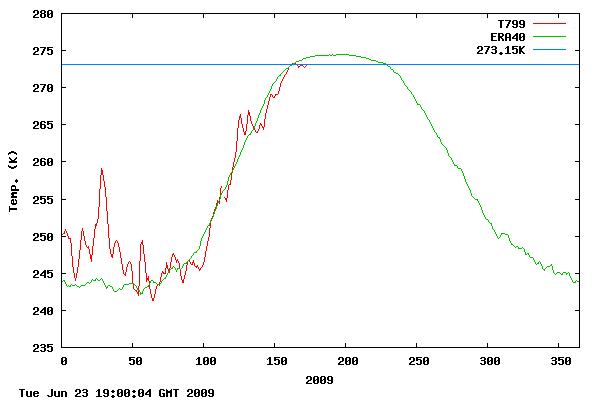
[NOTE: as a second source to Joe’s article I’ve added this weather station data from the “North Pole Cam” operated by NOAA. Link is here: http://www.arctic.noaa.gov/gallery_np.html
There is a webcam at the “North Pole” (at least it starts out very near there) that reports via satellite data uplink at regular intervals. They also have a weather station with a once weekly data plot. Note it is still below zero centigrade there.

Latest data (updated approximately weekly) Readers should note that the station really isn’t at the north pole anymore due to significant ice drift. – Anthony ]
The AMSR-E shows the ice situation on June 23rd:

See where we stand relative to recent years in terms of total extent here. We are using JAXA-IJIS AMSR-E data to track ice as NSIDC is using older satellites and the new director Mark Serreze has proven untrustworthy. The next two months will be interesting. Temperatures usually begin flatlining in late June which would suggest less ice loss, although the water temperature beneath plays a key role and all of the warm water that entered the Arctic when the Atlantic was very warm in the middle 2000s (now is nearer normal) may not have circulated out yet.
The other question is what effect the early spring Mt. Redoubt eruptions may be having. Are the sulfate aerosols trapped in the arctic stratosphere reflecting back some of what sunlight reaches the high latitudes?

Along the edge of the arctic, Ross Hays who worked for CNN and then NASA who last year posted from Antartica sent this note to me “They have me working in arctic Sweden until mid July. One of the Esrange staff members told me that so far Kiruna had had the coldest June in 150 years!”
See PDF here.
Alan the Brit
“revenge is a dish best served cooling!”
LOL!
WRT the ‘hot water’ under the ice, that seems a reasonable conclusion, since if it wasn’t hotter, it wouldn’t still be liquid…
Re Phil. (16:07:53) :
All SI units are written in lower case, unless the word would be capitalised anyway, e.g. at the start of a sentence. Kelvin temperatures should be written as 273 kelvin. If the unit is named after a person, as kelvins are, the abbreviation is captitalised, so we write 273K, 10Hz and 20W, for temperature, frequency and power, but 10m, 30s and 27g for displacement, time and mass.
HTH.
Thanks andy, sometimes I feel desperate in front of the certainty with which some people tend to affirm completely false stuff. So now, it’s not only me it’s also the whole NSDIC who’s wrong? As I said, the temperature problem is just a question of simple thermodynamics – applied correctly of course.
Anthony: I’m not insomniac, thanks. Don’t forget we don’t live in the same country :0)
John M (16:27:49) :
FWIW I’m GOP and I can’t stand Frank Luntz.
irishspecialistnurseries
One of the kiddies ?
James P
The water beneath the ice in the Artic can have a temperature between 0°C and -4 °C. The ice above (depending on air temperature, thickness, composition) between 0°C and -4°C
Since Flanagan never answered my question, I will answer it for him.
I asked if higher artic surface temperatures would be consistent with global warming. The answer of course is “yes.” If surface temperatures in the Arctic rise significantly, the warmists will say “that is exactly what is to be expected.”
And that’s one of my bigger philosophical problems with the global warming hypothesis. It’s often like astrology or bible codes. It doesn’t rule anything out in advance, it just explains things after the fact.
Is important knowledge, you must advertise your blog.
The environment must be respected and loved, even household cleaning should be done with natural products.
http://lavadoverde.wordpress.com
RE: “Given the HUGE and rather sudden downward trend in wind in the Arctic I suspect that that wind will not materialize.”
That sudden downward trend in wind is in and of itself highly disturbing.
brazil, you’re talking with yourself and are getting excited about nothing. I never even tried to relate this to global warming… So why should I justify I did so?
The water beneath the ice in the Artic can have a temperature between 0°C and -4 °C. The ice above (depending on air temperature, thickness, composition) between 0°C and -4°C
The ice can get a lot colder than that, surely? I’m not sure about the supercooled water, either, although I’m open to persuasion.
It’s not so complicated. The Arctic is in a cooling trend and the ice will increase.
Who can explain the large difference between JAXA and Nansen data?
Where does Nansen get their raw data from?
http://arctic-roos.org/observations/satellite-data/sea-ice/observation_images/ssmi1_ice_ext.png
http://www.ijis.iarc.uaf.edu/seaice/extent/AMSRE_Sea_Ice_Extent.png
“brazil, you’re talking with yourself and are getting excited about nothing. I never even tried to relate this to global warming…”
That wasn’t the impression I got. The original blog post was pointing out colder temperatures in the arctic, the obvious implication being that it’s evidence against the global warming hypothesis.
You seemed to be offering an alternate explanation — warmer water and/or increased melting, which would be consistent with global warming.
But if I misunderstood you, of course I apologize.
Don’t forget about the Sudden Stratospheric Warming event in January…
Flanagan (23:20:57) :
In any case, this experiment is quite easy to do. Just put some ice cube in a glass half-filled with (salty if you like) water and measure the temperature of the air above it while it’s melting.
Remember that you would need to have the thermometer well away from any artificial heat sources like, oh, for example, tarmac roads, airport runways, jet engines, air conditioners…
My dear old Mum was a grat fan of yours when you worked with Chesney Allen.
All together now: “Underneath the arches…”
Phil – here are some of the references from Moncton’s paper:
LORD MONCKTON
Global warming’ is No Global Crisis – Major Talking Points
Thursday, June 25th 2009, 4:37 PM EDT
Co2sceptic (Site Admin)
The warming effect of greenhouse gases is less than one-tenth the UN’s central estimate.
Spencer et al. (2008, cloud albedo); Douglass (2008, tropical mid-troposphere temperature change); Lindzen & Choi (2009 in press, outgoing long-wave radiation); and Armstrong, Green & Soon (2009 in press, zero-change benchmarking of climate forecasts) empirically confirm theoretical demonstrations (Schwartz, 2007; Monckton, 2008; Monckton & Evans, 2009 in draft) that climate sensitivity – the warming effect of all greenhouse gases, not just of CO2 – is less than one-fourth of the UN’s current central estimate. A CO2 doubling would cause just 1.5 F warming, not the 5.9 F imagined by the UN.
See http://climaterealists.com/index.php?id=3636
brazil, you really misunderstood me. I was just trying to give an explanation for the presently observed situation.
Quote: Johnny Honda (12:35:23) :
Look at that:
http://www.arcus.org/search/seaiceoutlook/2009_outlook/report_june.php
Most models predict very small arctic sea ice extent (3 of 4 a smaller extant than 2008), heuristic models predict more ice than last year.
I assume that in September we have maybe the proof, that all of these stupid computer models are WORTH NOTHING :End Quote
Your right Johnny, the models are rubbish.
That’s what comes of using linear methodologies to try and model a massively chaotic system like our climate. One day I’m sure we’ll have the capability of being able to build a good non-linear climate model, but not in our lifetimes I think.
“”” par5 (04:01:52) :
Jack Hughes (03:08:45) :
Silly question here: how do you report wind direction at the North Pole ? Every wind is from the South ?
I was thinking the same thing…. “””
Well both of you are thinking wrong; unless you can come up with a really neat explanation for what the hell happens to all of the extra atmosphere that come pouring into the north pole from the south, and never ever leaves.
Is there a Kirchoff’s law for air currents like there is for electric currents ?
There has to be some huge surplus of airt at the northpole; so just what is the atmospheric pressure right at the north pole where all that air stops.
George
“”” Tenuc (14:51:37) :
Quote: Johnny Honda (12:35:23) :
Look at that:
http://www.arcus.org/search/seaiceoutlook/2009_outlook/report_june.php
Most models predict very small arctic sea ice extent (3 of 4 a smaller extant than 2008), heuristic models predict more ice than last year. “””
Is a heuristic model any different form an ordinary wild arse guess ?
Some people want to know.
“”” James P (10:08:41) :
The water beneath the ice in the Artic can have a temperature between 0°C and -4 °C. The ice above (depending on air temperature, thickness, composition) between 0°C and -4°C
The ice can get a lot colder than that, surely? I’m not sure about the supercooled water, either, although I’m open to persuasion. “””
Well James, there isn’t any supercooled water below the arctic ice, and I wouldn’t bank on finding much 0 deg C water there either (at the north pole).
Salt water freezes well below zero C, so sub zero water is not supercooled if it is salty enough. If it is about 2.47% salinity, it freezes at its maximum density and at about -2.5 deg C. But sea water is typically 3.5% salinity, so it never has a maximum density before freezing and it freezes below -2.5 C
The floating ice however is largely fresh water, so it does melt at around zero C, so there is a temperature hysteresis, between freezing, and melting; once frozen the ice is stable till it gets heated back to zeroC.
“”” Dr Reese (19:14:00) :
Change is opportunity in disguise. Let’s forge forward and truly leave the 20th century in our dust! In the meantime let’s not wreck every ecosystem in our wake — especially the few remaining old growth forests in the Pacific Northwest.
http://DrReese.wordpress.com “””
Just clicked on your link Dr Reese. I’m not sure I would go on about the carbon credit of old growth forests.
If I am a forest left to my own ends; it seems to me that one of three things can happen to me.
The first possibility is that I can continue to gather carbon and other materials and turn them into wood; until I am just one solid block of wood.
The second option is that I could continue to lose carbon to the atmosphere, in decay, or fire, and simply evaporate and disappear.
A third option is that I could continue to absorb carbon from the atmosphere and build wood, but that rot and decay, could continue to return that carbon to the atmosphere, so that there was no net gain or loss of carbon.
Neither of the first two options has ever been observed to happen; and we have many examples of the last case; they are called “Old Growth Forests”.
Old Growth Forests, Dr Reese, are carbon neutral; unlike tree farming programs, which are net carbon sinks. Fortunately, the USA has so much tree farming; and other agriculture, that the entire USA is a net carbon sink; the only land based carbon sink on the planet (of any size).
But I am on your side; I too favor the conservation of old growth forests; but don’t try to sell that on the basis of carbon footprint; it just ain’t so.
“”” Flanagan (13:37:58) :
Mr Smith: well tried, but you won’t catch me misunderstanding thermodynamics. When ice melts, a lot of heat from oceans is used, which tends to cool sea surface temperatures. This, in turn, will in any case modify the flow of heat between water and air in the favor of liquid water. All in all, the surrounding atmopshere will tend to cool. “””
Nor I, Mr/Mrs/Miss/MS Flanagan.
You may have noticed Flanagan, that I said in my comment, that MOST of the ice surface is underwater in contact with that water.
I did NOT say that ALL of the ice surface is under water, or in contact with that water. Ergo, some of the ice surface is above the water, and is infact in contact with the air; and yes; during the period of ice melting, it is common to have the air temperature warmer than the ice; and it not unreasonable for some of the thermal energy required to melt some of the ice to come from the atmosphere, so that the atmosphere like the sea water also cools when the floating sea ice melts.
I invite your consideration of the following two part experiment; better yet, you could carry out such an experiment. the needed equipment is a thermometer to record the temperature, and a stop watch.
A good place to carry out such an experiment would be a winter/spring lake in Michigan or Wisconsin for example, and the selection of a lake, with a water temperature near zero, having floating ice on the water (broken),a nd an ambient air temperature of zero deg C. The experiment is best conducted at night so extraneous sorces of energy are absent.
Having confirmed that the water temperature, is about zero, and that ice is present, and that the still (no wind) air is also zero deg C, perform part one of the experiment.
Strip off all of your clothes, and start the stop watch. time how long it takes you to freeze to death; or get so cold that you are forced to abandon the experiment. Record that time (in the event you do survive).
Part two of the experiment is similar to part one; do all of the steps required in part one of the experiment, except before you start the stop watch; why don’t you just go and jump in the lake.
File a report here, on which stop watch reading is the smaller number.
I have already done this experiemnt; but not in Wisconsin; so I know the answer; so no cheating.
George
James P
“I’m not sure about the supercooled water,
I don’t think it’s correct to view sea water at -4 °C as “supercooled” as that’s the temerature at which sea water freezes. (Unless I’m wrong of course, and the salt is rejected in the cystalisation process and sea water freezes to fresh water ice.)
The air temperature and Sunlight are not going to melt the ice in near polar regions unless it is much warmer than freezing (say >10 deg C) due to the high surface albedo (reflection) and long wave radiation out dominating low insolation Solar absorption and air to snow heat transfer (with the exception if it gets very dirty, this may critically lower the albedo). The water temperature and flow rate under the ice totally dominate the melting. I assume if the air is especially cold (below 0 deg C), that it also implies the nearby water is also very cold, so the ice would not melt.