From Spaceweather.com
NASA’s STEREO-B spacecraft is monitoring an active region hidden behind the sun’s eastern limb.
On May 5th, it produced an impressive coronal mass ejection (movie) and a burst of Type II radio emissions caused by a shock wave plowing through the sun’s outer atmosphere. STEREO-B’s extreme UV telescope captured this image during the explosion:

Activity continued apace on May 6th with at least two more eruptions. Furthermore, recent UV images from STEREO-B reveal not just one but two active regions: image below.

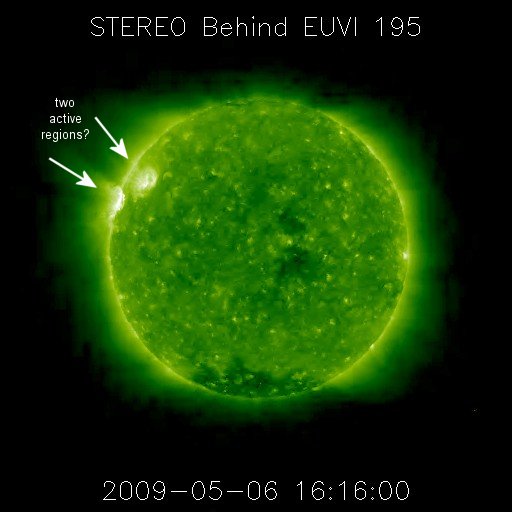
At the root of all this activity is probably a complex of sunspots. The region is not yet visible from Earth, but the sun is turning it toward us for a better view. Readers with solar telescopes should keep an eye on sun’s northeastern limb for an emergence on May 7th or 8th.
Joseph (06:01:34) : Re: ROM (03:23:30)
Has the Earth ever taken a direct hit from a CME, perhaps in pre-industrial times, say?
Slightly OT – This is reminding me of a paradigm-shifting book I read that was recommended somewhere in WUWT – no idea where! Magnetic Reversals and Evolutionary Leaps, by Robert Felix. Stunner. Classic. http://www.iceagenow.com/
Near as I can see CME’s since the solar minimum started have not disappeared. I would guess that weve had one about every 2-3 months. They have been one of the most interesting things about the sun lately. Weve had slow moving ones and large ones, and even one earth facing.. but Im going off of memory on that.
From: http://solarscience.msfc.nasa.gov/CMEs.shtml
dur… months should have been weeks as in 2 -3 weeks.
Anthony, those Coronal Mass Ejections are magnificent; “CME” does not quite capture the power, sounds something like MRE. The following comment came close though.
Alan the Brit in the IPCC (8:15): “Put another way, if the IPCC were an team of surgeons, & they said they had a low level of understanding of how the heart worked, yet they were happy to do your heart bypass operation, would you trust them to get it right? Not me guys!” The entire comment is great, both content and passion. Thanks
Leif Savalgaard, e.g., 09:05. Your generosity for the purpose of educating all of us is greatly appreciated. Like Joe Friday, “All we want are the [scientific] facts” aka “Just the facts, Ma’am”. Just doing a job, like all those other dedicated scientists putting the intellectual-scientific-con-artists behind the bars of knowledge.
Ron de Haan (08:59:00) on the Mafia-busting Italian magistrates on crooked windfarms using large sums of government [taxpayers] money: “My question:
And how is this different from any other wind power project? …There is non, except for the fact that we currently have the Mafia in Government.”
Absolutely true. A bow of gratitude to you, too.
Joseph (06:01:34) :
Has the Earth ever taken a direct hit from a CME, perhaps in pre-industrial times, say?
James A Marusek again below and as Les Francis (05:36:05) : says a somewhat long winded paper but a lot of info in there on previous massive CME events going way back into geological history.
http://personals.galaxyinternet.net/tunga/SSTA.pdf
In this paper Marusek also goes into great detail on the effects of a massive CME on our industrial civilisation and particularly provides examples and photos of the damage that run of the mill CME’s can do to the power transmission systems.
As to the power and size of the largest CME events he has this to say;
The data point on the lowest right
portion of the graph is the largest event
measured using Aluminum and Beryllium
dating from moon rocks. The graph implies
that solar storms with a fluence a million
time greater than the Carrington solar storm
are possible on a scale of approximately
once every million years.
He does go on to indicate that he thinks that this event may have been the result of a nearby super nova event but the evidence is there in the moon and earth rocks of events that vastly exceed, in power, any event that mankind has probably ever witnessed.
PaulHClark (10:02:01) :
Ron de Haan (05:04:43) :
Thanks for the link. I now see that the reference is to Miskolczi’s paper of a couple of years ago. The video says it has not been falsified but actually there have been a number of challenges to it – so I think he would need to deal with those first before we could confidently say he had disproved AGW in my humble opinion.
PaulClark,
Well, if we combine Miskolczi’s theory,
and we take this work: http://heliogenic.blogspot.com/2009/05/ocean-heat-agw-climate-models-v-reality.html
and we take Anthony’s Report on surface station here:
http://heliogenic.blogspot.com/2009/05/major-report-by-anthony-watts-on-junk.html
And we hustle a bit, I guess there is not much Global Warming left, don’t you thinks so?
And in all three cases we have left the sun out of the bucket, but that is only to do Leif a favor.
wendell krossa (11:05:14) :
Brilliant, comprehensive post….
Chris
Norfolk, VA, USA
To all the Gamesters-400 quatloos on the spot-cycle 23 Polarity,with cycle 24 latitude.
Which would make it the first cycle 25! Com’on baby needs a new pair of shoes!
It is a plage area at the moment. Look at the lower right latest entry.
http://gong.nso.edu/Daily_Images/
It is cycle 24 leading black.
Ray (10:15:11) :
what is your take on Robert Ehrlich’s Theory?
Speculative [which is not necessarily bad], but my main problem is that it is very indirect, namely that we first have to assume that the Sun controls the temperature, and then from the temperatures infer something about the Sun. It is a bit like saying that because we had the LIA we must have had a Maunder Minimum [Jack Eddy actually used that argument…]. The real proof will come when we have paleotemperatures from another planet or a moon.
Ron de Haan (18:16:23) :
“Well, if we combine Miskolczi’s theory,
and we take this work: http://heliogenic.blogspot.com/2009/05/ocean-heat-agw-climate-models-v-reality.html
and we take Anthony’s Report on surface station here:
http://heliogenic.blogspot.com/2009/05/major-report-by-anthony-watts-on-junk.html
And we hustle a bit, I guess there is not much Global Warming left, don’t you thinks so?
And in all three cases we have left the sun out of the bucket, but that is only to do Leif a favor.”
I agree with your thoughts entirely.
I think there are 2 major challenges to AGW from an evidence point of view:
1). the positive forcing that is supposed to occur in the upper troposphere is clearly in doubt see:
http://www.climateaudit.org/?p=5416
and
http://tropical.atmos.colostate.edu/Includes/Documents/Publications/gray2009.pdf
2). ocean heat as a robust metric of AGW is now showing signs of trending in a way that suggests AGW is not happening (as per the DiPuccio analysis)
What is interesting is that in both these fields the data measurements are open to much question and hence become the centre of the debate rather than having focus on what the data are telling us.
This is hugely familiar thoughthroughout the debate as Anthony’s excellent work has shown – the surface temp measures can hardly be trusted at all as well. But the system rolls on manipulating the data to suit its cause.
Hopefully soon we will get better data but somehow I doubt it.
On Miskolczi – he may well be right but others
http://www.geocities.com/bpl1960/Miskolczi.html
say otherwise and I think it would be good to see Miskolczi’s rebuttal of the questions raised.
In summary I think it will take global temperatures falling for a few more years while CO2 continues to rise before the debate is won. Interestingly if Mikolczi is right then a quiet sun should make that happen a little sooner.
wendell krossa (11:05:14) :
Recent levels of CO2 in the atmosphere have been unprecedented and dangerously low….Life evolved over the past 500 million years at levels of CO2 that were on average a more healthy 1500 ppm (see paleo-climate graphs at sites such as Geocraft.com). A dangerous upper limit of CO2 in the atmosphere would be from 5,000 to 10,000 ppm … Our atmosphere is currently “CO2 impoverished”.
Its not too good for humans:
Normal CO2 Levels
The effects of increased CO2 levels on adults at good health can be summarized:
normal outdoor level: 350 – 450 ppm
acceptable levels: < 600 ppm
complaints of stiffness and odors: 600 – 1000 ppm
ASHRAE and OSHA standards: 1000 ppm
general drowsiness: 1000 – 2500 ppm
adverse health effects expected: 2500 – 5000 ppm
maximum allowed concentration within a 8 hour working period: 5000 ppm
The levels above are quite normal and maximum levels may occasionally happen from time to time.
http://www.engineeringtoolbox.com/co2-comfort-level-d_1024.html
Rising levels of CO2 follow warming periods and do not precede or cause warming periods. See the Vostok Ice Core research at
Data from Ice cores is not year perfect and the further back in time the fewer data points are available. Check out this plot I made comparing dust ch4 co2 gisp and epica data. You will note that gisp temps start to rise 2000years after COI2 has risen and EPICA just about simultaneous temp and co2 rises (190ppm to 210ppm). Note also that the younger dryas only seems to occur in the NH.
http://img11.imageshack.us/img11/6826/iceage040kkq1.jpg
CO2 levels have been as high as 7,000 ppm in the past and no dangerous global warming occurred. During the Late Ordovician Period (some 400 million years ago) CO2 levels were 4,400 ppm and Earth was as cold as it is now.
Landmasses have moved. Ocean currents have changed, It is not sensible comparing effectively a different planet with this current state.
In the same vein, it’s not sensible to take temperatures in vastly different places take an average or mean, and call it a “Global Mean Temperature”.
Also, you’re basically saying that those other factors are the most important thing about climate, and not CO2. Thanks for confirming that.
What’s going on with the soho images. It really looks like that Coronal hole is not moving…
bill (02:52:31) :
Here’s a counter view that says the alarm you spread in your post is perhaps not correct.
http://www.ilovemycarbondioxide.com/pdf/Demonising_Carbon.pdf
Jeff Alberts (07:15:20) : etc
In the same vein, it’s not sensible to take temperatures in vastly different places take an average or mean, and call it a “Global Mean Temperature”.
I agree – so suggest some other way of measuring global warming/cooling
you’re basically saying that those other factors are the most important thing about climate, and not CO2.
CO2 is currently giving 1 (ish)degC per doubling of CO2.
So 380 760 1520 3060 6120 – four doublings == 4 to 8deg C and the CO2 level is it was a few hundred million years ago (according to geocarbsulf 3? – a computer model). Also what was NOx and CFCs etc. doing at that time. And for that matter what was the composition of the atmosphere? Change these and you get a different t vs co2 effect
An interesting document on trace gases and GW:
http://www-ramanathan.ucsd.edu/publications/Ram%20JGR%2090%20D3%205547-5566%201985.pdf
But does this logarithmic effect hold as more of the absoption lines get filled or does the temp increase flatten off further?
Jeff Alberts (07:14:06) :
In the same vein, it’s not sensible to take temperatures in vastly different places take an average or mean, and call it a “Global Mean Temperature”.
One way to combat GW [or AGW] is to argue that the object of their love doesn’t exist. This is classical rhetorics. Physically it is very sensible to compute a mean global temperature. The argument for this is simply Stefan-Boltzmann’s law that says the the total radiation from a body is proportional to its temperature to the forth power [this is valid for both black and ‘gray’ bodies with just a difference in the constant of proportionality]. Since it is sensible to collect and count all the photons emitted by the body, the total emission can be found, and therefore the ‘effective’ temperature can sensibly be calculated. We can define ‘effective’ temperature as that temperature that would give us the measured emission. It is sensible [if the body is the Earth] to call that effective temperature the ‘Global Mean Temperature’. The only question is whether the weather station or satellite data we use to estimate that temperature are good enough in coverage and/or quality. This may not be the case, but does not mean that it is not sensible to talk about a Global Mean Temperature.
PaulHClark (07:40:39) :]
From wiki
Plants can grow up to 50 percent faster in concentrations of 1,000 ppm CO2 when compared with ambient conditions.[28] Some people (for example David Bellamy) believe that as the concentration of CO2 rises in the atmosphere that it will lead to faster plant growth and therefore increase food production.[29] Such views are too simplistic; studies have shown that increased CO2 leads to fewer stomata developing on plants[30] which leads to reduced water usage.[31] Studies using FACE have shown that increases in CO2 lead to decreased concentration of micronutrients in crop plants.[32] This may have knock-on effects on other parts of ecosystems as herbivores will need to eat more food to gain the same amount of protein.[33
and
Prolonged exposure to moderate concentrations can cause acidosis and adverse effects on calcium phosphorus metabolism resulting in increased calcium deposits in soft tissue. Carbon dioxide is toxic to the heart and causes diminished contractile force.[36]
Toxicity and its effects increase with the concentration of CO2, here given in volume percent of CO2 in the air:
1%, as can occur in a crowded auditorium with poor ventilation, can cause drowsiness with prolonged exposure.[2]
At 2% it is mildly narcotic and causes increased blood pressure and pulse rate, and causes reduced hearing.[36]
At about 5% it causes stimulation of the respiratory centre, dizziness, confusion and difficulty in breathing accompanied by headache and shortness of breath.[36]
At about 8% it causes headache, sweating, dim vision, tremor and loss of consciousness after exposure for between five and ten minutes.[36]
A natural disaster linked to CO2 intoxication occurred during the limnic eruptions in the CO2-rich lakes of Monoun and Nyos in the Okun range of North-West Cameroon: the gas was brutally expelled from the mountain lakes and leaked into the surrounding valleys, killing most animal forms. During the Lake Nyos tragedy of 1988, 1700 villagers and 3500 livestock died.
… U.S. Occupational Safety and Health Administration says that average exposure for healthy adults during an eight-hour work day should not exceed 5,000 ppm (0.5%). …For …under ten minutes exposure, the U.S. National Institute for Occupational Safety and Health (NIOSH) and American Conference of Government Industrial Hygienists (ACGIH) limit is 30,000 ppm (3%). NIOSH also states that carbon dioxide concentrations exceeding 4% are immediately dangerous to life and health.[37]
…Concentrations higher than 1,000 ppm will cause discomfort in more than 20% of occupants, and the discomfort will increase with increasing CO2 concentration. The discomfort will be caused by various gases coming from human respiration and perspiration, and not by CO2 itself. At 2,000 ppm the majority of occupants will feel a significant degree of discomfort, and many will develop nausea and headaches. The CO2 concentration between 300 and 2,500 ppm is used as an indicator of indoor air quality.
Acute carbon dioxide toxicity is sometimes known by the names given to it by miners: blackdamp (also called choke damp or stythe). Miners would try to alert themselves to dangerous levels of carbon dioxide in a mine shaft by bringing a caged canary with them as they worked. The canary would inevitably die before CO2 reached levels toxic to people.
Carbon dioxide ppm levels (CDPL) are a surrogate for measuring indoor pollutants that may cause occupants to grow drowsy, get headaches, or function at lower activity levels. To eliminate most indoor air quality complaints, total indoor CDPL must be reduced to below 600. NIOSH considers that indoor air concentrations that exceed 1,000 are a marker suggesting inadequate ventilation. ASHRAE recommends they not exceed 1,000 inside a space.
It is not a “safe” gas
Leif Svalgaard (10:25:38) :
“It has been said so often that for a theory to be science it must be falsifiable. Since it is claimed that AGW has been falsified, it would seem that AGW certainly meets that criterium for being science :-)”
I take your point but I think we may have crossed lines [which is my fault given the wording I used 🙂 ]
Please allow me to try and explain:
Zagoni’s clip ends with the statement that until someone issues a paper to falsify Misklosczi’s theory then AGW is dead and that in two years no-one has issued such a paper.
The comment I made was that, “actually there have been a number of challenges to it – so I think he would need to deal with those first before we could confidently say he had disproved AGW in my humble opinion.” – meaning Miskolczi’s paper had been challenged.
The issue is can AGW be disproved/falsified? [and by implication is it science?]
First I would like to see the exponents of the AGW hypothesis specifying what the criteria would be for falsifiability. To date I have not seen them do that so one could argue that it is not science.
That said I think there are a couple of areas where we could reasonably challenge the AGW hypothesis – see my post above:
@ur momisugly PaulHClark (00:39:36) :
this would say AGW is science but would importantly put the onus on the proponents of the hypothesis to accept real world empirical evidence can disprove their theory and we can get on and measure it
I hope I have clarified what I meant but please let me know if this does not square with you?
bill (08:28:40) There is probably no compound that is safe at some unreasonable concentration. Even too much water can be ‘toxic’ if electrolytes diminish too much. To say that CO2 “It is not a “safe” gas ” is not a realistic argument. If the present concentrations were to triple, going to 1150ppm, that is still 0.11%, nine times less than causing “drownsiness”. To my knowledge, drowsiness is not a detrimental condition. Unmentioned by you is the necessity of the presence of CO2 in the lungs in order for O2 to be absorbed, it is an exchange. That is why hyperventalation is remedied by breathing into a paper bag, increasing the amount of CO2 present, allowing for more O2 to be absorbed. Without doing this, a person will pass out while hyperventalating due to lack of oxygen, then the CO2 increases in their lungs causing ‘normal’ breathing to resume. It is actually the level of CO2 in the lungs that stimulates the need to take a breath.
Oxygen gas (O2) can be toxic at elevated partial pressures, leading to convulsions and other health problems.[77][98][99] Oxygen toxicity usually begins to occur at partial pressures more than 50 kilopascals (kPa), or 2.5 times the normal sea-level O2 partial pressure of about 21 kPa. Therefore, air supplied through oxygen masks in medical applications is typically composed of 30% O2 by volume (about 30 kPa at standard pressure).[25] At one time, premature babies were placed in incubators containing O2-rich air, but this practice was discontinued after some babies were blinded by it.[25][100]
Oxygen toxicity to the lungs and central nervous system can also occur in deep scuba diving and surface supplied diving.[77][25] Prolonged breathing of an air mixture with an O2 partial pressure more than 60 kPa can eventually lead to permanent pulmonary fibrosis.[102] Exposure to a O2 partial pressures greater than 160 kPa may lead to convulsions (normally fatal for divers). Acute oxygen toxicity can occur by breathing an air mixture with 21% O2 at 66 m or more of depth while the same thing can occur by breathing 100% O2 at only 6 m.
Highly-concentrated sources of oxygen promote rapid combustion. Fire and explosion hazards exist when concentrated oxidants and fuels are brought into close proximity; however, an ignition event, such as heat or a spark, is needed to trigger combustion.[106] Oxygen itself is not the fuel, but the oxidant. Combustion hazards also apply to compounds of oxygen with a high oxidative potential, such as peroxides, chlorates, nitrates, perchlorates, and dichromates because they can donate oxygen to a fire.
Pure O2 at higher than normal pressure and a spark led to a fire and the loss of the Apollo 1 crew.Concentrated O2 will allow combustion to proceed rapidly and energetically.[106] Steel pipes and storage vessels used to store and transmit both gaseous and liquid oxygen will act as a fuel; and therefore the design and manufacture of O2 systems requires special training to ensure that ignition sources are minimized.[106]
Oxygen is NOT a safe gas.
bill (08:28:40) :
“It is not a “safe” gas”
Says more about the writer than he will ever know.
PaulHClark (08:54:01) :
I hope I have clarified what I meant but please let me know if this does not square with you?
My post was a bit tongue-in-cheek [note the smiley]. It was meant to just show how removed from reason the debate about falsifying AGW is.
Leif Svalgaard (09:30:52) :
My response was also tongue in cheek – [note the smiley] – yet it would be good to have your thoughts about the very issue of is AGW science or not?
Personally I struggle with the scientific argument about what fundamentally defines the AGW hypothesis in a way that it could be challenged empirically.
So come on – don’t leave it like this – “It was meant to just show how removed from reason the debate about falsifying AGW is.” – I respect and admire you immensely and I would very much welcome your views on these specifics:
– is the AGW hypothesis falsifiable?
– if so how?
Please understand I would very much understand if you did not want to comment.