Usually, and that means in the past year, when you look at the false color MDI image from SOHO, you can look at the corresponding magnetogram and see some sort of disturbance going on, even it it is not visible as a sunspot, sunspeck, or plage area.
Not today.
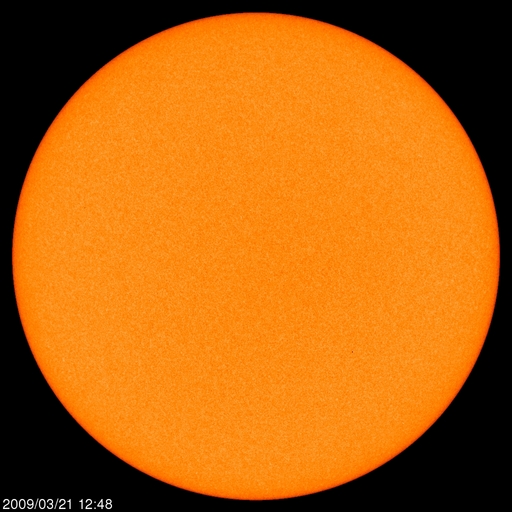
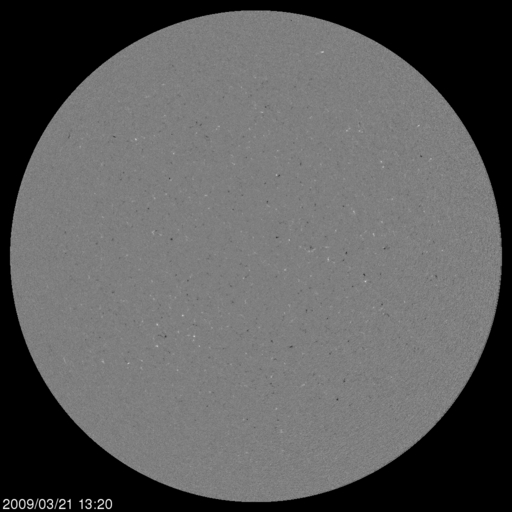
Left: SOHO MDI “visible” image Right: SOHO Magnetogram
Click for larger image
Wherefore art though, cycle 24?
In contrast, September 28th, 2001

Leif,
the BC of the bodies in the space around the Sun will move a lot
This is a crucial point I thought we agreed upon long time ago, and I really need to understand this. Is the Sun moving or is the BC moving? To simplify lets look at two systems, Sun-Earth-Moon, and GC(Galactic Center)-Sun-Jupiter. Isn’t it the Earth-Moon BC that orbits the Sun? In the same way it’s the Sun-Jupiter BC that orbits the GC, not the Sun, so the BC is the ‘fixed’ point in the solar system (moving through space of course), like Earth-Moon BC is the fixed point of the Earth-Moon system.
In the Sun-Jupiter two-body system they both orbit that system’s BC. Jupiter is accelerated by the Sun towards perihelion (if that’s the right name) and then decelerates again. Same with the Sun, Jupiter will make the Sun accelerate, just far less.
What I really need to know, seen from the GC (or actually from far ‘above’ the GC), will the picture be like Carsten’s simulator is showing, with the Sun moving around, or will you see the Sun moving at a constant speed with the BC moving around, if there were something at the BC to observe of course?
idlex (21:12:35) :
But the idea that the Earth or any other planet orbits the barycentre or SSCM is really a simplification. It’s sort of generally true, as a kind of general rule of thumb.
I agree in general with your descriptions of how things work. As you are a native English speaker, you are able to formulate these things better than I. Maybe your analysis of how different people address these issues are correct too.
Regarding the question that was raised about which point Jupiter orbits: It is a slightly odd question to me. It orbits what it orbits, it is a result and not a premise. Jupiter or any other object in the solar system do not follow intrinsically a circular or elliptical orbit, because the solar system contains more than 2 objects. These objects go where gravity takes them. But as the inner solar system is dominated by the mass of the Sun, the planetary trajectories are ‘near ellipses’ with the Sun at or near one of the ellipse focal points.
So describing the orbit of the planets using ellipses (via orbital elements or similar) is an approximation, however useful.
But, there is one thing that perhaps goes slightly against what has been said before here, and it is the following: I also used to ‘understand’ that the Earth and other planets without exception orbited the solar system barycentre (SSBC), as is evident in some exchanges with Leif a few months ago. Leif asserted that observations show the Earth follows almost exactly an elliptical orbit around the Sun, not the SSBC. I have since realized that this is true, because the Earth is close to the Sun and an object’s orbit is generally affected only by the mass inside its own orbit (the mass outside cancels out on average). To find out if it is true that the Sun is at the focal point, one could approximate the earth orbit (from astronomical observations, NOT derived from orbital elements) as an ellipse, and check where exactly the focal point falls. But observe that since the ellipse is an approximation, its focal point is an approximation too. Then do the same thing for Jupiter, if necessary. The answer will be that it is at or near the Suns centre of mass.
To illustrate further why it is not exact, pick a 3rd object, far away from the Sun. I propose “90377 Sedna” as a good candidate.
http://en.wikipedia.org/wiki/90377_Sedna
Sedna is a Trans-Neptunian object with a perihelion distance of some 76 Astronomical Units (AU), i.e. it is always far beyond Plutos orbit. For Sedna, all the mass we have considered relevant so far (Sun+8 planets+Pluto) is inside its orbit. I think if you repeat the experiment described for Earth and Jupiter above, you will find that the focal point of Sednas elliptical orbit approximation will coincide with (or be very close to) the SSBC. If you lump Sun+8 planets+Pluto into one object at the SSBC, Sednas orbit approximation will stay the same.
But does this change anything wrt. spin-orbit coupling or such? No. Pondering over approximated orbit focal points might give some insight to how gravity works, but it really isn’t a central issue.
I still do not have an answer to my question…its not a strawman, and there is a very clear reason for the question. If you dont know just say so.
tallbloke (23:07:55)
Because the matter and energy in the sun has a gradient from core to surface, the Einsteinian relativistic effect of the Jovian planets gravitation is to diferentially pull the matter of the sun north or south, creating internal pressure waves which result in the production of sunspots.
Of what Einsteinian relativistic effect are we talking about?
Special relativity? That is where the notion of “relativistic mass” and “rest mass” belongs.
As far as the general gravitational relativistic theory, where gravity is the deformation of the space time metric it makes no difference if the core of the sun is considered to have nuclei and nucleons with effective relativistic mass or rest mass. General relativity knows nothing of the quanta that are the bread and butter of special relativity. It is really a classical theory and the challenge for current physicists is to wed general relativity to quantum mechanics ( string theory is supposed to do that, but that is another story).
So, me thinks there is semantic confusion in this whole concept.
If we are talking general relativity we can conceive of gravitational waves originating from Jupiter in some way ( one would have to feed energy into this somehow) and impinging on the sun, and creating gravity waves ( usually called tides with the energies available) . Stronger effects than the gravitational tides are science fiction at the moment. General relativity could care less if the sun is a ball of furious photons or an inert crystal.( except for the aforementioned tide, which are small).
Special relativity could care less if there is a Jupiter and a gravitational wave coming from there at the plasma or whatever the core of the sun is.
btw,
: tallbloke (22:40:57)
My judgement is that you are out of your depth with questions about relativity, and will be keeping the salt pot on hand from now on.
I am a particle physicist and I think that to tell somebody at the level of Leif’s knowledge that they are out of their depth about relativity is at least funny. Relativity is the sine qua non for astrophysics.
anna v (22:36:15) :
One can always reduce any many body problem to a two body problem, by taking center of masses and total mass into two effective bodies, so there will always be the analytical solution. This does not mean that the solution for the individual bodies has been found.
The confusion starts when the many body problem is attributed to orbits for each object similar to the two body problem. There it is easy to double count by hand waving, which cannot happen if you set up an iterative numerical solution in a computer as you have done.
You have set out in various messages (anna v (21:32:16) : anna v (08:28:41) : anna v (08:17:49) 🙂 on this thread the analytical approach. As best I understand your proposed successive approximation, this would entail taking the solar system with a sun and 9 planets, and regarding it as 10 two-body problems, which can be solved. So you go away and get the analytical solutions to these 10 problems. And each of these solutions describes an elliptical orbit of some sort. And then you have each body go a bit of the way round their respective elliptical orbits, and then consider the new situation, where everything has moved, and another 10 two-body problems appear. And so you solve all these, and get another 10 ellipses. And you move each body part way along their new elliptical paths. And so on. The net result is that each body in the system is moves along a path which is made up of a series of short arcs of different ellipses. Each body is always moving along an elliptical path with the centre of mass of all the other bodies at one focus, but the succession of elliptical arcs will not itself be an ellipse. It will be some path made up of lots of bits of different ellipses. Right? (Bearing in mind that I myself don’t know how to d elliptical orbits of two-body
I can’t see where the confusion may creep in here by double-counting.
anna v (11:00:48) :
There is no reason the solutions would not work. It would be a different way of looking at it and generating successive approximations.
That seems to suggest that this is a way that the problem might be solved, and so perhaps not how it usually is solved?
Carsten Arnholm, Norway (03:08:38) :
As you are a native English speaker, you are able to formulate these things better than I. Maybe your analysis of how different people address these issues are correct too.
I’m certainly able to express ideas in English. But that doesn’t mean I have anything worth saying!
I was trying to understand how Geoff Sharp thinks about the motion of bodies in a complex system like the solar system, and to see what his disagreement with Leif was all about. But I think this may be beyond me. It’s hard enough dealing with my own limited incomprehension, never mind somebody else’s.
Geoff Sharp (04:56:50) :
I still do not have an answer to my question…its not a strawman, and there is a very clear reason for the question. If you dont know just say so.
Well, I for one don’t know the reason for the question. And I don’t know who is being asked this question either.
tallbloke (12:48:34) :
“Most of the Sun’s mass is in the core. It’s not a small fraction.”
Depends how you define the core. We are not necessarily talking about a mass or volume contiguous with what is defined as the core in other contexts. The amount of mass moved, how far and the gradient’s steepness are still open questions.
Sure, if I define the ‘core’ to be the mass within a cubic inch at the south pole, I’ll get a different answer. And since the displacement 140m is already assumed, it seems hard to argue that there are open questions about what causes it [how much mass move how far].
Where you made an assumption and an a priori judgement (and flung insults around based on them), I have demonstrated mathematically that the effect on Mercury and Venus’ orbits is negligibly small, and shot down your canard. Duck soup anyone?
no mathematics is needed. If the Sun suddenly jumped 300m ‘vertically’ with respect to Mercury’s orbit, Mercury would jump 300m too. But perhaps you don’t mean that, but only that the Sun expanded in all directions by 300m, in which case there will no effect, neither on Mercury nor on the Sun in terms of horizontal displacements.
This is nothing to do with the suns speed relative to anything, but to do with it’s internal temperature, which by the way, and to lay to rest your other canard about candles and kettles, is around 10 million kelvin.
The energy generated per kilogram is 0.0007 W [you generate 1.2W/kg] as I showed or 34 W in a volume of 1 cubic meter.
would propogate around the sun to maintain it’s sphericity. What is the standard model explanation for the corrugations please Leif?
They are hot material welling up near strong magnetic fields in active regions. Take away the magnetic field and the corrugations go away too.
Geoff Sharp (04:56:50) :
I still do not have an answer to my question…its not a strawman, and there is a very clear reason for the question. If you dont know just say so.
The reason for the question, please. My personal opinion should have little influence on what the planets do, lest we overdo the astrological consequences.
tallbloke (12:48:34) :
would propagate around the sun to maintain it’s sphericity. What is the standard model explanation for the corrugations please Leif?
Checking the data I may have given the size of the corrugations as too small if half a kilometer is what was mentioned. The precise measurements by the RHESSI satellite place the height at 0.010 arc second which is 7.2 km.
The ordinary solar granulation consists of near surface convections cells where the material move up in the middle of the cell, then horizontally to the edge, and finally down at the edges. The size of a cell is 1000km [1000,000 meter] and the speeds are of the order of 1 km/s [1000 m/s]. There are ~10 million of such cells at any given time. Contrast that to the 140m.
In all of this discussion nobody has used the word “geodesic”. I’m not about to expound (we have google) but in modern thought, bodies do not orbit, they follow geodesics which are straight lines through gravitationally curved space. As evidenced by the precession of Mercury, all of these calculations involving Newton’s law are themselves approximations.
idlex (05:59:08) :
I have not set up a numerical solution to the many body problem. You have.
I was just saying that a reduction to a two body problem is a first approximation, and as an answer to “what does the sun orbit”. I’d really need to put my thinking cap on to see how to go on from there. I think If I really were writing a program I would start with the heaviest and the sun, and add the next one and the next one as perturbations.
The double counting does not come in the numerical integrations. It comes when people handwave and say “Jupiter this” and “Saturn that”, without doing any calculations, having in mind images of orbits.
As both you and Carsten have shown, calculations show zero changes in angular momentum in the total system.
anna v (07:54:03) :
As both you and Carsten have shown, calculations show zero changes in angular momentum in the total system.
That we knew, of course, but more importantly that the Sun’s AM around the BC is precisely offset by the planet’s, so that no ‘extra’ AM is available for spin-orbit coupling [which couldn’t happen anyway due to lack of a coupling mechanism]. This is the point that was under discussion. If proponents of the correlations still consider them viable, they must now go search for a different mechanism. Progress happens when we can lop off branches of the ‘decision tree’ and the AM spin-orbit mechanism can now be lopped off and that is what all need to acknowledge so that ‘progress’ may be made along a different branch.
pochas (07:23:45) :
As evidenced by the precession of Mercury, all of these calculations involving Newton’s law are themselves approximations.
But they are good enough for this, and the precession of Mercury is only 0.43″ per year and Mercury’s contribution to the center of mass is negligible anyway.
Is it all in the orbital resonance?
Dr. Svalgaard
By altering the form of the equation, and limiting it to short periods as defined with the inequality
-0.1< COS[2pi(t-1941)/118] + COS[2pi(t-1941)/96] < 0.1
the point could be made in more obvious manner
http://www.geocities.com/vukcevicu/Anomalies.gif
Thus defined periods isolate consequential part of the graphical representation as shown with purple colour.
When the above inequality is satisfied, a long minimum will occur (Maunder, 1810, 1913), alternating with cycles reduced by about 30% in the amplitude relative to the neighbouring once (on each side inclusive) SC1, 9 & 19 ( not to be confused with low cycles occurring as a part of the general trend).
Two factors are rounded off (118 = approx 4*S or 10*J ; 96 = approx J+U or even 8*J=94.9, whatever combination used, out of 4 possible, only significant change is the part of the Maunder min graph, but still very clearly identifiable. 118-96 = 22 years , one Hale cycle. Length of each lobe (including total of two within M.min) is 52-3 (period 105-7) years, depending which combination is used (a previously not defined short term solar V-cycle (?!), the next one above Hale; 1.5V= 52+26=78= Gleissberg cycle.
Next zero crossing is due around 2024-25, and a prolong (Maunder type) 2180-2240, fortunately for the last one I will be elsewhere, so you want be able to prove me wrong (unless we meet on the “happy hunting grounds” blog).
vukcevic (08:59:09) :
Thus defined periods isolate consequential part of the graphical representation
and hide what doesn’t fit…
Happy cyclomania, here and on those hunting grounds, eventually.
A question I have asked before: how do your cycles agree with nobrainer’s ?
Leif Svalgaard (09:25:03) :
to
vukcevic (08:59:09) :
Thus defined periods isolate consequential part of the graphical representation and hide what doesn’t fit…
That is a total (accidental or deliberate) miss-interpretation of the argument.
We do not get sound vibrations from a bell until it is hit by the hammer (distance between two reaches zero value ).
We do not get solar cycle anomalies (“vibrations” within train of solar cycles) unless planetary orbital resonance generates an impulse as defined by the sum of two factors
COS[2pi(t-1941)/118] + COS[2pi(t-1941)/96]
i.e reaches zero value.
I was hopping for a more constructive (science based) critical comment,
but thanks anyway.
A question I have asked before: how do your cycles agree with nobrainer’s ?
I have no knowledge, method or time to go into proper appraisal of other contributors’ ideas, since you do that far better then I ever could.
vukcevic (10:16:55) :
We do not get sound vibrations from a bell until it is hit by the hammer (distance between two reaches zero value ).
We do not get solar cycle anomalies (“vibrations” within train of solar cycles) unless planetary orbital resonance generates an impulse as defined by the sum of two factors
I was hoping for a more constructive (science based) critical comment
But before it is even worth entertaining such an approach it must be shown that there is good reason to do so, and the curves you present[ed] [before removing some of it] do not IMHO establish that there is something worth investigating. I believe this to be a science based judgment. It is not constructive since there is no foundation on which to build.
,
but thanks anyway.
vukcevic (10:16:55) :
“A question I have asked before: how do your cycles agree with nobrainer’s ?”
I have no knowledge, method or time to go into proper appraisal of other contributors’ ideas, since you do that far better then I ever could.
This is a ‘cop out’ answer as you do have the knowledge to compute the times where your curve goes to zero and you do have the time [since you have the time to visit this and other blogs], and you do have the method as it is simply a listing of the times of minima followed by a listing of nobrainer’s minima for, say, the last 3000 years [only about 30 values]. You should have the motivation too as you are pushing a theory. I have little motivation as I think it is not worth it, but presumably you think your theory is worth it [I could be wrong on this 🙂 ]
tallbloke (23:22:22) :
on Ray Tomes, he did actually consult with world leading experts on GR in the formulation of his theory.
And here is what Ray says about that:
“I have generally had little joy with GR experts. I find that they often say things like “but that bending of light is half due to gravity and half due to the metric” or something similar. When I ask did the vector of the light change by 1 or 2 as a result of passing near the Sun they go quiet. I don’t think that that sort of words helps.”
Apart from the problems he is having the GR, there are other equally problematic issues:
Ray’s fundamental thesis is that [in his words]:
“GR effect by planets on radiation and relativistic matter in the Sun’s core causes slight convection cells in the solar interior leading to a varying amount of heat reaching the surface and to the production of magnetic fields”.
The solar interior is stable against convection and cannot [and therefore does not] convect. The condition for convection is only met in the convective zone, so no convections cells from the core. You can learn more about the interior [and about what we hope to learn from the SDO satellite].
Unfortunately, one cannot see what the outcome at bautforum turned out to be as Ray seems to be banned from the site…
Leif Svalgaard (11:36:02) :
You can learn more about the interior [and about what we hope to learn from the SDO satellite].
from this link: http://esa-spaceweather.net/spweather/workshops/esww/proc/thompson.pdf
Leif Svalgaard (10:37:29) :
vukcevic (10:16:55) :
…it must be shown that there is good reason to do so, ………… establish that there is something worth investigating.
Babcock-Leighton theory does not explicitly tell us why Maunder or Dalton type minima occur or why there are prolonged minima at 1810 and 1913, why medium size SC19 was slotted between two strongest cycles ever.
I could not think of a better reason within solar periodicity (except understanding why cycles happen at all), than to attempt to find out why these anomalies do take place.
My conclusion is:
Planetary orbital resonances generate impulses at specific times as defined by equation:
COS[2pi(t-1941)/118] + COS[2pi(t-1941)/96] = 0
resulting in anomalies within the solar cycles sequence.
and shown (not to scale) in
http://www.vukcevic.co.uk/Anomalies.gif
http://www.geocities.com/vukcevicu/Anomalies.gif
Two factors are rounded off (118 = approx 4*S or 10*J ; 96 = approx J+U or even 8*J=94.9, whatever combination used, out of 4 possible, only significant change is the part of the Maunder minimum graph, but still very clearly identifiable (118-96 = 22 years, one Hale cycle).
vukcevic (12:16:15) :
Babcock-Leighton theory does not explicitly tell us why Maunder or Dalton type minima occur or why there are prolonged minima at 1810 and 1913, why medium size SC20 was slotted between two strongest cycles ever.
B-L theory easily does that [and in several incarnations of the theory]. I think Figure 2 of Dikpati’s paper http://www.leif.org/research/Dikpati-Prediction-2005GL025221.pdf clearly shows that. I come to the same result using the very weak polar fields observed in 1965 [to the extent they could even be observed directly – below the noise level], so although the B-L theories are still hashing out the details [and boundary conditions], the theory itself has no problem with SC20.
attempt to find out why these anomalies do take place.
These are not anomalies anymore than rain in London on Tuesday is an anomaly because it didn’t rain Monday or Wednesday.
The build up of the polar fields is observed to be a rather random process because it is observed that only a handful of ‘surges’ of magnetic flux are getting to the poles [1/1000 of the total].
But that is not the main reason your formula has no use. The main reason is that it is not particularly good, in spite of your persistent claims that it is. Spend some time on comparing your retrodictions with nobrainer’s to get a feel for what poor correlation looks like.
Leif,
That we knew, of course, but more importantly that the Sun’s AM around the BC is precisely offset by the planet’s, so that no ‘extra’ AM is available for spin-orbit coupling
What kind of logic is this? The Sun’s AM varies from 0 to 4.0E40 almost
If it’s not transferred from the planets, where else can it come from than from the Sun’s own rotation?
vukcevic (12:16:15) :
Babcock-Leighton theory […] why medium size SC20 was slotted between two strongest cycles ever.
Let me try to make Dikpati’s result [which is part of a physical model using the induction equation on a realistic solar interior] intuitively clear to you. In her model the poloidal magnetic field from several [2 or 3] solar cycles are present at depth at the same time in the dynamo scheme, but these fields have opposite polarities from cycle to cycle and counteract each other, so two or three strong cycles invariably results in a small or medium cycle [a la SC20 after SC18 and 19, and SC10 after SC8 and 9, and SC5 after 3 and 4]. So, from her model, there is no anomaly. This is but one example. In my scheme there is no anomaly either.
Carsten Arnholm, Norway (03:08:38) – “[…] But as the inner solar system is dominated by the mass of the Sun, the planetary trajectories are ‘near ellipses’ with the Sun at or near one of the ellipse focal points. […] […] Leif asserted that observations show the Earth follows almost exactly an elliptical orbit around the Sun, not the SSBC. […] […] […] focal point […] is at or near the Suns centre of mass.”
Thank you Carsten. If anyone can point me to where Leif said that, I will be grateful – this is important.
Carsten – “But does this change anything wrt. spin-orbit coupling or such? No. Pondering over approximated orbit focal points might give some insight to how gravity works, but it really isn’t a central issue.”
This is an insightful comment, as it highlights that we are not all looking at this discussion through a “spin-orbit” lens. For some of us, spin-orbit coupling is not at the gravity centre of our minds today.
– – – – – – – – – – – – –
pochas (07:23:45) – ““geodesic” […] in modern thought, bodies do not orbit”
Thank you for bringing this up pochas.
One of the challenges in an interdisciplinary discussion is that we bring different dialects from our respective backgrounds. For example, I use the term ‘orbit’ the way it is used in chaos theory. What I am finding really interesting in this discussion is that many are so unwilling (it seems) to consider the time-integrated properties of ‘orbits’ – but I realize not everyone has been hammered by the same paradigm-shifts that have rippled through disciplines in which I have studied & researched in the past.
Interdisciplinary discussions are the best kind. Thank you for sharing.
– – – – – – – – – – – – –
Vukcevic: Thank you for reminding us to not allow excessive focus on amplitudes to swamp our attention to the (arguably more important) issue of phasing.
I get your point about null points and resonance – this is, in my view, the salient point for readers to take away (trying to put any cyclo-phobia aside for a second, if possible) from what you (from an electrical engineer’s perspective) have introduced to this discussion.
– – – – – – – – – – – – –
In response to tallbloke (00:15:13)
Thank you for your comments tallbloke.
I don’t have time for books, but if there is a related research article online I’ll be grateful if you can share the link.
A related article is:
http://icesjms.oxfordjournals.org/cgi/content/full/63/3/401
(full article is available free – online – both html & pdf)
I’m not saying I agree with the interpretation & conclusions – in fact I have strong reasons to suspect confounding based upon other research in which I have participated. Nonetheless, it is important that ideas like this get through, as they provide stimulating context that advances the starting frame of subsequent discussion.
– – – – – – – – – – – – –
In response to Leif Svalgaard (21:50:20) – regarding UV variation over solar cycles:
There is more to the story according to my understanding — but I have no interest in digging through files to find the references at this time – perhaps another day.
– – – – – – – – – – – – –
Leif Svalgaard (08:16:15) – “Progress happens when we can lop off branches of the ‘decision tree’ and the AM spin-orbit mechanism can now be lopped off and that is what all need to acknowledge so that ‘progress’ may be made along a different branch.”
As I’ve said above Leif, this hasn’t been given the thorough treatment that will put it to rest for all parties involved in the discussion – and I’m not just speaking of sociological momentum. I expect some will want to probe what happens when the planets and the sun are not treated as simple points, but rather as rotating balls of layers of spatiotemporally-heterogeneous viscous non-idealized fluids with non-laminar boundary conditions, etc., etc., etc., etc. I don’t think you can stop these people with rational ideas based on today’s conventional thinking — but it is perhaps good that they run into someone like you because it helps them learn about how they might adjust their lines of inquiry & presentation.
– – – – – – – – – – – – –
Leif Svalgaard (11:36:02) – “Unfortunately, one cannot see what the outcome at bautforum turned out to be as Ray seems to be banned from the site…”
There is a note about that – posted at
http://ray.tomes.biz/b2/index.php/a
Sounds like some pretty messy politics.
– – – – – – – – – – – – –
Geoff Sharp (04:56:50) – “I still do not have an answer to my question…its not a strawman, and there is a very clear reason for the question. If you dont know just say so.”
Leif Svalgaard (06:18:34) – “The reason for the question, please.”
Following this with interest…
As both you and Carsten have shown, calculations show zero changes in angular momentum in the total system.
The figures I have from Carsten show total angular momentum for the solar system as constant at 3.12621E+043 over 2 months in 1940. My own figures ( which don’t include Pluto like Carsten’s do) give it as 3.13285E+043 and constant over 20 years from 1940 onwards, with some variation after the 5th decimal place. My data for 2000 years seems to be the same, but is rather noisy.
Paul Vaughan (13:08:44) :
Leif asserted that observations show the Earth follows almost exactly an elliptical orbit around the Sun, not the SSBC. […] […] […] focal point […] is at or near the Suns centre of mass.”
Thank you Carsten. If anyone can point me to where Leif said that, I will be grateful – this is important.
not quite what I showed. An earlier discussion on this blog was about if the Earth-Sun distance in any way was influenced by the barycenter and the result was that it was not. This has nothing to do with orbits or ellipses. Carsten’s [and other’s] argument at the time was that if the Earth is orbiting the barycenter then if the barycenter was on the opposite side of the center of the Sun than the Earth, the distance between the Sun and the Earth should be less [by several solar radii] than when the barycenter would be on the same side as the Earth. The highly accurate JPL ephemeris showed that it makes no difference to the distance where the barycenter was. For people that would not accept that astronomers know how to calculate orbits [that was one of the objection – that it was all approximate or based on assumptions or whatnot] we offered an observational test: the total solar irradiance TSI depends on the distance [squared] and our measurements of TSI are now so precise that they confirm the ephemeris [ http://www.leif.org/research/DavidA10.png and
http://www.leif.org/research/DavidA11.png illustrate the barycenter prediction and compares with observations]
As I’ve said above Leif, this hasn’t been given the thorough treatment that will put it to rest for all parties involved in the discussion – and I’m not just speaking of sociological momentum. I expect some will want to probe what happens when the planets and the sun are not treated as simple points…
The JPL ephemeris calculations do not treat the bodies as points but takes into account the physical characteristics of the bodies as far as they are known to have influence on the ‘orbits’, but that is not really the point, which is that after THAT has been taken care off, then there is the distribution of matter in the Galaxy, and after that, the movement of the Galaxy and interaction with other galaxies, etc. This will never end because it is not fact-problem, but a belief-problem. The best we can hope for is that the discussion be taken to sites devoted to such things.