Usually, and that means in the past year, when you look at the false color MDI image from SOHO, you can look at the corresponding magnetogram and see some sort of disturbance going on, even it it is not visible as a sunspot, sunspeck, or plage area.
Not today.
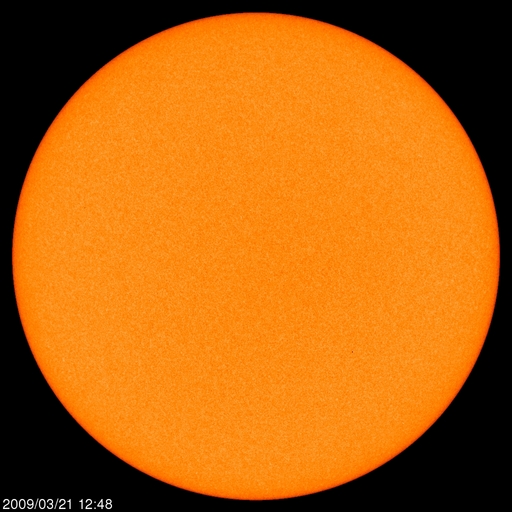
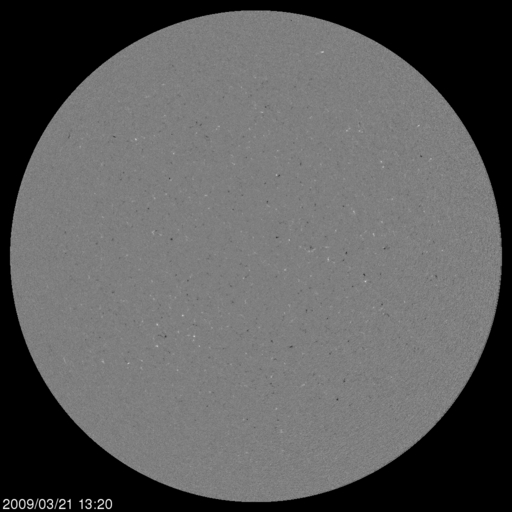
Left: SOHO MDI “visible” image Right: SOHO Magnetogram
Click for larger image
Wherefore art though, cycle 24?
In contrast, September 28th, 2001

Geoff Sharp (01:49:57) :
So here is a question we need to get a solid answer on….we have 400 years of Astronomy to fall back on.
WHAT POINT DO THE JOVIAN PLANETS ORBIT?
My naive physicist’s take on this question:
I think this question can only matter so much to you to put it in capital letters because you have Jupiter in an elliptical orbit with the Sun or SSB at one focus of the ellipse. And I’ll guess that’s how you work out the orbits of the various planets. I can’t see any other reason for wanting to know where this point is.
It seems to me that there are two ways of working out the orbit of a planet [somebody shoot me down if I’m wrong, please].
The first is way might be called the classical or Keplerian method, which entails placing one body at the focus of an ellipse, and another body going round that ellipse. I believe such 2-body systems can be fully described using a number of Orbital Elements. I don’t know for sure because I’ve never tried working out orbits this way. But I think this is what astronomers do as a matter of course when they come across some new asteroid or comet in the solar system.
This is the mathematically elegant way of doing things. But it only works for a 2-body system. But the solar system is an n-body system. Anna V was proposing upthread an interesting way of breaking down the n-body solar system into component 2-body systems, each of which could be solved, and getting an answer by successive approximations. And maybe that would work. I don’t know.
The other way of finding out what the orbit of a body is to forget all about ellipses and foci and so on, and instead compute the forces acting on each body due to gravitation, and their acceleration and speed, and finally their position after some interval of time. This is not mathematically elegant at all. It involves millions of calculations. It’s a brute force solution. Nobody would do things this way if they didn’t have computers to carry out all those millions of calculations.
Now, I believe that the way it’s done at, say, NASA, is to use both of these methods. First an elliptical orbit is worked out using orbital elements to give a good notion of what it will be. And then the whole problem is fed into a supercomputer somewhere to do the brute force solution over a week or two. And the result will be very like the ellipse calculated using the orbital elements, but it won’t be exactly the same. There’ll be little jiggles and wobbles as an orbiting body gets near some other body along the way. And the orbit won’t be an exact perfect ellipse. And it will be a more accurate description of the orbit than one described by an ellipse.
And the method I use in my simulation is the brute force method. There are no ellipses in my simulation. No foci. No barycentres or nodes or semi-major axes. There are just two or three simple equations which get solved about a hundred million times. And it has to be mathematically simple because I’m no great mathematician. Or rather, I have an, um, reduced instruction set.
And it seems to me that the divide between the barycentrists and their sceptics is the division between the classical Keplerians and the brute force computer simulation modellers. One bunch sees the orbital problem in terms of ellipses and foci. The other sees the orbital problem in terms of forces and accelerations. A lucky few can see things both ways. Or maybe only the unlucky few can see things one way only.
And I’m one of the unlucky, one-eyed few who only sees things in terms of forces and accelerations, and who builds computer models to produce brute force solutions. I never think about ellipses and foci and barycentres unless I have to. And the question “What point do the Jovian planets orbit?” is a meaningless question for me. For as I see it, there are only the planets, the forces of gravity working on them, and their consequent motion. They don’t ‘orbit’ about any ‘point’. Or if they do, that’s what drops out at the end of all those millions of calculations, not something I start with.
If the Keplerian barycentrists want a two-eyed view, they will build themselves inelegant, brute force simulations of orbits. And to myself learn how to become a Keplerian, I should do what Kepler did, and try and fit the orbits coming out of my simulations with some geometrical figure, like a circle or an oval or an ellipse.
And maybe I’ll try to do exactly that sometime.
Leif Svalgaard (05:17:14) :
tallbloke (23:22:22) :
Will SDO be able to detect small changes in temperature at the poles of the sun Leif? As small as say 20K?
I believe 1K or better, but could check on this if you can give me a reason that might be important. I think you might actually mean if SDO can detect a systematic difference between pole and equator rather than just fluctuations at the pole.
I asked because a possible test for the Tomes theory would be a fluctuation in the pole temperature alternating with the opposite pole. he estimated around 20K. I don’t know enough to know whether this might be swamped for some other reason.
tallbloke (07:49:05) :
wow, lots to cover. Ok, in the secondary thread on the sun’s radiant energy, there is an interesting exchange:
which just shows how confused Ray is. Now add to the 400 km/s the 225 km/sec around the center of the Galaxy and the 600 km/s relative to the Cosmic Background Radiation, and …
But it is all irrelevant because the orbits of Mercury and Venus and the observed oblateness of the Sun show that the solar core is not wiggling around.
this is a spurious correlation without having to consider it. Or even see it.
Bring it on.
The way you have snipped the quote gives me a sense of foreboding. I’ll keep my powder dry for now and improve the work. Besides, my phone line came down in the wind last night and I can’t upload it over the mobile phone I’m using as a modem as the mobile network blocks the ftp port number.
idlex (07:50:22) :
build themselves inelegant, brute force simulations of orbits. […] simulations with some geometrical figure, like a circle or an oval or an ellipse.
Astronomers [incl. JPL] use the brute force method. There are no orbits in the system, just bodies interacting. The result of the brute force approach is a HUGE file of positions. The data in this file is now fitted to a system of ‘epi’cycles [rather much like the old Greeks did] and the data is expressed as sums of hundreds of cosine waves. The simplified version for Mars [that Jean Meeus gives] contains 238 such cycles.
Geoff Sharp (07:07:05) :
“The angular momentum of the four planets do not depend significantly on where they are [together or opposed]. Move Uranus in by one solar radius and its AM changes from 5.47% to 5.44% of the total.”
What an unbelievable statement, with respect I think you may be out of your depth on this topic.
One last time: to calculate the angular momentum one takes the distance [for Uranus 4134 solar radii], multiply by the speed [6.8 km/s], and finally multiply by the mass [14.5 times the Earths]. Never mind the units are funny, the result is the same: if you move Uranus one solar radius out [typical for BC movement] the distance increases by a 1/4134 part and AM would increase by a similar small fraction. Actually, only half of that as the speed decreases a bit when Uranus is further out. So, the changes in the AM of Uranus [and any and all of the planets] caused by the BC moving around are VERY VERY small.
Your ‘unbelievable’ bit is just a reflection of the depth of your ignorance. Being ignorant is no shame, but refusing to learn is.
tallbloke (07:58:02) :
a possible test for the Tomes theory would be a fluctuation in the pole temperature alternating with the opposite pole. he estimated around 20K.
measured where? at what depth or height in the atmosphere?
Dr. Svalgaard
You frequently commented and rejected validity of my formulas be it polar fields or sunspot periodicity and amplitude envelope correlation.
I did a quick search of all comments, and I could not find any relating to what I call solar cycles’ anomalies formula.
http://www.geocities.com/vukcevicu/CycleAnomalies.gif
Here we have many degrees of freedom, but there is still a significant factor of “coincidence” that near zero values of this particular equation, relatively accurately pinpoint most of the anomalies within the train of known solar cycles, and surprisingly even Maunder minimum.
Please note, important time periods here are those when the two factors are (or near) equal but of opposite sign, the rest is of a little influence (kind of a hyperbolic response to it). An interpretation here could be: at certain times effect of factor A is cancelled out by factor B, resulting in an anomaly.
Two factors are rounded off (118 = approx 4*S or 10*J ; 96 = approx J+U or even 8J=94.9, whatever combination used, only significant change is part of the Maunder min graph, but still very clearly identifiable). Length of each lobe (including sum of two within M.min) is 52-3 (period 105-7) years, depending which combination is used.
Therefore, if one is to take all this literally (?), it could be concluded that there is a 52-ish or 106-ish years period within the solar cycles.
I am looking forward to your comment. Do your most severe!
I am opened for any clarifying questions, but shall not contradict your observations, which may be used as guide for a further assessment of this particular equation.
vukcevic (08:36:05)
Additional detail 118-96 = 22 years , one Hale cycle.
http://www.geocities.com/vukcevicu/CycleAnomalies.gif
Geoff Sharp (06:16:49) :
I dont have any figures, that work has been done and you seem to be re inventing the wheel.
If you don’t have any figures, how can you possibly tell Leif Svalgaard’s figures are wrong?
Geoff Sharp (21:33:57) to Leif Svalgaard (20:21:34) :
The only AM movement calculation that is important is that which affects the Sun, anything else is not relevant when discussing planetary theory as I have laid out. Your figures are wrong but you refuse to admit it.
I’ll ask again: what do you calculate solar angular momentum to be in early 1940 or 1941? Or any date you care to name?
And yes, I am re-inventing the wheel. I’m doing something that’s already been done many times over. I’ve been getting my hands dirty by trying to do it myself, rather than leave it to other people. I somehow find that doing things that way, I end up learning quite a lot of surprising things I didn’t know before. My little re-invented, home-made orrery has been quite a revelation since I constructed it. It still seems like a bit of a miracle that the planets really do go round in things that look like circles or ellipses (I haven’t checked which). I think that one of the surprises was simply to get an idea of the sheer scale of the solar system, how big it all is, how small the planets. The pictures of it in books, I realised, don’t really quite do it justice.
Carsten’s and Carl’s work show when the sun is dead centre on the SSB and at the same time the Sun experiences zero angular momentum, we have S/N/U together with J opposed. You and Svalgaard cannot walk away from those real world observations
Is the Sun ever dead centre on the SSB? I can’t see how that can happen while there are 4 massive planets pursuing separate orbits around it. I know that the Sun gets quite near the SSB on occasions, but dead centre? I’ll have to wind up my little orrey and look.
And thanks for placing me together with Leif Svalgaard. I don’t deserve such a high honour. I am, at best, a minor asteroid on which his sun exerts a little force, deflecting me slightly in my path. And I should hope not to get too near, because he shines 200,000 times more brightly than the Sun.
Here are some other interesting numbers for you: the energy production of the Sun is 0.3 W/m3, or 0.000006 W/kg. As I sit here in my chair my internal metabolism produces 1.2 W/kg, so is 200,000 times more efficient than the nuclear fusion in the Sun.
Leif Svalgaard (08:13:37)
The data in this file is now fitted to a system of ‘epi’cycles [rather much like the old Greeks did] and the data is expressed as sums of hundreds of cosine waves.
Really? How astonishing! I suppose that it must be a way to compress the data in that huge file. But how strange that the way they should choose to do it is with something that sounds so like the Ptolemaic approach of wheels within wheels in the turning celestial sphere.
One of the little revelations that has come out of my little orrery has been to be able to see the solar system through the eyes of the pre-Copernican Ptolemaic astronomers, simply by plotting the motion of the sun and planets around a stationary Earth. It’s very pretty. Some of the orbits look like flowers. I might try one day to construct my own system of epicycles to explain the phenomena, just like they did. And publish it as my Almagest. Perhaps complete with a suitable error half way through it which will render it useless.
idlex (09:34:31) :
The data in this file is now fitted to a system of ‘epi’cycles [rather much like the old Greeks did] and the data is expressed as sums of hundreds of cosine waves.
Really? How astonishing! I suppose that it must be a way to compress the data in that huge file
That is basically the reason. The initial set of cosine waves come from theory [any formula can be expanded as such a set – Vuk take note :~) ] but the fit incorporates the integration [and even some bits of observation – of some of the boundary conditions, masses, radii, etc]
I believe Carsten used the cosine sums given by Meeus. This is important because then you two use completely different methods, and the agreement becomes trustworthy.
idlex (09:05:55) :
because he shines 200,000 times more brightly than the Sun.
I’ve downsized to 1765 times 🙂
The goal of the rough calculation was, of course, just to point out how feeble the solar furnace is.
Leif Svalgaard (10:29:10) :
I believe Carsten used the cosine sums given by Meeus. This is important because then you two use completely different methods, and the agreement becomes trustworthy.
That’s interesting. How well (or how badly) do our results compare?
idlex (11:44:29) :
“I believe Carsten used the cosine sums given by Meeus. ”
That’s interesting. How well (or how badly) do our results compare?
At first blush it looks pretty good. I haven’t had time yet to do an in-depth analysis. Patience.
Fellow bary-eccentrics,
I’m missing a mechanism for transfering AM from the planets to the Sun. There must be a bearer of all that energy. Is it gravity, magnetism, a new undiscovered force? The last I’m afraid is aming a bit high.
As far as I understand the displacement is a result of gravity alone, a speed component is not visible in what we ‘observe’ using Carsten’s simulator for instance, right? If so I think AM is the wrong path. What we should focus on is what impact the motion of the Sun will have.
I’m assuming the Sun is revolving around the BC. Then the side closest to the BC will carry a smaller momentum than the other side of the Sun because of a much smaller radius. When the orbital speed decreases this must lead to an increase in rotation speed, and since the Sun is not solid the outer parts will speed up relative to the inner parts. http://virakkraft.com/Sun-SSB.jpg
idlex (07:50:22) :
The other way of finding out what the orbit of a body is to forget all about ellipses and foci and so on, and instead compute the forces acting on each body due to gravitation, and their acceleration and speed, and finally their position after some interval of time. This is not mathematically elegant at all. It involves millions of calculations.
This is numerical integration, and it is the only way that you can solve an N-body problem like the solar system (N-body problem = compute the positions and velocities for N objects under mutual gravitational influence). Closed algebraic solutions don’t exist for N>3.
Obviously, my simulator uses the same approach as yours. There are different numerical integration methods, some more accurate than others, but generally they are the same: Given some starting conditions for each object ( mass, position, velocity), future positions and velocities are computed using *only* Newton’s law of gravity F = G*m1*m2/(r^2)
http://en.wikipedia.org/wiki/Newton%27s_law_of_universal_gravitation
Now, I believe that the way it’s done at, say, NASA, is to use both of these methods. First an elliptical orbit is worked out using orbital elements to give a good notion of what it will be.
The elliptical orbits are expressed as “orbital elements”
http://en.wikipedia.org/wiki/Orbital_elements
From them you can estimate positions for an individual object without numerical integration. But orbital elements are only valid for a limited period before they start to get inaccurate.
And then the whole problem is fed into a supercomputer somewhere to do the brute force solution over a week or two.
Or a laptop for a couple of hours 🙂
And the method I use in my simulation is the brute force method. There are no ellipses in my simulation. No foci. No barycentres or nodes or semi-major axes. There are just two or three simple equations which get solved about a hundred million times.
True. The only assumption is what Leif said before. We accept and use Newton’s law of gravity, that’s all.
Leif Svalgaard (10:29:10) :
I believe Carsten used the cosine sums given by Meeus. This is important because then you two use completely different methods, and the agreement becomes trustworthy.
In a roundabout way, yes. The theory for establishing the initial conditions of the simulator is in the book “Astronomical Algorithms” by Jean Meeus
http://www.willbell.com/MATH/mc1.htm
My simulator is written in C++, and luckily there is a C++ library that implements the formulae in Meeus’ book. It is called AA+ and created by P.J. Naughter
http://www.naughter.com/aa.html
I use AA+ to compute initial positions and velocities. After that it is Newton’s law only.
Leif Svalgaard (08:03:25) :
tallbloke (07:49:05) :
wow, lots to cover. Ok, in the secondary thread on the sun’s radiant energy, there is an interesting exchange:
which just shows how confused Ray is. Now add to the 400 km/s the 225 km/sec around the center of the Galaxy and the 600 km/s relative to the Cosmic Background Radiation, and …
But it is all irrelevant because the orbits of Mercury and Venus and the observed oblateness of the Sun show that the solar core is not wiggling around.
Well, I’ve had some help to do the calcs on mercury.
Grav: Now, if we were to consider the the sun spins on the same plane as the orbit of Mercury, and then were to “suddenly” move vertically a distance of x = 300 m, the acceleration directly toward the sun would decrease by a factor of d^2 / [d^2 + x^2] = 1 / (1 + x^2 / d^2), 1 / (1 + 2.685 * 10^-17) = 1 – 2.685 * 10^-17, so only drops by a factor of 2.685 * 10^-17 over all. By comparison, the difference in acceleration for the precession of the orbit of Mercury, which is barely perceivable itself, is only on the order of 3 (v / c)^2 = 7.67 * 10^-8, so the change in the overall acceleration directly toward the sun as you described would be about 10 orders of magnitude smaller, insignificant and unmeasurable.
However, the effect would also transfer some of the overall acceleration of the sun to the vertical direction as well and produce an up and down motion of Mercury that would probably be more noticable. The ratio for the amount of the total acceleration of the sun that Mercury will experience in this direction would be the sine of the angle to the sun’s new position, so x / sqrt[d^2 + x^2] = 1 / sqrt[(d / x)^2 + 1] = 1 / sqrt[3.724 *10^16] = 5.181 * 10^-9, comparable to that of the precession of Mercury, but an order of magnitude or so smaller, although still measurable.
Now consider it’s not the whole sun suddenly jumping 300m but a small fraction of it’s mass and your mercury effect becomes truly tiny. For venus, orders of magnitude tinier. I suppose I might have the opportunity to become the new Einstein, spotting the millimetric effect of the core movement on mercury as it reaches perihelion. 😉
As for the suns oblateness, you told us a while ago about the ‘corrugations’ which rise up on the solar surface during the sunspot cycle. You said these were around half a km high if I remember correctly. I followed the link you provided and saw a graphic showing that perhaps around 20-24 of these mounds would encircle the sun. I think you’d have a hard time differentiating the oblateness caused by a 140m offsetting of the core on a 140,000,000m wide object covered in 500m high lumps randomly distributed over the solar surface.
Hi lgl
I think Landscheidt covered that one didn’t he? You can riffle through his papers at Geoff Sharp’s site. http://landscheidt.auditblogs.com/
idlex (07:50:22) :
Geoff Sharp (01:49:57) :
So here is a question we need to get a solid answer on….we have 400 years of Astronomy to fall back on.
WHAT POINT DO THE JOVIAN PLANETS ORBIT?
The question assumes such a point exists.
My naive physicist’s take on this question:
[…]
It seems to me that there are two ways of working out the orbit of a planet [somebody shoot me down if I’m wrong, please].
The first is way might be called the classical or Keplerian method, which entails placing one body at the focus of an ellipse, and another body going round that ellipse. I believe such 2-body systems can be fully described using a number of Orbital Elements. I don’t know for sure because I’ve never tried working out orbits this way. But I think this is what astronomers do as a matter of course when they come across some new asteroid or comet in the solar system.
This is the mathematically elegant way of doing things. But it only works for a 2-body system. But the solar system is an n-body system. Anna V was proposing upthread an interesting way of breaking down the n-body solar system into component 2-body systems, each of which could be solved, and getting an answer by successive approximations. And maybe that would work. I don’t know.
The other way of finding out what the orbit of a body is to forget all about ellipses and foci and so on, and instead compute the forces acting on each body due to gravitation, and their acceleration and speed, and finally their position after some interval of time. This is not mathematically elegant at all. It involves millions of calculations. It’s a brute force solution. Nobody would do things this way if they didn’t have computers to carry out all those millions of calculations.
They key phrase is “n-body problem”. Those interested in barycenters who haven’t read about this should. The Wikipedia page is good. Note the references to chaos theory.
Honey, I shrunk the sun by an order of magnitude. My bad.
idlex (07:50:22) :
Geoff Sharp (01:49:57) :
So here is a question we need to get a solid answer on….we have 400 years of Astronomy to fall back on.
WHAT POINT DO THE JOVIAN PLANETS ORBIT?
The question assumes such a point exists.
My naive physicist’s take on this question:
[…]
It seems to me that there are two ways of working out the orbit of a planet [somebody shoot me down if I’m wrong, please].
The first is way might be called the classical or Keplerian method, which entails placing one body at the focus of an ellipse, and another body going round that ellipse. I believe such 2-body systems can be fully described using a number of Orbital Elements. I don’t know for sure because I’ve never tried working out orbits this way. But I think this is what astronomers do as a matter of course when they come across some new asteroid or comet in the solar system.
This is the mathematically elegant way of doing things. But it only works for a 2-body system. But the solar system is an n-body system. Anna V was proposing upthread an interesting way of breaking down the n-body solar system into component 2-body systems, each of which could be solved, and getting an answer by successive approximations. And maybe that would work. I don’t know.
The other way of finding out what the orbit of a body is to forget all about ellipses and foci and so on, and instead compute the forces acting on each body due to gravitation, and their acceleration and speed, and finally their position after some interval of time. This is not mathematically elegant at all. It involves millions of calculations. It’s a brute force solution. Nobody would do things this way if they didn’t have computers to carry out all those millions of calculations.
They key phrase is “n-body problem”. Those interested in barycenters who haven’t read about this should. The Wikipedia page is good. Note the references to chaos theory.
Leif Svalgaard:
Astronomers [incl. JPL] use the brute force method. There are no orbits in the system, just bodies interacting. The result of the brute force approach is a HUGE file of positions. The data in this file is now fitted to a system of ‘epi’cycles [rather much like the old Greeks did] and the data is expressed as sums of hundreds of cosine waves. The simplified version for Mars [that Jean Meeus gives] contains 238 such cycles.
Leif Svalgaard (10:29:10) :
I believe Carsten used the cosine sums given by Meeus.
That means that Carsten’s simulator contains ephemerides which can show where solar system planets will be. And these have been worked out by supercomputers, and then boiled down into hundreds of cosine waves. So effectively Carsten is using extremely accurate values.
My “supercomputer”, by comparison, is the Intel Pentium microprocessor in my notebook. And I’m only using NASA Horizons ephemerides to start the simulation. Carsten’s results will be far superior to mine.
But would I be right in thinking that Carsten can’t fool around with the solar system? And he can only either wind it forward or backward? Last week, toying with ways of looking double stars, I hit on the expedient of simply making Jupiter 10 times heavier. It had a slight effect on the solar system, pulling in the outer planets. 10 times heavier still, and the effect was still greater. 1000 times heavier, with Jupiter about the same mass as the Sun, the result was a motorway pile-up. Saturn collided with Jupiter, and Jupiter began stripping off the inner planets from around the Sun, until only Mercury was left, and the Sun and Jupiter played ball with Mars, with the planet swapping from an orbit round the Sun to an orbit around Jupiter and back again. The whole process was like something out of Velikovsky. If I understand correctly how Carsten’s simulator works, he couldn’t do this.
Carsten Arnholm, Norway (12:40:53)
I use AA+ to compute initial positions and velocities. After that it is Newton’s law only.
Scrap my previous comment, then.