Many readers are familiar with a number of solar proxies used to gauge the activity of the sun, the most familiar being sunspot counts and type. However they aren’t the only metric you can use to determine when one cycle ends and another begins. The Heliospheric Current Sheet sounds a bit like a “newsletter” and in a sense it is, because it can announce the true end of solar cycle 23.
Here’s what it looks like:

Heliospheric current sheet – click for larger image
From Wikipedia:
The heliospheric current sheet (HCS) is the surface within the Solar System where the polarity of the Sun’s magnetic field changes from north to south. This field extends throughout the Sun’s equatorial plane in the heliosphere.The shape of the current sheet results from the influence of the Sun’s rotating magnetic field on the plasma in the interplanetary medium (Solar Wind). A small electrical current flows within the sheet, about 10−10 A/m². The thickness of the current sheet is about 10,000 km.
The underlying magnetic field is called the interplanetary magnetic field, and the resulting electric current forms part of the heliospheric current circuit.[4] The heliospheric current sheet is also sometimes called the interplanetary current sheet.
What the Heliospheric Current Sheet is telling us.
David Archibald writes:
One of the things that the now disbanded NASA Solar Cycle 24 Prediction Panel told us was that is that solar minimum is marked by a flat heliospheric current sheet. The heliospheric current sheet can be found here: http://wso.stanford.edu/gifs/Tilts.gif
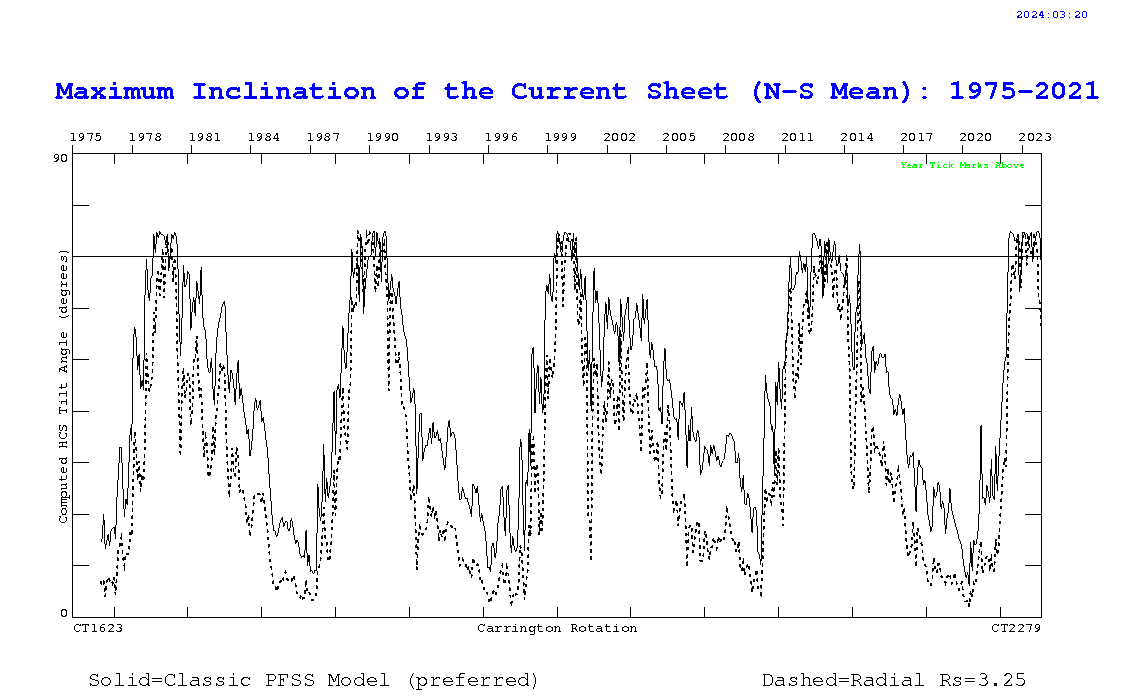
The site provides two data series – the classic and the radial, and notes that the radial may be possibly more accurate. Plotting up the radial data, the following chart is generated:

The heliospheric current sheet, for the last three minima, has got down to 3°. The last reading was 8.7°. It has been declining at an average of 8.6° per annum. If it holds that rate, solar minimum will be in August 2009. If it holds to the orange bounding line, solar minimum could be as late as April 2010. The last reading on the classic series is 22.8° and this series got down to 10° on average in previous solar minima. At its decline rate, solar minimum will be in another 1.9 years, which is late 2010.
To paraphrase a popular aphorism, Solar Cycle 23 isn’t over until the heliospheric current sheet has flattened, and it has a way to go yet.
oops, didn’t catch this in proofing….
That should have read, …
“No. They aren’t doing research, so why would funding constraints and publish or perish be relevant to them?”
NOTE ADDED IN PROOF
…a case in point…
http://motls.blogspot.com/2009/01/balling-michaels-climate-of-extremes.html
HasItBeen4YearsYet? (18:45:52) :
At the beginning, Michaels announces that he will have to leave his school in June 2009 because the current conditions don’t allow him to keep both his scientific integrity and the funding.
perhaps the opposite of the attitude you ascribe to ‘many’ researchers. I know personally hundreds of researchers and the attitude you describe is rare [at least in my large sample].
Leif Svalgaard (15:59:41) :
vukcevic (14:25:32) :
“I asked what the formula would look like if Jupiter was the only planet there. I.e. remove Saturn. Surely, the effect of Jupiter’s magnetosphere should be there even if Saturn is removed.”
I can see that we cannot progress further along the other questions, but this one you should not evade [as you have now done repeatedly]. Here there is no knowledge needed of plasma physics or statistics, so please make an effort to answer, what you think it should be. Then the same question, if Saturn was the only planet.
Please could you comment on these farside images.
This technique is still in its infancy and sometimes produces garbage, like now.
Ok, thanks Leif. Just one more on this if you will. The nearside is totally blank, the farside according to the instruments, was showing plausible small areas of activity before it went crazy with the big black blotches. Are they artifacts too? Is the sensitivity of the instrumentation the same for nearside and farside in these images?
http://soi.stanford.edu/data/full_farside/crots/2080.html
Thanks again.
Just a quick followup to help explain why I’m asking. If you look at these plots from back in 2000 and scroll down a little way to the 29th Nov, you see the same big black blotches suddenly appear. Garbage as you pointed out. But in the days before and after, you see smaller patches of activity which look very similar to the farside ones in the link in my previous post before the black garbage sets in. The point is, they look similar on both the nearside and farside, which is why I’m asking. It seems interesting that there is some activity on the farside while the earthside is staying totally blank.
And here’s the link :o)
http://soi.stanford.edu/data/full_farside/crots/1970.html
Leif Svalgaard (21:17:51) :
to
vukcevic (14:25:32) :
“I asked what the formula would look like if Jupiter was the only planet there. I.e. remove Saturn. Surely, the effect of Jupiter’s magnetosphere should be there even if Saturn is removed.”………..
Then the same question, if Saturn was the only planet.
I am not one of the ‘masters of the Universe’ to answer precisely what might happen if Saturn is to be removed (their fancy computer models buried Wall Street and so much more).
Beside, possibly being most beautiful planet of the solar system, I do not whish to offend the god of time Kronos, who came down to Italy and thought humans agriculture and fertility of land, I say we have had enough of money man, ‘back to the land’. Beside his son, Zeus (the mighty Jupiter) might take an offence to such outrages contemplation.
However, if you do whish to enrage ancient gods of our civilisation, you are more than welcome. Your torment in the centauries to come, might be eased somewhat by the fact that:
North South asymmetry in the SSN would be simpler and distinctly linked to the Hale cycle, so no need for such a ‘least credible solution’ as two magnetic dynamos operating along each other.
If you read
http://www.vukcevic.co.uk/ solar subcycle link
you would find a detailed description how a particular planet’s magnetosphere makes its contribution to the SSN, which might help with the dilemma.
This correlation is not only good, but it it profoundly significant:
http://www.vukcevic.co.uk/PolarFields-vf.gif
http://www.geocities.com/vukcevicu/PolarFields-vf.gif
Leif Svalgaard (21:17:51) :
to
vukcevic (14:25:32) :
“I asked what the formula would look like if Jupiter was the only planet there. I.e. remove Saturn. Surely, the effect of Jupiter’s magnetosphere should be there even if Saturn is removed.”………..
Then the same question, if Saturn was the only planet.
I am not one of the ‘masters of the Universe’ to answer precisely what might happen if Saturn is to be removed (their fancy computer models buried the Wall Street, and so much more).
Beside, possibly being most beautiful planet of the solar system, I do not whish to offend the god of time Kronos, who came down to Italy and thought humans agriculture and fertility of land, I say, we have had enough of money-men, ‘back to the land’. Beside his son, Zeus (the mighty Jupiter) may take an offence to such outrages contemplation.
However, if you do whish to enrage the ancient gods of our civilisation, you have been warned. Your torment in the centauries to come, might be eased somewhat by the fact that you may observe:
North South asymmetry in the SSN would be simpler and distinctly linked to the Hale cycle, so no need for such a ‘least credible solution’ as two magnetic dynamos operating along each other.
If you read
http://www.vukcevic.co.uk/ solar subcycle link
you would find a detailed description how a particular planet’s magnetosphere makes its contribution to the SSN, which might help with the dilemma.
This correlation is not only good, but it is profoundly significant:
http://www.vukcevic.co.uk/PolarFields-vf.gif
http://www.geocities.com/vukcevicu/PolarFields-vf.gif
tallbloke (00:40:22) :
It seems interesting that there is some activity on the farside while the earthside is staying totally blank.
The method doesn’t quite work yet, so I would not place any significance in whatever differences and garbage pop up from time to time. The method is sound, though, and with the data from the new SDO [Solar Dynamics Observatory] to be launched later this year will be a great help for forecasting solar activity a couple of weeks ahead.
Tom wrote:
The electric/plasma universe people invaded Wikipedia a couple of years ago and it took some time to deal with them
I don’t know why I needed “dealing with”? I wrote the original article on Wikipedia’s “. Likewise, I wrote articles on “Double layers“, and “Birkeland currents“, and the “Plasma pinch” and others.
All the articles are thoroughly referenced and has received minor editing. Is there a problem with the article that I am unaware of?
Why no “preview” or editing options for comments?
My first sentence above should read:
I wrote the original article on Wikipedia’s “Heliospheric current sheet”
REPLY: “Why no “preview” or editing options for comments? ” because wordpres.com free hosting for this website does not offer it. – Anthony
Ian Tresman (07:53:44) :
I don’t know why I needed “dealing with”? I wrote the original article on Wikipedia’s “. Likewise, I wrote articles on “Double layers“, and “Birkeland currents“, and the “Plasma pinch” and others.
I raised the original enquiry. Contentious points apparently are :
Electric current
The electric current in the heliospheric current sheet is directed radially inward (apparently not in vicinity of the Sun, only in distant parts where spiral is nearly circular), the circuit being closed by outward currents aligned with the Sun’s magnetic field in the solar polar regions (existence of this is disputed).
Refer to the Dr. L. Svalgaard’s entry on the matter.
Could someone please take a moment and answer a relatively simple question:
Are satellite-borne instruments at greater risk of damage from higher levels of cosmic rays, or is the increase only a minor issue?
vukcevic wrote:
Contentious points .. current sheet is directed radially inward the circuit being closed by outward currents aligned with the Sun’s magnetic field in the solar polar regions
I agree with you, it should probably be attributed to Alfvén and Israelevich, and the standard view cited. I note that the academic astronomer did not pick up on this. Don’t forget that anyone can edit Wikipedia and amend it.
“Are satellite-borne instruments at greater risk of damage from higher levels of cosmic rays”
I’ve done some electronic design, not like George Smith, but note that SORCE indicates measuring UV with a diode sensor which I take to be crude but durable. They say sigma for the sensor is 12-24%, an unusual spread except when noting that solar flares may boost UV 100% and include X-Rays.
So I think this may well indicate CR sensitivity of some sensors in the form of alpha particles and the like in the solar wind when CMEs are earth directed.
All the same, electromagnetic surges are more commonly destructive to electronics of all sorts.
Ian Tresman (11:45:31) :
“current sheet is directed radially inward the circuit being closed by outward currents aligned with the Sun’s magnetic field in the solar polar regions”
I agree with you, it should probably be attributed to Alfvén and Israelevich, and the standard view cited. I note that the academic astronomer did not pick up on this. Don’t forget that anyone can edit Wikipedia and amend it.
Because it is incorrect. For once, the polarity of the solar fields changes every 11 years so the direction of the current should change too. This is not the only error.
I wrote:
“current sheet is directed radially inward
Leif wrote:
“Because it is incorrect. For once, the polarity of the solar fields changes every 11 years so the direction of the current should change too”
For want of appearing like I am digging myself into a hole, yes, I agree with you completely. Alfvén writes of a “radial current”, and it was my error to say that they were directed just inwards.
Thanks for answering, Gary. I am going to assume that satellites going over the poles are going to get a dose of CR’s, and maybe some High Speed Coronal Hole gusts from time to time, but it won’t be anything special.
I do wonder about today’s microprocessors that are down to 45 and 32 nm being easier to damage by CR’s.
I don’t know how wide in nm a CR is.
Leif Svalgaard (21:17:51) :
Leif Svalgaard (15:59:41) :
vukcevic (14:25:32) :
“I asked what the formula would look like if Jupiter was the only planet there. I.e. remove Saturn. Surely, the effect of Jupiter’s magnetosphere should be there even if Saturn is removed.”
After the brief excursion into ancient Greek mythology, it would be impolite to totally ignore you question. On the other hand, I was surprised by insistence on this particular point. As far as the formula is concerned, the answer is simple: it would loose its second component, thus it would directly follow Jupiter’s cycle. It should be noted that the synchronising (or a modulating effect) is related to the Hale cycle.
Since heliosphere is not homogeneous, gradient of the strength of solar wind varies along 360 degrees, then if planetary feedback is controlling factor, it is obvious that it would be function of that gradient. In addition, the heliosphere is prone to incursion by strong CRs from its front end; this may change the magnetosphere’s effectiveness (squeezed from both directions). In addition, huge magnetospheres (both J & S) may shield the sun, for period of time, from any incursion effect CRs they may have on the solar activity.
Ian Tresman (16:26:21) :
……………. Alfvén writes of a “radial current”, and it was my error to say that they were directed just inwards.
I am particular interested in accuracy and other any references to:
the circuit being closed by outward currents aligned with the Sun’s magnetic field in the solar polar regions.
beside Israelevich’s work, which I have been aware of for some time.
vukcevic (07:33:43) :
I am particular interested in accuracy and other any references to: the circuit being closed by outward currents aligned with the Sun’s magnetic field in the solar polar regions.
There is no such current.
vukcevic (02:51:17) :
it would be impolite to totally ignore you question.
Totally? Even partially would be impolite.
It should be noted that the synchronising (or a modulating effect) is related to the Hale cycle.
makes no sense, explain.
Since heliosphere is not homogeneous, gradient of the strength of solar wind varies along 360 degrees
Because the Sun in rotating [160 times as fast as Jupiter’s orbital movement, and 400 times as fast as Saturn’s] the heliosphere does not have any 360 degree variation on the time scales of interest.
the heliosphere is prone to incursion by strong CRs from its front end; this may change the magnetosphere’s effectiveness (squeezed from both directions).
Because of the rotation mentioned above, the CRs are evenly distributed in longitude within the heliosphere.
In addition, huge magnetospheres (both J & S) may shield the sun, for period of time, from any incursion effect CRs they may have on the solar activity.
The CRs have absolutely no effect on solar activity.
—–
Even if Jupiter’s magnetosphere would have an effect [which it cannot, remember], Jupiter from the viewpoint of the Sun would always be sitting there [almost stationary] in the sky, while the Sun rotates 160 times during a Jupiter orbit. There would be no asymmetry that could have any influence on anything.
Leif Svalgaard (12:27:14) :
to
vukcevic (02:51:17) :
it would be impolite to totally ignore you question.
-Totally? Even partially would be impolite.
Degree of politeness is subject to the context and culture.
It should be noted that the synchronising (or a modulating effect) is related to the Hale cycle.
– makes no sense, explain.
The formula describes the Hale cycle (either the polar field or SC); the function ABS is used for a visual impression of the SC coincidence.
Since heliosphere is not homogeneous, gradient of the strength of solar wind varies along 360 degrees
-Because the Sun in rotating [160 times as fast as Jupiter’s orbital movement, and 400 times as fast as Saturn’s] the heliosphere does not have any 360 degree variation on the time scales of interest.
I think you have misunderstood my statement about gradient of the strength. What I have in mind is something totally different. In order not labour a verbal description please refer to the article and image:
http://sci.esa.int/science-e/www/object/index.cfm?fobjectid=36805
from the European Space Agency.
the heliosphere is prone to incursion by strong CRs from its front end; this may change the magnetosphere’s effectiveness (squeezed from both directions.
– Because of the rotation mentioned above, the CRs are evenly distributed in longitude within the heliosphere.
Not so according to scientist from University of California, Berkeley:
‘These ENAs were traced back to hot ions in the heliosheath, the region between the termination shock and heliopause, which are more intense (indicated by color code) around the nose of the heliosphere, with an asymmetric double peak.’
http://www.universityofcalifornia.edu/news/article/18148
In addition, huge magnetospheres (both J & S) may shield the sun, for period of time, from any incursion effect CRs they may have on the solar activity.
-The CRs have absolutely no effect on solar activity.
Since CR’s are charged particles (can be and are modulated by the Solar activity) , and usually all come from same direction into heliosphere than it is reasonable to expect an assumed current (movement of charged particles) and associated magnetic field. Since I believe in the currents feedback, and you do not, I believe that such current may have an effect, and you do not.
Impasse !
-Even if Jupiter’s magnetosphere would have an effect [which it cannot, remember], Jupiter from the viewpoint of the Sun would always be sitting there [almost stationary] in the sky, while the Sun rotates 160 times during a Jupiter orbit. There would be no asymmetry that could have any influence on anything.
Again not exactly: It revolves along an elliptical orbit which regularly takes it into parts of the heliosphere, subject to the points as described in:
http://sci.esa.int/science-e/www/object/index.cfm?fobjectid=36805
http://www.universityofcalifornia.edu/news/article/18148
For time being ( to my regret) I will have to temporarily terminate our dialogue, since I will be shortly off to Florence for few days, make an effort to visit Istituto e Museo di Storia della Scienza and hopefully have chance to take a look at some of Galileo’s telescopes.
I will revisit WUWT on my return.
Thank you for giving me oportunity for the fascinating and enjoyable exchange, at least from my point of view.
vukcevic (14:46:47) :
“it would be impolite to totally ignore you question.
Degree of politeness is subject to the context and culture.”
Ignoring my question is impolite in this context and this culture.
The formula describes the Hale cycle (either the polar field or SC); the function ABS is used for a visual impression of the SC coincidence.
Still makes no sense. What do you think the Hale cycle is?
“the heliosphere does not have any 360 degree variation on the time scales of interest.”
I think you have misunderstood my statement about gradient of the strength
apart from ‘gradient of strength’ not being defined or having much meaning, what happens at 100 AU has no bearing of what happens between the Sun and Jupiter.
“Because of the rotation mentioned above, the CRs are evenly distributed in longitude within the heliosphere.”
Not so according to scientist from University of California, Berkeley: ‘These ENAs”
The ENAs are not cosmic rays and are not charged.
assumed current (movement of charged particles) and associated magnetic field. Since I believe in the currents feedback, and you do not,
The CRs are not currents and have no associated and measurable magnetic fields.
“There would be no asymmetry that could have any influence on anything.”
Again not exactly: It revolves along an elliptical orbit which regularly takes it into parts of the heliosphere, subject to the points as described in:
The eccentricity of Jupiter’s orbit is slight [1 in 20] and it does not take Jupiter into the parts of the heliosphere that are 100 AU away.
This discussion reminds me of a discussion I once had with someone believing that the Earth was only 6000 years old. He was equally impervious to reason, facts, and coherent arguments. He even used the same word as you: “you believe in something and I in something different, Impasse!”.