Many readers are familiar with a number of solar proxies used to gauge the activity of the sun, the most familiar being sunspot counts and type. However they aren’t the only metric you can use to determine when one cycle ends and another begins. The Heliospheric Current Sheet sounds a bit like a “newsletter” and in a sense it is, because it can announce the true end of solar cycle 23.
Here’s what it looks like:

Heliospheric current sheet – click for larger image
From Wikipedia:
The heliospheric current sheet (HCS) is the surface within the Solar System where the polarity of the Sun’s magnetic field changes from north to south. This field extends throughout the Sun’s equatorial plane in the heliosphere.The shape of the current sheet results from the influence of the Sun’s rotating magnetic field on the plasma in the interplanetary medium (Solar Wind). A small electrical current flows within the sheet, about 10−10 A/m². The thickness of the current sheet is about 10,000 km.
The underlying magnetic field is called the interplanetary magnetic field, and the resulting electric current forms part of the heliospheric current circuit.[4] The heliospheric current sheet is also sometimes called the interplanetary current sheet.
What the Heliospheric Current Sheet is telling us.
David Archibald writes:
One of the things that the now disbanded NASA Solar Cycle 24 Prediction Panel told us was that is that solar minimum is marked by a flat heliospheric current sheet. The heliospheric current sheet can be found here: http://wso.stanford.edu/gifs/Tilts.gif
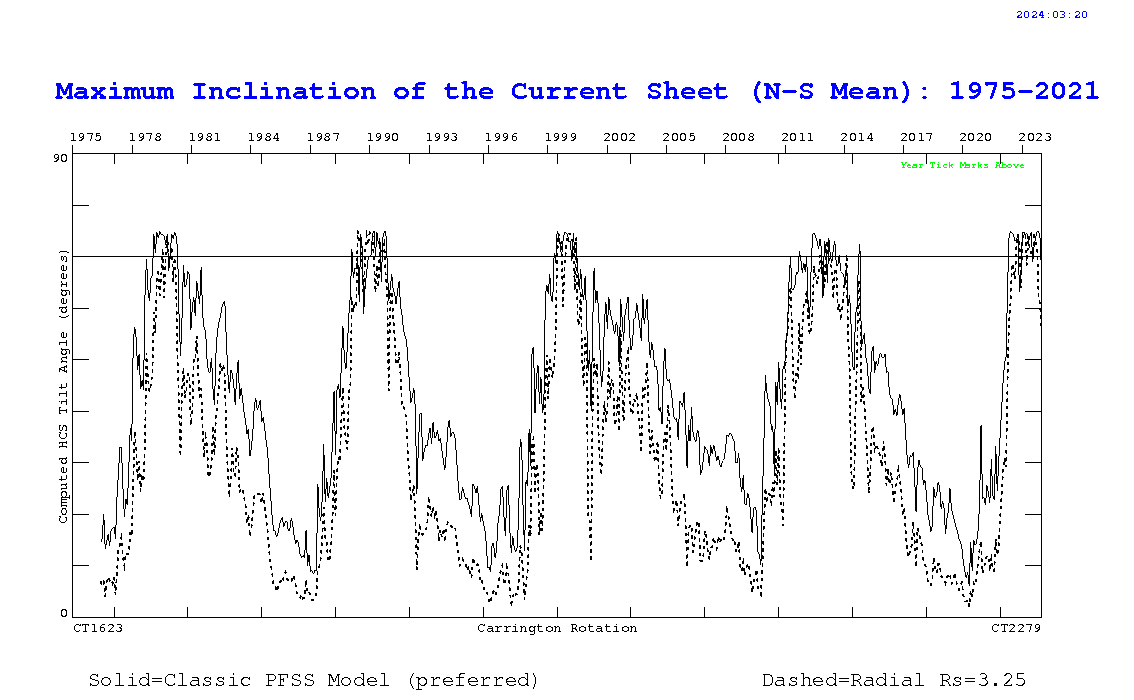
The site provides two data series – the classic and the radial, and notes that the radial may be possibly more accurate. Plotting up the radial data, the following chart is generated:

The heliospheric current sheet, for the last three minima, has got down to 3°. The last reading was 8.7°. It has been declining at an average of 8.6° per annum. If it holds that rate, solar minimum will be in August 2009. If it holds to the orange bounding line, solar minimum could be as late as April 2010. The last reading on the classic series is 22.8° and this series got down to 10° on average in previous solar minima. At its decline rate, solar minimum will be in another 1.9 years, which is late 2010.
To paraphrase a popular aphorism, Solar Cycle 23 isn’t over until the heliospheric current sheet has flattened, and it has a way to go yet.
Adolfo Giurfa (11:07:41) :
There was a big low about 2000-2001. Any explanation?
Yes, the data from WSO then was bad [useless] because of equipment problems.
George Patch (11:18:29) :
How does this relate to the sun’s magnetic field and the now infamous step function of October 2005?
It does not, and that step is a fluke [caused by a single large sporadic solar storm in September 2005, see http://hirweb.nict.go.jp/sedoss/solact3/do?d=2005,09,15
Geomagnetic activity is determined basically by three things:
1) solar wind speed V
2) interplanetary magnetic field B
3) the tilt angle of the the Earth’s magnetic axis against the direction to the Sun
The observations of V and B for the last 6 years [page 1 of]
http://www.leif.org/research/Most%20Recent%20IMF,%20SW,%20and%20Solar%20Data.pdf
do not show any special changes apart from the general decline of B [which may have abated since the summer of 2008]. There are spikes in B and V at various times caused by large solar storms [Oct. 2003, Jan. 2005, Dec. 2006] and less conspicuous ones at other times. Last, but not least, the storm in Sept. 2005 was enhanced because of the favorable attack angle. Thus no significance can [and should] be attached to the ‘step’
Leif Svalgaard (10:14:32) :
The last reading on the classic series is 22.8° and this series got down to 10° on average in previous solar minima.
You shouldn’t switch back and forth being the radial and classic just to inflate the numbers when convenient. Stick to one or the other.
Dr. Svalgaard,
Let me first add my voice of appreciation for your diligent participation in this forum. Having said that, however, I must admit that in this instance I had a different interpretation of David Archibald’s intention. Unless I am missing something here (which I might be, since this is not my field), it seems pretty clear to me that he is not, as you suggest, “switching back and forth” between the two data sets in order to “inflate the numbers” for the sake of convenience.
In fact he seems to be responsibly presenting both sets of data — illustrating the radial data in the graph and summarizing the classic data. His purpose seems to be the opposite of the one which you impute to him, which is to allow readers access to both data sets and the freedom to decide which of them might be more relevant. If I have misunderstood, I welcome a correction. If not, I think it would be better to stick to the real issues and not impugn Mr. (Dr.? sorry, I’m not sure) Archibald’s method without substantive reason.
Thanks again for the fruitful dialogue.
-psi
Mike M (10:05:24) :
….the now disbanded NASA Solar Cycle 24 Prediction Panel…
Who says it is disbanded? Not that I know of. It has been decided not to have anymore meetings, but there is still email and phone activity.
Can you overlay sunspot numbers on the HSC graph?
Leif
because the Earth goes ‘above’ the current sheet in March [north of the HCS] and in September [south of the HCS]
When does the earth reach it’s maximum height above and below the flattened HCS please Leif
They should have disbanded the NASA GISS office first.
Mr. Archibald,
I hope you know what you’re talking about cause this guy Lief sure does.
How come Lief does’nt find the correlation and thereby the final analysis for predicting or knowing at what point we are in sc23. I know that’s all you’re doing. I commend Anthony for recognizing this as well.
Please continue informing us David. There are those of us who do understand.
Back to reality folks:
Solar variations do affect climate, but they are not the only factor. As there has been no positive trend in any solar index since the 1960s (and possibly a small negative trend), solar forcing cannot be responsible for the recent temperature trends. The difference between the solar minimum and solar maximum over the 11-year solar cycle is 10 times smaller than the effect of greenhouse gases over the same interval.
http://news.bbc.co.uk/1/hi/in_depth/629/629/7074601.stm
Direct satellite measurements of solar activity show it has been declining since the mid-1980s and cannot account for recent rises in global temperatures, according to new research.
The findings debunk an explanation for climate change that is often cited by people who are not convinced that greenhouse gas emissions from human activities are causing the Earth’s climate to warm.
http://www.newscientist.com/article/dn12234
The wikipedia entry on Heliospheric current sheet was started by Ian Tresman, a proponent of the plasma universe theory and a supporter of Eric Lerner, author of “The Big Bang Never Happened.” That’s not to say it cou
However, in 2007 the article was visited by user:ScienceApologist who is an academic astronomer in his day job, and he and Ian were quibbling over a rather minor detail, so I gather that ScienceApologist had no problems with the article overall. The article has been remarkably stable since.
The electric/plasma universe people invaded Wikipedia a couple of years ago and it took some time to deal with them. This article looks like it was not badly affected, but I’d be happier knowing that Leif was generally in agreement with it.
A link to the drawing of Leif’s original conception, please, unless it’s already here.
====================================================
Leif Svalgaard (10:14:32) :
“…The current understanding of the HCS and its ‘flatness’ derives from
http://www.leif.org/research/A%20View%20of%20Solar%20Magnetic%20Fields,%20the%20Solar%20Corona,%20and%20the%20Solar%20Wind%20in%20Three%20Dimensions.pdf
…undulations of the current sheet depend on the strength of the polar fields: a weaker polar field results in a more warped [extending to higher latitudes] current sheet. The polar fields right now are weak and the current sheet is more warped [go to higher latitude] than at some previous minima with stronger polar fields…”
I have noticed in the Stanford Wilcox series that the HCS tilt has been decreasing
http://wso.stanford.edu/gifs/Tilts.gif
while the strength of the solar polar fields remains weak
http://wso.stanford.edu/gifs/Polar.gif
What’s going on?
28 days without a #24 sunspot. Longest gap since Jul/Aug/Sep08.
Leif Svalgaard (11:12:39) :
to
vukcevic (09:43:58) :
Furthermore the current and the magnetic field are at right angles to each
of course…
Thanks for the explanation. On the NASA’s sketch
http://www-istp.gsfc.nasa.gov/istp/halebopp/disconnect/bopp_intersect.html
two sets of helispheric currents (one above one below magnetic equator?) presumably should be ‘flowing’ into and out of the screen’s plane.
Crucial question : is the magnetic field (green lines) a cause or consequence of the current flow, i.e. what is their mutual relationship?
“Back to reality folks:”
Oh, boy, back to the warmers’ favorite logical error: if we don’t know what is causing something, it has to be CO2 (mankind)! That ain’t reality, as I understand it, Jane.
Jane
First off, why would anyone assume the affect of solar activity would be instant and not delayed? I would expect a considerable delay if solar activity as a whole was a driver, though some effects might be quick.
Second why is temperature not changing in lockstep with solar activity a problem for people who can than turn around and blame carbon dioxide? Which is not only also not in lockstep; i.e long periods of cooling while carbon dioxide is rising 1940s to 1970s and 1998 to present. But, in addition the paleo record clearly suggests that in the past temperature changes have happened first with CO2 change lagging behind by centuries.
The most reasonable explanation is of course temperature increase causes CO2 to increase as would be predicted from gas soluability and for that matter Le Chatlier’s principle.
To me the fun thing is that the recent cooling really doesn’t fit models that use either solar or GHG as primary drivers of the change. If GHG it shouldn’t be cooling if solar variability it shouldn’t already be cooling. It has to be much more complicated than either.
Too bad this is so political, this kind of question is what makes science fun.
The first paragraph of my post at 13:11 should read,
The wikipedia entry on Heliospheric current sheet was started by Ian Tresman, a proponent of the plasma universe theory and a supporter of Eric Lerner, author of “The Big Bang Never Happened.” That’s not to say it couldn’t be a very good article, only that it should be looked at carefully.
(And, or course, the same is true for every wikipedia article. Articles about mundane topics can be surprisingly contentious, if one or two people have fixed ideas about it.)
“28 days without a #24 sunspot. Longest gap since Jul/Aug/Sep08.”
Ramping up? Schadenfreude is delicious.
Not completely OT, and I didn’t notice anything about it (but I may have missed it, I don’t read all comments from all thread!):
more or less prediction of Dalton minimum (if I got it right) from prof de Jager
http://www.cdejager.com/wp-content/uploads/2009/02/2009-forecasting-jastp-71-239.pdf
Jane (13:09:28) :
I tend to agree in part with John Christy’s view when he is asked about the solar influence on climate. He acknowledges that there is an appearent relationship between the two. And that increased or decreased jules of energy is not enough….something else must be working, The problem is that the mechanism of that ‘something else’ has not been identified.
In a recent presentation Christy paraphrased a former instructor say ‘We should always begin our scientific experiments with this statement…”At our present level of ignorance we think we know…..”
While John Christy says this; “Our ignorance about the climate system is enormous, and policy makers need to know that.” I am known for saying that when it comes to actually understanding the climate man / science is still in kindergarten. We know a couple of letters of the alphabet and the only word we can spell is “A”… and that is by accident. THAT… is the only reality.
I will agree that solar activity / changes are not the ‘only’ factor. However, solar irradiance / state to me are a big part of the key. Anyone who can prove that incorrect would also be able to tell me exactly why glacial periods occur and exactly what triggers them.
psi (11:57:32) :
allow readers access to both data sets and the freedom to decide which of them might be more relevant.
I don’t know what his motivation was, but it is best to stick with he thinks is best. The website itself [and me too] suggests that “The classic model results tabulated here probably give a better estimate”.
tallbloke (12:27:14) :
When does the earth reach it’s maximum height above and below the flattened HCS
On March 7th we are the most North of the HCS and on September 7th we are the most South of the HCS. Or actually of the Sun’s equatorial plane. The HCS sweeps past us every 27 days, and we go through it about 4 times every sweep.
MC (13:06:21) :
Mr. Archibald,
I hope you know what you’re talking about cause this guy Leif sure does. How come Leif does’nt find the correlation
Because it is just curve eye-balling and not grounded in physical reality [as so much of the stuff that goes for Science here at the ‘best science blog’ 🙂 ]
Tom (13:11:30) :
I’d be happier knowing that Leif was generally in agreement with it.
The nonsense about the current is the worst, but there are many other minor in accuracies, among such the history of the HCS. I have seen worse Wiki articles. And I don’t feel like rewriting it.
kim (13:12:03) :
A link to the drawing of Leif’s original conception, please, unless it’s already here.
it is already here, but here it is again: Figure 6 in http://www.leif.org/research/A%20View%20of%20Solar%20Magnetic%20Fields,%20the%20Solar%20Corona,%20and%20the%20Solar%20Wind%20in%20Three%20Dimensions.pdf
The Figure was first published in Nature in 1976 [reference in the link]. It is interesting to note that the HCS drawn is for a Four-Sector IMF [like we have right now].
John-X (13:13:32) :
What’s going on?
The low-latitude fields are [were] decreasing as the sunspots petered out [SC23 flatlined]. The tilt is a balance of the polar fields and the low-latitude fields. With the polar fields steady and solar activity flat-lined, the HCS should stay steady too, but don’t forget that the computed HCS tilt is somewhat of a mathematical abstraction that only approximately approaches reality.
vukcevic (13:20:40) :
should be ‘flowing’ into and out of the screen’s plane.
Yes, i would have preferred the standard electrical engineer symbol of an arrow seen from the front [circle with dot] and seen from the end [circle with cross fins].
Crucial question : is the magnetic field (green lines) a cause or consequence of the current flow, i.e. what is their mutual relationship?
They exist together, but in an MHD situation with infinite conductivity the magnetic field is the dominant and fundamental quantity. Since the conductivity is not quite infinitely high, currents can and do flow. There is a similar current across the Earth’s magnetospheric tail [from dawn to dusk] and in all other magnetospheres.
There is an additional complication: the Sun is rotating, so both the magnetic field and therefore also the current are changing direction as you move away from the Sun, so that very far from the Sun the field is around the Sun and the current is radial. The Earth is kinda at a halfway point [the field makes a 45 degree angle with the radial].
You can consider the current from a local point of view: imagine you have a sheet of magnetic field lines pointing away from you on top of another sheet pointing towards you. I have a drawing here: http://www.leif.org/research/Current-Sheet-Cartoon.png
A charged particle will gyrate around the magnetic field in opposite directions for the away and toward field lines. The net result will be a drift in the direction of the big arrow. Particles with the opposite charge will gyrate in the opposite direction and their ‘big arrow’ will point the other way, so at the place of the big arrows you have opposite charges going opposite ways, voila: a current. This current will serve to keep the two magnetic fields apart. with no particles to carry the current, the two magnetic fields would reconnect and cancel each other out.
TitiXXXX1892 (14:03:34) :
“…more or less prediction of Dalton minimum (if I got it right) from prof de Jager
http://www.cdejager.com/wp-content/uploads/2009/02/2009-forecasting-jastp-71-239.pdf
de Jager and Duhau argue we’re in a “transition” from a “Grand Maximum;” the transition they say began in 2000 and will end around Cycle 24 maximum, which they see as January 2014.
They do not predict a Grand Minimum will follow, but a “period of lower solar activity,” with “regular oscillations.” The period of “regular oscillations” they say, will last 60 to 100 years.
The first oscillation (presumably including Cycle 24 minimum and Cycle 25), “might,” they say, be strongly negative, and “might” be similar to the Dalton minimum.
Let’s see how well they do on their prediction of Cycle 24 max in January 2014, “with a maximum sunspot number Rmax=68±17.”
jae (13:35:21) :
Oh, boy, back to the warmers’ favorite logical error: if we don’t know what is causing something, it has to be CO2 (mankind)! That ain’t reality, as I understand it, Jane.
Another fallacy of the same ilk:
“if it is not CO2 it’s gotta be the Sun”
Lee Kington (14:27:37) :
However, solar irradiance / state to me are a big part of the key. Anyone who can prove that incorrect would also be able to tell me exactly why glacial periods occur and exactly what triggers them.
You are confusing solar irradiance and solar insolation. The latter is part of the cause of glacial periods, but has nothing to do with the Sun [caused by changes of the Earth’s orbit and tilt due to the planets tugging].
Anthony,
could you please somehow prevent your audience from posting things that are way off topic? This thread is about the heliospheric current sheet as a solar proxy, and not a warm place for CO2 food fights. That’s really boring, distracting and a calculated misuse of the freedom of speech.
there are lots of suggestions that solar activity has risen over the last hundred years and especially over longer periods. ( mostly unrefuted). ie the oceans have warmed gradually etc and maintained their warmth.
solar variations are also important in the formation of ozone in the higher atmosphere. These can directly affect temperatures beneath and the extent of artic and antartic winters.
other delays are obviously ocean currents, volcanic eruptions etc.
temperature.
Other effects that stop these cycles closely correlating are the massive ice fortresses of greenland antartica etc which effectively along with mountains and other land masses ensure that solar variation is masked to some extent by the earths geography. anyway i think there was a really good article a week ago or so by leifgard (above) about how the trends can be seen.. here is the link
http://meteo.lcd.lu/globalwarming/Svensmark/Reply_to%20Lockwood_et_al_2007.pdf.
(higher altitudes show less variation than lower ones too)