Many readers are familiar with a number of solar proxies used to gauge the activity of the sun, the most familiar being sunspot counts and type. However they aren’t the only metric you can use to determine when one cycle ends and another begins. The Heliospheric Current Sheet sounds a bit like a “newsletter” and in a sense it is, because it can announce the true end of solar cycle 23.
Here’s what it looks like:

Heliospheric current sheet – click for larger image
From Wikipedia:
The heliospheric current sheet (HCS) is the surface within the Solar System where the polarity of the Sun’s magnetic field changes from north to south. This field extends throughout the Sun’s equatorial plane in the heliosphere.The shape of the current sheet results from the influence of the Sun’s rotating magnetic field on the plasma in the interplanetary medium (Solar Wind). A small electrical current flows within the sheet, about 10−10 A/m². The thickness of the current sheet is about 10,000 km.
The underlying magnetic field is called the interplanetary magnetic field, and the resulting electric current forms part of the heliospheric current circuit.[4] The heliospheric current sheet is also sometimes called the interplanetary current sheet.
What the Heliospheric Current Sheet is telling us.
David Archibald writes:
One of the things that the now disbanded NASA Solar Cycle 24 Prediction Panel told us was that is that solar minimum is marked by a flat heliospheric current sheet. The heliospheric current sheet can be found here: http://wso.stanford.edu/gifs/Tilts.gif
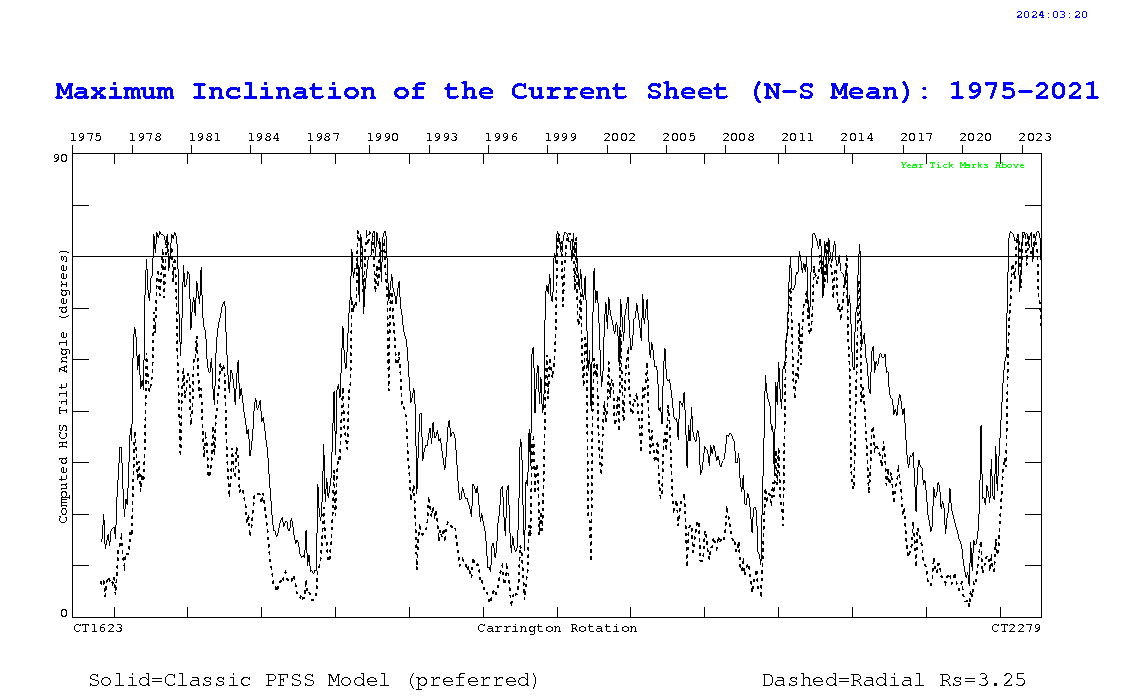
The site provides two data series – the classic and the radial, and notes that the radial may be possibly more accurate. Plotting up the radial data, the following chart is generated:

The heliospheric current sheet, for the last three minima, has got down to 3°. The last reading was 8.7°. It has been declining at an average of 8.6° per annum. If it holds that rate, solar minimum will be in August 2009. If it holds to the orange bounding line, solar minimum could be as late as April 2010. The last reading on the classic series is 22.8° and this series got down to 10° on average in previous solar minima. At its decline rate, solar minimum will be in another 1.9 years, which is late 2010.
To paraphrase a popular aphorism, Solar Cycle 23 isn’t over until the heliospheric current sheet has flattened, and it has a way to go yet.
Could you mark the ends of cycles 21 and 22 on the graph for comparison?
REPLY: when they hit and stay near the green line – Anthony
So based on this, how many spotless days??
Sorry, I meant as already determined from the standard sources.
Laying a bounding line seems to work quite well for solar cycle 21, not so well for sc 22. Hence David Archibalds fairly wide prediction of Aug 2009-Apr 2010.
Is data for earlier cycles non-existant, patchy, or good?
Boy, given the SC21 and SC22 traces, I wouldn’t project a straight line to set a target minimum date
All references but one (links in the text) lead to Wikipedia. I am told that some of the Wiki’s entries are suspect; e.g.
Electric current
The electric current in the heliospheric current sheet is directed radially inward, the circuit being closed by outward currents aligned with the Sun’s magnetic field in the solar polar regions. The total current in the circuit is on the order of 3×10^9 amperes.[4] As a comparison with other astrophysical electric currents, the Birkeland currents that supply the Earth’s aurora are about a thousand times weaker at a million amperes. The maximum current density in the sheet is on the order of 10-10 A/m² (10-4 A/km²).
http://en.wikipedia.org/wiki/Heliospheric_current_sheet
Any comments?
REPLY: I tend to worry about Wiki entries that are contentious. This one did not seem to be. I’m certainly no expert on the HCS, so I’ll defer comments about the validity of that explanation to Leif and David. – Anthony
You can see some data at:
ftp://ftp.ngdc.noaa.gov/STP/SOLAR_DATA/SUNSPOT_NUMBERS/MONTHLY
and
http://www.swpc.noaa.gov/ftpdir/latest/DSD.txt
This appears to be the lowest since at least 1913. You get back to the Dalton Minimum for numbers that are lower. Could you comment on this?
Also, could you also comment on how global temperatures are tracking? An update would be informative.
Thanks,
Jeff
Wow! What a wild looking purple graph!!
this is really cool information. the most interesting tidbit nestled in the article was this line
….the now disbanded NASA Solar Cycle 24 Prediction Panel…
and i wonder if NASA will disband a whole group for giving faulty predictions, why is Hansen still there?
REPLY: I tend to worry about Wiki entries that are contentious. This one did not seem to be. I’m certainly no expert on the HCS, so I’ll defer comments about the validity of that explanation to Leif and David. – Anthony
Thanks Anthony for the prompt reply. I am counting on it to be correct (word for word), if not, then need to be edited by the experts.
Would the minimum be the first time the measurement reached the green line, or the second? It appears the data creates a “W” at the bottom.
Connecting the tops to project a bottom is not likely to be accurate. The measurements might hit the green line, then bounce up only to fall and hit the green line a second time before rising for an extended period. If one draws a line intersecting the two highest points in Cycle 21, this happens—the green line is hit twice before the rising line intersects with the red and “breaks out.”
The August 09 minimum may be a better bet.
What the Heliospheric Current Sheet is telling us.
One of the things that the now disbanded NASA Solar Cycle 24 Prediction Panel told us was that is that solar minimum is marked by a flat heliospheric current sheet.
This is a misunderstanding of what has been known for the last 30+ years.
The last reading on the classic series is 22.8° and this series got down to 10° on average in previous solar minima.
You shouldn’t switch back and forth being the radial and classic just to inflate the numbers when convenient. Stick to one or the other.
The current understanding of the HCS and its ‘flatness’ derives from http://www.leif.org/research/A%20View%20of%20Solar%20Magnetic%20Fields,%20the%20Solar%20Corona,%20and%20the%20Solar%20Wind%20in%20Three%20Dimensions.pdf
The relevant figure is Figure 5 that shows how the undulations of the current sheet depend on the strength of the polar fields: a weaker polar field results in a more warped [extending to higher latitudes] current sheet. The polar fields right now are weak and the current sheet is more warped [go to higher latitude] than at some previous minima with stronger polar fields. Since the polar fields are not getting any stronger, the current sheet will not get much flatter [near the Sun]. The flatness is dictated by a balance between the polar fields and the low-latitude magnetic field. The latter is about as low as it will go and the polar fields are not getting stronger [rather any SC24 activity will weaken the polar fields and strengthen the mid-latitude fields and any SC23 activity still to come will strengthen the low-latitude fields]. There is no ‘law’ that says that the HCS should reach the same flatness at every minimum. It all depends on the polar fields. In 1954 the polar fields were very strong [resulting in the mighty cycle 19] and the HCS was completely flat [’tilt angle’ = 0] for almost a year [we know this because there were no ‘sector boundaries’ at the time]. This time around, the polar fields are much weaker and the HCS is not so flat.
Just extrapolating the curve is not science, especially since we do know how these things work and therefore do not need to extrapolate [which is what you have to do, if you don’t know anything].
Finally, the WSO tilt angle is based on a potential field [PF] calculation [see http://www.leif.org/research/Calculation%20of%20Spherical%20Harmonics.pdf for the derivation of my program used to calculate these things at WSO] that we know is not correct physics [it assumes that there are no currents in the inner corona]. The PF calculation assumes that the extent of the HCS is fixed at the ‘source surface’ and just carried out by the solar wind from there. A more correct MHD calculation shows that there is further flattening as we progress further out. Even though the PF calculation may say that the extent is 22 degrees near the Sun, the real current sheet is flatter than that further out.
A measure of the flatness of the HCS is the so-called Rosenberg-Coleman effect, which states that the flatter the current sheet, the bigger is the imbalance between the polarities of the interplanetary magnetic field observed at Earth [because the Earth goes ‘above’ the current sheet] in March [north of the HCS] and in September [south of the HCS]. A neat way of showing this is simply to calculate the average signed radial field over a solar rotation. If we are centered on the HCS this average sould be zero [equal amount of inwards (say above the HCS) and outwards field (say below)]. Any imbalance [very flat HCS] should show up as a sinusoidal yearly wave. Such wave was observed throughout 2008 http://www.leif.org/research/Rosenberg-Coleman-Effect-2008.png . Compare this with Figure 3 of http://www.leif.org/research/Asymmetric%20Rosenberg-Coleman%20Effect.pdf to see the wave at earlier solar minima, and also to see that the Rosenberg-Coleman effect is an indicator of we being on the ascending branch of the cycle [see Figure 2].
I say again, just extrapolating curves when you do not know what is going on may be good clean fun, but is not science.
The cycle 24 panel has been disbanded? Why? Complete lack of competence?
vukcevic (09:43:58) :
The electric current in the heliospheric current sheet is directed radially inward, the circuit being closed by outward currents aligned with the Sun’s magnetic field in the solar polar regions.
Since the polarity of the heliospheric magnetic field reverses polarity every 11 years the current should change direction too, so the above statement is clearly suspect. Furthermore the current and the current are at right angles to each other, so for a magnetic field extending radially outward from the Sun, the current would be around the Sun, not radial, and so on.
Richard deSousa (09:47:23) :
Wow! What a wild looking purple graph!!
Yes. I’m very proud of it. When we made our first drawing of the HCS [see e.g. Figure 6 in http://www.leif.org/research/A%20View%20of%20Solar%20Magnetic%20Fields,%20the%20Solar%20Corona,%20and%20the%20Solar%20Wind%20in%20Three%20Dimensions.pdf ] it lacked some ‘pizzazz’ and John Wilcox took it over to a artist {Werner Heil] at Ames Research Center and asked him to ‘jazz it uo’. And what a job he did! I use it my screen background image [tiled] so look at many times a day.
The orange line used for extrapolation goes from the maximum value of 75 degrees and down, but that value [75] is a complete artifact due to the observing characteristics of the Stanford magnetograph [basically its large 3 arc minute aperture]. The correct maximum value is 90 degrees [as the fields reverse]. Try to redraw your graph using the correct value and show us again.
DA, yer on a roll!
Thre was a big low about 2000-2001. Any explanation?
Leif Svalgaard (10:26:51) :
vukcevic (09:43:58) :
Furthermore the current and the magnetic field are at right angles to each
of course…
Based on the previous cycles I would not extend a straigt line but more of en exponential decay… that could reach a minimum around 2015. Does that year sounds familiar to readers of WUWT?
What are the consequences on climate when we go through the lobes and when we are not in a lobe? Would it be possible that the small current inside a lobe would increase earth’s magnetic field and reduce cloud formation?
Jeff
Try this for the latest satelite data.
http://discover.itsc.uah.edu/amsutemps/
Click on plot graph
How does this relate to the sun’s magnetic field and the now infamous step function of October 2005? My untrained eye is seeing a similar drop in the heliospheric current sheet around the same time frame.
The opera ain’t over until the red cabbage is flat.
Interesting graphics… I’d call the maroon one a kawasaki diagram! (After Japanese mathematician who invented fourfold-symmetry origami, creating a similar shape, except this one has 2),
still quite strange, the minimum keeps being pushed further and further. No news from NASA though,,, it seems as though hathaway et al are tired of shifting goalposts…
Perhaps the Mayan astronomers were right, 2012 might really be the ‘death of the 5th sun’ literally!… ok, ok, not exactly science but still intriguing none the less! 🙂
I think the prognosis from a curve fit of such wiggly data have little value.
If there is more such data on earlier it would be much appreciated.
best,
“panel disbanded…Complete lack of competence?”
“extrapolating curves when you do not know what is going on may be good clean fun, but is not science.”
Another year will go a long way towards deciding the issue: How much do we know and when did we learn it? No bet.