A guest post by Steven Goddard
One of the most widely discussed climate feedbacks is the albedo effect of polar sea ice loss. Ice has a relatively high albedo (reflectance) so a reduction in polar ice area has the effect of causing more shortwave radiation (sunlight) to be absorbed by the oceans, warming the water. Likewise, an increase in polar sea ice area causes more sunlight to be reflected, decreasing the warming of the ocean. The earths radiative balance is shown in the image below. It is believed that about 30% of the sunlight reaching the earth’s atmosphere is directly reflected – 20% by clouds, 6% by other components of the atmosphere, and 4% by the earth’s surface.

We all have heard many times that summer sea ice minimums have declined in the northern hemisphere over the last 30 years. As mentioned above, this causes more sunlight to reach the dark ocean water, and results in a warming of the water. What is not so widely discussed is that southern hemisphere sea ice has been increasing, causing a net cooling effect. This article explains why the cooling effect of excess Antarctic ice is significantly greater than the warming effect of missing Arctic ice.
Over the last 30 years Antarctic sea ice has been steadily increasing, as shown below.

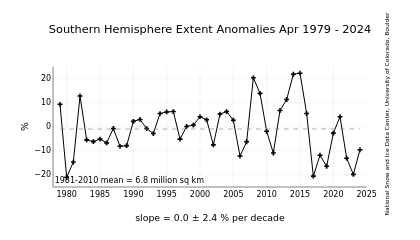
December is the month when the Antarctic sun is highest in the sky, and when the most sunlight reaches the surface. Thus an excess of ice in December has the maximum impact on the southern hemisphere’s radiative balance. In the Antarctic, the most important months are mid-October through mid-February, because those are months when the sun is closest to the zenith. The rest of the year there is almost no shortwave radiation to reflect, so the excess ice has little effect on the shortwave radiative (SW) balance.
This has been discussed in detail by Roger Pielke Sr. and others in several papers.
So how does this work? Below are the details of this article’s thesis.


1. As mentioned above, the Antarctic ice excess occurs near the December solstice when the sun is highest above the horizon. By contrast, the Arctic ice deficiency appears near the equinox – when the sun is low above the horizon. Note in the graph below, that Arctic ice reaches it’s minimum in mid-September – just when the sun is setting for the winter at the North Pole. While the September, 2008 ice minimum maps were dramatic, what they did not show is that there was little sunlight reaching the water that time of year. The deviation from normal did not begin in earnest until mid-August, so there were only a couple of weeks where the northern hemisphere SW radiative balance was significantly impacted. Thus the water in most of the ice-deficient areas did not warm significantly, allowing for the fast freeze-up we saw during the autumn.
The 2008 peak Arctic ice anomaly occurred near the equinox, when it had the minimum heating effect on the ocean.

By contrast, the peak Antarctic ice anomaly occurred at the December solstice, when it had a maximum cooling effect, as shown below.
2. The next factor to consider is the latitude of the ice, which has a strong effect on the amount of solar insolation received. Arctic sea ice is closer to the pole than Antarctic sea ice. This is because of the geography of the two regions, and can be seen in the NSIDC images below.
Antarctic sea ice forms at latitudes of about 55-75 degrees, whereas most Arctic ice forms closer to the pole at latitudes of 70-90 degrees. Because Antarctic ice is closer to the tropics than Arctic ice, and the sun there reaches a higher angle above the horizon, Antarctic sea ice receives significantly more solar radiation in summer than Arctic sea ice does in its’ summer. Thus the presence or absence of Antarctic ice has a larger impact on the SW radiative balance than does the presence or absence of Arctic ice.
At a latitude of -65 degrees, the sun is about 40 degrees below the zenith on the day of the solstice. Compare that to early September negative anomaly peak in the Arctic at a latitude of 80 degrees, when the sun is more than 70 degrees below the zenith. The amount of solar radiation hitting the ice surface at those maxima is approximately 2.2 times greater in the the Antarctic than it is in the Arctic = cos(70) / cos(40) .
The point being again, that due to the latitude and date, areas of excess Antarctic ice reflect a lot of SW radiation back out into space, whereas deficient Arctic ice areas allow a much smaller quantity of SW radiation to reach the dark surface of water. Furthermore, in September the angle of incidence of the sun above the water is below the critical angle, so little sunlight penetrates the surface, further compounding the effect. Thus the Antarctic positive anomaly has a significantly larger effect on the earth’s SW balance than does the Arctic negative anomaly.
3. The next point is an extension of 2. By definition, excess ice is further from the pole than missing ice. Thus a 10% positive anomaly has more impact on the earth’s SW balance than does a 10% negative anomaly.
4. Due to eccentricity of the earth’s orbit, the earth is 3% closer to the sun near the December solstice, than it is during the June solstice. This further compounds the importance of Antarctic ice excess relative to Arctic ice deficiency.
All of these points work together to support the idea that so far, polar ice albedo feedback has been opposite of what the models have predicted. To date, the effect of polar albedo change has most likely been negative, whereas all the models predicted it to be positive. There appears to be a tendency in the climate community to discount the importance of the Antarctic sea ice increase, and this may not be appropriate.
My views on nuclear power are already on record on WUWT a few days ago, on the Accuweather-Bastardi post.
To crosstalk, re Jatropha trees (or any other bio-diesel plant)
I respectfully disagree, and here is why. Firstly, it is not necessary for the Jatropha trees to infringe on food crop land, when they can replace other trees that have no obvious positive qualities. I worked years ago in Brazil where this was done quite successfully, although their trees are hybrid Eucalyptus. The company is still in business, thriving in fact, and it is Aracruz. Where I worked they had cleared trees and brush over approximately 70,000 acres and planted their Eucaplypus. The trees grow around one foot per month, and are harvested after only 7 years. Then they are processed onsite into pulp destined for ultra-high grade paper. A similar thing can be done with Jatropha as far as replacing indigenous trees.
see http://www.aracruz.com
Secondly, I agree that it is unwise to use crop land for growing fuel, but that point is so widely recognized there is a push to develop bio-fuel plants that will grow on marginal land. I also do not agree that the desert is fragile and must be protected. The key is adequate fresh water. As was pointed out many years ago, the limiting element for growing bio-fuels is water, and after that, land. Deserts are farmed with great success not only in California, also Arizona and New Mexico. One can see the farms from airplanes, they appear as giant green circles.
For the non-U.S. readers, I am of course aware that not all countries have land for discretionary use. Many countries are much more densely populated than the U.S., as I very well know from having visited or worked in many. But, where water is available, it may well be advantageous to replace existing forests with trees that yield bio-diesel.
Roger E. Sowell
Marina del Rey, California
Phil: “I find all these articles more and more worrying. It seems that everything the IPCC and the AGW alarmists have been telling us has been wrong and that all the indications are that the feedbacks are currently negative and that we are in for a hell of a cooling. No more talk of volcanoes as well please.”
Keep your eye on Yellowstone. It has become very active in the past 6 weeks and if it erupts at 1/100th the magnitude of its last big blast, Mt. St. Helens will look like a popped corn kernel in comparison.
Martin Lewitt (19:46:17) :
When you compare cycle 23 to 13 and 22 to 11 are you considering the isotopic proxies or just the sunspot data, what is your reasoning?
I compare the sunspot numbers [and not just the proxies that are harder to calibrate]. Some of the evidence can be found here:
http://www.leif.org/research/AGU%20Spring%202007%20SH54B-02.pdf
http://www.leif.org/research/De%20maculis%20in%20Sole%20observatis.pdf
and most recently here:
http://www.leif.org/research/Napa%20Solar%20Cycle%2024.pdf
at this meeting Luca Bertello from Mount Wilson Observatory told me after my talk that they have just finished digitizing all the Ca II K-line spectroheliograms since 1915. From that data they have calculated a monthly Ca II K-index which is a very good proxy for the modern sunspot number and for F10.7. We have analyzed Luca’s data and they show the same jump in 1945, so there is now little doubt that the sunspot record must be revised. We are writing a joint Letter to Astrophysical Journal on this result. It is becoming clear that there really has not been a progressive change in solar activity the past 300 years. The solar maxima in 1778 and 1787 were likely higher than in 1957, consistent with the 14C production rate at that time: http://www.leif.org/research/14C.png
Martin Lewitt (19:46:17) :
When you compare cycle 23 to 13 and 22 to 11 are you considering the isotopic proxies or just the sunspot data, what is your reasoning?
I compare the sunspot numbers [and not just the proxies that are harder to calibrate]. Some of the evidence can be found here:
http://www.leif.org/research/AGU%20Spring%202007%20SH54B-02.pdf
http://www.leif.org/research/De%20maculis%20in%20Sole%20observatis.pdf
and most recently here:
http://www.leif.org/research/Napa%20Solar%20Cycle%2024.pdf
at this meeting Luca Bertello from Mount Wilson Observatory told me after my talk that they have just finished digitizing all the Ca II K-line spectroheliograms since 1915. From that data they have calculated a monthly Ca II K-index which is a very good proxy for the modern sunspot number and for F10.7. We have analyzed Luca’s data and they show the same jump in 1945, so there is now little doubt that the sunspot record must be revised. We are writing a joint Letter to Astrophysical Journal on this result. It is becoming clear that there really has not been a progressive change in solar activity the past 300 years. The solar maxima in 1778 and 1787 were likely higher than in 1957, consistent with the 14C production rate at that time: http://www.leif.org/research/14C.png
Roger Sowell:
I think you brought up a good point but what I am attempting to do here is carry it forward to what would happen if it were successful.
That is fine but what is going to force people to only plant them in such circumstances? If there is money to be made, good money growing fuel, people are going to plant these things all over the place. American farming is done on an industrial scale. We don’t have peasants with a few acres that are willing to grow something that might get them a few dollars a year. We would grow those things in rows with automated harvesters. If you look at the natural habitat of those trees, they seem to grow pretty well in marginal soil. In marginal soil they produce one crop of nuts. In better soil they will grow multiple crops of nuts per year. Guess what that farmer is going to do? And when he is done, that land isn’t going to look anything like it was when it started.
My point is that nothing is without consequences. Yes, we can probably grow a lot of these trees on scrubland that is now grazing cattle. But where are the cattle going to be grazed? There is very little private land that us unused for something and to put something new into production, something else will have to be moved out of the way and if the new thing makes more money than, say, hay or corn, people are going to stop planting hay and corn and plant fuel. People are going to want to plant a crop that makes them more money.
This is where emotion comes into the equation for me. I do a fair bit of desert camping and have relatives that live in the desert where I travel often. I love Nevada and Utah and Arizona and New Mexico and Southern California. Joshua trees make me smile. They feel like old friends. The spring carpet of flowers, watching a single thunderstorm move across the land. To see all that ruined with row upon row of these things worries me. Do you realize how much those things will shade the ground? Sagebrush and creosote bush might be “useless” to you but I wouldn’t want to see them destroyed. In fact, I would rather see the dams out west pulled down and replace them with nuclear power, too. Putting that much shade on the ground would kill the native life and you would end up with grass and all sorts of other stuff growing out there. You would completely change the ecosystem. For what? For the amount of energy a couple of nuclear plants could produce and power electric trains and cars instead? I’ll take the nukes.
Look at it like this: More oil naturally seeps naturally into the Pacific off of Coal Oil Point in California in one year than leaked from all offshore drilling activity in North America over the entire decade of the 1990’s. Before we drilled off the coast of California, the beaches in Santa Barbara were polluted with naturally seeping oil. The beaches were covered with tar. I have a friend who is 90 years old who lived there then. Offshore drilling is the best thing to happen to that environment.
Drilling a hole in the ground and pulling out oil for several years has much less environmental impact that growing biofuels. With today’s drilling technology, you can drill several wells in several different location from one spot. You no longer need a field of rigs.
If there is big money to be made growing fuel, people will do it and they will do it on a major scale and I am afraid that the net result would be destruction of habitat, more deforestation, and changes in land utilization that ultimately result in lower food production if the fuel crop brings more cash than a food crop.
I don’t see biofuels as being particularly necessary or environmentally friendly.
Another way to look at the problem:
How many of those nuts would it take to produce in one year the amount of energy produced by one nuke plant? How many trees would that take? How much land area would it take to grow that many trees? What is the footprint of one nuke plant?
How many of those nuts would it take to produce in one year the amount of energy produced by the average oil well ( I know, varies greatly). How much land area to produce that? How much land area does one well take up? There is one in the middle of Oklahoma City airport between runways (or was) that takes up about the same amount of space as two or three parking places.
And why exactly do you want biofuel? For what purpose do we need it? To reduce CO2? For what reason? And we couldn’t possibly grow enough of those trees to be a reasonable replacement for oil on anything more than a thimble full in an ocean. Do you know how much oil we consume in a day? 20,680,000 barrels per day in 2007. How many square miles of these trees would it take to put a measurable dent in 20+ million barrels *each day*?
We are talking enormous costs for little gain.
Burch Seymour (06:23:34) :
” What is not so widely discussed is that southern hemisphere sea ice has been increasing, ”
“I was cleaning up in the basement and happened into an old issue of Popular Science mag – February 1997. The cover shows a Zodiac motoring past a large ice-something (berg, glacier) and the cover story.. “Antarctic Meltdown? Controversial New Evidence for a Changing Climate.”
Burch,
This only proof over what extend of time humanity is enduring AGW Propaganda.
I am afraid you have been seriously “brainwashed”.
Here is some therapy:
1. A picture of a Zodiac motoring past a large Ice Berg is no proof of a melting icecap.
2. Global Warming does not exist.
3. There has been NO raise in temperature on the SH
4. Antarctica Ice Mass has been growing during the warming (0.6 degree Celsius over a period of 22 years) on the NH. The same goes for the icecap of Greenland.
5. All reports on disappearing ice caps and drowning Polar Bears are plain HOG WASH
6. You can find all sound scientific arguments in the archive of this web site and http://www.icecap.us
Start reading and heal yourself.
You can do it.
Disclaimer:
Reading Popular Magazines without verifying the claims made in regard to climate, CO2 and AGW is “dangerous” since 1980.
Leif Svalgaard (21:32:58) :
The solar maxima in 1778 and 1787 were likely higher than in 1957, consistent with the 14C production rate at that time
If we look at the past 300 yrs it has been one of the highest in regard to angular momentum in maybe the last 7000 yrs. In my research I noticed with increased angular momentum you can get two outcomes.
1. Greater chance of grand minima and longer grand minima.
2. Stronger solar cycle strength, there have been no high performers during low angular momentum.
The angular momentum was lower in 1780-90 than 1950-60, so this one will be interesting to watch.
http://landscheidt.auditblogs.com/files/2008/12/ultimate_graph2all.jpg
Leif Svalgaard (08:25:58) :
Leif, with regard to your response to my comment:
The satellite records for the past 3 decades show a trend of about 1.3 to 1.5 degrees C per century. (comment)
or 13-15 degrees C per millennium. It is not advisable to extrapolate outside the length of the record, if you don’t know what causes the trend. (response)
I take it that your point is that you wouldn’t extrapolate the current trend for 3 decades (or for the last 100 years) because future conditions will be different. Therefore, your implicit position may be that the climate models give us the best tools, imperfect though they are, to have a sense of what future temperatures will be.
My point, though, going back to my first post, was that the current temperature trends contain the data we need to properly calibrate the model. In other words, rather than taking climate models with their uncertainties and wide ranges as the word of God, we need to see if we can fit the different climate influences to the reality of the data before us.
How much of the warming to date, combining all the information we have on GHGs, sulfates, black carbon, El Nino trends, and solar trends, is attributable to each? That is why I took the rate of warming today, and asked that we calibrate our models to that rate — not because I believe we can extrapolate today’s trend linearly.
Your thoughts?
nobwainer (Geoff Sharp) (01:26:46) :
http://landscheidt.auditblogs.com/files/2008/12/ultim…
just shows that there is no correlation at all. It stands as the clearest observational refutation of the angular momentum idea.
crosspatch:
I disagree with almost everything you wrote. Insufficient time now to go into details, but just a couple of thoughts: please explain how electric power from a nuke will provide energy for long-haul trucks, cross-country trains, and airplanes.
Another basis for disagreement: if everyone throughout history held your position of “no changes – I like it the way it is NOW” then where would we be? Where would the farms be, and how would we grow food? Where would houses be, or would we all live in trees? Where would the refineries and factories be, that provide virtually everything we have and use, from clothes to cars to gasoline to medicine and laptops?
Los Angeles, Las Vegas, Phoenix, Tucson, Salt Lake City, and many more were just desert once, too. Somehow the world survived their transformation into cities.
Roger E. Sowell
Marina del Rey, California
John (05:36:08) :
I take it that your point is that you wouldn’t extrapolate the current trend for 3 decades (or for the last 100 years) because future conditions will be different. Therefore, your implicit position may be that the climate models give us the best tools, imperfect though they are, to have a sense of what future temperatures will be.
No, I did not imply that the models give us the best tools. They may be completely worthless. The way forward is to see how well the models predict what is going on. e.g. run the models with data up to year N, predict the situation for N+1, 2, 3, … and compare. I understand from anecdotal evidence that the result is not what the models predict,
How much of the warming to date, combining all the information we have on GHGs, sulfates, black carbon, El Nino trends, and solar trends, is attributable to each?
Lean and Rind has answered that question [using what they consider to be the best data available – one could quibble with that but show me better data]. Here is their result: http://www.leif.org/research/LeanRindCauses.pdf
One criticism of their analysis might be that the PDO is not included, but the other factors seem to be covered reasonably well [perhaps with a too large solar forcing – using the Wang et a. 2005 TSI].
John (05:36:08) :
asked that we calibrate our models to that rate
As I understand it, the models are not calibrated, but are claimed to be based on physics: you put in the equations and the initial data, then calculate what happens. To my knowledge, the observed trend over time is not fed back into the model for calibration or adjustment.
Leif,
Thanx, it looks like you are resolving some of the “poorly understood” solar variation that needed to be explained. Your argument for less attribution of the recent warming to solar assumes that the decrease in the earths geomagnetic dipole field does not have significant impact on the coupling of solar variation to the climate. Absent evidence and a mechanism, that is a reasonable assumption.
But your period of comparison after removing the trend, also influences your conclusion of no secular trend in solar activity incease over the last 165 years. First though, consider that removal of the trend increases the possible significance for solar vis’a’vis aerosol attribution of cycle 20. If one considers cycle 20 a cooling event and draws a horizonal line someplace through it on your 14C graph, most solar activity back to 1500 falls significantly below it, and one might conclude that there actually were secular trends if one started at cycles 12 or 14, or 1810, 1700 or 1500. If we consider the intregrals even with the more active periods you have reconstructed, the recent solar activity is encountering an ocean far cooler than the equilibrium for this level of activity. In a sense the maunder minimum had a significant impact on the ocean state, resulting in a long tail. Earlier warm periods still argue that we are too dismissive of forcings other than greenhouse gasses. I am assuming you are accepting of the climate commitment work of Meehl, et al, and Wigley, et al.
Leif Svalgaard (05:39:53) :
just shows that there is no correlation at all. It stands as the clearest observational refutation of the angular momentum idea.
Or perhaps that you dont understand the graph.
Perhaps you could tell me your understanding along with where you think it falls down?
“To my knowledge, the observed trend over time is not fed back into the model for calibration or adjustment.”
And that disconnect between the models and the reality is puzzling to me. And why someone would cling so tenaciously to the model output as the difference between the models and the observations widens over time is even more puzzling. And when certain observations are “adjusted” in a way that seems to make that disparity disappear and the most divergent stations (rural) removed wholesale from the observation data, it gives the appearance of being downright crooked.
Martin Lewitt (06:43:58) :
assumes that the decrease in the earths geomagnetic dipole field does not have significant impact on the coupling of solar variation to the climate. Absent evidence and a mechanism, that is a reasonable assumption.
There are two different aspects:
1) did the Sun vary
2) did the Earth vary
The evidence is that the Sun didn’t, and we know that the Earth did. There will be people that assume that the latter has a climate connection, e.g. http://www.physorg.com/news151003157.html
Earlier warm periods still argue that we are too dismissive of forcings other than greenhouse gases.
It is clear that climate varies without greenhouse gas forcings. It is not clear that this variation is solar related, because the solar variations are too small to have significant impact. This does not stop people from saying, “hey, yesterday there were no sunspots and lo and behold it snowed in London”.
nobwainer (Geoff Sharp) (07:10:53) :
“just shows that there is no correlation at all. It stands as the clearest observational refutation of the angular momentum idea.”
Or perhaps that you dont understand the graph.
To make the graph more understandable, plot the data in an X-Y scatter plot, with X being, say, Rmax and Y being Angular momentum.
“I disagree with almost everything you wrote.”
No problem, I enjoy discussions more when there is actually a little dialog than a big “amen” session 🙂 I won’t get angry and call you rude names or anything. Maybe someday we can discuss it over wine and cheese.
“Insufficient time now to go into details, but just a couple of thoughts: please explain how electric power from a nuke will provide energy for long-haul trucks, cross-country trains, and airplanes.”
I am glad you raised that point. Let me take the easy one first. Our incoming President wants to build large infrastructure projects to get the country moving economically and put people to work. If I might be so bold to make a suggestion, an intercontinental high speed electric rail system rivaling the Interstate highway system and powered by nuclear energy would be a great asset to the country. The system should be designed, like the Interstate system, with no at-grade crossings and limited interconnection. It should be designed for long haul, high speed use. Freight and passenger transport costs would not be tied to the cost of oil. If the oil got cut off for some reason, we could still move freight and people coast to coast. The system should be initially designed for 100MPH travel with an eventual goal of 200MPH when fully completed.
Our railroad system is backwards. The rail companies own the road and in many cases the people own the rolling stock. It should be the other way around like the highway system. The people should own the line of communication with private rolling stock. What if UPS had to build all of their own private roads to deliver packages and what if they let others use them but gave their own trucks priority on those roads? What if everyone always had to pull over and let a UPS truck by. Would we have a FedEx? FedEx would have to build their own roads, and that gets really inefficient. While I am not calling for nationalizing the railroad lines, I am calling for building a new set of fast routes owned by the people that all the companies could use just as all companies can ship goods on the highways, all shipping lines can use ports and all airlines can use airports and the air traffic corridors. The reason the railroads are in such bad shape is that we have the still in a 19th century economic model. If the railroads were free from road maintenance, they could concentrate on rolling stock. New companies could get in the business, more competition and lower costs would bring prices down to move freight. At certain points on these lines would be large freight and passenger transfer stations where containers could be loaded off/on trucks or ships on/off trains.
Along this rail grid would also be a necessary power distribution grid. You could allow various jurisdictions along the route to connect to this grid. They could buy power when they need it or supply power when they have a surplus. The engineering of high speed rail through rugged territory would require the building of world class tunnels and bridges. All of it would operate on nuclear energy with recycled fuel. Locomotives are electric anyway. They simply use a diesel or turbine to drive a power plant that produces electricity for the traction motors. It is a simply matter to build a system that takes the electricity directly from a third rail, for example or even inductively couple it.
Planes might someday be able to operate on hydrogen which could be generated with excess power from nuclear plants. But overall, planes are probably dinosaurs as oil becomes more scarce unless we change the fuel anyway. And we aren’t going to grow enough “biofuel” to power airliners and still eat at the same time. that 20 million barrels was only for the US. World consumption is something closer to 45 million barrels every day. Now we are talking close to 2 billion gallons of oil every day.
Long haul trucks will probably remain fuel based but if we had a national rail system, you might see more freight operators switching to using rail for long haul transport and use trucks only for shorter runs from the cargo ports to the final destination greatly cutting the consumption of fuel. With a system I have described, UPS could get their own locomotives and rolling stock without having to build and maintain the road, just like they currently do with trucks and planes.
“if everyone throughout history held your position of “no changes – I like it the way it is NOW”
Apparently I didn’t make myself understood and that is my fault. I am not against change at all. I am against that particular kind of change because I see it as having an enormous cost with no real benefit. The kinds of biofuels that I think are feasible are things like the algae-based research. This would be grown in tanks, can operate 24×7, don’t rely on weather based fruit production and the output isn’t seasonal. It would provide a steady supply of fuel day in and day out without a huge footprint of land to support it, without a huge requirement for machinery, labor, processing, etc. The plants basically produce crude oil that can be refined using our existing infrastructure. That is a biofuel technology I can fully support. I can not support something that would potentially take thousands of square miles to produce oil that is susceptible to fire, blight, frost, nematode infestation, variable production quantity/quality, etc.
We are going to need to preserve the land for food production. I can grow tomatoes around an oil rig, I can graze cattle in an oil field. I can’t graze cattle in a field of these trees. And what happens when the local animals try to eat a fallen nut from those trees and are poisoned but have nothing else to eat because the natural vegetation is now “weeds” and is destroyed? It just doesn’t seem to be environmentally friendly on an industrial scale.
I support the idea of renewable sources where they make sense. I don’t support the notion of renewable just for the sake of renewable at the cost of destruction of habitat by other means. How much energy will it take to fertilize, irrigate, harvest, and process that crop? Current crop biofuels are a net loss. They take more energy to produce than they provide causing an increase in fossil fuel consumption for every gallon of them that you burn. You would have a smaller fossil fuel footprint by simply burning gasoline.
Leif,
I don’t dismiss the AGW hypthesis, it is plausible, but nearly all the observational climate sensitivity evidence is based upon solar or aerosols and is assumed to apply to GHGs. In a nonlinear system where these are coupled in different ways, I don’t think equal sensitivities is entitled to be the null hypothesis.
The case for AGW might be stronger if the all the AR4 models did not have correlated positive surface albedo biases that globally and annually averaged to over 3W/m^2 (Andreas Roesch), if the models were not 30 years behind the climate in the Arctic melting (Scambos) and if all the models didn’t fail to reproduce the amplitude of signature of the solar cycle found in the observations (Camp and Tung, plus a later paper that I can’t recall at the moment). Evidently models “matching” the climate incorrectly and “matching” each other to within a factor of two, and having documented correlated biases against solar forcing is considered good enough to achieve “very likely” (90%) confidence. This ignores the precipitation and cloud issues that probably dwarf these other errors. I understand that most were arguing for more than 90%, and that 90% was a compromise.
I think the models are remarkable achievements, but need another decade or more of development (3 to 4 year development cycles, bad but not nuclear fusion at least) . Our best hope for resolving attribution earlier is an extreme solar cycle in this modern instrument era.
“because the solar variations are too small to have significant impact. ” -Leif
Why? Because the climate models say so and the climate models think of everything. There is no possible way that they are wrong, and you guys are just going to have to get used to the idea that the computer models know way more than you do and nothing that they “know” is wrong. Every time observation disagrees with them, it is solely due to chance.
Martin Lewitt (10:02:43) :
nearly all the observational climate sensitivity evidence is based upon solar or aerosols and is assumed to apply to GHGs.
I don’t think the climate sensitivity are in the models at all. To my knowledge, the models integrate the equations [the ‘physics’] with a time step on the order of minutes [which is why they require supercomputers], so the sensitivity should come out of the model result rather than being put in. The main reason for the models not reproducing the solar cycle [and also the main reason the climate doesn’t] is that the cycle changes are completely drowned out by the daily, seasonal, and orbital changes. This http://www.leif.org/research/Erl76.png shows the variation through the year of the TSI for the past solar cycle. There are 12 curves [one for each year]. They all fall on top of each other except for the vary small wiggles you see occasionally. The maximum is near January 4th and the minimum near July 4th. The solar cycle variation of 1 W/m2 should be compared to the 90 W/m2 annual cycle. The models do have this variation of TSI built in. An interesting question is: what would happen to the model output if one changed the annual cycle? E.g. by a factor of two [or more]. I have posed this question to some of the modelers, but they have not reacted to it [one answer I got: “we are too busy”].
Leif Svalgaard (11:10:20) :
The models do have this variation of TSI built in.
I want to elaborate on this a bit. The models are constructed to include all the physics we know about and judge to be relevant [admittedly, some are ‘parameterized’ because we cannot calculate the ‘microphysics’ well enough, e.g cloud formation]. The radiative input is taken from [actual or average] the solar irradiance correctly modulated by distance [90 W/m2] and solar activity [1 W/m2], so should be treated correctly [no parameterization needed]. The sensitivity of the calculated climate to these variations is thus something that can be calculated from [almost] first principles and do not depend on our having derived it empirically. A crucial test [as I alluded to] would be to vary the radiative input. Crank up the solar cycle by a factor of ten and see how the modeled climate reacts. This has not been done [AFAIK]. I don’t know why not. It should be easy to do.
TJ (10:53:03) :
“because the solar variations are too small to have significant impact. ”
Why? Because the climate models say so and the climate models think of everything.
No, the models do not say so. See my latest posts on this. We can put the models to the test on this. The reason for my statement is that the changes in the energy involved are too small. Imagine that we moved the Sun further away but kept the overall TSI not due to solar activity [e.g. TSI at solar minimum] the same [in a thought experiment we can do anything]. We keep the output [at the Sun] due to solar activity the same as it is. By this device we can make the influence of solar activity on the overall solar output as small as we want [we can also make it bigger by moving the Sun closer]. At some point, it is clear that the impact of the ever decreasing solar activity fraction becomes negligible. So, it is all about the energy of the solar activity fraction compared to the whole. One can estimate the effect of the observed fraction if one has an appropriate physical mechanism. Such estimates fall short compared to the actual variability of the climate. Now, one could postulate or speculate that unknown or poorly known mechanisms amplify the effects, but that is not science, that is speculation. Sometimes speculation is useful and sometimes is even proven correct, but the [usual remote] possibility of this is not enough cause us to embrace every speculation and act upon it.
“A crucial test [as I alluded to] would be to vary the radiative input. Crank up the solar cycle by a factor of ten and see how the modeled climate reacts. This has not been done [AFAIK]. I don’t know why not. It should be easy to do.”
Don’t most models have a variable for particulates/aerosols? Could that be used as a proxy for solar changes? Might increasing the “aerosols” in the model result in an impact similar to a reduction of solar output?