A guest post by Steven Goddard
One of the most widely discussed climate feedbacks is the albedo effect of polar sea ice loss. Ice has a relatively high albedo (reflectance) so a reduction in polar ice area has the effect of causing more shortwave radiation (sunlight) to be absorbed by the oceans, warming the water. Likewise, an increase in polar sea ice area causes more sunlight to be reflected, decreasing the warming of the ocean. The earths radiative balance is shown in the image below. It is believed that about 30% of the sunlight reaching the earth’s atmosphere is directly reflected – 20% by clouds, 6% by other components of the atmosphere, and 4% by the earth’s surface.

We all have heard many times that summer sea ice minimums have declined in the northern hemisphere over the last 30 years. As mentioned above, this causes more sunlight to reach the dark ocean water, and results in a warming of the water. What is not so widely discussed is that southern hemisphere sea ice has been increasing, causing a net cooling effect. This article explains why the cooling effect of excess Antarctic ice is significantly greater than the warming effect of missing Arctic ice.
Over the last 30 years Antarctic sea ice has been steadily increasing, as shown below.

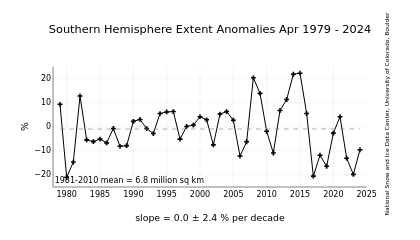
December is the month when the Antarctic sun is highest in the sky, and when the most sunlight reaches the surface. Thus an excess of ice in December has the maximum impact on the southern hemisphere’s radiative balance. In the Antarctic, the most important months are mid-October through mid-February, because those are months when the sun is closest to the zenith. The rest of the year there is almost no shortwave radiation to reflect, so the excess ice has little effect on the shortwave radiative (SW) balance.
This has been discussed in detail by Roger Pielke Sr. and others in several papers.
So how does this work? Below are the details of this article’s thesis.


1. As mentioned above, the Antarctic ice excess occurs near the December solstice when the sun is highest above the horizon. By contrast, the Arctic ice deficiency appears near the equinox – when the sun is low above the horizon. Note in the graph below, that Arctic ice reaches it’s minimum in mid-September – just when the sun is setting for the winter at the North Pole. While the September, 2008 ice minimum maps were dramatic, what they did not show is that there was little sunlight reaching the water that time of year. The deviation from normal did not begin in earnest until mid-August, so there were only a couple of weeks where the northern hemisphere SW radiative balance was significantly impacted. Thus the water in most of the ice-deficient areas did not warm significantly, allowing for the fast freeze-up we saw during the autumn.
The 2008 peak Arctic ice anomaly occurred near the equinox, when it had the minimum heating effect on the ocean.

By contrast, the peak Antarctic ice anomaly occurred at the December solstice, when it had a maximum cooling effect, as shown below.
2. The next factor to consider is the latitude of the ice, which has a strong effect on the amount of solar insolation received. Arctic sea ice is closer to the pole than Antarctic sea ice. This is because of the geography of the two regions, and can be seen in the NSIDC images below.
Antarctic sea ice forms at latitudes of about 55-75 degrees, whereas most Arctic ice forms closer to the pole at latitudes of 70-90 degrees. Because Antarctic ice is closer to the tropics than Arctic ice, and the sun there reaches a higher angle above the horizon, Antarctic sea ice receives significantly more solar radiation in summer than Arctic sea ice does in its’ summer. Thus the presence or absence of Antarctic ice has a larger impact on the SW radiative balance than does the presence or absence of Arctic ice.
At a latitude of -65 degrees, the sun is about 40 degrees below the zenith on the day of the solstice. Compare that to early September negative anomaly peak in the Arctic at a latitude of 80 degrees, when the sun is more than 70 degrees below the zenith. The amount of solar radiation hitting the ice surface at those maxima is approximately 2.2 times greater in the the Antarctic than it is in the Arctic = cos(70) / cos(40) .
The point being again, that due to the latitude and date, areas of excess Antarctic ice reflect a lot of SW radiation back out into space, whereas deficient Arctic ice areas allow a much smaller quantity of SW radiation to reach the dark surface of water. Furthermore, in September the angle of incidence of the sun above the water is below the critical angle, so little sunlight penetrates the surface, further compounding the effect. Thus the Antarctic positive anomaly has a significantly larger effect on the earth’s SW balance than does the Arctic negative anomaly.
3. The next point is an extension of 2. By definition, excess ice is further from the pole than missing ice. Thus a 10% positive anomaly has more impact on the earth’s SW balance than does a 10% negative anomaly.
4. Due to eccentricity of the earth’s orbit, the earth is 3% closer to the sun near the December solstice, than it is during the June solstice. This further compounds the importance of Antarctic ice excess relative to Arctic ice deficiency.
All of these points work together to support the idea that so far, polar ice albedo feedback has been opposite of what the models have predicted. To date, the effect of polar albedo change has most likely been negative, whereas all the models predicted it to be positive. There appears to be a tendency in the climate community to discount the importance of the Antarctic sea ice increase, and this may not be appropriate.
J. Peden:
“You are dealing with someone who is very insecure and needs group approval or even group dictation as to what he “thinks” – potentially involving literally everyone. So if you threaten his groupthink bubble, you are going to pay for it by way of an irrational, punishing response. He has already essentialy delivered a personal threat to you as to his response, should you question his Dogma.”
J., I think that you have hit the nail on the head on that one.
Parenthetical, besides my interest in science, I am very interested in what people think, why they think it, and how that affects what they do. Don’t get the idea that I am a fan of “Psychology” as it is currently practiced, because I am not. This relates to Climate Change in that I am looking for differences between the personalities and world views of the adherents and skeptics of AGW.
I find my Meteorology prof (the AGW supporter) quite likable, and I think that he would be wounded at the very suggestion that he had “essentially delivered a personal threat.” He is fun to engage in discussions, and other students have told me that “he loves a good argument, but make sure he ultimately wins.” I have argued with him in class about other topics, and we have both enjoyed the sparring, BUT… I do proceed with caution for fear of insulting in front of the other students.
Now my Geology prof is not a warm cuddly guy at all, but I find him rather delightful, in spite of the fact that he is pig-headed, and would piss me off regularly. The difference with this guy is that if I told him that he was full of sh$$ in front of the class, I doubt that he would never retaliate in even the most subtle manner, nor would he lose a moment’s sleep over it. I NEVER argued science with him in class, because this old bastard is so good, that it would be like showing up to a gang fight with a Nerf bat. So, therefore, I restrained my self to a little judicious heckling.
Actually on the last day, when I brought my voluminous take-home-final-from-hell to his office, I mentioned the heckling, and he told me that he had enjoyed it.
BTW, I learned so much in that geology class that it literally changed the way I see the world.
Philip_B (23:41:42) :
Interesting. Much is made of loss of Arctic ice as proof of GW, but the gain in Antarctic ice is studiously ignored.
There’s a good reason for that, it isn’t happening.
Leif, So it seems like you’ve got some doubt on the subject. Am I right? This really changes everything you’ve said that I’ve read. Was it for money? Were you pressured? Why didn’t you say what you say on here? Have you recently had a revelation? I feel a bit hard done by here as you basically flatly threw out everything I’ve said when you actually have some unanswered doubt? Where there is doubt there is room for discovery. Ed.
Edward Morgan (09:23:19) :
Am I right?
It seems that you have not read or comprehended anything of what I posted. Repeating my posts doesn’t seem worthwhile.
Leif, I did read your stuff carefully it just doesn’t add up for this reason.
New Scientist is an important magazine what was the point of your comment in line with the hypothetical.
Most of the readers of New Scientist will reckon you believe solar radiation can play a significant part in climate while most of the readers on here will reckon you don’t. Surely if the sun doesn’t do much then your true opinion would have been far more important than anything else said in the article? People would need to know. Ed
A little hard to take Pravda seriously:
http://english.pravda.ru/photo/report/sea_monster-1816
http://english.pravda.ru/photo/report/UFO-1584/
Edward Morgan (11:27:14) :
People would need to know.
I think you are placing too much importance on my opinion. I have said numerous times that:
1) it has not been demonstrated to my satisfaction that the variations of solar activity and irradiance the past several hundred years result in more than, say, 0.1C variation of the temperature.
2) the Sun has varied a lot less over that time than commonly thought.
Many people [even Anthony on point 1 – after all this blog is about climate not about the Sun] may disagree with this, but that does not preclude my comments on the matter.
Leif, Thanks for your response. I’ll let New Scientist know so that their readers don’t get a false impression I mean after all its a minor difference in understanding for them.
Question; Mr Scientist. Bears are making a comeback in England, how do you think this will effect the future?
Answer; There will be skirmishes with Bears and people will have to arm themselves.
Thank-you very much for your important opinion. New Scientist
Edward Morgan (12:00:21) :
I’ll let New Scientist know so that their readers don’t get a false impression
I’ll look forward to New Scientist publishing your letter and having them set their readers straight.
Of course I won’t bother as it is more honest as it stands. By a beautiful twist of fate. Ed
Edward Morgan (12:44:17) :
Of course I won’t bother as it is more honest as it stands.
So you were being dishonest about your intention…
Danish proverb: ‘a thief thinks everybody steals’
By a beautiful twist of fate.
Your twisted view here does you a disservice. There are times where it pays to listen to people rather than projecting your own wishes.
E. M. Smith:
“And don’t forget that the mandated CO2 sequestration means that the coal burners (Exxon competition) must collect the CO2 and dispose of it. This means Exxon can be subsidized in enhanced oil extraction via CO2 injection. They get PAID to enhance oil production by their competition. Gotta love it.”
It gets better! Recently Dow in Freeport, TX, announced construction of a hydrogen plant using petroleum coke as the starting material, with complete CO2 capture for later sales. Oil drilling/production companies purchase the CO2 for injection into their wells to stimulate oil flow. There are carbon offsets to boost the cash flow. The CO2 remains sequestered in the oil field. As CO2 sequestering is not yet required in Texas, Dow’s primary incentive is replacing naatural gas (expensive) with pet-coke (very inexpensive).
I don’t think the oil companies will get paid to take the CO2. Rather, the CO2 will be sold at a market price. Some oil companies will shut down their CO2 generators and realize some savings, presumably. The market for CO2 may be going down, though, so maybe that is a commodity that could be shorted.
Also, oil companies have their own furnaces that produce CO2, especially in refineries. They will be likely to capture and re-use their own CO2, not helping out a competitor!
Roger E. Sowell
Marina del Rey, California
Pierre Gosselin :
“Dear Mr Sowell,
Again, I can only advise you to take a few minutes and to use your engineering talents and calculate the scale of a storage infrastructure that would be needed to buffer a couple of windless days, should wind energy someday provide 10 or 20% of USA’s electrical need. ”
Good advice. Already done, by lots of serious engineers and businessmen. Also, good points by all that there are few locations suitable for pumped storage hydroelectric, and building more runs into serious opposition.
To illustrate the importance some rather sober and serious people attach to this, there is a multi-day conference in Austin, TX next week on wind power and storage systems. See:
http://www.utcle.org/conference_overview.php?conferenceid=829
Re: biofuels, I agree if you are referring to ethanol. My car is dual-fuel capable with E85, and I refuse to buy any. But, there is a much better argument for biodiesel. Have a look at the Jatropha tree.
And I agree that it is mostly about economics. I have some experience in economics, especially for world-scale energy projects. I have performed a couple of dozen detailed feasibility studies including financing options for multi-billion dollar projects thus far in my career. Sometimes the problem is that people do not think in sufficiently large scale. ExxonMobil recognizes this, and one result is a new generation of LNG tankers that are much larger than any ever built. Where economies of scale exist, bigger is much better.
Europe has different challenges than the U.S., but nothing insurmountable. There are certain geographic and geologic differences, such as no large land expanses such as the desert southwest in the U.S. Technologies must always suit the application, and IMHO one size does not fit all.
You may be right that all this renewable energy talk is nonsense. I disagree, as I know that it is happening, with men of sound judgement and prudent investing standards. As with global warming (or is it cooling?) we must wait and see. I am not waiting, though. I am one who is making it happen.
Btw. Even ExxonMobil, no fan of renewables, predicts that biodiesel will comprise 7 percent of transportation fuels in 2030. That is up from less than one percent today.
Stay tuned, sports fans. This is about to get interesting!
Roger E. Sowell
Marina del Rey, California
Leif, I thought of not writing to them afterwards. I would have written to them but I then realised what people thought to that article is more correct for me. If you don’t you write to them. You can’t expect me with my view to do that. And of course you were the one who said it. So put the gallows away.
In judgement I feel the thief comment is a little out of place. In honesty I don’t know why you say what you say and I do suspect you are making it up. That’s where I’m at. Now of course I am trying really hard to get it right for potentially all sorts of great all inclusive reasons that I care passionately about and have felt deeply all my life. Go find my contradictory article.
With the twist of fate thing. I was pleased in the end to think you have helped people wonder about the effect of solar cycles with your New Scientist piece. I assure you if I agreed with you and I’m looking for the truth. I wouldn’t have said it. The real problem is the gap from me to the land of the Wizard of Oz. Ed
Some Danish physicist have another perspective
http://www.physorg.com/news151003157.html
“Have a look at the Jatropha tree. ”
The problem with growing any crop is that the amount of land available for cultivation of anything is limited. To increase the production of something, production of something else must decrease or habitat not currently being cultivated must be modified. While that tree is touted as not competing with food crops, I maintain that is true only while it is not widely cultivated. If cultivation would expand on an industrial scale and if said cultivation were profitable, it would displace less profitable crops. Even if currently uncultivated land were placed into production of it, it would likely greatly change the natural habitats where it is planted.
Converting an area with little vegetation where local species have adapted to the environment to wholesale production of this plant could be catastrophic to what is one of the most delicate ecosystems on the planet. Desert ecosystems are extremely vulnerable to even the slightest change because they exist on the margins of sustaining life in the first place.
Once the trees are planted, increasing seed production would be the first order of business. We would soon see irrigation and fertilization and eventually complete change in the local ecosystem. If it proves very profitable, production would begin to move to more conventional crop locations where it would begin to displace food crops. Exchanging foor for a poisonous oil that can not be used for any other purpose seems somewhat dangerous.
A very effective method of CO2 sequestration would be to pulp waste paper and use it to fill old coal mines. Basically putting the carbon right back where you got it from. Coal would be mined and burned. The CO2 absorbed by trees, turned into paper used in the economy and then buried back into the coal mine where the CO2 came from. That would give a positive use of the CO2 before it is sequestered.
I guess the bottom line is that I believe fossil fuels are more environmentally friendly than the jatropha tree. Nuclear with recycled fuel even more friendly. No need to destroy thousands of acres of desert habitat with nuclear and no CO2 emissions.
maksimovich thanks for that article. Sounds spot on. Cheers, Ed.
Leif,
Solanki had an earlier correlation type analysis that claimed to prove that the Sun could account for no more than 30% of the recent warming. The problem with it was that it didn’t take into account climate commitment due to the thermal inertia of the oceans. Solanki’s later work showed that solar activity plateaued at one of its highest levels in the last 8000 years circa 1940, after increasing over most of the 19th and early 20th centuries. So once it dips solar activity is unlikely to return to current levels for quite some time.
TJ indicated that you have concluded that that the solar luminosity differences even at the maunder minimum would not be enough to explain the cooling. Have you considered that UV varies by a much greater amount and has nonlinear impacts through stratospheric chemistry? Have you considered particle fluxes from the solar wind? Have you considered that GHGs couple to the climate quite differently from solar, with solar penetrated 10s of meters into the oceans, while GHGs impact on the ocean in the top few microns? All the non-paleo model independent analyses of climate sensitivity are based on aerosols and solar, not on GHGs, so in this nonlinear system climate sensitiviy GHGs may be quite different.
John,
Solar activity does not have to have an upward trend to account for some of the recent warming. The aerosol event that is hypothesized to have contributed to the mid century cooling (global dimming?) and then cleared up during the 80s (global brightening) just allowed the impact of the high level of solar forcing to return with a vengence (to paraphrase Leif).
Jcbmack,
Far from being the warmest in the last 100000 years, the recent warming is not clearly higher than the Medieval Warm Period, keep in mind the undercertainties. It is almost certainly cooler than the Holocene optimum which occurred in the last 10,000 years.
crosspatch (15:54:57) :
“I guess the bottom line is that I believe fossil fuels are more environmentally friendly than the jatropha tree. Nuclear with recycled fuel even more friendly. No need to destroy thousands of acres of desert habitat with nuclear and no CO2 emissions”.
You are right.
The introduction of carbon fuels saved the whales that were caught for a.o lamp oil from extinction.
Carbon fuels are the engine of our economies and we can’t function without them.
There is no energy supply problem because there is enough.
The world’s major problems are over fishing, habitat destruction and food security.
The moment we use food stocks or land to produce fuel we start killing people and species.
CO2 is NO PROBLEM, AGW does not exist.
The real threat to humanity is the corrupt United Nations, the mislead, corrupt and stupid politicians, the crooked bankers and scare mongers like Gore and Hanson who screw science and public trust spreading BS.
The return of our old winters, the internet with sites like WUWT eventually will cope with this problem.
And if a new Dalton/Maunder Minimum arrives this chapter in our history will be closed forever.
It would be nice if it happens in Gore’s life time.
Just the idea that this AH almost made President of the USA is hard to imagine.
Skating on Dutch Canals
http://www.jaunted.com/story/2009/1/10/132848/432/travel/Pass+the+Dutchie:+Queen+Beatrix+Laces+Up+Her+Ice+Skates+as+Canals+Freeze+in+Holland
Edward Morgan (14:03:34) :
I was pleased in the end to think you have helped people wonder about the effect of solar cycles with your New Scientist piece.
If I have, it was not intentionally. I was pointing out the logical consequence of assuming that AGW and solar activity were both important drivers. One can do that [especially since that was the basic premise of the piece] without accepting that that are.
Martin Lewitt (17:05:50) :
solar activity plateaued at one of its highest levels in the last 8000 years circa 1940, after increasing over most of the 19th and early 20th centuries.
Except that solar activity has not been increasing fro the past 200 years. Solar cycle 23 was not more active than cycle 13 and cycle 11 was more active than cycle 22.
TJ indicated that you have concluded that that the solar luminosity differences even at the maunder minimum would not be enough to explain the cooling. Have you considered …
I think that when conditions are equal, the results are equal. The solar wind and magnetic field during the Maunder minimum was no less than at current minima.
Solar activity does not have to have an upward trend to account for some of the recent warming.
Sounds almost like CO2 does not have to have a downward trend to account for the recent cooling. Or: Solar activity does not have to have a downward trend to account for the recent cooling. Throw enough different variables in the stew and you can get anything you want out.
I find my Meteorology prof (the AGW supporter) quite likable, and I think that he would be wounded at the very suggestion that he had “essentially delivered a personal threat.” He is fun to engage in discussions, and other students have told me that “he loves a good argument, but make sure he ultimately wins.” I have argued with him in class about other topics, and we have both enjoyed the sparring, BUT… I do proceed with caution for fear of insulting in front of the other students.
My 19 year-old daughter has recounted this same dynamic in class, except that she does’t give a shit about what these [lesser than] morons think. Why should she?
Leif,
Climate commitment due to the thermal inertia of the oceans is not just another variable. The mixing layer takes decades and the deep ocean centuries to reach equilibrium. Of course the forcings change long before that can happen. This is one of the things I think the models get right. When you store heat into the oceans you don’t have to get much more than a storage rate and the heat capacity of water right, to get the commitment in the ball park.
When you compare cycle 23 to 13 and 22 to 11 are you considering the isotopic proxies or just the sunspot data, what is your reasoning? I haven’t looked at the Solanki papers in awhile, I could be recalling them incorrectly. I new to this blog, if there is a paper or another entry, I’ll be happy to look at it. — thanx