A guest post by Steven Goddard
One of the most widely discussed climate feedbacks is the albedo effect of polar sea ice loss. Ice has a relatively high albedo (reflectance) so a reduction in polar ice area has the effect of causing more shortwave radiation (sunlight) to be absorbed by the oceans, warming the water. Likewise, an increase in polar sea ice area causes more sunlight to be reflected, decreasing the warming of the ocean. The earths radiative balance is shown in the image below. It is believed that about 30% of the sunlight reaching the earth’s atmosphere is directly reflected – 20% by clouds, 6% by other components of the atmosphere, and 4% by the earth’s surface.

We all have heard many times that summer sea ice minimums have declined in the northern hemisphere over the last 30 years. As mentioned above, this causes more sunlight to reach the dark ocean water, and results in a warming of the water. What is not so widely discussed is that southern hemisphere sea ice has been increasing, causing a net cooling effect. This article explains why the cooling effect of excess Antarctic ice is significantly greater than the warming effect of missing Arctic ice.
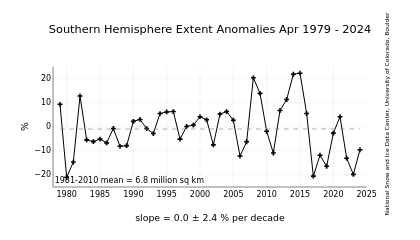
Over the last 30 years Antarctic sea ice has been steadily increasing, as shown below.

December is the month when the Antarctic sun is highest in the sky, and when the most sunlight reaches the surface. Thus an excess of ice in December has the maximum impact on the southern hemisphere’s radiative balance. In the Antarctic, the most important months are mid-October through mid-February, because those are months when the sun is closest to the zenith. The rest of the year there is almost no shortwave radiation to reflect, so the excess ice has little effect on the shortwave radiative (SW) balance.
This has been discussed in detail by Roger Pielke Sr. and others in several papers.
So how does this work? Below are the details of this article’s thesis.


1. As mentioned above, the Antarctic ice excess occurs near the December solstice when the sun is highest above the horizon. By contrast, the Arctic ice deficiency appears near the equinox – when the sun is low above the horizon. Note in the graph below, that Arctic ice reaches it’s minimum in mid-September – just when the sun is setting for the winter at the North Pole. While the September, 2008 ice minimum maps were dramatic, what they did not show is that there was little sunlight reaching the water that time of year. The deviation from normal did not begin in earnest until mid-August, so there were only a couple of weeks where the northern hemisphere SW radiative balance was significantly impacted. Thus the water in most of the ice-deficient areas did not warm significantly, allowing for the fast freeze-up we saw during the autumn.
The 2008 peak Arctic ice anomaly occurred near the equinox, when it had the minimum heating effect on the ocean.

By contrast, the peak Antarctic ice anomaly occurred at the December solstice, when it had a maximum cooling effect, as shown below.
2. The next factor to consider is the latitude of the ice, which has a strong effect on the amount of solar insolation received. Arctic sea ice is closer to the pole than Antarctic sea ice. This is because of the geography of the two regions, and can be seen in the NSIDC images below.
Antarctic sea ice forms at latitudes of about 55-75 degrees, whereas most Arctic ice forms closer to the pole at latitudes of 70-90 degrees. Because Antarctic ice is closer to the tropics than Arctic ice, and the sun there reaches a higher angle above the horizon, Antarctic sea ice receives significantly more solar radiation in summer than Arctic sea ice does in its’ summer. Thus the presence or absence of Antarctic ice has a larger impact on the SW radiative balance than does the presence or absence of Arctic ice.
At a latitude of -65 degrees, the sun is about 40 degrees below the zenith on the day of the solstice. Compare that to early September negative anomaly peak in the Arctic at a latitude of 80 degrees, when the sun is more than 70 degrees below the zenith. The amount of solar radiation hitting the ice surface at those maxima is approximately 2.2 times greater in the the Antarctic than it is in the Arctic = cos(70) / cos(40) .
The point being again, that due to the latitude and date, areas of excess Antarctic ice reflect a lot of SW radiation back out into space, whereas deficient Arctic ice areas allow a much smaller quantity of SW radiation to reach the dark surface of water. Furthermore, in September the angle of incidence of the sun above the water is below the critical angle, so little sunlight penetrates the surface, further compounding the effect. Thus the Antarctic positive anomaly has a significantly larger effect on the earth’s SW balance than does the Arctic negative anomaly.
3. The next point is an extension of 2. By definition, excess ice is further from the pole than missing ice. Thus a 10% positive anomaly has more impact on the earth’s SW balance than does a 10% negative anomaly.
4. Due to eccentricity of the earth’s orbit, the earth is 3% closer to the sun near the December solstice, than it is during the June solstice. This further compounds the importance of Antarctic ice excess relative to Arctic ice deficiency.
All of these points work together to support the idea that so far, polar ice albedo feedback has been opposite of what the models have predicted. To date, the effect of polar albedo change has most likely been negative, whereas all the models predicted it to be positive. There appears to be a tendency in the climate community to discount the importance of the Antarctic sea ice increase, and this may not be appropriate.
Steven Goddard (11:26:12) :
According to the NSIDC:
“The interval indicates that we are 95% confident that the “true” slope or trend line is between the values given. If the interval includes zero, we cannot reject the hypothesis that there is no trend in extent for that month.”
http://nsidc.org/data/seaice_index/interpretation.html#linearregression
For the S. Hemisphere ice extent anomalies, the null hypothesis (0% slope) can not be rejected. Which, I think, means the trendline is not statistically significant (at the 95% confidence level).
If the trend of the S. Hemisphere ice extent is not statistically significant, then you can’t conclude that “the effect of polar albedo change has most likely been negative.”
Once again, statistics is not my bag- am I missing something?
As of right now, WattsUpWithThat and Climate Audit combined have now received over 51% of the total votes in the “Best Science” category.
We can get at least one more vote in for WUWT before the polls close. Please help us make it a strong finish: click
Thanks!
Roger Sowell (10:36:54) :
“Pierre Gosselin — steady, there, steady!
The engineers are on it, so no need for 1-to-1 gas turbine backups for wind power. Or for wave or solar power, for that matter.”
Hi Roger,
Pierre Gosselin is technically correct re the need for (nearly) 100% backup of wind power by conventional electric power generation. From my earlier post on another thread:
The biggest problem I see with wind power is the “substitution capacity”, the percentage of conventional power generation that can be permanently retired when new wind power is put into service. This number is typically less than 10%.
The best report I’ve found on this subject is:
E.On Netz Wind Power Report 2005, Germany
http://www.eon-netz.com/Ressources/downloads/EON_Netz_Windreport2005_eng.pdf
Simply, the wind often does not blow when we need the peak power – so we need a ~same-size conventional power station over the hill, spinning and ready to take over when the wind dies… …the fact that wind power varies as the cube power of the wind speed is a further problem – power variations in the grid due to varying wind speed can cause serious grid upsets, even shutdowns.
Just one such blackout in a cold winter could have devastating results – for a preview, look up a sampling of the mortality stats during the Ontario-Quebec Ice Storm of a decade ago.
http://www.phac-aspc.gc.ca/publicat/ccdr-rmtc/99vol25/dr2517ea.html
Storage of electricity is much easier said than done.
One interesting idea for electricity storage is a “super battery”, consisting of many plugged-in electric cars. This should be possible in a decade or two.
Wind power is supposed to work well in conjunction with (excess) hydro power, but I have not seen this clearly demonstrated.
I have studied this subject and in conclusion I am yet not a fan of wind power.
Regards, Allan
Chris V,
Please read again what I wrote – carefully this time.
If you look at the Antarctic ice data since 1990, it is a statistically significant upwards trend.
http://nsidc.org/data/seaice_index/images/s_plot.png
I’ll just jump in on the ‘pumped water hydro’ line.
Hydroelectric power generation can reach exceedingly high efficiency ratios. Pumping can also be very efficient. It depends on what type of pump or turbine you’re using exactly. But 85% or so is possible with a fairly run-of-the-mill effort. (Under laboratory conditions you can exceed 95%, but you tend to have problems making the widget larger due to mechanical issues like vibration.)
This is a quite reasonable number in comparison to the competition for methods of storing energy. (Batteries really, really suck.) Note that you’re also going to send this energy down the high voltage power lines, which completely suck.
Leif Svalgaard (13:12:07) :
Leif Svalgaard (13:05:11) :
Maybe someone could find the article back.
http://www.newscientist.com/article/mg19125691.100-global-warming-will-the-sun-come-to-our-rescue.html?full=true
Another interesting statement from the same article.
Svalgaard warns: “If the Earth does cool during the next sunspot crash and we do nothing, when the sun’s magnetic activity returns, global warming will return with a vengeance.”
I have read this before and wondered.
My enjoyment of the google power usage article was all for the irony of it. Google is the group that says its motto is “Do no evil…” except when you can help the Chinese send some of their refusniks off to the organ farms.
I have worked on one of the largest pumped storage plants ever created – Helms Power Plant, in the PG&E system. It was built to take the excess energy Diablo Canyon Nuclear PP pushed out at night. An equivalent facility would be almost impossible to build now. There are good areas for it, but you couldn’t get it through CEQA or any other major environmental regulatory path without it being tied up for decades in court. Environmentalists hate dams, and thats what you need for pumped storage…
I’d write more on the rest, but efficiency isn’t the problem. Its economics, as I’ve written here before. Have to go – the little girl wants her daddy…
Steven Goddard (15:31:19) :
Oh- since 1990.
But your opening post says the antarctic ice has been steadily increasing over the last 30 years, not since 1990.
And the graph you provided shows the ice extent trendline for the last 30 years.
What’s the trend and the error bars since 1990? And have you done the calculations to show that the antarctic albedo-cooling is greater than the arctic albedo-warming?
Leif explain please the nobwainer extract above. Did you say as you are quoted as in the article?
Svalgaard warns: “If the Earth does cool during the next sunspot crash and we do nothing, when the sun’s magnetic activity returns, global warming will return with a vengeance.”
Ed.
A byproduct of natural gas is condensate. it is the heavy component that comes up a gas well. This is a very high profit commodity and companies such as ExxonMobil benefit handsomely from this product. At one stage just a couple of gas fields made up a rather large proportion of EM’s yearly turnover and profit and most of this was from condensate not the natural gas.
ATTITUDES AND UNDERSTANDING AT MY STATE UNIVERSITY:
I am a graduate student and a public school science teacher. In the fall 2008 semester, I took a class in meteorology, and in geology. My professor in the meteorology class is a staunch believer in AGW. He states that the jury is in. There is no longer any doubt that we are destroying the planet with CO2 emissions. He advocates for immediate and sweeping laws and treaties to reduce CO2 emissions by 50-80%, and that to largely replace fossil fuels with alternative sources is completely doable and absolutely essential. Part of the class requirement was to bring in articles about meteorology and climatology for the class to evaluate and discuss. This professor told me that I may not bring in any articles that discounted AGW, because that is “fringe science” and that the consensus on AGW is already fully established. He also believes that there should be massive class action lawsuits by the countries that will be affected by rising sea level and drought against the oil companies and CO2 producing countries.
I must say that I highly respect this man’s intelligence and knowledge (which are both considerable), and that he is truly a nice guy, but I do not understand his dogmatic adherence to the AGW theory, and his unwillingness to even discuss the matter.
Now my Geology professor, OTOH, is a cantankerous, ornery old curmudgeon, and, I might add, one of the most brilliant scientists I have ever known. He told us in no uncertain terms that AGW is a “crock of sh##.” I would make smart-ass remarks in class, and he would threaten to come over and “stomp me into the floor”. Since he is ex Special Forces, I think he probably could have done it too (even though he is at least 70 years old), but in reality, I think that he was amused, and respected that I had the guts to hassle him. But I digress…..
Word-of-mouth among the(undergraduate) university students (like in my chemistry class), was that most of the science professors were pretty skeptical of AGW.
Of particular interest, my meteorology class consisted of almost all K-12 science teachers. When I brought up the mechanism of greenhouse effect in class, all of them knew that the “heat” was somehow “trapped” or “reflected” by greenhouse gasses, but NO ONE in the class had any idea of the mechanism of radiation-absorption-re radiation.
So rather than regale you with my astute and fascinating reflections apropos my observations of what people know and think about climate change in the University, I would like to hear your thoughts.
-Kris
kkstewart:
I would suggest keeping your head down until you have some kind of tenure or seniority. In the mean time, keep reading this site so you’re up to speed on the current science.
When you have the same job security as your meteorology professor, as Captain Picard would say: “Engage!”
Oh, and one other thing: Vote!
“I have read this before and wondered.”
Well, temperatures started falling while we were still in cycle 23’s solar maximum.
Temperature behavior seems to be tied more to PDO/ENSO though a deep solar minimum will probably have an additional impact.
If we have an exceptionally cold PDO combined with a “Daltonesque” minimum, things might get pretty cold. Toss a major volcanic eruption on top of that sometime in the next decade and it could get interesting.
Svalgaard warns: “If the Earth does cool during the next sunspot crash and we do nothing, when the sun’s magnetic activity returns, global warming will return with a vengeance.”
Yup, if someone hid you and put a mask on you, i bet you would be ready for vengeance when you were let loose, too…
kkstewart
I share your pain. I’ve been there.
There is so much pressure both financial and social to be a “good guy” that it takes enormous courage to publicly disagree. It seems to me that a lot of the old timers, especially the ones who don’t have to worry about getting grants to stay employed, seem to be openly skeptical. While the younger ones are either true believers or pretend to be.
If your meteorology prof really thinks that the jury is in on all these issues then frankly he does not understand scientific method. I don’t know what he was teaching but science doesn’t exist with that type of attitude.
Smokey:
You are probably right about keeping my head down. The Meteorology professor (The AGW true believer) is my Academic Adviser, and I still have to take three more classes from him. He is also the one that evaluates my Master’s Research Project.
Actually, I am not teaching right now. I am licensed for high school science, but am taking the year off to get my MSc.
The purpose of my previous post was to relate the attitudes toward AGW that I observed in academia last semester.
crosspatch (17:54:50) :
“I have read this before and wondered.”
What I meant by that is I wonder what the “and we do nothing” comment referred to.
What can man do about a quiet or active sun, not much….maybe Svalgaard was referring to Co2?
And also that the leaves the door open to the possibility of decent temperature change based on the Sun.
meant to say he leaves grrrr….
Of course CO2 is not responsible for all the warming, we have methane and water vapor as well. We do not deny that there are cooling years or even transient cooling trends longer than the aforementioned. I do not think we are anywhere near a cataclysmic point in time from warming alone, despite the current increasing in forces in many hurricanes, increased drought frequency and weather anomalies; prior to industrialization in the planet’s history, we have had plenty of famines, droughts and floods. I do not argue with these facts. I do want to point out, however, that skin cancer, lung cancer, current weather anomalies have reached proportions that were not previously realized in human history and the warming looks to be the warmest in the last 100,000 plus years. (the thirty year trend)
Also thermohaline circulations, artic ice sheet changes in the southern Antartic do not explain away warming or strongly evidence that warming is overcome by cooling in the trend analysis.
I found this post thought provoking as a blog post, but inadequate in data and evidence as a thesis. I look forward to seeing more details and compelling evidence.
kkstewart (17:35:33) :
If your meteorology professor said that plate tectonics was “a crock of —“, what would you say?
If your biology professor said that the big bang was a “crock”, what would you say?
If your physics professor said evolution was a “crock”, what would you say?
Out of curiosity, what’s your geology professor’s specialty? Geology covers a lot of ground…
“He also believes that there should be massive class action lawsuits by the countries that will be affected by rising sea level and drought against the oil companies and CO2 producing countries.”
The UNFCCC and Kyoto would give them money without lawsuits, from the developed countries which sign.
Svalgaard also repeated assures us that even during the Maunder Minimum the change in luminosity of the sun was so small, and based on all of the models, insignificant, that it contributed in no way to the LIA. So I would say, if the earth cools during a sunspot crash, then the models are clearly wrong, and we have no idea whether AGW will return “with a vengeance.”
Also, I don’t think that scientists dismiss the importance of a growing Antarctic ice shelf. I believe that there is a popular theory that ice ages begin with cooling of the southern ocean as the shelf expands, absorbing more CO2, starting ice age.
It is pretty clear that if the planet’s climate is unstable, which it is on millennial scales anyway it has more of a tendency in the past few million years to dive into ice ages than to warm.
kkstewart (17:35:33) :
I think you should ask your geology professor why he thinks your meteorology professor is such an AGW supporter. After a stream of invective and suggestion that you ask your meteorology professor yourself, he might come up with a reasonable answer. (Again – don’t ask him “Why is Dr. M such an AGW supporter,” ask “Why do you think Dr. M is such an AGW supporter?”)
The answer will probably include that in geologic timeframes the Earth has had much higher CO2 concentrations and didn’t self-destruct. Geologists think in a very different timeframe than meteorologists. Heck, the jet stream wasn’t even discovered until World War II and decent global temperatures only go back to 1979 when the Pacific Decadal Oscillation flipped warm.
Read ( http://members.iinet.net.au/%7eglrmc/2007%2005-03%20AusIMM%20corrected.pdf ) or watch ( http://www.youtube.com/watch?v=FOLkze-9GcI ) geologist Bob Carter’s reports. There’s a good chance your geology professor will say similar things and then rant about how much more weather he’s seen than your meteorology professor has.
Ah yes, reminds me of the day my high school Chemistry teacher tried to harass me while I was finishing up yesterday’s homework before class started…. I told him if he had been to the Christmas concert last night (I did the lighting for it) he might be in a better mood today.
Edward Morgan (16:55:37) :
Svalgaard warns: “If the Earth does cool during the next sunspot crash and we do nothing, when the sun’s magnetic activity returns, global warming will return with a vengeance.”
You have to read the full article and see what the general drift of Clark’s points were. He quoted several authors [Solanki, Haigh, …] that speculated that AGW was perhaps half of the effect and solar the other half [quibble if it was 30% or some other number close to 1/2]. In that context and if that was true, then indeed a low solar cycle would temporarily mask the AGW, which would, of course, if nothing was done to ameliorate AGW, come back with a ‘vengeance’ once strong solar cycles returned. My input to the article was the prediction that solar activity would be low and my agreeing to the above hypothetical. I would certainly not claim credit for predicting the present cooling as following from my prediction of a low cycle.
TJ (19:11:18) :
So I would say, if the earth cools during a sunspot crash, then the models are clearly wrong,
It could just be coincidence as there is a lot of natural variability in the system. This is one of main gripes, that people make too much of single occurrences,