A guest post by Steven Goddard
One of the most widely discussed climate feedbacks is the albedo effect of polar sea ice loss. Ice has a relatively high albedo (reflectance) so a reduction in polar ice area has the effect of causing more shortwave radiation (sunlight) to be absorbed by the oceans, warming the water. Likewise, an increase in polar sea ice area causes more sunlight to be reflected, decreasing the warming of the ocean. The earths radiative balance is shown in the image below. It is believed that about 30% of the sunlight reaching the earth’s atmosphere is directly reflected – 20% by clouds, 6% by other components of the atmosphere, and 4% by the earth’s surface.

We all have heard many times that summer sea ice minimums have declined in the northern hemisphere over the last 30 years. As mentioned above, this causes more sunlight to reach the dark ocean water, and results in a warming of the water. What is not so widely discussed is that southern hemisphere sea ice has been increasing, causing a net cooling effect. This article explains why the cooling effect of excess Antarctic ice is significantly greater than the warming effect of missing Arctic ice.
Over the last 30 years Antarctic sea ice has been steadily increasing, as shown below.

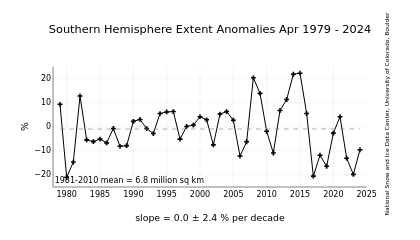
December is the month when the Antarctic sun is highest in the sky, and when the most sunlight reaches the surface. Thus an excess of ice in December has the maximum impact on the southern hemisphere’s radiative balance. In the Antarctic, the most important months are mid-October through mid-February, because those are months when the sun is closest to the zenith. The rest of the year there is almost no shortwave radiation to reflect, so the excess ice has little effect on the shortwave radiative (SW) balance.
This has been discussed in detail by Roger Pielke Sr. and others in several papers.
So how does this work? Below are the details of this article’s thesis.


1. As mentioned above, the Antarctic ice excess occurs near the December solstice when the sun is highest above the horizon. By contrast, the Arctic ice deficiency appears near the equinox – when the sun is low above the horizon. Note in the graph below, that Arctic ice reaches it’s minimum in mid-September – just when the sun is setting for the winter at the North Pole. While the September, 2008 ice minimum maps were dramatic, what they did not show is that there was little sunlight reaching the water that time of year. The deviation from normal did not begin in earnest until mid-August, so there were only a couple of weeks where the northern hemisphere SW radiative balance was significantly impacted. Thus the water in most of the ice-deficient areas did not warm significantly, allowing for the fast freeze-up we saw during the autumn.
The 2008 peak Arctic ice anomaly occurred near the equinox, when it had the minimum heating effect on the ocean.

By contrast, the peak Antarctic ice anomaly occurred at the December solstice, when it had a maximum cooling effect, as shown below.
2. The next factor to consider is the latitude of the ice, which has a strong effect on the amount of solar insolation received. Arctic sea ice is closer to the pole than Antarctic sea ice. This is because of the geography of the two regions, and can be seen in the NSIDC images below.
Antarctic sea ice forms at latitudes of about 55-75 degrees, whereas most Arctic ice forms closer to the pole at latitudes of 70-90 degrees. Because Antarctic ice is closer to the tropics than Arctic ice, and the sun there reaches a higher angle above the horizon, Antarctic sea ice receives significantly more solar radiation in summer than Arctic sea ice does in its’ summer. Thus the presence or absence of Antarctic ice has a larger impact on the SW radiative balance than does the presence or absence of Arctic ice.
At a latitude of -65 degrees, the sun is about 40 degrees below the zenith on the day of the solstice. Compare that to early September negative anomaly peak in the Arctic at a latitude of 80 degrees, when the sun is more than 70 degrees below the zenith. The amount of solar radiation hitting the ice surface at those maxima is approximately 2.2 times greater in the the Antarctic than it is in the Arctic = cos(70) / cos(40) .
The point being again, that due to the latitude and date, areas of excess Antarctic ice reflect a lot of SW radiation back out into space, whereas deficient Arctic ice areas allow a much smaller quantity of SW radiation to reach the dark surface of water. Furthermore, in September the angle of incidence of the sun above the water is below the critical angle, so little sunlight penetrates the surface, further compounding the effect. Thus the Antarctic positive anomaly has a significantly larger effect on the earth’s SW balance than does the Arctic negative anomaly.
3. The next point is an extension of 2. By definition, excess ice is further from the pole than missing ice. Thus a 10% positive anomaly has more impact on the earth’s SW balance than does a 10% negative anomaly.
4. Due to eccentricity of the earth’s orbit, the earth is 3% closer to the sun near the December solstice, than it is during the June solstice. This further compounds the importance of Antarctic ice excess relative to Arctic ice deficiency.
All of these points work together to support the idea that so far, polar ice albedo feedback has been opposite of what the models have predicted. To date, the effect of polar albedo change has most likely been negative, whereas all the models predicted it to be positive. There appears to be a tendency in the climate community to discount the importance of the Antarctic sea ice increase, and this may not be appropriate.
To edriley (09:05:09) :
If you look back at the “Midwinter Report Card” posting on this site you’ll notice that Kum Dollison (14:44:12) provided a link to Mauna Loa “raw data” which indicated there was no rise in CO2 levels between November and December.
Such a flat-lining of CO2 levels during winter, when they ordinarily rise, would be “unprecedented.”
Likely the data will be “corrected,” however too much “correcting” makes people get suspicious. Next thing you know people will be heading up to the top of Mauna Loa with their own little testing kits, to double-check and verify the data. (After all, when McIntyre headed up into the hills to double-check on the Bristlecone Pine data, the results were an eye-opener.)
In any case, I eagerly look forward to Anthony posting on this subject.
I’m sorry, but I am losing my sense of humor for this sort of nonsense. It used to be novel, it has become annoying. Keep in mind, there are those that will actually believe this garbage.
Art (21:49:29) :
What do you make of this story from Science Daily:
“Scientists Refute Argument Of Climate Skeptics”
A lot of good responses to your question, however
let me ask you a question Art;
Art, what do you make of the story??????????
Several comments on the article:
“Scientists Refute Argument Of Climate Skeptics”
The AGW machine is working overtime to come up this this stuff. First of all, the headline is disingenuous. I don’t recall any “skeptic” of claiming that the recent warming is any “accident” as implied by the article. Second, the headline implies moral relevancy – “we’re the real scientists and you’re not”.
The whole premise of the article is moot. The final periods of an increasing trend are going to be statistically higher than previous periods. DUH!
Finally, the last paragraph is inherently contradictory with itself and shows what I consider scientific dishonesty:
“Our study is pure statistical nature and can not attribute the increase of warm years to individual factors, but is in full agreement with the results of the IPCC that the increased emission of greenhouse gases is mainly responsible for the most recent global warming“, says Zorita in summary
Shame on you Zorita! Did you have to put that in to get published or just to get the next grant!
Squidly
Stop posting this stuff as I then have to read it causing signifacant carbon emissions. So you are directly responsible for causing catastrophic global warming.
TonyB
To Art (first post, asking about Science Daily article):
http://www.sciencedaily.com/releases/2009/01/090109115047.htm
It is likely correct that man-made emissions have had some effect on rising temps since 1990. The two questions are:
1. How much?
2. What are the drivers?
The satellite graphics on WUWT this past week suggest a linear trend of about 1.3 to 1.5 degrees C per century. No so bad, certainly not a climate catastrophe, unless it were to accelerate.
What are the drivers? A major driver not much discussed is the shift from “global dimming” (occurring up to about 1990), followed by “global brightening.” This refers to the fact that up to 1990, less sunlight penetrated to the earths surface over time. After 1990, the opposite occurred. Note that the Science Daily article uses 1990 as a start point.
Most articles I’ve read about the subject suggest that the fall of the FSU and eastern European communist countries, with the massive shut down of very dirty industry, caused a very substantial reduction in sulfates in the atmosphere. Sulfates have direct cooling effect (in dry air, they are whitish) and an indirect cooling effect as well (the help form clouds via cloud condensation nuclei). It appears that about 1/6 of the reduction in sulfate is from the US acid rain program, about 1/6 from the similar Western European program, and about 2/3 from the fall of the FSU. Chinese increases in SO2 emissions leading to sulfate formation are less than the decreases just described.
For more, google “solar dimming” and “solar brightening,” or “global dimming and brightening.”
So we have at least three major candidates for the recorded warming: increases GHGs, decreased sulfates, and natural (solar?) influences.
It is complex to sort them out, it is obvious to say. But sort them out we must. The IPCC and others include sulfates in their models — but the question is, have the people who wrote the Science Daily article tried to parse out the effects separately, or are they implying (by not discussing sulfate) that it is all due to GHGs?
Pierre Gosselin — steady, there, steady!
The engineers are on it, so no need for 1-to-1 gas turbine backups for wind power. Or for wave or solar power, for that matter.
Energy storage is a hot topic with great interest and funding for research. Sandia National Lab has a good site on their efforts, see
http://www.sandia.gov/ess/
There are at least four technologies under study and various stages of deployment: compressed air, pumped water hydroelectric, batteries, and flywheels.
Besides, all of this will be just a curious footnote to history, once the hydrogen from sunshine technology has matured. Artificial photosynthesis, whereby sunshine splits water into hydrogen and oxygen, then the hydrogen is piped to a conventional power plant, is the ultimate technology.
Artificial photosynthesis should make everybody happy, at least those who have sufficient sunshine to split the water. No CO2. No toxics. No drilling. No byproducts, just water vapor. Sustainable.
[ WAY off topic, Anthony, I know. But, I wanted to inject a ray of sunshine into this discussion! — Roger ]
Roger E. Sowell
Marina del Rey, California
Also on Drudge – my all time favorite…
Revealed: the environmental impact of Google searches
http://technology.timesonline.co.uk/tol/news/tech_and_web/article5489134.ece
And the best comment:
People,
Please think of Mother Gaia
Use Dogpile to search, it queries multiple search engines.
Nosmo, Harrisville PA, USA
Good advice to ward off that global cooling!
I loved another of the comments that google only uses friendly hydropower to run its servers. Unless google built the dams, they are only using power that would have normally been there. Another suggests that google may not have its own server farms. Hahahaha! The ignorance has left me in complete despair. We are all doomed. As the dodos said in the movie “Bring on the Ice Age!!!”
Oops. I see squidley posted a similar article. I still think the comments on the telegraph web site make for great entertainment though…
“Very clean and clinical, but how do you adjust for the dirty soot factor?”
I believe at the North pole, soot would impact most by increasing radiation in winter. If the ice darkens in winter, it would radiate even more heat than it otherwise would. As there is much more ice (and therefore more soot) in winter, the impact of increased radiation in winter might more than offset an increase in absorption in summer. Particularly as ice area decreases in summer and the soot is a decreasing factor as the summer progresses.
A little off topic: So the Russian scientists are predicting a new ice age is imminent. That would explain their combative behavior regarding energy and their natural gas reserves. May be they are doing the Europeans a service by making the Europeans change their silly belief the earth is going to melt from the heat. If indeed the Russian scientists are correct, Europe and the US better start thinking about increasing our use of carbon based energy or nuclear power before it’s too late and we are beset by a new ice age.
Again, just to try to make the AGW horse die so that then all we’d be doing here is “beating a dead horse”, as to the Science Daily article, which says:
“The GKSS Research Centre asks: is it an accident that the warmest 13 years were observed after 1990, or does this increased frequency indicate an external influence?”
If the Earth was indeed in a significant “Global Warming” trend, regardless of the cause, why would anyone be surprised that the most recent years were among the most warm?
And if the Earth had been in a “Global Warming” trend, then started to cool, why would anyone be surprised that the immediately cooling years involved with the changing trend were still among the most warm?
And, more generally, why would anyone want to rush off in a virtual panic to effect an alleged “cure” to an alleged “disease”, which was not only worse than the disease or even a bona fide disease all by itself, but also which was then allegedly addressing a condition – GW – which perhaps doesn’t really exist, and when what instead exists is a genuine disease-producing condition – Global Cooling – to which the alleged GW “cure” can only contribute by reducing the Energy needed to inhibit GC’s adverse effects?
TonyB,
I was replying to the original poster, but to your point, I agree .. 😉
Oops, sorry, I boiled another gallon of tea! (have to read article to appreciate)
– Squidly
“Exxon had already dropped its funding of lobby groups which deny the science of climate change”
Climate always changes and always has and always will. Without “change” we would have never had a Holocene Optimum (climate much warmer than today), Younger Dryas (much colder than today), Roman Warm Period and Medieval Warm Period (somewhat warmer than today) or Little Ice Age (somewhat colder than today).
Climate always changes. The question is exactly how much change humans have on that. As far as global climate is concerned, I am fairly convinced at this point that our impact is somewhere close to zero in a global scale.
Brendan,
I was actually replying to the original poster of the article.
I should really take this opportunity however to clarify my original response. I am not dissing the posting of those kinds of articles here. I rather enjoy a chuckle now and then. However, I am dissing those that write bogus crap like that. I am beginning to lose patience as there is so much of that kind of garbage floating around, and I know of people that will actually believe the stuff. Hence, it simply fuels more of the hysteria. Keep posting them here though, I like the humor of it (I’m sure others here do too).
– Squidly
“And, more generally, why would anyone want to rush off in a virtual panic to effect an alleged “cure” to an alleged “disease”, which was not only worse than the disease or even a bona fide disease all by itself, but also which was then allegedly addressing a condition – GW – which perhaps doesn’t really exist, and when what instead exists is a genuine disease-producing condition – Global Cooling – to which the alleged GW “cure” can only contribute by reducing the Energy needed to inhibit GC’s adverse effects?”
You ask why?
Money.
JimB
DaveM (08:13:39) :
1) The next Ice Age appears to be on schedule. Rather, the cycles of the
previous ice ages remain in place. This is hardly news.
2) AGW proponents need to look at geologic time scales. This is hardly news.
3) Russian nationalistic propaganda remains in place. The first time I heard Radio Moscow on Dad’s shortwave radio around age 12 taught me more about propganda than anything I learned in school. I still remember the superior tone of voice as the announcer compared superior Russian factory output to America’s. For example, the article goes out of its way to praise Milankovich. I was a bit surprised to see Carl Sagan describes as famous, but I guess he’s not a threat.
4) I wish a paper version was available in supermarket check out lanes. Life isn’t the same without tabloids like “World News Weekly” and the others that gush over UFOs. Here we have photos of a suicidal chicken, photos of a “Hellish hairy sea monster” (what _is_ that, anyway?), and a photo of a nano-scale toilet. This is great stuff!
Chris V
If you look at the Antarctic ice data since 1990, it is a statistically significant upwards trend.
http://nsidc.org/data/seaice_index/images/s_plot.png
Isn’t it just that the Antarctic is more sensitive to the sun’s downward turn because it is nearer land which loses heat quicker. Keep thinking, Ed.
On the original topic (has a post ever been taken over this badly?)
Somehow it never registered with me that
1) the NH ice edge is much closer to the pole than is the SH ice edge.
2) the relative minima are out of phase.
I guess I don’t quite understand why either minimum occurs when it does. The NH minimum makes sense to me as I’d expect the region to remain in melting conditions after the summer solstice. The SH pattern seems odd. Perhaps thanks to its much greater size and less ice movement than in the Arctic the higher sun angle can track the ice edge. As soon as the sun heads north, there’s not enough heat to counter the cold from the south and the ice edge rushes back.
Roger Sowell (10:36:54) :
You are hereby banned from posting for the next five (5) minutes for bad punnery. 🙂
Brendan (10:40:12) :
Also on Drudge – my all time favorite…
Revealed: the environmental impact of Google searches
http://technology.timesonline.co.uk/tol/news/tech_and_web/article5489134.ece
I personally like the irony of posting an article on the web about the “bad” CO2 effects of using the web…
“Scientists Refute Argument Of Climate Skeptics”
What’s a “climate skeptic”. Someone who doesn’t believe in climate? Does anyone fit that category.
Ric Werme —
*grin*
This may deviate a bit from the subject but I wonder if anyone has studied the degree to which space satellites and debris may refect energy into space?