A guest post by Steven Goddard
One of the most widely discussed climate feedbacks is the albedo effect of polar sea ice loss. Ice has a relatively high albedo (reflectance) so a reduction in polar ice area has the effect of causing more shortwave radiation (sunlight) to be absorbed by the oceans, warming the water. Likewise, an increase in polar sea ice area causes more sunlight to be reflected, decreasing the warming of the ocean. The earths radiative balance is shown in the image below. It is believed that about 30% of the sunlight reaching the earth’s atmosphere is directly reflected – 20% by clouds, 6% by other components of the atmosphere, and 4% by the earth’s surface.

We all have heard many times that summer sea ice minimums have declined in the northern hemisphere over the last 30 years. As mentioned above, this causes more sunlight to reach the dark ocean water, and results in a warming of the water. What is not so widely discussed is that southern hemisphere sea ice has been increasing, causing a net cooling effect. This article explains why the cooling effect of excess Antarctic ice is significantly greater than the warming effect of missing Arctic ice.
Over the last 30 years Antarctic sea ice has been steadily increasing, as shown below.

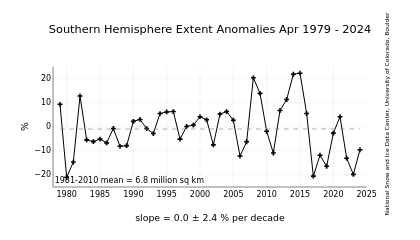
December is the month when the Antarctic sun is highest in the sky, and when the most sunlight reaches the surface. Thus an excess of ice in December has the maximum impact on the southern hemisphere’s radiative balance. In the Antarctic, the most important months are mid-October through mid-February, because those are months when the sun is closest to the zenith. The rest of the year there is almost no shortwave radiation to reflect, so the excess ice has little effect on the shortwave radiative (SW) balance.
This has been discussed in detail by Roger Pielke Sr. and others in several papers.
So how does this work? Below are the details of this article’s thesis.


1. As mentioned above, the Antarctic ice excess occurs near the December solstice when the sun is highest above the horizon. By contrast, the Arctic ice deficiency appears near the equinox – when the sun is low above the horizon. Note in the graph below, that Arctic ice reaches it’s minimum in mid-September – just when the sun is setting for the winter at the North Pole. While the September, 2008 ice minimum maps were dramatic, what they did not show is that there was little sunlight reaching the water that time of year. The deviation from normal did not begin in earnest until mid-August, so there were only a couple of weeks where the northern hemisphere SW radiative balance was significantly impacted. Thus the water in most of the ice-deficient areas did not warm significantly, allowing for the fast freeze-up we saw during the autumn.
The 2008 peak Arctic ice anomaly occurred near the equinox, when it had the minimum heating effect on the ocean.

By contrast, the peak Antarctic ice anomaly occurred at the December solstice, when it had a maximum cooling effect, as shown below.
2. The next factor to consider is the latitude of the ice, which has a strong effect on the amount of solar insolation received. Arctic sea ice is closer to the pole than Antarctic sea ice. This is because of the geography of the two regions, and can be seen in the NSIDC images below.
Antarctic sea ice forms at latitudes of about 55-75 degrees, whereas most Arctic ice forms closer to the pole at latitudes of 70-90 degrees. Because Antarctic ice is closer to the tropics than Arctic ice, and the sun there reaches a higher angle above the horizon, Antarctic sea ice receives significantly more solar radiation in summer than Arctic sea ice does in its’ summer. Thus the presence or absence of Antarctic ice has a larger impact on the SW radiative balance than does the presence or absence of Arctic ice.
At a latitude of -65 degrees, the sun is about 40 degrees below the zenith on the day of the solstice. Compare that to early September negative anomaly peak in the Arctic at a latitude of 80 degrees, when the sun is more than 70 degrees below the zenith. The amount of solar radiation hitting the ice surface at those maxima is approximately 2.2 times greater in the the Antarctic than it is in the Arctic = cos(70) / cos(40) .
The point being again, that due to the latitude and date, areas of excess Antarctic ice reflect a lot of SW radiation back out into space, whereas deficient Arctic ice areas allow a much smaller quantity of SW radiation to reach the dark surface of water. Furthermore, in September the angle of incidence of the sun above the water is below the critical angle, so little sunlight penetrates the surface, further compounding the effect. Thus the Antarctic positive anomaly has a significantly larger effect on the earth’s SW balance than does the Arctic negative anomaly.
3. The next point is an extension of 2. By definition, excess ice is further from the pole than missing ice. Thus a 10% positive anomaly has more impact on the earth’s SW balance than does a 10% negative anomaly.
4. Due to eccentricity of the earth’s orbit, the earth is 3% closer to the sun near the December solstice, than it is during the June solstice. This further compounds the importance of Antarctic ice excess relative to Arctic ice deficiency.
All of these points work together to support the idea that so far, polar ice albedo feedback has been opposite of what the models have predicted. To date, the effect of polar albedo change has most likely been negative, whereas all the models predicted it to be positive. There appears to be a tendency in the climate community to discount the importance of the Antarctic sea ice increase, and this may not be appropriate.
Currently one of the most effective ways to refute the Science Daily/alarmist crowd is to cast a vote for a real science site: WUWT: click
The AGW promoters will squeal like stuck pigs, but more people will begin to pay attention to what skeptics are saying.
[Right now the combined number of votes for WUWT and Climate Audit — another true science site — have surpassed 50% of all votes cast in the “Best Science” category. The more votes we get, the harder it will be to spin the result as a “popularity contest.” One person’s popularity contest is another person’s “consensus.” It is becoming increasingly clear that the AGW emperor has no clothes.]
Smokey, at the end of the poll the AGW alarmist crowd will claim that WUWT is not a science blog. (that’s already been n mentioned has it not?)
Art, regarding the Science Daily article, ditto to philincalifornia’s term, “infantile”, to describe the contents of the article. Likewise, infantile readers are mainly supposed to merely repeat the article’s headline. In other words, it’s a classic propaganda piece, aimed at a specific audience: “The Monkeys know it’s true because they always say it’s true.”
“The GKSS Research Centre asks: is it an accident that the warmest 13 years were observed after 1990, or does this increased frequency indicate an external influence?”
Right off the bat, who in their right analytical mind would ever call any valid warming or cooling trend an “accident”? Or, for that matter, any period of non-trend “not an accident”?
This misapplied term, “accident”, itself is specifically intended by the authors to be loaded in order to imply all by itself that any trend must be due to an “external” = “unnatural” [= man-made or perhaps Space Alien?] interference And it also refers only to a statistical model of temperature trends which falsely presumes that essentially no significant Earthly temperature trends are caused by “natural” forces, and it also falsely implies that essentially no significant Global trends have ever existed in the Earth’s history! At least, that is, prior to Man’s presence [or perhaps only due to the actions of Space Aliens prior to Man’s existence?], which is the subtext of the article and which the “infantile” readers are supposed to absorb.
OT
Wind energy supply dips during cold snap
http://www.telegraph.co.uk/earth/energy/windpower/4208940/Wind-energy-supply-dips-during-cold-snap.html
“But sources in the energy industry say that the lack of wind has caused the country’s wind farms to grind to a halt when more electricity than ever is needed for heating, forcing the grid to rely on back up from fossil fuels or other renewable energy sources. “
Les Francis (03:35:33),
The Weblog Awards committee has placed WUWT in the same science category as RealClimate. If the warmist losers want to be poor sports about their lack of votes, they need to take their sour grapes complaints to the Weblog Awards people.
Mike McMillan
The smoothed Hadley readings back to 1850 in the science daily report
http://www.sciencedaily.com/releases/2009/01/090109115047.htm
look much less impressive when compared to unsmoothed Hadley records back to 1660
http://cadenzapress.co.uk/download/menken_hobgoblin.jpg
They would look even less impressive if we could trace it back through history to the Holocene optimums
TonyB
Daniel Taylor (01:42:52) :
This is off topic but I just couldn’t resist.
Fox News has a story about Google searches causing global warming. http://www.foxnews.com/story/0,2933,479127,00.html
Seems like a damned good way to stop people informing themselves & turning the MMCC tide.
Stop internet traffic! Do it for the kids!
DaveE.
Is there a difference in cloud cover between the Artic 80 deg in September and the Antarctic 65 deg in December? If so, would it enhance or weaken the effect described in the article? And to what extend?
Extra, extra, read all about!!
“lack of wind has caused the country’s wind farms to grind to a halt when more electricity than ever is needed for heating, forcing the grid to rely on back up from fossil fuels or other renewable energy sources. “
Bunch of clowns and their wind energy…….
This is awesome stuff! I would love to know what the alarmists have to say on this one!
Ecotretas
Maybe Steve missed some elements like IR down welling, even when the sun is below the horizon. Maybe he missed why the Antarctic was predicted to be cooler, Ozone hole, Narrower but stronger AV. Maybe he missed that snow at Antarctica would actually increase and mitigate SLR. Maybe he missed that the net SIA is currently 945,000 below 79-00 mean. Maybe he missed that the surface of snow and snow-off days particularly on the Northern Hemisphere over a much greater area than the summer/winter flux at the Antarctic is missing. Maybe Steve missed that Man added GHG’s account physically and demonstrably 1.6 watts to the heat retention capacity, whilst the sun mean flux only account for 0.2-0.3 watts per square meter. Nice theory, [snip-way over the line ~ charles the moderator taking a break from vacation in the SH]
PS What about those huge ABC’s in Asia and over the Indian? Would those account for the mitigating cooling? 0.6C it says.
Art (21:49:29) :
What do you make of this story from Science Daily:
“Scientists Refute Argument Of Climate Skeptics”
http://www.sciencedaily.com/releases/2009/01/090109115047.htm
To understand the problem with their approach, remember that the “average” value of a sine wave is 0.
In this case, climate is deterministic and the result of multiple cyclical processes, some of which may not have been identified. Their approach, however, rests on the unstated hypothesis that climate is forced by CO2, which they have, again implicitly, falsified to something along the lines of “climate is a random process” (“it is extremely unlikely that the frequency of warm record years after 1990 could be an accident”).
I’d also like to know what model they used for the Monte Carlo run. (I’m assuming that the way it was presented, “Monte-Carlo-Simulation,“ was a result of garbled translation.) This gets into the entire area of what constitutes an accurate constructive simulations. For example, did they use one that accurately backcasts the data used to develop it? If not, their sim is useless.
“is it an accident that the warmest 13 years were observed after 1990, or does this increased frequency indicate an external influence?” Someone correct me if I’m wrong, but isn’t this statement false, as addressed numerous times on this site?
I think they should go back to University and take some statistics courses.
Or, since the average depth of they Gulf of Mexico is 3 feet, they could wade from Tampa to Galveston.
To the link by Art (21:49:29)
The best statistical methods don’t help when the data they are apply to are faulty
The external driver for the frequency of warm years is Hanses.
PS trend 60,000 km square annum off at Arctic and 25,000 km square plus at Antarctic, implying that the Antarctic Sea Ice cooling weight is exceeding a factor of 2.4.
The Arctic as mentioned has 945,000 km square less currently where the Antarctic has 162,000 km square more. That ratio is even more significant.
http://arctic.atmos.uiuc.edu/cryosphere/iphone/iphone.currentarea.series.html
Currently the Baltic and the Seas near Vladivostok are ominously iceless. Their cover and latitude seems significant to me. Explanations?
First of the title of the article by itself indicates the bias. The title clearly implies that if you have not accepted the AGW hypothesis then you are not a scientist. Since they are presumably refuting theories by scientists who are not on the AGW bandwagon then they should at least do them the courtesy of calling them “Climate Skeptic Scientists”.
Secondly the quote below is from the article:
That quote alone tells me the quality and depth of the so called refutation.
There is plenty of evidence of the cyclical nature of climate caused by things such as the PDO and NAO, if you dont believe this then have a look at the AGWers excuses for the current 10 years trend. Because of this cyclical nature their research is in fact flawed since they have based it on the premise of climate being non-cyclical. i.e. This years temperature bears no relationship to last years. This is a false premise.
Carbon footprint of Britons for few days ‘bigger than annual footprints of poorest’
http://www.telegraph.co.uk/earth/earthnews/4210332/Carbon-footprint-of-Britons-for-few-days-bigger-than-annual-footprints-of-poorest.html
“The charity are lobbying the Government to help Britons reduce their carbon footprints by increasing the amount of energy from renewables and improving efficiency, while also helping those in the developing world to improve lifestyles through low carbon energy.”
Build more windmills????
Julian Flood (02:24:13):
It could be dust spread on the ice. It could be smoothed, surfactant and oil-spill polluted water not producing as many clouds as usual. It could be smoothed water having reduced albedo during insolation. It could be smoothed water having less emissivity during darkness. It could be plankton blooms lowering albedo…
So, five things it might be. Add in your sun and eruptions (oceans is a bit general), that’s seven things it might be. Surely there must be more? Oh, yes. CO2. Eight.
Julian, climate is not a random walk. If you will study the history, you’ll see that the warming of the 20th century is in no way out of the ordinary. Yes, of course man can and does have some small impact, mostly regional in nature. Yes, of course we should be concerned about pollution (which does NOT include C02), and try to limit it as much as possible. But, hitching concern about pollution to the AGW bandwagon is a huge mistake, and one that environmentalists will surely rue.
As for volcanoes, sure they have an effect, temporarily lowering temps somewhat when there are more, or bigger ones than normal, and I suppose the argument could be made that if there were fewer, smaller volcanoes in a certain time period, it would allow temps to rise a bit more during a warm trend, or cool a bit less during a cool trend. So what? The evidence now is we’re cooling. The oceans having switched to their cool phase PDO would seem to be the primary reason, however ultimately, it is the sun which determines which way our climate heads, and as of now, it looks to be heading “south”.
Answering a few questions –
Cryosphere Today measures ice area, whereas NSIDC measures extent. The key points of this article are that the timing of the anomalies and the latitude of excess/missing ice are what effects the SW budget. If the North Pole were ice free on Sept 21, it would have essentially no impact on the SW budget, because there is no direct sunshine. Measured at June 21, there has been very little loss of Arctic ice. The losses have been seen late in the summer, towards the equinox, when they have minimum effect.
Ice thickness has almost no impact on the SW balance. The light reflects off the surface.
The Science Daily article seems to be stating the obvious. If you accept the temperature data they are using, the earth is warming. Anyone can see that from looking at the graph. No need for Monte Carlo analysis to reach that conclusion.
I have no idea why Antarctic sea ice has been increasing and won’t speculate. I’m just pointing out how the observed trend affects the SW balance.
Re: Wind energy supply dips during cold snap
WUWT was among the first to point this out on Jan. 1
http://wattsupwiththat.com/2009/01/01/an-opportunity-for-europe-in-2009/#more-4766
Art,
I read the Science daily article and I agree with the other posters. It is a classic ‘strawman’ attack. The term ‘accident’ is horribly loaded (and horribly unscientific I might add. It implies that the ‘skeptics’ (whomever they may be) argue that the the climate system is random and proceed to show that it is not. Well of course it isn’t random, its a complex, non-linear, chaotic system. Chaotic systems are not random, in fact, I don’t think there are any natural ‘random’ systems, they are all deterministic. The problem with chaotic systems is that, unless you know the precise value of every variable and the exact functioning of every process in the system at time t0, you cannot skillfully predict the state of the system at time t+1 (or any other period for that matter. I don’t think any climate scientist can tell you with a straight face (with possibly one or two exceptions) that we know all the variables and the functioning of all the processes that affect earth’s climate, so we can’t reliably predict its future state.
The sad thing is that most likely now ‘natural’ climate effects will be forever branded as ‘random’ and since these gents have ‘proved’ climate changes are not ‘random’, the climate changes we are experiencing are not ‘natural’, hence they must be man made.
The Science Daily article says:
Gee, I thought that part of the science was settled. One thing that pricks up my ears is what warmists compare from past to present to make their point. In 1999 it was easy to say 1998 was the warmest year on record, now they’re saying the past 10 years is the warmest decade on record, and here they’re reaching back 18 years.
Can we recall his degree and send him back to school? I think I’ll add this to my list of stupid quotes. I only have a couple (_my_ standards are high), but I think this qualifies.
Newcomers to the thread – don’t bother reading that article.
Another Arctic expedition in 2010
Northern Pole of Inaccessibility
http://news.bbc.co.uk/today/hi/today/newsid_7809000/7809290.stm
http://news.bbc.co.uk/1/hi/england/berkshire/7808276.stm
“For the first leg of the journey Jim will lead a team of trained novices to reach the Geographic North Pole, leaving the last landfall of Canada in February 2010. Having reached this he will continue alone and without re-supply to the Arctic Pole a further 269 miles into the very centre of the Arctic Ocean”
http://www.ice-warrior.com/ArcticPole.htm
The Catlin Arctic Survey looks like an interesting project. It should give some hard evidence on ice thickness. The problem I see is that ti heeds to be done every year so that trend lines can be established. The sponsoring outfit is a hardcore warmer in philosophy, but they may end up documenting the dawn of the new ice age!
re: the Arctic expedition. Any scientist worth anything at all understands that if you have preconceived ideas about what you are looking for, you will find it. Science is subjective and relative to the degree that bias is present. Science is objective and absolute to the degree that bias is absent. I believe the scientists on their way to measure ice depth and concentration will report subjective and relative data. I guess there is no such thing as the null hypothesis anymore.
This is an excellent post!
I think another point for this excellent posting by Steven Goddard is how heat loss is increased from open ocean compared with ice-covered ocean due to the existence of convective heat loss from the open ocean’s surface. The radiative and convective heat losses from open Arctic oceans will result in rapid ice formation.
Diogenes (22:55:57) : “I would be curious to see the graph of reflectivity w.r.t. latitude and season used by the GCMs, it must be tremendously complex……. or maybe they just don’t bother with such things.”
You are correct that the reflectance does not have a critical angle, and rapidly approaches R=100% at very shallow incidence angles. It is indeed complicated by the fact that the ocean surface, especially in the southern oceans, is not a specular reflector. There are surface topological features that are large relative to a wavelength of light. That makes the prediction of surface absorbance (the parameter that we really care about) dependent on surface roughness, water droplet size and density above the surface, foam, etc.
jorgekafkazar (23:43:57) :
I looked up some data on the emissivity of ice versus open water, and they are very similar and high (effectively blackbody sources in the IR). Ice is also a poor thermal insulator, having a thermal conductivity not much different from liquid water. Ice can also be a poor reflector of short-wave radiation, depending on air inclusion size and density. However, ice allows snow to build up as a top cover. Snow has very good insulating properties, and a high reflectance. The interesting result of snow-covered ice over water is the freezing rate of the underlying water will slow or stop as the thermally insulating snow cover reduces heat loss to the atmosphere.
Art (21:49:29) :
What do you make of this story from Science Daily:
“Scientists Refute Argument Of Climate Skeptics”
http://www.sciencedaily.com/releases/2009/01/090109115047.htm
Reading the Abstract, it appears the authors used Hadcrut Surface Temperatures (ST). Although Hadcrut is probably better than GISS ST, both ST datasets exhibit a strong warming bias (ref. McKitrick and Michaels recent paper, etc.).
I suggest the authors should have used UAH or RSS Lower Tropospheric (LT) temperatures. These LT temps also show a warming trend, which has peaked and started to decline and now approaches 1979 LT temperature levels, when the satellites were launched.
A switch of the Pacific Decadal Oscillation to cool phase will probably result in further average cooling, unfortunate for humanity.
For a plot of LT’s, see
http://icecap.us/index.php/go/joes-blog/is_this_the_beginning_of_global_cooling/
This plot uses a 6th order polynomial fit and ends in mid-2008.
Roy Spencer has an up-to-date plot using a 4th order polynomial fit, at
http://www.drroyspencer.com/latest-global-temperatures/
Neither of these polynomial fits is predictive, but combined with the PDO shift and other factors such as solar inactivity, the probability is for more cooling.
Raw UAH LT monthly data is available at
http://vortex.nsstc.uah.edu/data/msu/t2lt/tltglhmam_5.2