A guest post by Steven Goddard
One of the most widely discussed climate feedbacks is the albedo effect of polar sea ice loss. Ice has a relatively high albedo (reflectance) so a reduction in polar ice area has the effect of causing more shortwave radiation (sunlight) to be absorbed by the oceans, warming the water. Likewise, an increase in polar sea ice area causes more sunlight to be reflected, decreasing the warming of the ocean. The earths radiative balance is shown in the image below. It is believed that about 30% of the sunlight reaching the earth’s atmosphere is directly reflected – 20% by clouds, 6% by other components of the atmosphere, and 4% by the earth’s surface.

We all have heard many times that summer sea ice minimums have declined in the northern hemisphere over the last 30 years. As mentioned above, this causes more sunlight to reach the dark ocean water, and results in a warming of the water. What is not so widely discussed is that southern hemisphere sea ice has been increasing, causing a net cooling effect. This article explains why the cooling effect of excess Antarctic ice is significantly greater than the warming effect of missing Arctic ice.
Over the last 30 years Antarctic sea ice has been steadily increasing, as shown below.

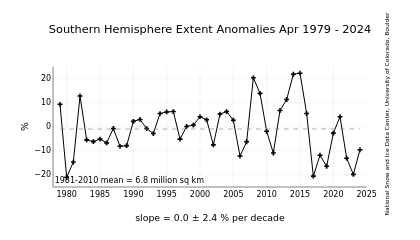
December is the month when the Antarctic sun is highest in the sky, and when the most sunlight reaches the surface. Thus an excess of ice in December has the maximum impact on the southern hemisphere’s radiative balance. In the Antarctic, the most important months are mid-October through mid-February, because those are months when the sun is closest to the zenith. The rest of the year there is almost no shortwave radiation to reflect, so the excess ice has little effect on the shortwave radiative (SW) balance.
This has been discussed in detail by Roger Pielke Sr. and others in several papers.
So how does this work? Below are the details of this article’s thesis.


1. As mentioned above, the Antarctic ice excess occurs near the December solstice when the sun is highest above the horizon. By contrast, the Arctic ice deficiency appears near the equinox – when the sun is low above the horizon. Note in the graph below, that Arctic ice reaches it’s minimum in mid-September – just when the sun is setting for the winter at the North Pole. While the September, 2008 ice minimum maps were dramatic, what they did not show is that there was little sunlight reaching the water that time of year. The deviation from normal did not begin in earnest until mid-August, so there were only a couple of weeks where the northern hemisphere SW radiative balance was significantly impacted. Thus the water in most of the ice-deficient areas did not warm significantly, allowing for the fast freeze-up we saw during the autumn.
The 2008 peak Arctic ice anomaly occurred near the equinox, when it had the minimum heating effect on the ocean.

By contrast, the peak Antarctic ice anomaly occurred at the December solstice, when it had a maximum cooling effect, as shown below.
2. The next factor to consider is the latitude of the ice, which has a strong effect on the amount of solar insolation received. Arctic sea ice is closer to the pole than Antarctic sea ice. This is because of the geography of the two regions, and can be seen in the NSIDC images below.
Antarctic sea ice forms at latitudes of about 55-75 degrees, whereas most Arctic ice forms closer to the pole at latitudes of 70-90 degrees. Because Antarctic ice is closer to the tropics than Arctic ice, and the sun there reaches a higher angle above the horizon, Antarctic sea ice receives significantly more solar radiation in summer than Arctic sea ice does in its’ summer. Thus the presence or absence of Antarctic ice has a larger impact on the SW radiative balance than does the presence or absence of Arctic ice.
At a latitude of -65 degrees, the sun is about 40 degrees below the zenith on the day of the solstice. Compare that to early September negative anomaly peak in the Arctic at a latitude of 80 degrees, when the sun is more than 70 degrees below the zenith. The amount of solar radiation hitting the ice surface at those maxima is approximately 2.2 times greater in the the Antarctic than it is in the Arctic = cos(70) / cos(40) .
The point being again, that due to the latitude and date, areas of excess Antarctic ice reflect a lot of SW radiation back out into space, whereas deficient Arctic ice areas allow a much smaller quantity of SW radiation to reach the dark surface of water. Furthermore, in September the angle of incidence of the sun above the water is below the critical angle, so little sunlight penetrates the surface, further compounding the effect. Thus the Antarctic positive anomaly has a significantly larger effect on the earth’s SW balance than does the Arctic negative anomaly.
3. The next point is an extension of 2. By definition, excess ice is further from the pole than missing ice. Thus a 10% positive anomaly has more impact on the earth’s SW balance than does a 10% negative anomaly.
4. Due to eccentricity of the earth’s orbit, the earth is 3% closer to the sun near the December solstice, than it is during the June solstice. This further compounds the importance of Antarctic ice excess relative to Arctic ice deficiency.
All of these points work together to support the idea that so far, polar ice albedo feedback has been opposite of what the models have predicted. To date, the effect of polar albedo change has most likely been negative, whereas all the models predicted it to be positive. There appears to be a tendency in the climate community to discount the importance of the Antarctic sea ice increase, and this may not be appropriate.
Leif said,
“1st: it would not slow down the ball, and if it did it would eventually cause the ball to rotate the other way.”
I’m holding the ball I spin as I release it. It is horizontally balanced and is spinning horizontally. The force downward due to gravity accelerates it to a point where the friction with the atmosphere limits the downward force and a maximum speed is achieved. However there is a very slight increase in gravity’s pull as well (as we know the further away from the earth the less the pull of gravity.) this would cause a slight acceleration. Within the realms of the spin (perfectly horizontal) capable by the pitcher the spin would stop because the spin put on the ball is not continually applied and the force against the spin is (the atmosphere increasing slightly as we near the ground too) eventually if we could keep it horizontal and build a tower high enough the spin would stop. The downward pull of gravity is definitely against the HORIZONTAL spin in this example because of the atmosphere.
Leif, you seem to be saying that there is no friction like that in space.
Leif, for this to be correct
Take a look at http://www.leif.org/research/Barycenters.pdf
What would happen if your centre of mass moved. Your a structure now, move yours (what moves it) how do you react. The planets react too, they are connected, they are a structure moving.
Ed
If you took Saturn and Jupiter and put them on one side of the sun and from a fixed not orbiting viewing point looked at the positions then moved them to the other side you would see their effect on the sun. The solar system is held together by mass you move that mass around and everything moves.
REPLY: This thread is about polar sea ice – enough with the barycentric babble. – Anthony
It is these changing forces that are part of the sun’s changes.
Anthony, OK, but can I request at some point that the planets be a topic of discussion where we can freely debate this. Maybe a guest post on the subject. Please. Ed
REPLY: I’ll consider it, though I don’t give barycentric theory much credence. I think it is mostly a case of visualization of coincidental cycles. – Anthony
I get it. The only way that stuff coming from the Sun could have the power to heat up or cool down Earth in an appreciable way and that would not get buried in the stronger influences of the stuff we have on the Earth, such as oceans and jet stream patterns, would be to change the distance from the Sun to the Earth. The barycenter is one of those phenomena that some people think have an influence not just on the Sun, but ultimately on us, climatically. But if the distance between us does not change no matter where the barycenter goes, it should be excluded as a possible influence on our climates and temperature patterns. So in the context of Earth’s climates and weather patterns, the barycenter is not an area of interest.
REPLY: Nicely said, Anthony
So if this effects the sun which effects us more noticeably then it should still be thrown out. The Milkanovitch cycles also show this distance to change. Is this true or not??? Has the debate truly ended???
Pamela Gray (08:16:12) :
But if the distance between us does not change no matter where the barycenter goes, it should be excluded as a possible influence on our climates and temperature patterns.
And both calculations and observations show that the distance between the Sun and the Earth do not in any way change when the barycenter moves around. We had a long discussion of that some time ago, and it does not seem fruitful to repeat all that again.
Edward Morgan (07:53:01) :
Anthony, OK, but can I request at some point that the planets be a topic of discussion where we can freely debate this. Maybe a guest post on the subject. Please. Ed
REPLY: I’ll consider it, though I don’t give barycentric theory much credence. I think it is mostly a case of visualization of coincidental cycles. – Anthony
Edward Morgan (08:42:08) :
Has the debate truly ended???
It might be more appropriate to have such a debate after “The Great Debate”:
http://meetingorganizer.copernicus.org/EGU2009/sessionprogramme/GB
I have tentatively accepted to participate, as per the following email exchanges:
On Wed, Nov 26, 2008 at 3:22 AM, Silvia duhau silvia.duhau@gmail.com wrote:
Dear Dr. Leif Svalgaard:
This is to invite you to act as a member of the opponent panel in the debate Planetary dynamics and solar activity have a role in climate change and geodynamics?
– A debate dedicated to the memory of Rhodes W Fairbridge
We have invited already to Cornelis de Jager, Ivanka Charvatova and Dirk Callebaut that has honored us by accepting our invitation
There will be It will be a great honor for us, if you accept to participate as a member of one of the panels: either the proponent or the opponent
(that is : to sustain the refutation of the hypothesis that solar
dynamo-orbital motions interaction as a cause neither of solar activity variations nor climate variations).
Dear Silvia,
The debate is supposed to discuss:
1) To what extent does the sun regulate the Earth’s climate? What is the evidence? What are the processes?
2) Does solar system dynamics significantly affect solar and planetary dynamos? If it did, could this affect the Earth’s climate dynamics?
3) Does solar activity result in geomagnetic field variations? Does it change the Earth’s rate of rotation? Do variations in the Earth’s
geomagnetic field and/or variations in the Earth’s rate of rotation
affect the planet’s climate dynamics.
I think that point (1) is much too broad. A whole week’s worth of
debate on this point alone would not do justice to the problem, so I think that point (1) should simply be dropped, as it would otherwise dilute the issue of real concern to Fairbridge, namely if there are any planetary influence on solar activity, and thereby on climate. Clearly, if there were no solar effect, there would presumably not be any climate effect either. So, I propose to debate only (2) and (3) while relegating (1) to a few remarks at the end. If you can agree to this, I would be glad to accept, otherwise, I would have to pass on this.
Dear Leif:
I am very grateful for your positive answer and for your advice.
In fact, I was thinking in erasing one of the questions, more if the
debate have only 1hr 30′.
Moreover, you are absolute right, as the debate is in the memory of Fairbridge, question 1 is out of place.
Please, I would like to have from you any suggestion for changes in questions 2 and 3. since we have time to change them in the EGU web page.
Regards
Silvia
——
So, perhaps, enough for now. My only concern is that no matter the outcome, it will have no effect on the position of the two sides, in which case the exercise is a waste of time, but at least it doesn’t hurt to recognize Fairbridge.
The way Leif gets to change the programme is so honest and of course they will remain in the same ranks because the solar lot are right and Leif has other interests.
Just been looking at loads of correlates between rainfall and cosmic rays absolutely perfect they are. But is this on the agenda for truth Winston. This isn’t only site in the world Leif. Control that.
Edward Morgan (10:21:30) :
This isn’t only site in the world
Try your luck at Tamino’s:
http://tamino.wordpress.com/
Pamela Gray (08:16:12) :
But if the distance between us does not change no matter where the barycenter goes, it should be excluded as a possible influence on our climates and temperature patterns.
This is where people get mixed up….its nothing to do with the distance from the Sun, that particular planetary influence is covered nicely by Milankovitch and is pretty well an excepted fact. I am arguing that the Jovian planets control angular momentum which has a direct link to the output of the sun, I am not interested in barycenter talk….I am in the middle of some convincing work that will tie this whole thing up, keep your minds open and above all study the information that is coming out….dont think there is nothing new out there to discover in this area.
I would love a seat at the great debate…perhaps I can get some proxy help.
http://landscheidt.auditblogs.com/archives/58
Freudian slip? I’m sure you mean “accepted” fact…
Jeff Alberts (12:31:11) :
Freudian slip? I’m sure you mean “accepted” fact…
Was rather poor wasnt it. It would be more correct to say “past experimental results, papers and observation support Milankovitch’s theory”.
Leif Svalgaard (14:12:31) :
The changes are with respect to the center, not to the bodies. But first can you and no-brain agree as to what you talking out? e.g. about the distance between the Sun and the Earth.
We will see who has the “brain” at your upcoming “Great Debate”. I suspect you might be under pressure if I manage to get my latest work to the conference.
Hi,
Just read the article and I had to point out the failure to take into account total areal extent of ice. The author argues that a 10% anomaly in the antarctic is more important than a 10% anomaly in the arctic, but this fails to take into account the fact that total areal extent is much greater in the arctic and a 10% anomaly represents a much larger area of ice.
Thanks for any thoughts.