A guest post by Steven Goddard
One of the most widely discussed climate feedbacks is the albedo effect of polar sea ice loss. Ice has a relatively high albedo (reflectance) so a reduction in polar ice area has the effect of causing more shortwave radiation (sunlight) to be absorbed by the oceans, warming the water. Likewise, an increase in polar sea ice area causes more sunlight to be reflected, decreasing the warming of the ocean. The earths radiative balance is shown in the image below. It is believed that about 30% of the sunlight reaching the earth’s atmosphere is directly reflected – 20% by clouds, 6% by other components of the atmosphere, and 4% by the earth’s surface.

We all have heard many times that summer sea ice minimums have declined in the northern hemisphere over the last 30 years. As mentioned above, this causes more sunlight to reach the dark ocean water, and results in a warming of the water. What is not so widely discussed is that southern hemisphere sea ice has been increasing, causing a net cooling effect. This article explains why the cooling effect of excess Antarctic ice is significantly greater than the warming effect of missing Arctic ice.
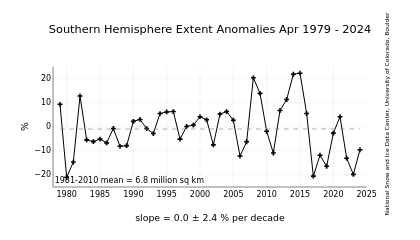
Over the last 30 years Antarctic sea ice has been steadily increasing, as shown below.

December is the month when the Antarctic sun is highest in the sky, and when the most sunlight reaches the surface. Thus an excess of ice in December has the maximum impact on the southern hemisphere’s radiative balance. In the Antarctic, the most important months are mid-October through mid-February, because those are months when the sun is closest to the zenith. The rest of the year there is almost no shortwave radiation to reflect, so the excess ice has little effect on the shortwave radiative (SW) balance.
This has been discussed in detail by Roger Pielke Sr. and others in several papers.
So how does this work? Below are the details of this article’s thesis.


1. As mentioned above, the Antarctic ice excess occurs near the December solstice when the sun is highest above the horizon. By contrast, the Arctic ice deficiency appears near the equinox – when the sun is low above the horizon. Note in the graph below, that Arctic ice reaches it’s minimum in mid-September – just when the sun is setting for the winter at the North Pole. While the September, 2008 ice minimum maps were dramatic, what they did not show is that there was little sunlight reaching the water that time of year. The deviation from normal did not begin in earnest until mid-August, so there were only a couple of weeks where the northern hemisphere SW radiative balance was significantly impacted. Thus the water in most of the ice-deficient areas did not warm significantly, allowing for the fast freeze-up we saw during the autumn.
The 2008 peak Arctic ice anomaly occurred near the equinox, when it had the minimum heating effect on the ocean.

By contrast, the peak Antarctic ice anomaly occurred at the December solstice, when it had a maximum cooling effect, as shown below.
2. The next factor to consider is the latitude of the ice, which has a strong effect on the amount of solar insolation received. Arctic sea ice is closer to the pole than Antarctic sea ice. This is because of the geography of the two regions, and can be seen in the NSIDC images below.
Antarctic sea ice forms at latitudes of about 55-75 degrees, whereas most Arctic ice forms closer to the pole at latitudes of 70-90 degrees. Because Antarctic ice is closer to the tropics than Arctic ice, and the sun there reaches a higher angle above the horizon, Antarctic sea ice receives significantly more solar radiation in summer than Arctic sea ice does in its’ summer. Thus the presence or absence of Antarctic ice has a larger impact on the SW radiative balance than does the presence or absence of Arctic ice.
At a latitude of -65 degrees, the sun is about 40 degrees below the zenith on the day of the solstice. Compare that to early September negative anomaly peak in the Arctic at a latitude of 80 degrees, when the sun is more than 70 degrees below the zenith. The amount of solar radiation hitting the ice surface at those maxima is approximately 2.2 times greater in the the Antarctic than it is in the Arctic = cos(70) / cos(40) .
The point being again, that due to the latitude and date, areas of excess Antarctic ice reflect a lot of SW radiation back out into space, whereas deficient Arctic ice areas allow a much smaller quantity of SW radiation to reach the dark surface of water. Furthermore, in September the angle of incidence of the sun above the water is below the critical angle, so little sunlight penetrates the surface, further compounding the effect. Thus the Antarctic positive anomaly has a significantly larger effect on the earth’s SW balance than does the Arctic negative anomaly.
3. The next point is an extension of 2. By definition, excess ice is further from the pole than missing ice. Thus a 10% positive anomaly has more impact on the earth’s SW balance than does a 10% negative anomaly.
4. Due to eccentricity of the earth’s orbit, the earth is 3% closer to the sun near the December solstice, than it is during the June solstice. This further compounds the importance of Antarctic ice excess relative to Arctic ice deficiency.
All of these points work together to support the idea that so far, polar ice albedo feedback has been opposite of what the models have predicted. To date, the effect of polar albedo change has most likely been negative, whereas all the models predicted it to be positive. There appears to be a tendency in the climate community to discount the importance of the Antarctic sea ice increase, and this may not be appropriate.
Leif, Of course a rabbit can’t move a freight train, is this analogy accurate enough though? Why does the sun move in a pattern consistent enough to link some of its movement with Jupiter and the centre of mass of the solar system. The sun and Jupiter are in a kind of balance connected with their masses so why can’t certain more conjunctive positions of the planets (more mass in one direction at that point) move slightly the centre of gravity of the solar system (one sun radii lets say) its not that much but enough it stands out to me to cause different effects on the sun including slowing its spin. I mean do you not agree that Jupiter and the planets when aligned move the sun at all and that the sun moves around the centre of the mass of the solar system? Ed
E.M.Smith (18:19:10) :
(especially if my Uncle is talking 😉
That trait appears to be familial and obviously reccurs in each succeeding generation.
Does anyone have a link to a historical wind distribution and duration chart, site, data? (Hey! Real weather stuff!)
Climatic Wind Data for the United States
Abstract: Wind data in this summary were extracted from the NCDC’s Edited Local Climatological Data publication (C00128), Air Force and Navy climatic briefs, and other sources. The total period of this summary is 1930- 1996, though the period of record (POR) for which wind data is summarized varies for individual locations, and may begin and end at any time during the 1930- 1996 period. Wind summaries from a total of 321 stations from all U.S. states are presented. The wind elements summarized by month and overall annual values include prevailing wind directions (given in compass points), mean wind speeds, and either peak gusts (in miles per hour), fastest-mile, or highest 5-second winds. Peak wind types may be combined to reflect the highest reported wind. Updated wind data for many sites can be obtained from the post 1996 Edited Local Climatological Data – Annual publications.
http://www.ncdc.noaa.gov/oa/documentlibrary/other-doc.html#C00518
A rather trustworthy source ;<0.
Leif Svalgaard (19:57:40) :
Allan M R MacRae (19:49:11) :
Climate change is natural and cyclical
I would not disagree with that, except for downplaying the ‘cyclic’ bit. I don’t think there is strict cyclicity, just that it ‘goes up and down’.
Agree the up-and-down cycles are less than perfect – although there is something of interest in the PDO and/or Gleissberg – and possibly also in longer cycles but I haven’t looked at them.
I published Tim Patterson’s global cooling prediction (for 2020-2030) in 2002 – but perhaps we were a bit late…
Here is a note received this morning from a friend in Spain:
“The whole of Europe went through a big chill. Last week it’s been 20º below zero in Cantabría, Spain, and traffic collapsed in snowed-in Madrid. Same chaos in Marseille, with 30 cm of snow in the streets…
… Will we heat our frigid homes with wind powered electricity costing as much as the rent ? Or solar-powered juice going for twice that amount ?”
It is particularly distressing for me to see this cold winter misery unfolding, as Europeans’ inadequate alternative energy systems fail to keep them warm.
This disastrous scenario was not only predictable, it was predicted – by Sallie Baliunas (Harvard U Astrophysicist), Tim Patterson (Carleton U Paleoclimatologist) and me in September 2002, at:
http://www.apegga.org/Members/Publications/peggs/WEB11_02/kyoto_pt.htm
“The ultimate agenda of pro-Kyoto advocates is to eliminate fossil fuels, but this would result in a catastrophic shortfall in global energy supply – the wasteful, inefficient energy solutions proposed by Kyoto advocates simply cannot replace fossil fuels.”
This egregious error in energy policy is costing lives, and was entirely avoidable. The enviro-scare movement and foolish politicians are primarily responsible.
Another point we made in the same article, that Europeans may wish to consider as they huddle and freeze.
“Climate science does not support the theory of catastrophic human-made global warming – the alleged warming crisis does not exist. ”
Best regards, Allan
Science will never reach them. We can only hope that later generations will not be so brainwashed from birth.
Jeff Alberts (09:42:07) :
Science will never reach them.
And neither the planetary folks.
I’m looking for a .csv file on the ’79-’00 gold standard ice average. Anybody know who might have such a thing available?
Allan M R MacRae (07:55:38) :
Here is a note received this morning from a friend in Spain:
“The whole of Europe went through a big chill. […]
It is particularly distressing for me to see this cold winter misery unfolding, as Europeans’ inadequate alternative energy systems fail to keep them warm.[…]
This egregious error in energy policy is costing lives, and was entirely avoidable. The enviro-scare movement and foolish politicians are primarily responsible.
“No one expects the Spanish Inquisition …” 8-}
Tim Clark (05:58:42) :
That trait appears to be familial and obviously reccurs in each succeeding generation.
You left off the smiley. The smiley. You now, the …
Did I forget to mention that the uncle is from my wife’s family?… It must be contagious rather than familial. 😉
Thanks for the wind data!
Roger Sowell (23:43:40) :
E.M. Smith
Thanks!
You are most welcome. BTW, ‘strike’ gives you
strikeoutfont… Useful for lawyers…Sadly true.
Edward Morgan (04:25:32) :
I mean do you not agree that Jupiter and the planets when aligned move the sun at all and that the sun moves around the centre of the mass of the solar system? Ed
This is another area not covered in Jagers so called paper, its something explained away by others as having no effect because we are free falling through space or use “flat eather” type ridicule as we see from Svalgaard on a constant basis. But its interesting that the Sun follows 2 distinct paths, 1 wide loop of around 2 solar radius formed by J+S together and 2 a much smaller loop that crosses back over itself formed by J+S opposed where the Sun is much closer to the centre of the solar system. When you look at the pattern the Sun is pulled all over the place. The Sun spends approx 10 yrs in each loop which could be a rhythm or resonance setting up the solar cycles and polarity changes. Outside of grand minima period this is exactly the type of solar cyclic motion and timing involved. But of course N+U come along approx every 178 yrs to spoil the party, creating max and min momentum that completely changes the ordered path the Sun was following. This also coincides EXACTLY with grand minima….everytime.
Science cant deny these facts, but instead the majority hide behind ridicule and arguments that it “cant be real” because they dont have a scientific argument right now and the facts go against all the work they have done so far…its akin to the AGW crowd and the IPCC trying to pull the wool over our eyes.
Leif,
You never responded to the points made in my last post and you seem to have resorted to ridicule. I could think of a million uses of Landscheidt’s findings which could benefit those who know. If you’ve ever read the Christ Conspiracy by Acharya S (a great book) you will find all you need to know about how astrology has been hidden from the masses for a long time and used secretly against them. The science/art ended not because it was disproven but due to propaganda and reductionist thinking, the disbelief in it today is not through thorough study and testing but a backwash from that campaign. I feel people like Seymour and Landscheidt and others who follow true scientific discovery are really brave and outstanding people. How do you see yourself?
Would Al Gore have managed to effect so many if we knew it was natural cycles connected to the planets? In a way we have a new inquisition with modern myths like Global Warming instead of a belief in a literal godman. Many would never believe today in some of those old myths but of course if you profess to have the truth about AGW and through all sorts of negative tactics, educational and media control, you can dupe the people into believing and can wield a great deal of power. This is an insult to the wonderful people of this planet and completely not necessary. Ed
Edward Morgan (15:57:46) :
You never responded to the points made in my last post
Because we have covered that ground so many times before
you seem to have resorted to ridicule.
You seem to do a good job on your own:
“If you’ve ever read the Christ Conspiracy by Acharya S you will find all you need to know about how astrology has been hidden from the masses for a long time and used secretly against them.”
Leif. That’s unfair to Acharya S. Maybe I should forward that to her as this is such a popular site. Sounds like slander.
You left the debate before it was through but you always do that when we get to the nitty gritty. Ed
Edward Morgan (19:53:04) :
You left the debate before it was through but you always do that when we get to the nitty gritty. Ed
I was also looking for an answer ….but we both know sometimes the Facts get in the way.
nobwainer, me too.
I had an idea helped by Percy Seymour that the reason when the sun is slowed down in its spin it is more active was that the braids around the sun are released somewhat by a slower turn allowing things to be released. Speeding up pulls them tighter, more horizontal in their loops. See fig 5 here http://www.tmgnow.com/repository/solar/percyseymour1.html you probably already know this. Ed
nobwainer (Geoff Sharp) (20:42:59) :
Edward Morgan (19:53:04) :
You left the debate before it was through but you always do that when we get to the nitty gritty. Ed
I was also looking for an answer ….but we both know sometimes the Facts get in the way.
Well, if we continued, what would you consider to be a convincing proof [that can be given today] that the planetary theory is invalid? For a theory to be scientific it must be falsifiable [an opinion held by most scientists and philosophers], so what aspects of the planetary theory can be falsified today?
Leif Svalgaard (00:28:38) :
We just want you to answer the question: I mean do you not agree that Jupiter and the planets when aligned move the sun at all and that the sun moves around the centre of the mass of the solar system? Ed
Further on successful predictions:
Europeans are freezing from cold temperatures and the results of incompetent energy policies, since they have relied on intermittent wind power when they really needed fossil fuels or nuclear power to survive.
Here is one of my newspaper articles from 2002. It is a much more accurate indicator of recent climatic events than the IPCC reports, and includes a prediction of global cooling. The global cooling predictions was provided in a phone conversation with paleoclimatologist Tim Patterson, who based his comments on the Gleissberg Cycle. We may or may not be a bit late in this prediction.
My predictions on energy are proving correct. If I were to make any changes, I would be more negative on wind power and corn ethanol than in this article – based on further research on the very low “Substitution Factor” of wind power, and the very low energy efficiency of corn ethanol. In general, I do not support energy technologies that require ongoing operating subsidies, that mask the fact that these technologies are wasteful and uneconomic.
It is deeply regrettable that politicians worldwide have been so badly advised on this critical issue for the survival of our societies.
Best regards, Allan
____________________________________________________________________
Kyoto hot air can’t replace fossil fuels
Allan M.R. MacRae
Calgary Herald
September 1, 2002
The Kyoto Accord on climate change is probably the most poorly crafted piece of legislative incompetence in recent times.
First, the science of climate change, the treaty’s fundamental foundation, is not even remotely settled. There is even strong evidence that human activity is not causing serious global warming.
The world has been a lot warmer and cooler in the past, long before we ever started burning fossil fuels. From about 900 to 1300 AD, during the Medieval Warm Period or Medieval Optimum, the Earth was warmer than it is today.
Temperatures are now recovering from the Little Ice Age that occurred from about 1300 to 1900, when the world was significantly cooler. Cold temperatures are known to have caused great misery — crop failures and starvation were common.
Also, Kyoto activists’ wild claims of more extreme weather events in response to global warming are simply unsupported by science. Contrary to pro-Kyoto rhetoric, history confirms that human society does far better in warm periods than in cooler times.
Over the past one thousand years, global temperatures exhibited strong correlation with variations in the sun’s activity. This warming and cooling was certainly not caused by manmade variations in atmospheric CO2, because fossil fuel use was insignificant until the 20th century.
Temperatures in the 20th century also correlate poorly with atmospheric CO2 levels, which increased throughout the century. However, much of the observed warming in the 20th century occurred before 1940, there was cooling from 1940 to 1975 and more warming after 1975. Since 80 per cent of manmade CO2 was produced after 1940, why did much of the warming occur before that time? Also, why did the cooling occur between 1940 and 1975 while CO2 levels were increasing? Again, these warming and cooling trends correlate well with variations in solar activity.
Only since 1975 does warming correlate with increased CO2, but solar activity also increased during this period. This warming has only been measured at the earth’s surface, and satellites have measured little or no warming at altitudes of 1.5 to eight kilometres. This pattern is inconsistent with CO2 being the primary driver for warming.
If solar activity is the main driver of surface temperature rather than CO2, we should begin the next cooling period by 2020 to 2030.
The last big Ice Age, when Canada was covered by a one-kilometre-thick ice sheet, ended only about 10,000 years ago, and another big one could start at any time in the next 5,000 years. Mankind clearly didn’t cause the rise and fall of the last big Ice Age, and we may not have any ability to control the next big one either.
It appears that increased CO2 is only a minor contributor to global warming. Even knowing this is true, some Kyoto advocates have tried to stifle the scientific debate by deliberate misinformation and bullying tactics. They claim to be environmentalists — why do they suppress the truth about environmental science?
Some environmental groups supporting Kyoto also lack transparency in their funding sources and have serious conflicts of interest. Perhaps they are more interested in extorting funds from a frightened public than they are in revealing the truth.
Do they not know or care that Kyoto will actually hurt the global environment by causing energy-intensive industries to move to developing countries, which are exempt from Kyoto emission limits and do not control even the most harmful forms of pollution?
The Canadian government wants to meet its Kyoto targets by paying billions of dollars a year for CO2 credits to the former Soviet Union. For decades, the former Soviet Union has been the world’s greatest waster of energy. Yet it will receive billions in free CO2 credits because of the flawed structure of Kyoto. No possible good can come to the environment by this massive transfer of wealth from Canadians to the former Soviet Union.
Kyoto would be ineffective even if the pro-Kyoto science was correct, reducing projected warming by a mere 0.06 degrees Celsius over the next half-century. Consequently, we would need at least 10 Kyoto’s to stop alleged global warming. This would require a virtual elimination of fossil fuels from our energy system. Environment Canada knows this but doesn’t really want to tell you all the economic bad news just yet.
What would the economic impact of 10 Kyoto’s be? Think in terms of 10 times the devastating impact of the oil crisis of the 1970s (remember high unemployment, stagflation and 20 per cent mortgage rates) or 10 times the impact of Canada’s destructive and wasteful National Energy Program. Be prepared for some huge and unpleasant changes in the way you live.
Fossil fuels (oil, natural gas and coal) account for 87 per cent of the world’s primary energy consumption, with 13 per cent coming from nuclear and hydroelectricity. Is it possible to replace such an enormous quantity of fossil fuels?
Hydrogen is not an answer — it is a clean secondary energy currency like electricity, but it is made from primary energy such as fossil fuels, nuclear or hydro.
Kyoto advocates want expanded renewable energy such as geothermal, wind, and solar power and biomass to provide our future needs. Is this possible?
In 2001, there was a total global installed capacity of eight gigawatts (GW) of geothermal power and 25 GW of wind power. Even assuming the wind blows all the time, this equals only one quarter of one per cent of worldwide primary energy consumption. The contribution of solar electrical power generation is so small as to be inconsequential. To replace fossil fuels, we would need to increase all these renewables by a staggering 33,000 per cent.
Of course, wind doesn’t blow all the time — wind power works best as a small part of an electrical distribution system, where other sources provide the base and peak power. Although wind power has made recent gains, it will probably remain a small contributor to our overall energy needs. A 1,000-megawatt wind farm would cover a land area of 1,036 square kilometres, while the same-size surface coal mine and power plant complex covers about 36 square kilometres. Wind farms cover a much bigger area, are visible for miles due to the height of the towers and kill large numbers of birds.
What about solar? The electricity generated by a photovoltaic solar cell in its entire lifetime does not add up to the energy used to manufacture it, not to mention the requirement for vast areas for solar farms. These solar cells make sense only in limited special applications or in remote locations.
Hydroelectric power is another renewable, but environmental activists don’t want more hydro because it dams rivers.
What about biomass solutions such as ethanol? Canada, the United States and a few other countries may have available crop land for ethanol to partially meet our local needs, but it is clearly not a global solution.
Many developing countries will reject renewable energy due to higher costs, since renewables usually require subsidies to compete with fossil fuels.
Conventional nuclear fission or, someday, fusion are the only two prospects that could conceivably replace fossil fuels. But Kyoto activists hate nuclear.
Conservation is a good solution, but Canada has been improving its energy efficiency for decades, in response to rising energy prices. Significant improvements have been achieved in heating and insulation of homes, automotive mileage and industrial energy efficiency. However, Canadians live in a cold climate and our country is vast. There are practical limits to what we can achieve through energy conservation.
So where will all the energy come from if we eliminate oil, natural gas and coal? Kyoto supporters have provided no practical answers, they just want to ratify this flawed treaty. It would be nice if our energy supply solutions were simple, but they’re not. In the long run, if we implement Kyoto we will have only two choices — destroy our economy and suffer massive job losses and power blackouts, or break the terms of Kyoto, which will be international law.
Instead of Kyoto, a new global anti-pollution initiative should be drafted by people who have a much better understanding of science, industry and the environment. It should focus, not on global warming and CO2, but on real atmospheric pollutants such as SO2, NOx and particulates as well as pollutants in the water and soil — and no country should be exempt.
Then there might be a chance to actually improve the environment, rather than making it worse and wasting billions on the fatally flawed Kyoto Accord.
______________________________________________________________________
Allan M.R. MacRae is a professional engineer, investment banker and environmentalist.
nobwainer (Geoff Sharp) (02:55:47) :
We just want you to answer the question: I mean do you not agree that Jupiter and the planets when aligned move the sun at all and that the sun moves around the centre of the mass of the solar system?
Of course it does [although one has to be a bit careful with the words]. So, now I have a question for you: does the Earth move around the center of mass of the solar system? What does that movement do to the distance between the Sun and the Earth?
And I just want to you to answer this question:
“what would you consider to be a convincing proof [that can be given today] that the planetary theory is invalid? […] what aspects of the planetary theory can be falsified today?
Leif, said, “what would you consider to be a convincing proof [that can be given today] that the planetary theory is invalid?”
There would be many ways of doing this. Firstly I think you agree that the sun’s spin is slowed and speeded up by the movements of Jupiter and the other planets in various configurations due to a change in the angular momentum of the sun.
I think you also agree that magnetic canals are wound up by the spin becoming more parallel to the equator the quicker it spins.
Do you however agree that the change in spin rate would loosen and tighten the canals as the sun slows and speeds up respectively?
This releases pressure when slowing and gains pressure when increasing allowing in the first instance energy to be released. Like tightening bands around a sponge. Through the loosening a motion is set going in the suns plasma that has a momentum which enables some of it in the form of x-rays, flares, e.t.c to burst forth beyond the magnetic canal boundaries.
If you can prove that tightening magnetic canals don’t increase pressure and that loosening canals don’t decrease then this would prove that no energetic change can be caused by this process or if you can prove that no such loosening tightening takes place then this would disprove it also.
Ed.
Leif Svalgaard (07:37:21)
Of course it does
OK we are getting somewhere…we all know you had to agree with this outcome. The next question is a bit harder. If we all agree the sun is pulled around the centre of the solar system in a very irregular pattern, can you give a 100% guarantee that this motion has NO effect on the Sun.
And I just want to you to answer this question:
“what would you consider to be a convincing proof [that can be given today] that the planetary theory is invalid? […] what aspects of the planetary theory can be falsified today?
Such a weird question….this is an area of science that wouldnt have a clue whats going on. How can we be so presumptuous to prove anything incorrect in these times. The dynamo theory has no answers for the length of the Schwabe and Hale cycle, the modulation of every solar cycle and not an idea on grand minima. What would you consider proof that the dynamo theory is invalid?
nobwainer says:
I think you have fallen for Leif’s cleverly laid trap. If you cannot state what would falsify your “theory” then you are not engaging in science. I suspect that Leif can state precisely those observations that would falsify the solar dynamo theory.
Edward Morgan (09:23:37) :
I think you agree that the sun’s spin is slowed and speeded up by the movements of Jupiter and the other planets in various configurations due to a change in the angular momentum of the sun.
No, not at all. Angular momentum is with respect to an origin or axis. If angular momentum with respect to one origin [barycenter] changes that has no corresponding effect on angular momentum around the other origin [center of Sun].
Do you however agree that the change in spin rate would loosen and tighten the canals as the sun slows and speeds up respectively?
As the Sun doesn’t spin up/down the way you think, the answer to this doesn’t matter. And any effect goes the other way: more magnetic activity slows the Sun down.
If you can prove that tightening magnetic canals don’t increase pressure and that loosening canals don’t decrease then this would prove that no energetic change can be caused by this process or if you can prove that no such loosening tightening takes place then this would disprove it also.
If you increase the magnetic field, the plasma density decreases
nobwainer (Geoff Sharp) (09:27:33) :
If we all agree the sun is pulled around the centre of the solar system in a very irregular pattern, can you give a 100% guarantee that this motion has NO effect on the Sun.
The Sun is not ‘pulled around’, it is in free fall and feels no forces from that. And the word ‘NO’ is meaningless as stated. What matters is how much. If something moves 1 millimeter, there is some [tiny, tiny, tiny] effect which cannot be taken seriously.
Such a weird question
This question is central to all science. It is what sets science apart from religion or astrology.
The dynamo theory has no answers for the length of the Schwabe and Hale cycle,
the Hale cycle is just twice the Schwabe cycle, and the length of that is set by the speed of the meridional circulation which in turn may be set by a temperature difference between pole and equator.
The dynamo theory has no answers for the modulation of every solar cycle
the strength of the polar fields [itself a result of a random walk] controls the modulation of the solar cycle.
and not an idea on grand minima.
Solar Grand Minima and Random Fluctuations in Dynamo Parameters, Solar Physics, Issue Volume 250, Number 2 / August, 2008 DOI 10.1007/s11207-008-9202-z, Pages 221-234
D. Moss, D. Sokoloff, I. Usoskin and V. Tutubalin
Abstract We consider to what extent the long-term dynamics of cyclic solar activity in the form of Grand Minima can be associated with random fluctuations of the parameters governing the solar dynamo. We consider fluctuations of the alpha coefficient in the conventional Parker migratory dynamo, and also in slightly more sophisticated dynamo models, and demonstrate that they can mimic the gross features of the phenomenon of the occurrence of Grand Minima over suitable parameter ranges. The temporal distribution of these Grand Minima appears chaotic, with a more or less exponential waiting time distribution, typical of Poisson processes. In contrast, however, the available reconstruction of Grand Minima statistics based on cosmogenic isotope data demonstrates substantial deviations from this exponential law. We were unable to reproduce the non-Poissonic tail of the waiting time distribution either in the framework of a simple alpha-quenched Parker model or in its straightforward generalization, nor in simple models with feedback on the differential rotation. We suggest that the disagreement may only be apparent and is plausibly related to the limited observational data, and that the observations and results of numerical modeling can be consistent and represent physically similar dynamo regimes.
What would you consider proof that the dynamo theory is invalid?
That the Hale polarity law is violated.
My question still stands unanswered…
Richard Sharpe (10:11:40) :
So we have this situation where no one can claim they have the science proved. If we cant prove it, how can we disprove it? seems totally illogical to me. I will wait to see what Svalgaard comes up with on his theory on what would make the dynamo theory invalid.
BTW I have an uncle who is Richard Sharp from the UK, obviously you are not the same person….the Sharp name does crop up quite a bit in these forums.